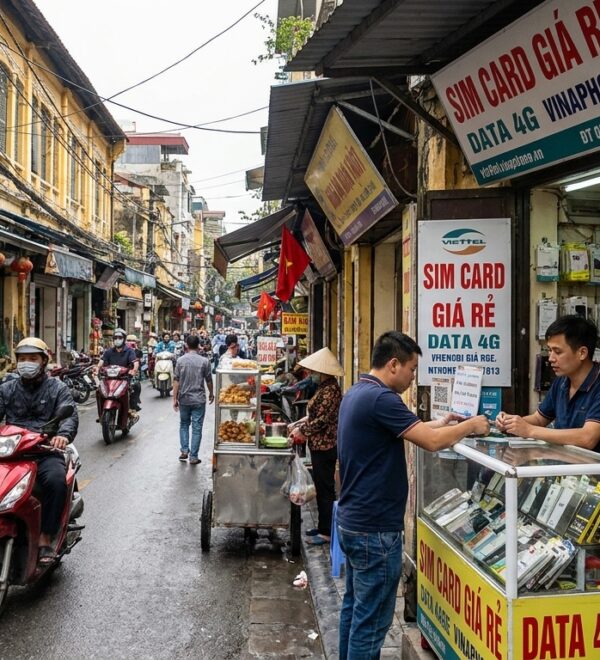
For everything else about the city, our Hanoi travel guide has the full picture. Our Hanoi motorbike scams guide covers the exact scripts to watch for and how locals actually rent.
Last updated: May 2026 — Le Duan section access, train schedule windows, and 2026 rerouting status verified.
The first time I went to Hanoi Train Street, I stood in front of a locked gate for 45 minutes.
I didn’t. I stood there, increasingly annoyed, watching other tourists get funneled into plastic chairs and handed menus while waiting for a train that one cafe worker — with cheerful confidence — told me was “coming very soon. Maybe five minutes.”
It wasn’t five minutes. I left without seeing a single train.
Second time, I knew where to go. The Le Duan section. No barricades. No escort. No one selling anything. Just a narrow residential alley with railway tracks running through it and, when the schedule cooperates, a blue-white-red commuter train passing close enough to feel the wind before you properly hear it.
That’s the visit worth having. Here’s how to get it in 2026.
⚠Real Talk
The 2018-era “sit on the tracks with your coffee while kids play around you” experience is over. If that’s what you’re expecting based on photos from five years ago — adjust now. What remains is still genuinely extraordinary when the train comes through. It’s just not the spontaneous residential-street thing it once was.
What Hanoi Train Street Actually Is (And What It Used to Be)
The track was built by the French in 1902. It runs directly through a residential neighborhood — some families have been living in buildings inches from the track for over 65 years.
This wasn’t designed as an attraction. It’s just how the city grew around its infrastructure and never moved the infrastructure.
For decades, almost nobody outside Hanoi knew it existed. Then around 2015–2018, travel Instagram happened. The photos went everywhere. Cafes appeared. Tourists followed. By 2019 the situation had become dangerous enough — tourists standing on active tracks, blocking the path, swarming it with phones — that the Hanoi government shut it down entirely.
It reopened in 2023 with strict safety regulations. What you’re visiting in 2026 is a managed version of what once existed organically.
That doesn’t make it not worth seeing. It means you need to know what you’re actually walking into.
The Two Sections of Train Street — Only One Is Worth Your Time
Phung Hung / Tran Phu — The Tourist Section (With One Caveat)
This is the section every travel blog shows. Lanterns strung between buildings. Cafes with trackside seating. Colorful signs.
It also has barricades, a police officer at the gate, and cafe owners who have turned “helping you get in” into a full-time profession.
The main entrance is near 3 P. Trần Phú. To get past the gate, you go with a cafe owner — they escort you to their table, you order one drink (50,000–100,000 VND — a coffee or a beer), and you stay until the train comes.
If you try to switch cafes after being escorted in, they’re going to be upset. The understanding is clear: they brought you in, you’re their customer.
The experience itself, when it works: genuinely good. Cafe workers take the tables down 5–10 minutes before the train, give safety instructions — “tuck your knees toward the wall, away from the tracks” — and then the blue-white-red cars come through with a gust of wind that hits your face before the noise fully catches up.
The problem is everything you have to get through to reach that moment. The false train-time promises. The drink pressure. The shouting if you try to reposition.
Who it’s for: People who specifically want the lantern-lit, cafe-on-the-tracks photo experience, are okay with the managed version, and can commit to one cafe for the full wait.
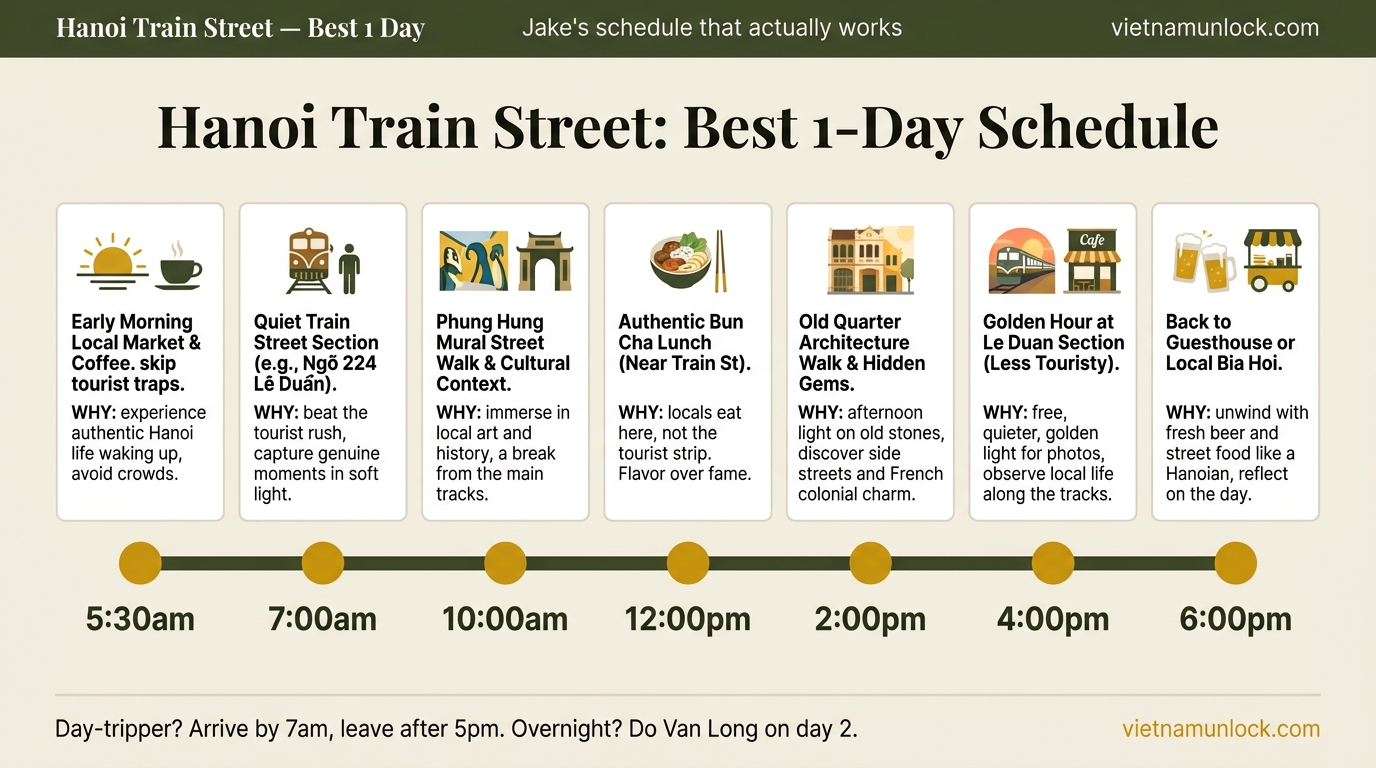
Le Duan / Ngõ 224 Lê Duẩn, Dong Da — The Actually Good Section
This is the section most blogs don’t mention because it doesn’t photograph as dramatically. It’s in the Dong Da district — about a 10-minute Grab ride from Hoàn Kiếm Lake.
Address to enter into Grab yourself: Ngõ 224 Lê Duẩn, Kham Thien, Dong Da district.
When you get there: no barricades. No one asking you to buy anything. The tracks run between narrow residential buildings — laundry overhead, a motorbike parked on one side, a neighbor checking their phone on a plastic chair. It’s someone’s street, not a tourism zone.
The viewing experience when the train comes is nearly identical to Phung Hung. You’re close. The wind hits you. It’s the same train. But you’re standing in a working neighborhood when it happens — not in a managed cafe zone.
↗Insider Tip
At Le Duan: arrive 30 minutes early and find a position against the building wall — residential side, not the track side. When you hear the horn coming from around the corner, press flat: knees in, arms in, nothing protruding. The gap between you and the passing train is smaller than your brain will be comfortable with. That’s normal. Stay still, and two minutes later you’ll understand exactly why people fly across the world for this.
Who it’s for: Everyone who wants the experience without the tourist management layer. Especially valuable if you have limited time in Hanoi and can’t afford to lose 90 minutes waiting at a gated section for a train that may not arrive on the schedule you were given.
The Scams Running Right Now — What to Watch For
The “Five Minutes” Train Timing Lie
This is the one that burns the most people.
A December 2024 TripAdvisor review: “Total scam. They promise you the train is coming ‘in 5 minutes.’ We were there over an hour and a half — arrived at 10:50 AM, train wasn’t arriving until 7 PM. Really pushy guy touting for business. Hustler energy was really off-putting.”
The cafe owners at Phung Hung know the real schedule. They don’t share it until you’re seated and have ordered. “Five minutes” is the line that gets you into the chair.
Fix: Know the approximate schedule before you arrive. Trains run roughly at 3:30 PM and 7:30 PM — variable, but those are the windows. Ask your hotel reception to confirm the morning of your visit. Don’t trust schedule information from anyone standing near the Train Street entrance.
The Drink Escort Hustle
The cafe escort system itself isn’t a scam — it’s the deal at Phung Hung. You get escorted in, you buy a drink, you watch the train.
Where it becomes a problem: when it turns aggressive. A February 2025 TripAdvisor review describes an elderly couple being shouted at and physically hit with a stick when they tried to leave without paying. These incidents went viral. They’re not isolated.
The rule: if an escort turns into physical pressure, touching, or shouting — leave. Walk out directly. The Le Duan section is a Grab ride away and none of this exists there.
The Wrong District Drop-Off
Tell a xe ôm (say: say-ohm — motorbike taxi) driver “Train Street” and they will often take you to whichever section earns them a referral. Some will take you to a closed section and then offer to connect you with a cafe that “has a special deal.”
Fix: Use Grab. Enter Ngõ 224 Lê Duẩn, Kham Thien, Dong Da yourself. Let the app navigate.
ℹKnow Before You Go
Train Street sections can close without warning during safety inspections — this happens unpredictably and can turn a planned afternoon into a walk around the neighborhood with nothing to show for it. Backup plan: Long Bien Bridge is 15 minutes away. Hoa Lo Prison is nearby. Don’t bet your entire Hanoi afternoon on Train Street working out. Our Hanoi day trips guide compares the options honestly.
How to Do This Right — Step by Step
Step 1 — Morning of your visit: Ask your hotel reception to confirm today’s train schedule. Real schedule — not “usually around 3:30” but “I called and it’s 3:35 today.” If they can’t confirm, go for the 3:30 PM window and plan around uncertainty.
Step 2 — Grab to Ngõ 224 Lê Duẩn, Kham Thien, Dong Da district. Enter this address yourself. Don’t say “Train Street” to the driver.
Step 3 — Arrive 30–40 minutes early. Find a wall-side position in the alley. Don’t stand on the tracks for photos. Locals use this path daily — move for them when they need to pass.
Step 4 — Listen for the horn. You’ll hear it from around the corner before the train is visible. When you do: press flat against the wall, knees in, arms in, phone in your pocket or held tight.
Step 5 — Stay five minutes after it passes. The tourists disperse instantly. The neighborhood comes back — kids resume playing, the vendor reopens their cart, a neighbor comes out to check something. That quiet return after the spectacle is the most honest version of Train Street you’ll get. Don’t miss it by rushing out with the crowd.
The Bottle Cap Thing (Optional, Not Officially Endorsed)
Something the guides don’t mention — because it’s technically not allowed, and yet happens constantly enough that some cafes near the tracks sell the results as souvenirs.
Locals sometimes place bottle caps (nắp chai) flat on the rail before the train arrives. When the cars roll over them, the caps get pressed into thin, smooth metal discs — perfectly flat, lighter than a coin, with the logo still readable if you look close. Kids collect them. Some cafe counters keep a small jar of them, 20,000 VND each.
As Hanoi mementos go, it’s about as good as it gets: an object flattened by a 124-year-old train route running through someone’s backyard, weighing nothing in your bag.
I’m not going to tell you to do it. Placing anything on an active railway track is technically illegal, and in theory a badly-placed object can affect the track surface. But I’ve watched it happen dozens of times at Le Duan with zero incident, and I’ve seen those same caps in five different cafes. You’re an adult. Make your own call — just know the risk is yours, not the train’s.
The Mistake I Made — And What It Actually Cost Me
First visit: late morning, walked from Hoàn Kiếm Lake following Google Maps straight to Phung Hung. Metal gate. Police. Three cafe owners offering escort.
I didn’t want to buy anything — I just wanted to look at the track — which I understand now is precisely not how this works.
I stood there for 45 minutes in what I can only describe as a standoff with a concept. The cafe owners were patient. The police officer was patient. The gate stayed closed. I left without seeing a single train.
The frustration had nothing to do with Train Street itself and everything to do with not knowing which section to go to or what the rules were.
Second visit: Grab to Lê Duẩn, arrived 35 minutes early, stood against the wall. Heard the horn. Train came through — blue-white-red cars, close enough that I genuinely flinched — and for about two minutes I understood completely why people fly across the world for a working train through a 124-year-old residential corridor.
The gust hit my face. The mechanical roar. The laundry still hanging in the window of the house two feet from the track. Real. Worth it. Zero regrets about the second visit.
The 2026 News Nobody Else Is Writing About
The most important thing in this article:
Hanoi is planning to reroute the trains running through Train Street by Q2 2026. Southern trains rerouted to Hanoi Station. Northern trains to Gia Lam. If implemented, the tracks through the residential corridors become inactive.
No train, no Train Street. The alleys remain. The cafes remain. The buildings remain. But the thing people fly to Hanoi to see — a working commuter train passing inches from people’s front doors — is gone.
As of April 2026 the trains are still running. But this is the year it might actually end.
Go this year if you’re going. And verify current status before you plan a whole afternoon around it — infrastructure decisions in Vietnam can move faster than blog update cycles.
⚠Real Talk
When Train Street closes, there will be a wave of “I visited before it was gone” content. That’s not why you should go. Go because it’s a genuine piece of how this city works — a 124-year-old track threading through living rooms and kitchens because nobody ever had the resources or the reason to move it. That’s worth seeing on its own terms, not because of the deadline.
What Travelers Actually Say: The Consensus
The most consistent message in traveler reviews: people who went to Le Duan loved it; people who went to Phung Hung without knowing the schedule lost 60–90 minutes to the “5 minutes” loop and left frustrated. The gap between the two experiences is stark enough that they read like reviews of different attractions. Le Duan gets descriptions like “genuinely surreal,” “one of the most unique moments of our Vietnam trip,” “can’t believe this is real.” Phung Hung swings between “actually worth it” (from people who committed to one cafe and got lucky with timing) and “tourist trap” (from people who didn’t).
The 2026 rerouting concern runs through recent reviews — multiple travelers mention feeling rushed because of “might be closing” reports. Current reality: both sections are open and trains still running as of early 2026. The rerouting hasn’t happened yet. Go now, verify the morning of.
⚠Real Talk
A handful of negative reviews describe physical altercations at Phung Hung — staff blocking or shouting at people who tried to leave without buying. If you go to Phung Hung: pick one cafe, commit, leave only when ready. If pressure turns physical, walk directly out. The Le Duan section has none of this.
Two things worth sorting before you land: a Vietnam eSIM so you have data the moment you clear customs, and travel insurance — medical costs for uninsured foreigners in Vietnam are significant.
Airalo eSIMs activate instantly. Buy before departure — airport SIM queues in Vietnam can take 30+ minutes.
FAQ — Hanoi Train Street 2026
Is Hanoi Train Street worth visiting?
Yes — if you go to the Le Duan section and time the visit correctly. Probably not — if you go to Phung Hung without knowing the schedule, get caught in the “5 minutes” loop, and wait 90 minutes for nothing. The difference between a good and a bad Train Street visit is almost entirely logistical.
Do I have to pay to see Hanoi Train Street?
Le Duan section: free, no conditions. Phung Hung section: no official entrance fee, but you need to buy a drink (50,000–100,000 VND / $2–$4) at a licensed cafe to enter.
Is it safe?
Yes, if you follow the rules. Press against the wall when the train comes. Keep knees and arms in. Don’t stand on the tracks for photos before the train arrives. Locals do this every day — treat it with the same level of basic common sense they do and you’ll be fine. Not recommended with young children unless you’re very confident managing them in a tight space with a train 18 inches away.
Should I go to Phung Hung or Le Duan?
Le Duan for most people. Phung Hung if you specifically want the lantern-lit, trackside-cafe atmosphere and are prepared to commit to one cafe for the full wait.