

Last updated: May 2026 — Transport options, city-to-city timing, and overnight train availability verified.
By the time I reached Hoi An — day 11 — I had stopped looking at things. I was moving through the Ancient Town at 7am to beat the crowds, eating bánh mì standing up to save time, scheduling “relaxation.” I slept through my own birthday somewhere on a night bus between Da Nang and Nha Trang. I was so focused on ticking destinations that I’d stopped traveling.
I’ve been living in Hanoi for five years now. I’ve done every version of this route. Here’s what I’d actually tell someone planning a vietnam itinerary for the first time — not what looks good on paper, but what works on the ground.
How Long Do You Actually Need in Vietnam?
Honest answer: more than you think, less than feels comfortable to book.
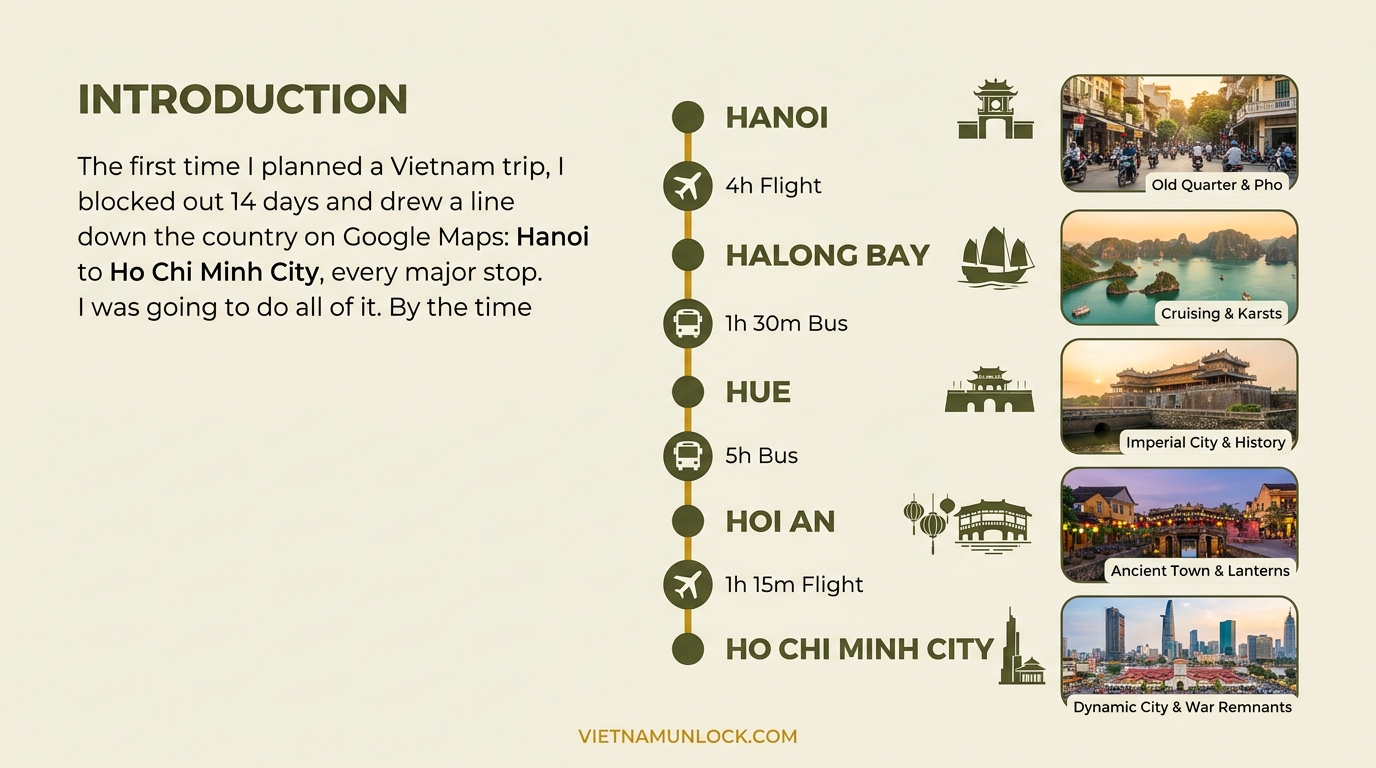
Vietnam is 1,650 kilometers from top to bottom, roughly the distance from London to Athens. Most people try to cover it in the time they’d spend visiting a single European city. That’s the root cause of every “Vietnam was too exhausting” TripAdvisor post you’ve ever read.
Here’s the breakdown by trip length that actually works:
- 7 days — Pick one region. North or south. Not both.
- 10 days — One region properly, or two-thirds of the classic route if you move efficiently and fly at least once.
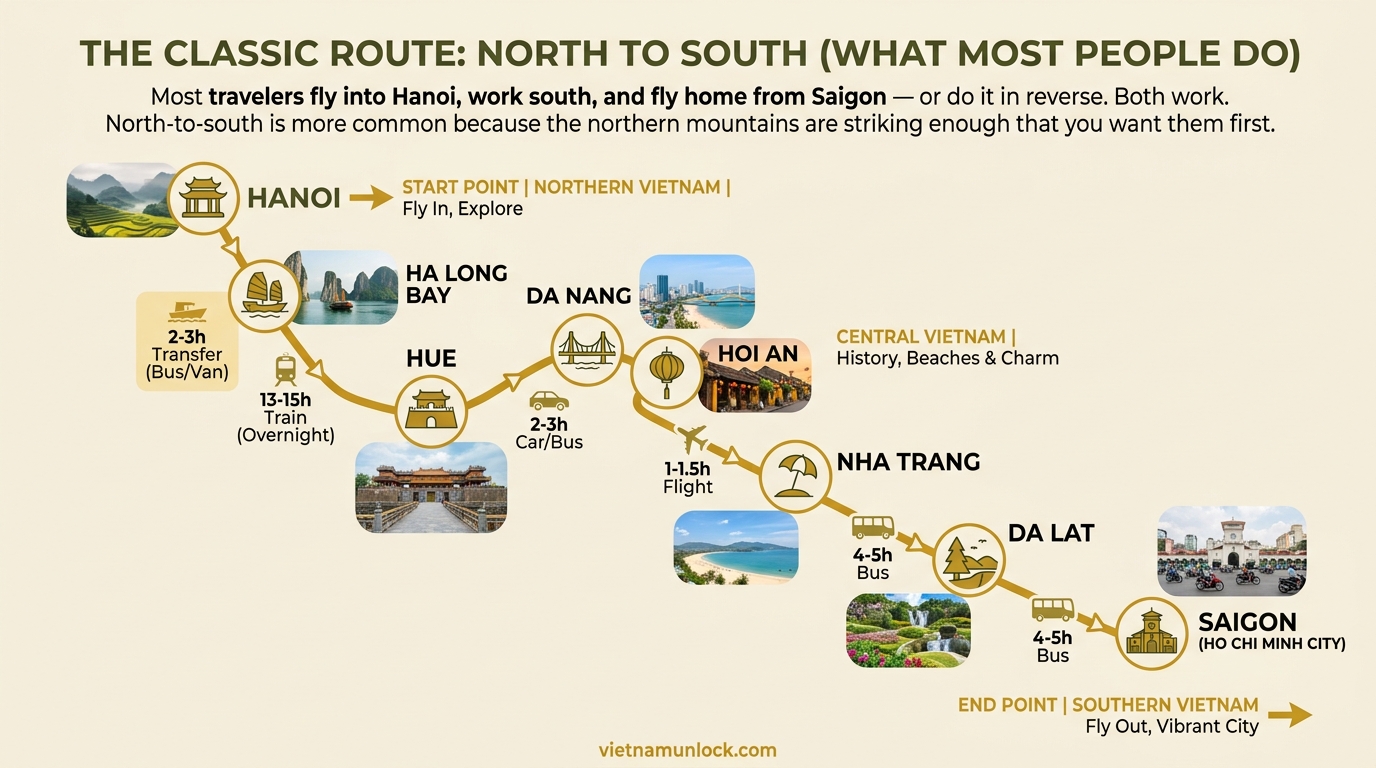
- 2 weeks (14 days) — The classic route works, but you need to choose: rushed highlights or slower immersion in fewer places. Most first-timers choose the first and regret it by day 10.
- 3 weeks — This is the sweet spot for the full north-to-south (or reverse). Enough time to actually slow down in two or three places.
- 1 month+ — Add Ha Giang, Phong Nha, the Mekong properly, a cooking class you don’t rush out of. This is when Vietnam stops feeling like a checklist.
✓Quick Answer
The standard Vietnam itinerary runs Hanoi → Ninh Binh → Ha Long Bay → Hue → Hoi An → Saigon, with optional stops like Ha Giang Loop (north) or Mekong Delta / Phu Quoc (south). Allow 3 weeks for the full route at a sane pace. Two weeks works only if you fly at least one leg and accept you’ll miss things. One week is enough for one region done well.
The Classic Route: North to South (What Most People Do)
Most travelers fly into Hanoi, work south, and fly home from Saigon — or do it in reverse. Both work. North-to-south is more common because the northern mountains are striking enough that you want them early, when you’re still energized. The south is easier to end on: flatter, warmer, more beach-oriented.

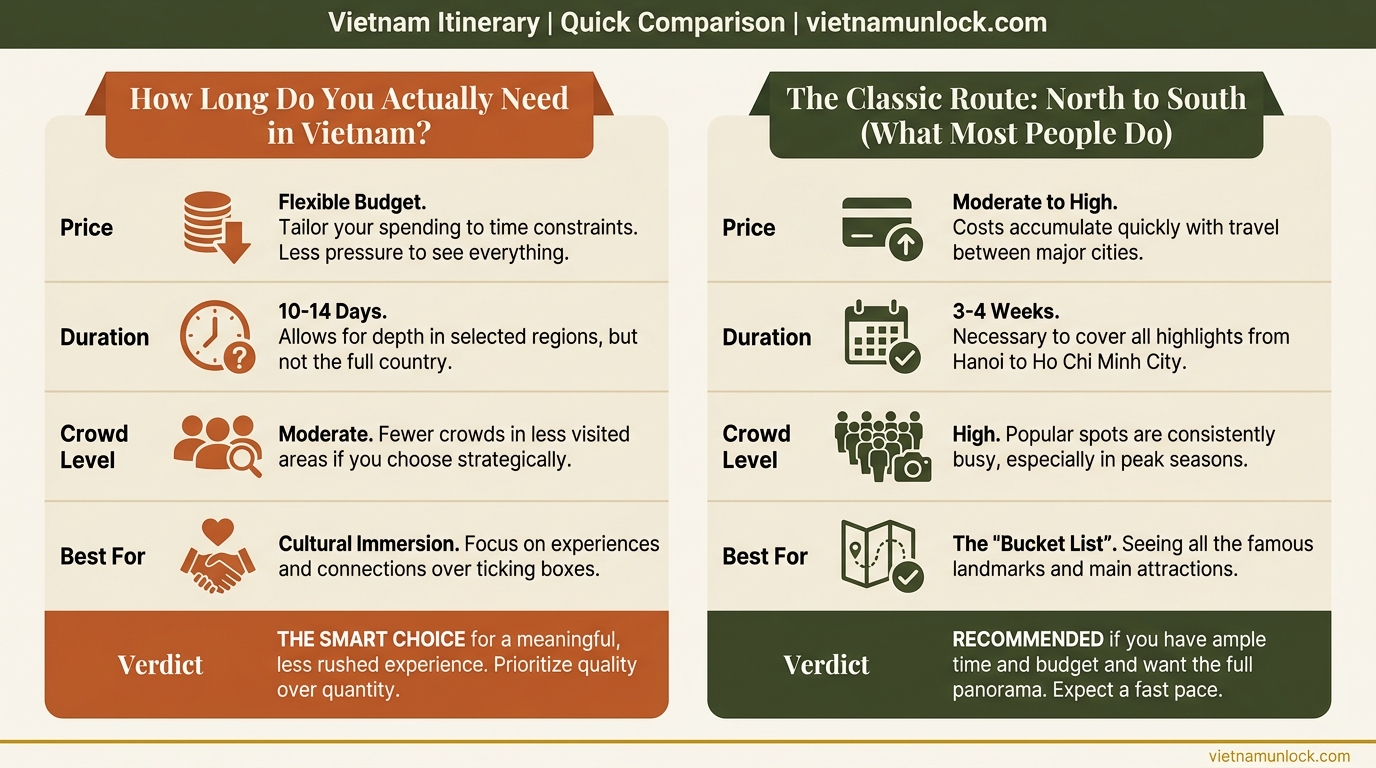
This is the route, stop by stop:
Hanoi — 3 nights minimum

Don’t treat Hanoi as a launching pad. Spend three nights here before rushing anywhere. The Old Quarter at 6am — before the tourist traffic starts — is something specific: condensed milk dripping through a street coffee filter, old men playing chess under a banyan tree, motorbikes threading past each other at speeds that shouldn’t work but do. You won’t find this by rushing through.
Day trips from Hanoi include Ninh Binh (90 minutes south), Ha Long Bay (3.5 hours east), and — for those with more time — Ha Giang Loop (4–5 hours north). None of these require you to leave your accommodation base in Hanoi, which keeps costs and logistics simple.
Ninh Binh — 2 nights

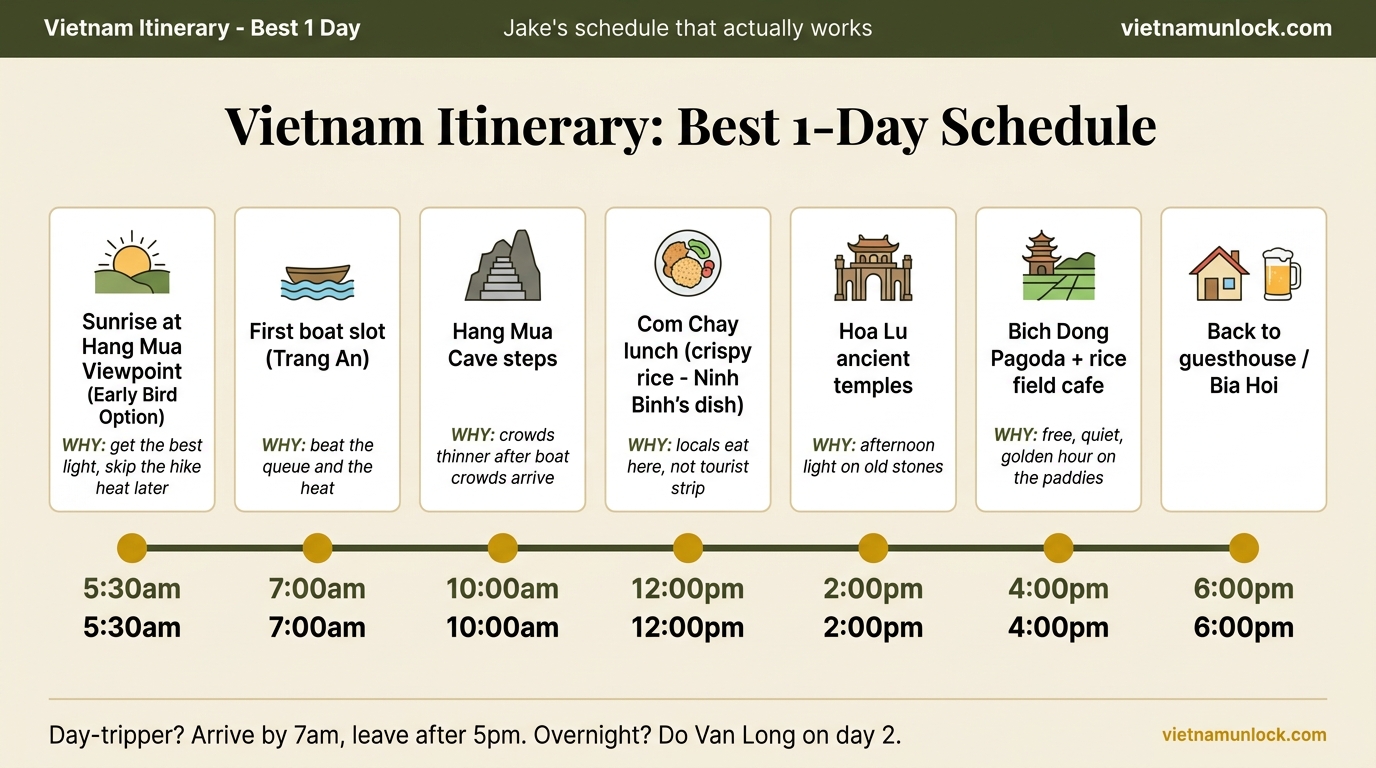
Do this before Ha Long Bay. Ninh Binh is Ha Long Bay’s geology on land — limestone karsts rising from rice paddies, rowing boats through cave systems — with a fraction of the crowds. Trang An boat tour for a full morning, Mua Cave for the sunrise hike, Bich Dong Pagoda if you have an afternoon left. That’s three days of material in a region most people give twelve hours.
If you’re short on time: Ninh Binh as a day trip from Hanoi is possible but you’ll be back in the van by 5pm wondering why you didn’t stay overnight.
Ha Long Bay — 2 nights on a cruise

One-night cruises are almost never worth it. You spend most of the first day getting there, sleep once, and spend most of the second day getting back. Two nights on a mid-range or better boat gives you actual time in the bay — kayaking, floating villages, watching the karsts at dawn when the mist hasn’t cleared.
Budget around $120–180 USD for a two-night mid-range cruise. Cheaper is possible but the quality gap is real. The very cheap tours cut corners on the boat and on food — and you’re at sea for two days.
Alternative: Lan Ha Bay (accessed from Cat Ba Island) offers similar scenery with significantly fewer boats. If Ha Long feels too crowded for you: Lan Ha is the fix.
[IMAGE: Ha Long Bay limestone karsts at sunrise, rowing boat in foreground, minimal mist, calm water — no other tourists visible]
Hue — 2 nights

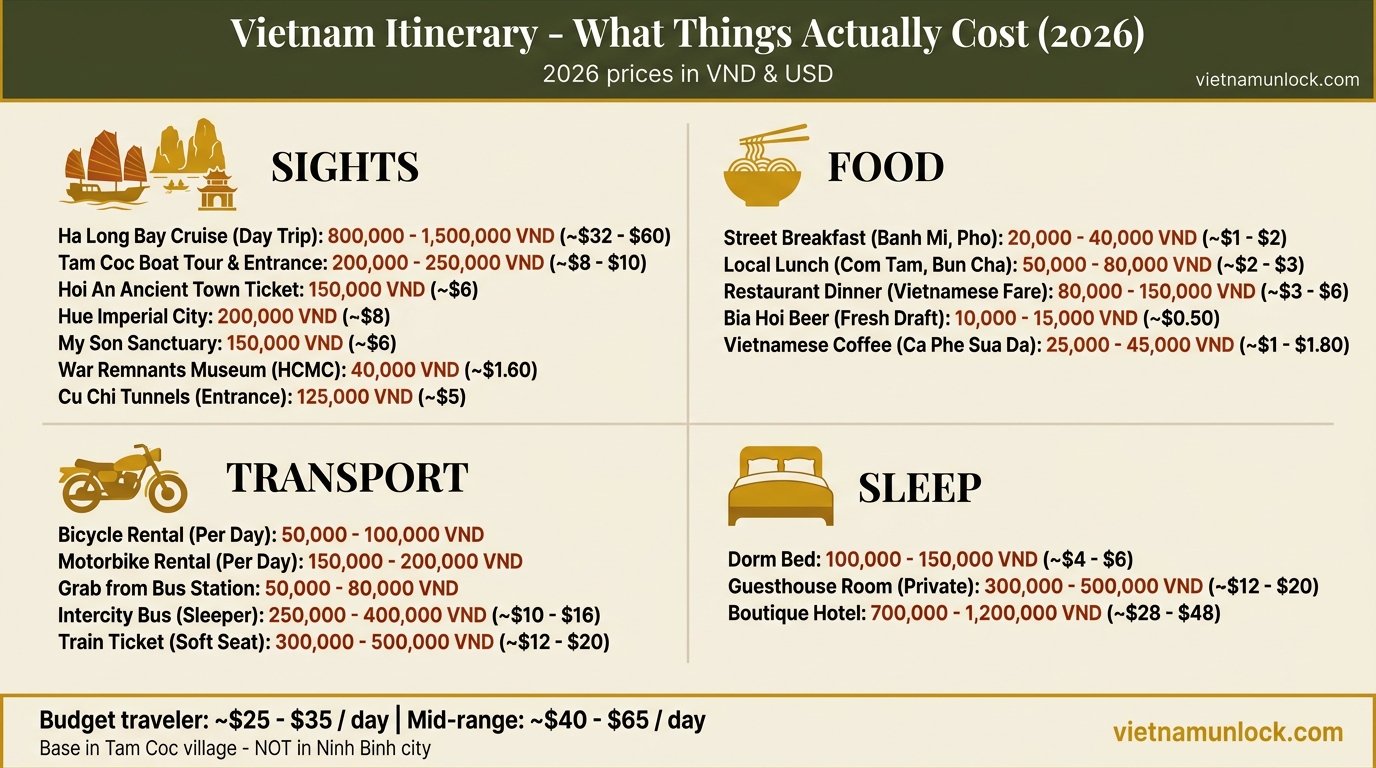
Hue is where Vietnam’s imperial history lives. The citadel, the royal tombs, Thien Mu Pagoda. Hire a motorbike for a day and do the royal tombs circuit south of the city — it takes four hours and costs about 150,000 VND in fuel. The food here is distinct: bánh bèo (steamed rice cakes), bún bò Huế (spicy beef noodle soup that hits differently than Hanoi’s pho), bánh khoái (crispy pancake). Don’t eat at restaurants with laminated English menus within 300 meters of the citadel gate.
Hue is also where the central Vietnam heat starts to register. April to August: pack for 35°C and humidity. October to December: pack a waterproof jacket — this is the rainiest stretch on the whole coast.
Hoi An — 3 nights minimum

Hoi An is the one place on this entire route where I’d tell you to slow down and stop planning. The Ancient Town is genuinely beautiful — yellow walls, lanterns, tailor shops, the Thu Bon River at dusk — but the magic requires time to find. Day one, everyone hits the same Insta spots. Day two, you find the quieter streets. Day three, you’ve figured out which café serves the best cao lầu and you’re eating lunch at a table where no one else speaks English.
An Bàng Beach is 5km from town — motorbike it in the morning, be back by 2pm before the afternoon heat. The tailors on Trần Phú Street can turn around a custom shirt or dress in 24 hours; budget $30–60 USD for decent quality, be skeptical of anything below $20.
Day trip: My Son Sanctuary (ancient Cham ruins, 45 minutes west) is worth a half-day if history is your thing. Miss it if it isn’t — crowds have grown and the condition of the ruins is less dramatic than photos suggest.
Da Nang — optional, 1 night
Da Nang is the transit hub between Hoi An and Nha Trang. Most travelers pass through without stopping. The exception: the Marble Mountains are genuinely worth a half-day, Ba Na Hills is a fun cable car day trip if you’re traveling with people who want a theme-park-adjacent experience, and My Khe Beach is a good 48 hours of nothing if you’re craving sand before the Saigon sprint. Otherwise, hop on a train or a flight and keep moving. For a full breakdown of what’s worth your time here, see our Hoi An things to do guide.
Nha Trang — optional, 2 nights
Nha Trang divides travelers. The beaches are real and the seafood is excellent. The bar strip on Trần Phú Boulevard is loud and geared toward package tourists from specific markets. The divide between “authentic Nha Trang” and “Russian Las Vegas” (a phrase you’ll encounter in every Vietnam travel forum) is a real one — but it’s navigable. Stay north of the main tourist strip, eat at the fish market, and ignore the neon.
Some travelers skip Nha Trang entirely on a 2–3 week itinerary and go straight from Da Nang to Saigon. That’s legitimate. Nha Trang adds two days to your route for an experience that’s more beach-optional than essential.
Ho Chi Minh City (Saigon) — 3 nights minimum

Saigon hits different after three weeks in Vietnam. The energy is relentless — this is a city that doesn’t sleep, doesn’t apologize for its volume, and rewards the curious with some of the best street food in the country. Ben Thanh Market for orientation, War Remnants Museum for one sobering morning, the Mekong Delta for a day trip if you haven’t done the south-to-north route.
Eat on Bùi Viện Street once (it’s an experience, not a recommendation). Eat on Võ Văn Tần Street every other morning for bánh mì at 20,000 VND.
If Phu Quoc or the Mekong Delta are on your list: build them into your final days here before your flight home. Can Tho floating market is a genuine experience that requires an overnight stay to see at dawn — not worth doing as a rushed day trip from Saigon.
[IMAGE: Saigon street at dusk — motorbikes, street food stalls glowing, people eating on plastic stools — Ben Thanh area, authentic street-level perspective] For the full breakdown of neighborhoods, museums, and street food streets, see our Saigon things to do guide.
Vietnam Itinerary by Trip Length
7 Days in Vietnam
You have two real options, not three:
Option A — The North: Hanoi (2 nights) + Ninh Binh (2 nights) + Ha Long Bay cruise (2 nights). Fly back to Hanoi for departure. This is compact, logical, and leaves you with genuinely good memories of one region instead of blurry snapshots of five.
Option B — The South: Saigon (2 nights) + Mekong Delta overnight (1 night) + Phu Quoc (3 nights). Beach-heavy, warmer, slightly more relaxed. Works well for travelers arriving from other Southeast Asian destinations.
Don’t attempt the full north-to-south in 7 days. I’ve watched people try. They described it as “an airport simulator.”
2 Weeks in Vietnam (14 Days)
This is the most common trip length and the one with the most casualties. Two weeks is enough for the classic route only if you manage transport ruthlessly and accept that some stops will be short.
Realistic 14-day structure: Hanoi (2) → Ninh Binh (2) → Ha Long Bay cruise (2) → fly to Da Nang → Hoi An (3) → fly to Saigon (2) → optional Phu Quoc (2). That’s 15 days with tight scheduling — drop either Ha Long or Phu Quoc to make it 13. For a deeper dive on this region, the northern Vietnam guide covers timing, logistics, and what to prioritize.
The key is flying. Hanoi to Da Nang: $25–50 USD with Vietjet or Bamboo. Da Nang to Saigon: similar. Train is beautiful but slow — do it if you have a 3-week trip, not a 2-week one. For a full breakdown of beaches, islands, and pacing, see our southern Vietnam travel guide.
3 Weeks in Vietnam (21 Days)
This is where Vietnam clicks. Three weeks lets you add Hue properly, slow down in Hoi An, take the train between at least two cities, and arrive in each place without immediately planning your exit.
Suggested structure: Hanoi (3) → Ninh Binh (2) → Ha Long Bay cruise (2) → Hue (2) → Hoi An (3) → Nha Trang (2) → Saigon (3) → Mekong Delta (1 day trip) → Phu Quoc (3). That’s 21 days. You won’t be bored and you won’t be broken.
1 Month in Vietnam
Add Ha Giang Loop to the northern section — 5 days minimum, 7 if you want to breathe. This is the most dramatic landscape in Vietnam and the hardest to reach: 4–5 hours north of Hanoi, mountain roads that require either a motorbike license or a hired Easy Rider guide. It’s the trip within the trip that most people who’ve done it describe as the reason they came back.
A month also gives you Phong Nha (cave systems in central Vietnam, genuinely underrated), an actual cooking class in Hoi An that isn’t one-hour-and-a-photo, and the kind of off-day in a small town where you sit and watch a chess game between two strangers for an hour without feeling like you’re wasting time.
[IMAGE: Ha Giang Loop mountain switchback — Dong Van plateau, early morning light, motorbike on road, no tourists in frame]
Getting Between Cities: The Honest Transport Breakdown
Domestic Flights
Vietnam’s domestic air network is excellent and cheap. Vietjet, Bamboo Airways, and Vietnam Airlines connect every major tourist city. Book 2–4 weeks out and you’ll find Hanoi → Da Nang for $25–40 USD, Da Nang → Saigon for $30–50 USD. Same-day flights can run $80–120 USD.

Baggage fees: Vietjet charges for checked bags separately. Budget for this — it’s 15–20 USD extra if you have a bag over 7kg. Vietnam Airlines includes 23kg checked, which is worth the slightly higher base fare for anyone who overpacks.
12Go covers most Vietnam routes — sleeper buses, trains, and island ferries. Compare schedules and book in advance during peak season (Dec–Feb, Jun–Aug).
Overnight Sleeper Buses
 sleeper bus interior — night bus between cities — Vietnam Unlock” width=”1200″ height=”675″ />
The classic budget option. Hanoi to Hue: 11–12 hours, $12–18 USD. Da Nang to Saigon: 16 hours, $15–25 USD. The good news: you don’t lose a day. The bad news: you lose a night’s sleep. The quality range is significant — book with Futa Bus or Phuong Trang (both have flat beds and reliable schedules) rather than the cheapest option you find through a hostel front desk.
Pro tip learned the hard way: don’t book the back row of a sleeper bus. Every pothole doubles in amplitude. Pay 20,000 VND more for a middle-section berth if you’re on a longer route.
Train

The Reunification Express (Hanoi to Saigon, stopping everywhere) is genuinely beautiful. Hugging the coastline between Da Nang and Nha Trang, eating bún bò from the dining car, watching the sea appear and disappear — this is a travel experience, not just transport. Soft sleeper berths: $30–60 USD depending on route length. Book at least a week ahead — the 4-berth soft sleeper cabins sell out.
What the train is not: fast. Hanoi to Hue is 13–14 hours. Hanoi to Saigon is 30+ hours. Take it for the experience on a longer trip, take the bus or fly on a shorter one.
Grab Within Cities
Use Grab. Don’t negotiate with street motorbike taxis (xe om) unless you know what the route should cost. Airport taxis at Noi Bai (Hanoi) and Tan Son Nhat (Saigon) are legitimate with Vinasun and Mai Linh — but the Grab pickup at both airports takes 10 minutes and costs a third of what the taxi touts will quote you if you hesitate at the arrivals exit.
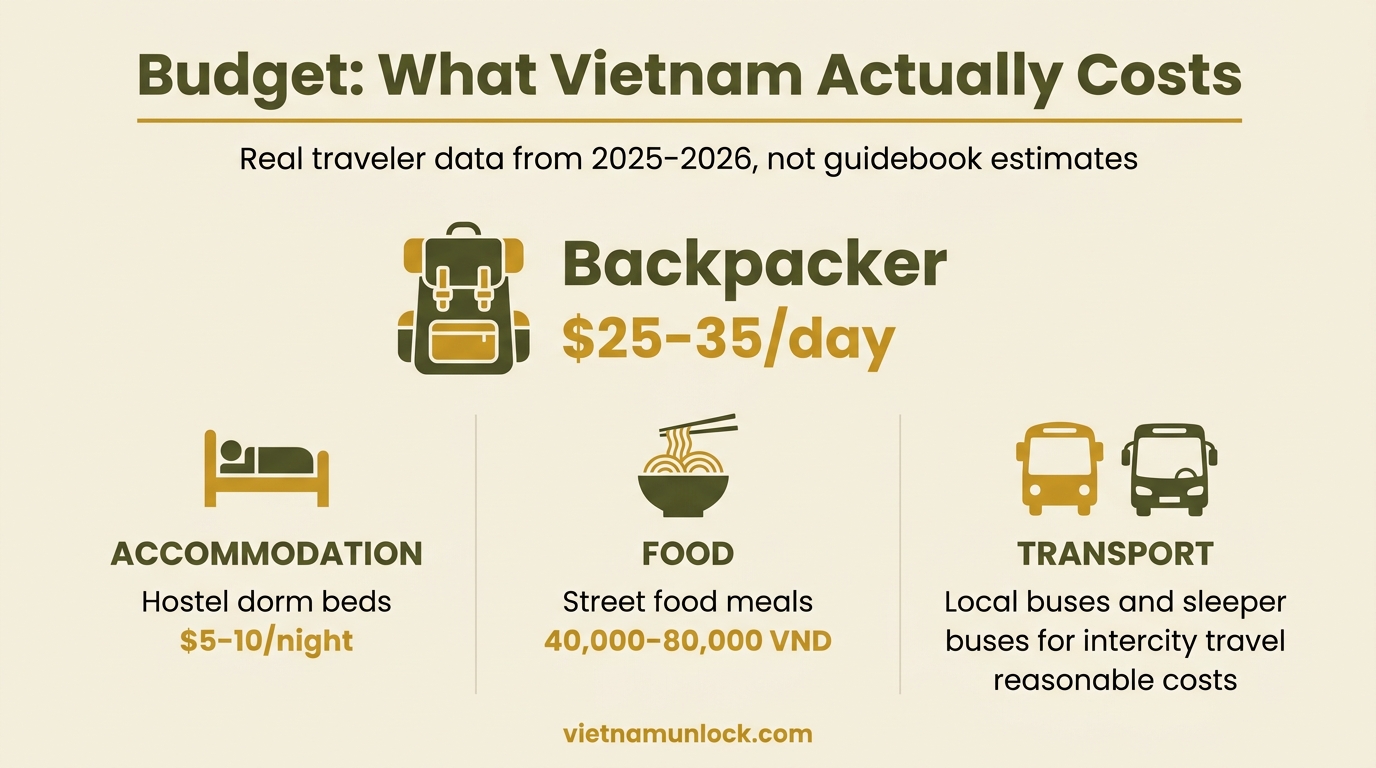
Budget: What Vietnam Actually Costs
Real traveler data from 2025–2026, not guidebook estimates:

- Backpacker ($25–35/day): Hostel dorm beds $5–10/night, street food meals 40,000–80,000 VND, local buses and sleeper buses for intercity. Travelers doing 60-day trips reported daily averages around $29–31 USD excluding international flights — with some days under $15 USD if they stayed put.
- Mid-range ($50–80/day): Private hotel rooms $25–45/night (air con, private bathroom, decent Wi-Fi), restaurant meals 150,000–300,000 VND, mix of buses and one or two domestic flights. Most comfortable option for trips under 3 weeks.
- Comfort ($100+/day): Boutique hotels, Ha Long Bay cruise on a proper boat, guided tours, airport transfers. Ha Long Bay alone at this tier is $120–180 USD for two nights. Still dramatically cheaper than equivalent quality in Europe or Australia.
The expenses people consistently underestimate: activities (entrance fees add up — $5–15 USD per attraction), tour costs (Ha Long cruise, boat tours), and the domestic flight decision. Adding two domestic flights to a 2-week trip adds $60–100 USD per person but saves 20–24 hours on buses. Worth it.
What to Skip and What to Slow Down For
Skip (or adjust expectations)
Ba Na Hills, Da Nang — Unless you’re traveling with children or you specifically enjoy theme parks. The Golden Bridge photographs well; in person you’re in a line for 45 minutes with 400 other tourists. Worth it? You decide.
Cu Chi Tunnels, Saigon — Legitimate history, but the experience is now extremely packaged. The shooting range they’ve built adjacent to it is jarring. If war history is important to you, the War Remnants Museum in Saigon hits harder and doesn’t require a half-day drive.
Ha Long Bay on a budget boat — Ha Long Bay proper on a one-night tour is the Vietnam disappointment story I’ve heard most consistently over five years. Either commit to two nights on a mid-range boat, or swap to Lan Ha Bay / Ninh Binh for similar scenery with more breathing room.
Slow down for
Hoi An, especially before 7am — The Ancient Town at 6am, before the tour groups arrive and the shops open, is one of those things you only get by staying, not by visiting.
Ha Giang Loop — No amount of photos prepares you for Mã Pí Lèng Pass. If you have five extra days in the north, this is where they go.
Any local market, anywhere — The 5am fish market in Hội An. The Đồng Xuân market in Hanoi at 6am. The floating market in Can Tho at dawn. These are the places where the actual Vietnam — not the tourist Vietnam — is doing its morning routine, and you’re briefly in it.
What Travelers Actually Say: The Consensus
The recurring theme in traveler reviews of Vietnam trips: underestimating the distances and overestimating available time. People who planned a north-to-south trip in 10 days almost universally describe feeling like they were on a bus or a plane every day. People who picked one region and went deep describe some of the most memorable travel experiences of their lives. The advice to “do less” is the single most consistent piece of feedback from return travelers, and the single piece most ignored by first-timers.
The other consistent note: the places travelers expected least delivered most. Ninh Binh appears in dozens of “I didn’t know this existed and it was my favorite” reviews. Ha Giang — specifically the Loop — gets described as “life-changing” with a frequency that would be annoying if it wasn’t so consistently backed by specifics. Hoi An is the one destination that consistently over-delivers on its reputation for travelers who stay at least two nights and go at the right time.
⚠Real Talk
The “5 cities in 14 days” itinerary format is the most-recommended and most-regretted approach to Vietnam. Regret-free trips happen when people give places enough time to actually land. Two nights minimum per destination. Three in Hanoi and Hoi An. One week on the Ha Giang Loop if you’re doing it. Vietnam rewards the traveler who slows down far more than the one who ticks boxes.
Frequently Asked Questions About Vietnam Itineraries
Should I go north to south or south to north?
North to south is more common because Hanoi flights are often cheaper to book from Western countries, and starting in the north means starting with Ha Giang and Ninh Binh — which are high-impact early in a trip. South to north works equally well logistically. Choose based on where flights are cheapest.
Can I do Vietnam in 10 days?
Yes, one half of the country. Hanoi + Ninh Binh + Ha Long (10 days, north), or Saigon + Mekong + Phu Quoc (10 days, south). Attempting more than one half in 10 days means you’re moving every 1–2 days — which works in theory and exhausts you in practice.
What’s the best time of year to visit Vietnam?
This is complicated because Vietnam spans 15 degrees of latitude and the weather systems are regional. Simplified: November–April is best for the central and south coast. May–October brings rain to central Vietnam (Hue and Hoi An get the worst of it October–December) but the north is fine. The south (Saigon, Phu Quoc) is drier December–April. Ha Giang is best September–October (rice terraces) and March–April (buckwheat flowers). The gap between “Sapa the idea” and “Sapa the place” catches most first-timers — our Sapa Vietnam travel guide explains why staying in the town is the wrong move and what the valley looks like when you get it right.
Is Vietnam safe for solo female travelers?
Generally yes — Vietnam consistently ranks among the safer Southeast Asian destinations for women traveling alone. Street harassment is low compared to regional norms. The main risks are the same for everyone: transportation scams at airports, overcharging in tourist areas, and the standard bag-snatch risk on motorbikes in Saigon. Use Grab, book reviewed accommodation, and the usual solo-travel common sense applies.
Do I need a visa for Vietnam?
E-visa through the official evisa.gov.vn portal — $25 USD for single entry, 90 days. Most nationalities qualify. Apply at least 5 business days before you fly. Warning: multiple fake websites have launched mimicking the official portal and charging $50–100 USD with no result. The official URL is evisa.gov.vn — bookmarked, not searched.
Should I get a local SIM card?
Yes. A Viettel 30-day unlimited SIM costs 60,000–80,000 VND ($2.40–3) at any phone shop in the Old Quarter. Grab requires data. Google Maps requires data. Don’t rely on hostel WiFi for navigation. Full breakdown in the Hanoi SIM card guide.