Last updated: May 2026 — prices and logistics verified May 2026.
Every traveler who has done the Ha Giang Loop says the same thing.

“Out of all the things I did in Vietnam — actually, out of everything I’ve done in Asia — the Ha Giang Loop was the most memorable.”
And yet, most 2-week Vietnam itineraries leave it out entirely. Too far north. Too much time. Not enough days.
Three weeks changes that. With 21 days, you get the full country — Hanoi to Ho Chi Minh City, one direction — and you still have four days to ride the most dramatic road in Southeast Asia before you fly south. This is the 3-week Vietnam itinerary I’d give to anyone who asks.
✓Quick Answer
The best 3-week Vietnam itinerary runs Hanoi (3 nights) → Ha Giang Loop (4 nights) → overnight back to Hanoi → fly to Da Nang → Hue (2 nights) → Hoi An (3 nights) → fly to HCMC (3 nights) + 3 buffer days. Budget $35–50/day plus ~$150–200 for two domestic flights. Total: 21 days, one direction, no backtracking.
The 3-Week Vietnam Route at a Glance

What a Third Week Actually Gets You
The 2-week Vietnam itinerary works. It covers Hanoi, Ha Long Bay, Hue, Hoi An, and Ho Chi Minh City — all the anchors, one direction, two domestic flights.

But it leaves out Ha Giang.
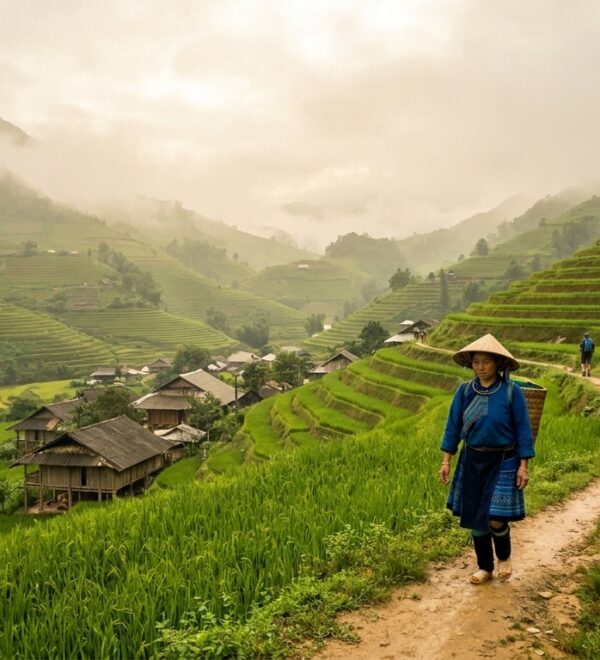
Ha Giang is the extreme north — 350 kilometers of limestone mountains, ethnic minority villages, and roads so exposed that the guardrails feel more like suggestions than barriers. It doesn’t fit in two weeks without rushing everything else. Three weeks is where it finally fits properly.
You also get three extra buffer days. That sounds small on paper. In reality, a weather delay in Ha Giang, a motorbike breakdown on a mountain pass, an extra night in Hoi An because you didn’t want to leave — these aren’t edge cases. They’re the trip.
→WHO IT’S FOR
This route is for independent travelers with 3 weeks who want the full country — north mountains to southern delta — without the blur of rushing. It requires comfort with overnight buses, motorbikes (or hiring a guide), and non-air-conditioned guesthouses. If you want beach time only or don’t want to be more than 2 hours from a city hospital, this isn’t your route.
Days 1–3: Hanoi — Don’t Skip the Slow Start
Hanoi lands hard. Even if you’ve traveled Southeast Asia before. The air hits you like warm soup when you step outside the terminal. The motorbikes start before you find the taxi rank. It’s loud in a way that doesn’t stop — it layers.

Three days here is right. One day to absorb. One day to explore. One day to actually enjoy it.
Day 1: do nothing you planned. Find the nearest bún bò Hà Nội (say: boon baw hah noy) stall — bowl of beef noodle soup in a broth that smells like shrimp paste and charcoal — eat it on a plastic stool, watch the traffic. Sleep with the fan on. The Old Quarter at midnight is still fully operational.
Day 2: Hoan Kiem Lake at 6am before anyone else has arrived, then the Vietnamese Women’s Museum if you want to understand something about how this country actually works. Walk up Phan Đình Phùng for the tree-canopied colonial blocks — it’s the only street in Hanoi that feels like somewhere else.
Day 3: Tây Hồ (West Lake). Rent a bicycle from any guesthouse. Ride the perimeter. Stop at Trấn Quốc Pagoda for 30 minutes, then find a cà phê trứng (egg coffee, say: cah feh chung) place on Đinh Tiên Hoàng — the kind with the small room and the hand-lettered menu. That evening: pack for Ha Giang. You leave tomorrow night.
↗Insider Tip
Book your Ha Giang sleeper bus from Mỹ Đình Bus Station (not Giáp Bát) — it’s the northern departure hub. Tickets: 200,000–250,000 VND (~$8–10). Depart 7–8pm, arrive Ha Giang city 5–6am. Your tour or guesthouse should let you drop bags early and sleep a few more hours before the loop starts.
For Hanoi accommodation, I’ve stayed at a few places near the Old Quarter that hit the mid-range sweet spot — around 500,000–800,000 VND (~$19–30/night) for clean rooms, fast WiFi, and staff who actually know the city. [Check current Hanoi hotel rates here](link: hanoi hotels booking.com affiliate) before you go — prices swing dramatically by season.
Days 4–7: Ha Giang Loop — The Reason You Added the Week
This is why the extra week exists. Let’s be clear about that.

The Ha Giang Loop is 350 kilometers of the most dramatic road in Vietnam — possibly in Southeast Asia. Limestone karsts that rise like broken teeth from river valleys. Villages where H’mong (say: hmong) women sell corn wine from plastic bottles at the side of the road. The Nho Que River, jade-green and completely still at the bottom of a 700-meter canyon, visible only if you stop at Ma Pi Leng Pass and look down.
Four days is the minimum to do it without being destroyed. I did it in three days the first time. I arrived back in Ha Giang city sunburned, saddle-sore, and furious at myself for rushing through Meo Vac (say: meh-oh vac) in 45 minutes — a town that deserves three hours — because I was behind schedule. The second time I did it properly: four days, no fixed timeline past the guesthouses I’d booked. Different trip entirely.
⚠Real Talk
Every blog that says “you can do Ha Giang in 2–3 days” is technically correct and practically wrong. Yes, your body can survive it. No, you won’t have time to sit at a cliffside viewpoint for an hour and actually feel where you are. Four days minimum. Five if you’re prone to “I’ll just stay one more night.”
Day 4 (Ha Giang → Yen Minh, ~80km): The road climbs from the moment you leave Ha Giang city. You pass Đồng Văn Karst Plateau Geopark — a UNESCO site that nobody treats like a UNESCO site, because the geology is the backdrop and the road is the point. Stop at the cliffside cafes above Quản Bạ (say: kwan bah) — they serve instant noodles and sugarcane juice, and the view over Twin Mountains makes both taste better than they are. Yen Minh at night is cold and quiet. Sleep well.
Day 5 (Yen Minh → Dong Van, ~50km): Shorter day, slower pace. Dong Van (say: dong van) old town has a French colonial quarter wedged into limestone — cafes and guesthouses that opened in the last decade but somehow look like they’ve been there for fifty years. Walk the Sunday market if the timing works. At dusk, find the viewpoint above the town and watch the light go flat on the peaks.
Day 6 (Dong Van → Meo Vac → overnight, ~40km): Ma Pi Leng Pass is this day. Twenty kilometers of road that threads between limestone towers and through switchbacks so tight you can see the previous section of road directly below you. At the bottom of the canyon: Ta Lang Harbor, 5km from Dong Van, where you can take a river cruise up the Nho Que. The water is the color of uncut jade. I know that sounds like something I’d normally ban from writing. I’m keeping it.
Meo Vac market — if you hit it on a Sunday — is the real Ha Giang. H’mong, Dao, and Giay (say: zay) people come down from the mountains before sunrise. The thắng cố (say: thahng coh) stall — horse meat stew simmered in a giant blackened pot, the smell of fat and chili drifting through the cold morning air — opens around 5am. By 8am the tourist buses have arrived and it’s a different place.
Day 7 (Meo Vac → Ha Giang, ~100km via Du Gia): The long return road. Du Gia valley is where most guides stop — a cluster of guesthouses and rice terraces and one waterfall that requires a short hike. After that, it’s straight back to Ha Giang city. Cold beer at a place called Top of the Loop on the main strip. You’ll understand the name when you get there.
ℹKnow Before You Go
You need a motorcycle license to self-ride — an International Driving Permit (IDP) with motorcycle category covers you legally. No IDP: hire an Easy Rider guide (say: ee-zee rye-der) — a local driver who takes you on the back of his bike and narrates. Cost: 800,000–1,500,000 VND/day (~$30–57). Worth every dong for the mountain road sections. If you want a car tour with an English-speaking guide, budget $150–340 per person for 3 days through agencies in Hanoi.
Day 8 (Transit): Ha Giang Back to Hanoi, Then South
This is the hardest day on paper. Easy in practice.
 south vietnam 3 weeks final — vietnam unlock” loading=”lazy” width=”1200″ height=”675″ style=”width:100%;height:auto;”>
Morning bus from Ha Giang city back to Hanoi’s Mỹ Đình station — about 7 hours, 180,000–220,000 VND (~$7–8). You arrive early afternoon. You have time for a shower at your old guesthouse (most will hold your bag and let you use the facilities for a small fee), a bowl of phở, and a Grab to Nội Bài airport for an evening flight to Da Nang.
Domestic flights Hanoi → Da Nang: 700,000–1,500,000 VND (~$27–57) on VietJet or Bamboo. Book at least 2 weeks out. The late evening flights (8–9pm) give you enough margin after the bus.
Arrive Da Nang at night. Take a Grab to Hue — about 100km, 500,000–700,000 VND (~$19–27) for a private car, or hop a shared shuttle for 130,000 VND (~$5). You’re in Hue before midnight.
Days 8–9: Hue — Two Days Is Not Enough, But It’s What You Have
Hue (say: hway) is the city that makes the most sense the least you expect it to. It was the imperial capital for over a century. The Nguyễn dynasty built its Forbidden City here — a smaller, dustier, more honest version of Beijing’s. Half of it was bombed during the Tết Offensive in 1968. The other half is still standing.

Day 1 in Hue: rent a bicycle from your guesthouse (around 50,000–80,000 VND, ~$2–3/day) and ride across the Trường Tiền Bridge to the Imperial Citadel (say: twong tyen). Entry is 200,000 VND (~$8). Give it three hours, minimum — the outer walls take longer to walk than the map suggests, and the Thế Tổ Miếu temple complex in the southeast corner is the part most people miss entirely.
Day 2: eat. Hue food is the reason Central Vietnam exists as a food destination. Bún bò Huế (say: boon baw hway) — rice vermicelli in lemongrass broth with slices of pork and beef, the broth reddened with shrimp paste — hits differently here than anywhere else you’ve had it. Get it from the stalls along Nguyễn Chí Thanh street before 8am, when they’re still cooking fresh. Bánh khoái (say: banh kwai) — a sizzling crispy rice crepe filled with shrimp and pork — from Lac Thien restaurant near the citadel moat.
Afternoon: Thiên Mụ Pagoda (say: tyen moo) by motorbike along the Perfume River. Seven tiers. The river in front of it looks like a scroll painting, except there’s a plastic bag floating by every few minutes — Vietnam’s version of keeping it real.
Days 10–12: Hoi An — Stay Longer Than You Plan To
The drive from Hue to Hoi An (3–4 hours by private car, about 600,000–900,000 VND, ~$23–34) goes over the Hải Vân Pass (say: hai van). Stop here. Get out of the car. The pass sits at 500 meters above sea level with the South China Sea on one side and a green mountain spine on the other — on a clear day it’s the kind of view that stops mid-sentence. Your driver will wait. Five minutes. Maybe ten.
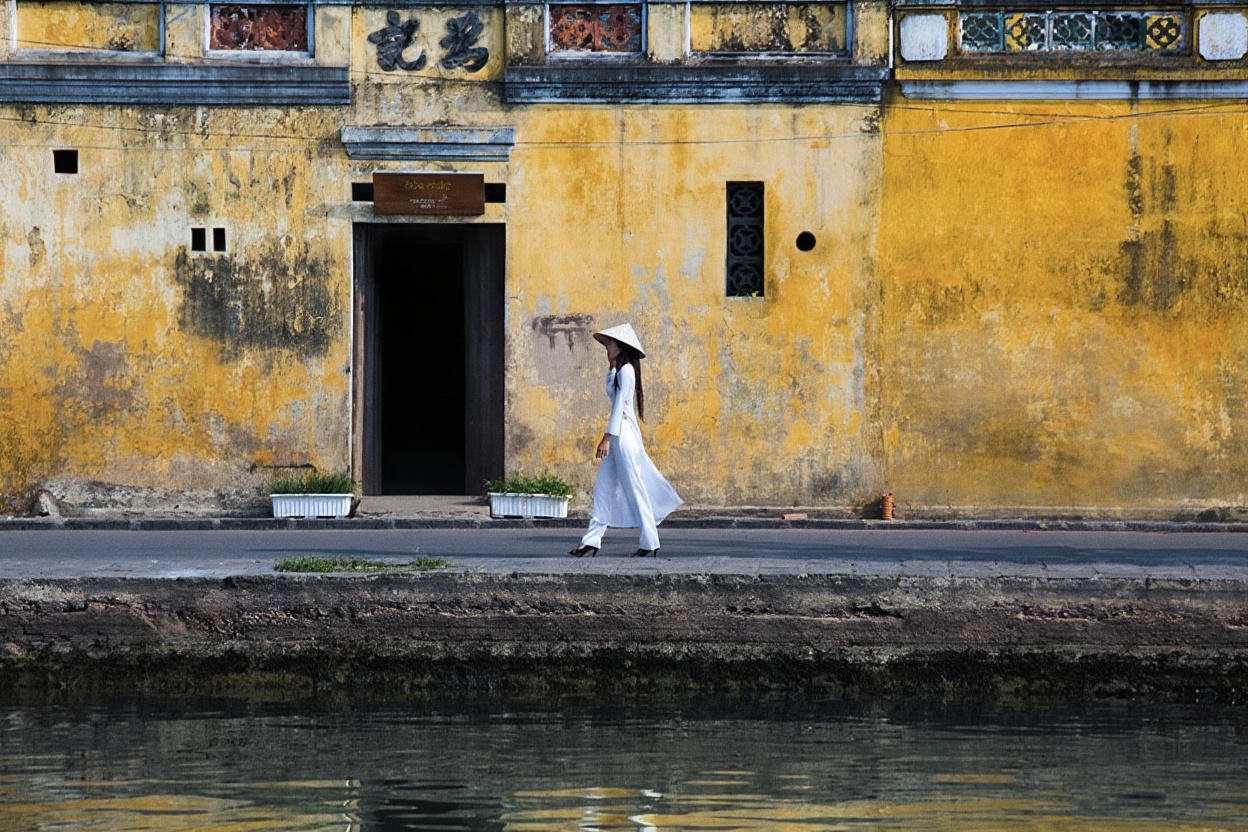
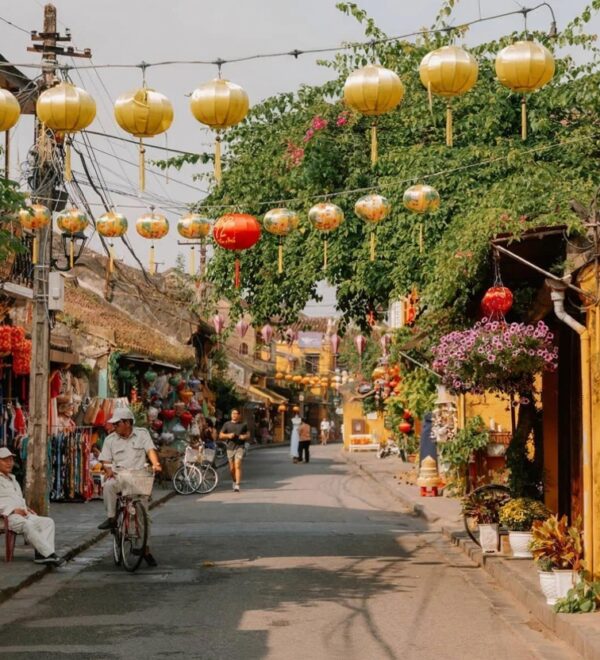
Hoi An (say: hoy an) is the most photographed town in Vietnam. The Ancient Town glows yellow at night from the lanterns that line every alley. It’s also exhausting if you approach it like a tick-box exercise — ancient town, tailors, cooking class, done. Three days here lets you do it slowly enough to find the version that’s not in the photos.
Day 1: Ancient Town on foot at 7am, before the tour groups. The smell of incense from Chua Cầu (the Japanese Covered Bridge) in the cool morning air. Bánh mì (say: banh mee) from Bánh Mì Phượng on Phan Châu Trinh — get there early, the line is real, and it’s worth every minute. Afternoon: An Bàng Beach (say: an bang), 5km from the Old Town, mostly uncrowded, cheap beer at the shack bars right on the sand.
Day 2: Cooking class. If you’re going to do one thing in Hoi An that costs real money, make it a market-to-table cooking class — they take you to the wet market at 6am (the vendors shouting over each other, the smell of fish and lemongrass and wet concrete), then back to a kitchen where you actually cook the dishes you’ll eat for lunch. [GetYourGuide has a solid list with reviews](link: hoi an cooking class getyourguide affiliate) — look for classes with 4.8+ ratings and actual market visits, not just the kitchen portion.
Day 3: slow. Rent a bicycle and ride toward Trà Quế village (say: tra kway) — a herb farming village 3km north of town where farmers have grown morning glory and lemongrass in the same fields for generations. Or do nothing. Hoi An does nothing particularly well.
★JAKE’S PICK
For the Hue–Hoi An leg, I book a shared shuttle with a stop at Hải Vân Pass rather than a private car — about 130,000–180,000 VND (~$5–7). The driver stops for 20 minutes and you walk up to the old military bunkers at the summit. Worth the slower pace.
Days 13–15: Ho Chi Minh City — Saigon at Full Speed
Fly Da Nang → Ho Chi Minh City. VietJet, Bamboo, Vietnam Airlines — 600,000–1,200,000 VND (~$23–46), 1.5 hours. Book this before you leave home.
Ho Chi Minh City (HCMC, still called Saigon (say: sigh-gon) by everyone who lives there) is different from Hanoi in every way that matters. Hanoi is political, contained, northern cold. Saigon is commercial, sprawling, relentlessly hot, and doesn’t apologize for either.
Day 1: War Remnants Museum in District 3. It’s heavy — American war equipment displayed in a courtyard, photographs from the war that will stay with you for days. Go in the morning, 28,000 VND (~$1) entry, give it two hours minimum. The third floor is the hardest. Lunch after, not before. Then District 1’s Bến Thành Market (say: ben thang) — not for shopping, just for the organized chaos of it, the smell of raw meat and dried shrimp and someone frying something in a wok the size of a small car. For a full breakdown of what to do and skip, our Hoi An things to do guide covers every worthwhile stop without the fluff.
Day 2: Chợ Lớn (say: chaw luhn) — Saigon’s Chinatown in District 5. Older than the tourist areas, louder than most, and the bánh bao (say: banh bao, steamed buns) from the stalls near Bình Tây Market (say: binh tai) are the best I’ve had outside of Hong Kong. Take a Grab — it’s 20 minutes from District 1 and feels like a different city.
Day 3: rooftop bar at Bui Vien Walking Street at night (say: boo-ee vee-en) — it’s loud, it’s chaotic, it’s full of backpackers, and it’s genuinely fun in a way that doesn’t require apology. Or skip it entirely and find a cà phê võng (say: cah feh vong) — a hammock café — somewhere in District 3 and read for four hours. Both are correct Saigon experiences.
Days 16–18: Mekong Delta Day Trip (Or Two)
The Mekong Delta (say: dong bang song cuu long) is Saigon’s backyard — 90 minutes south by road, a completely different world. Flat land. Brown rivers. Floating markets. Farmers who’ve been growing the same fruit for four generations in the same delta soil.
Day trips from Saigon are fine, but an overnight to Cần Thơ (say: can thuh) is better. Cần Thơ is the largest Mekong city — it has guesthouses, good food, and the Cái Răng floating market (say: kai rang) at 5am, which is the real thing: boats loaded with wholesale fruit and vegetables, sellers living aboard, the river smelling like engine oil and ripe mango.
Klook has the widest selection for Vietnam and is usually the cheapest. KKday is strong on day trips and local experiences.
on top of transport from Saigon. Shared buses run from Phạm Ngũ Lão (say: fam ngoo lao) in District 1 for about 120,000–170,000 VND (~$5–6) each way to Cần Thơ.
Days 19–21: Buffer Days — This Is Where the Trip Gets Good
The buffer is not leftover time. The buffer is the plan.
Weather closes the Ha Giang Loop for a day. A motorbike falls over in Meo Vac (ask me how I know). A flight gets delayed and you miss a connection. You find a guesthouse in Hoi An run by a couple who make their own bánh cuốn (say: banh kwon) every morning and you simply cannot leave.
Three days at the end of a 3-week Vietnam itinerary means none of those things can wreck the trip. Use them however the trip demands. Some people add Phu Quoc island (1-hour flight from HCMC, 700,000–1,000,000 VND, ~$27–38). Some go back to Hoi An. Some sit in Saigon and eat and eat and eat.
The worst thing you can do is pre-plan the buffer days. They need to stay empty. For a deeper breakdown of the city, our Saigon things to do guide covers every district worth your time.
What This Trip Costs
Total budget estimate for 3 weeks: $800–1,200 (budget) or $1,800–2,500 (mid-range), including domestic flights and Ha Giang transport. Not including international flights.
The Two Flights You Need to Book Before Anything Else
These are not optional:
Flight 1 — Hanoi (HAN) → Da Nang (DAD): 700,000–1,500,000 VND (~$27–57). Book this before you leave home. Evening departure (7–9pm) works best — it gives you the full Ha Giang day, return bus time, and airport buffer. VietJet and Bamboo both fly this route multiple times daily.
Kiwi.com finds the best routing combinations — often cheaper than booking direct. For open-jaw (fly into Hanoi, out of Saigon), it’s especially useful.
Flight 2 — Da Nang (DAD) → Ho Chi Minh City (SGN): 600,000–1,200,000 VND (~$23–46). Same airlines. Book at the same time as Flight 1. Late afternoon departure gives you a full final morning in Hoi An.
Compare prices on Skyscanner — set your dates and look at VietJet, Bamboo, and Vietnam Airlines side by side. Booking 3–4 weeks out usually gets you the best rates.
Getting a SIM Card and Staying Connected
Buy a Vietnamese SIM at Nội Bài Airport arrivals — Viettel or Mobifone booths are right outside customs. Around 150,000–200,000 VND (~$6–8) for 30 days of unlimited data. Works everywhere on this route including Ha Giang — signal thins out on some mountain passes but returns in towns.
Alternatively, an Airalo eSIM set up before you land means you’re connected from the moment the plane touches down. More expensive (~$15–20) but no airport queue.
3-Week Vietnam Itinerary FAQ
How do I do the Ha Giang Loop without a motorbike license?
Hire an Easy Rider guide. These are local drivers who take you on the back of their bike and handle all the navigation. Cost: 800,000–1,500,000 VND/day (~$30–57). For 4 days, budget 3,200,000–6,000,000 VND (~$121–228). Alternatively, book a jeep tour from Hanoi — more expensive ($150–340/person for 3 days) but includes accommodation, meals, and an English-speaking guide.
Can I skip Ha Giang and still have a good 3-week trip?
Yes. But then I’d say: add a Ha Long Bay overnight cruise (2 nights on a boat — book a mid-range cruise, not the cheapest option), extend Hue to 3 nights, or add Phu Quoc at the end for 3 beach days. Check the 10-day itinerary if you want a tighter, less physically demanding route.
North to south or south to north?
North to south. Always. Flights are slightly cheaper flying into Hanoi and out of HCMC from most Western cities. The weather logic works better — you catch northern Vietnam in its drier window before the summer rains hit. And Ha Giang’s roads are easiest to ride before the full summer humidity sets in.
Do I need travel insurance?
Yes, specifically for motorbike coverage. Most standard travel insurance excludes motorbike accidents if you don’t have a valid license. SafetyWing and World Nomads both cover motorbike use with proper documentation — read the fine print before you ride anything in Ha Giang.
What’s the best time of year for this itinerary?
October to April. This covers the dry season for most of the route. Ha Giang is best September–November (harvest, clear skies) and February–April (buckwheat flowers bloom on the plateau — pink and white fields between limestone — one of those things that sounds like a cliché until you see it). Avoid Ha Giang June–August: the roads flood, visibility is nil on the passes, and the loop becomes genuinely dangerous.
The Honest Version
Three weeks in Vietnam sounds like a lot until you’re in Ha Giang on day six watching the mist clear off the Đồng Văn plateau at 7am and realizing you leave tomorrow. Then it sounds like nothing.
The itinerary above is the version I’d give anyone who asks — north to south, Ha Giang as the centerpiece, two domestic flights to save your sanity, and three buffer days you absolutely will use. What it doesn’t include: Con Dao, Phong Nha, Ninh Binh, Da Lat, Mũi Né. Vietnam is a long country. Three weeks covers the spine. The ribs you’ll have to come back for.
If you want to compare routes before you book, the 2-week version skips Ha Giang but adds Ha Long Bay — read both and see which trade-off fits your trip.
Start with flights. Everything else follows.