Last updated: May 2026 — Prices, addresses, and opening hours verified across Old Quarter and Ba Dinh district.
Smoke. That’s the first thing.
I’ve been eating on Hanoi’s plastic stools for five years. I’ve worked through every phở stall in Hoàn Kiếm, ruined a shirt with bún chả splatter, and had at least three genuinely life-altering bánh mì moments on the same street corner. This is the best Hanoi street food guide I wish someone had handed me when I landed.
Specifically for Americans. Because we need to have a talk about expectations first.
Northern Vietnamese Food Is Not What You’ve Had Before
Let’s get this out of the way immediately.
The Vietnamese food most Americans know — the phở at that strip-mall place your coworker swears by, the bún bò Huế from a restaurant with four-star Yelp reviews — is almost entirely Southern Vietnamese or Vietnamese-American. Adapted for Western palates that want heat, big aromatics, and bold flavors announcing themselves upfront.
Hanoi food doesn’t do that.
Northern Vietnamese cooking is restrained. The broths are cleaner. The herbs are less aggressive. The spice is close to absent. What it does instead is build depth — in the slow-cooked bones of a phở broth, in the fermented sweetness of a bún chả dipping sauce, in the quieter, more precise way everything lands on your tongue.
Your first bowl of Hanoi phở might actually disappoint you. That’s not a failure. That’s your palate recalibrating. Give it two days.
⚠Real Talk
Saying “this isn’t as good as the pho back home” is like saying a Burgundy isn’t as good as a Napa Cab. They’re different things. Northern phở is about subtlety. Your local Vietnamese-American restaurant is about adaptation to a different market. Both are correct. Neither is better. Approach Hanoi food like you’re learning a new dialect — not correcting a mistake.
The 5 Hanoi Dishes Americans Actually Need to Eat
Phở Bò — The One You Came For
Phở bò (say: fuh buh — the “ph” sounds like an “f”). Beef noodle soup. You already know this one.
What you don’t know is that Hanoi phở is a completely different species from what you’ve eaten stateside. No bean sprouts dumped in. No hoisin squirted on top. No sriracha bottle appearing at your elbow. In Hanoi, adding sriracha to your phở is roughly equivalent to putting ketchup on sushi — the purists will notice, and there are many purists, and they will watch you do it.
The broth here is paler, cleaner, and built on bones that have been at a low simmer since before you went to sleep last night. You get a squeeze of lime, fresh chilies on the side if you ask, maybe a few fresh herbs. That’s the whole equation.
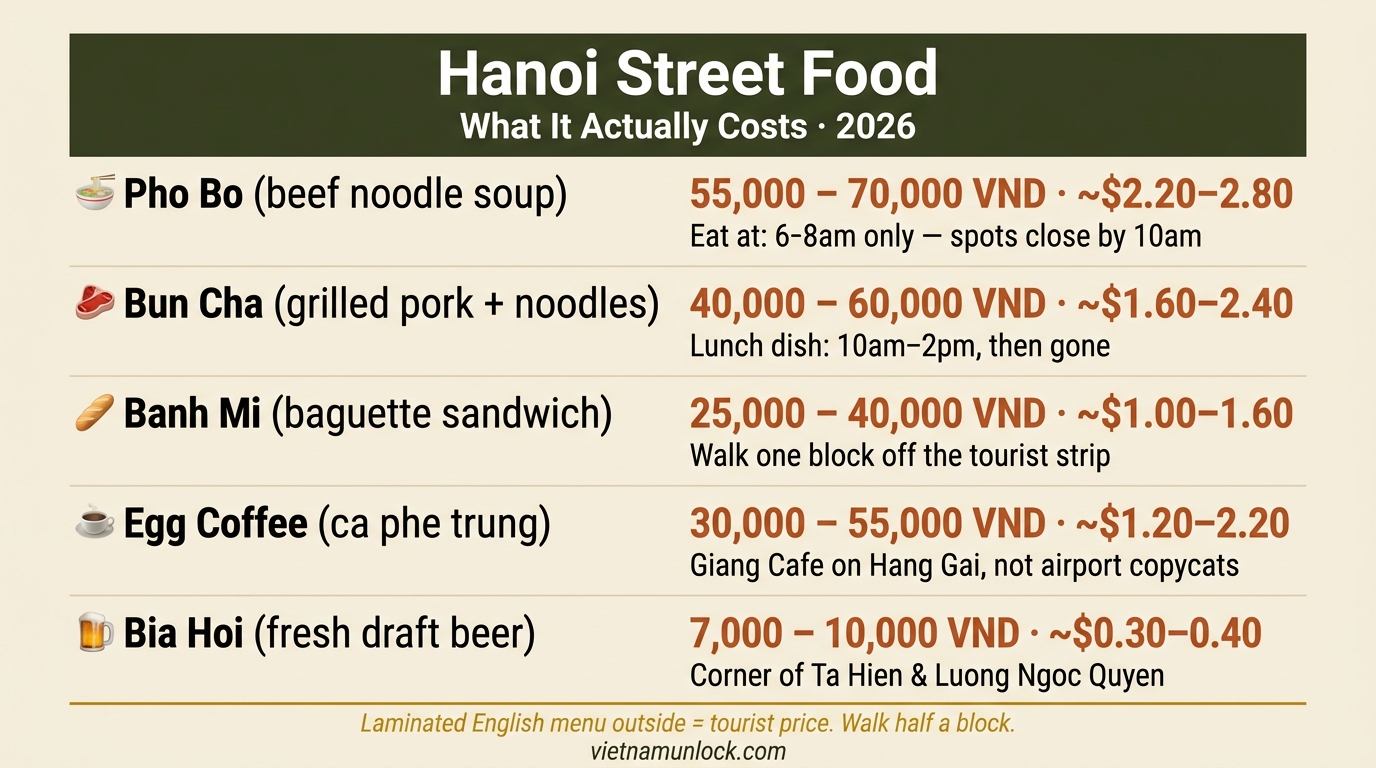
Where to go: Phở Thìn at 13 Lò Đúc Street, Hai Bà Trưng district. Open 6–10 AM, 11 AM–2 PM. Expect a queue — get there by 6:30 AM and you’ll get a stool. The broth is darker than most (they char the onion and ginger before it goes in the pot), the beef is seared in beef fat before it hits your bowl, and the whole operation runs with the kind of controlled chaos where your bowl arrives in three minutes regardless of how many people are ahead of you. One bowl: 55,000–70,000 VND (~$2.30–$2.80 USD).
★Jake’s Pick
Get there at 6:30 AM on a weekday. Take whatever plastic stool is closest to the kitchen. Order tái chín (say: tie chin) — half rare, half well-done beef. Eat without stopping to photograph it. The steam will hit your face when the bowl lands in front of you and it’ll be the most awake you’ve felt since you landed.
Who it’s for: Everyone who eats meat. The morning-person tax applies — the best phở shops in Hanoi close by late morning. Sleep past 9 and you’re eating something else.
Bún Chả — The Obama Dish (And Honestly, It Beats Phở)
In 2016, Barack Obama sat on a plastic stool in Hanoi, ate bún chả with Anthony Bourdain, and drank Hanoi Beer. The bill was $6. If you haven’t seen that clip, find it before your flight.
Bún chả (say: boon cha) is grilled pork — flat patties and fatty round meatballs — served over cold rice vermicelli noodles with a bowl of warm, sweet-sour fish sauce broth on the side. You dip. You eat. You sit there for a moment wondering why you spent the last ten years of your life eating other things.
The smell of a bún chả stall is one of those Hanoi smells that gets stored somewhere permanent. Charcoal. Pork fat. Caramelized sugar from the marinade hitting the coals. You will walk past a bún chả grill months after leaving Hanoi and your stomach will remember before your brain catches up.
Where to go: Bún Chả Đắc Kim at 21 Nguyễn Hữu Huân, Lý Thái Tổ. Communal wooden tables, tiny plastic stools, fluorescent lighting, zero pretense. A full combo — bún, chả, nem cuốn (fresh spring rolls), and a Saigon Beer — costs 150,000 VND (~$6 USD). Open 7 AM–10 PM. This is also the street where you’ll find Tạ Hiện corner (Beer Street) buzzing after dark, so you can eat dinner and pivot straight to bia hơi without moving more than 100 meters.
For the famous version: Bún Chả Hương Liên at 24 Lê Văn Hưu has the framed photo of Obama on the wall and prices slightly higher to match the fame. Still excellent. Know you’re paying the pilgrimage tax.
ℹKnow Before You Go
Bún chả is strictly a lunch dish. Most stalls start around 10 AM and run out by 2 PM. Show up at 6 PM looking for bún chả and you’ll find closed grills and very confused stall owners. This is non-negotiable — plan accordingly.
Who it’s for: Anyone who eats meat. Skip if you’re vegetarian — there’s no meaningful substitute here and you’ll be disappointed. Come back for this dish even if you have only three days in the city.
Bánh Mì — Vietnam’s Sandwich (Not the Whole Foods Version)
Yes, you know bánh mì. Yes, your city has a bánh mì place. No, it’s not the same.
The bánh mì (say: bun mee) you’re getting here is made on a baguette so light it shatters when you bite it — a direct inheritance from French colonial baking, right there in your hands. Inside: pâté, Vietnamese cold cuts, pickled daikon and carrot, cucumber, jalapeño, a thin smear of mayo, fresh cilantro. It costs 25,000–55,000 VND ($1–$2.35 USD) and takes about 90 seconds to eat standing on the sidewalk.
It’s not meant to be a sit-down meal. It’s a refueling stop. A quick decisive thing. And it’s perfect.
Where to go: Bánh Mì 25 at 25 Hàng Cá, Hàng Bồ, Hoàn Kiếm. Open 7 AM–9 PM. The avocado bánh mì costs 55,000 VND ($2.35) and is, genuinely, one of the better things I’ve eaten in five years here. The sit-down spot is across the street; the takeaway window is faster and probably the move.
Who it’s for: Everyone. Budget travelers especially — this is your cheapest, most satisfying thing in Hanoi. Get two. One now, one in an hour.
Cà Phê Trứng — Egg Coffee (The Honest Take)
I’ll be straight with you: egg coffee wasn’t my favorite thing I’ve eaten here.
Cà phê trứng (say: ca feh trung) is strong Vietnamese drip coffee under a thick layer of whipped egg yolk and condensed milk foam. It’s rich, sweet, and calorie-dense in a way that feels wrong at 9 AM but makes sense in the context of Hanoi winters, which are colder than everyone warns you.
It’s absolutely worth trying once — it’s a Hanoi-specific thing that exists nowhere else, and the ritual of drinking it slowly in a dim, narrow café while motorbikes go past below is genuinely good. But don’t make it your daily coffee. Once you’ve had the egg coffee experience, track down a sidewalk cà phê sữa đá (iced coffee with condensed milk, say: ca feh sua da) from any corner cart for 15,000–20,000 VND ($0.60–$0.80). You’ll have four of those a day by the end of the week.
The original: Café Giang at 39 Nguyễn Hữu Huân — a narrow staircase, a cluttered upstairs room with windows the size of a magazine, and a cup of something that tastes like dessert masquerading as coffee. Drink it slowly. Don’t rush it. It’s meant to be lingered over.
↗Insider Tip
Café Giang’s upstairs room gets cold when it rains — bring a layer in winter months (Nov–Feb). The egg coffee is meant to be sipped in the order it arrives: start with the foam at the top, let the coffee underneath warm the rest. Don’t stir it.
Bánh Cuốn — The Dish Americans Don’t Know They’re Missing
This is the one. The dish American food media mostly ignores. The one that’ll stop you mid-bite.
Bánh cuốn (say: bun coon) is a delicate steamed rice flour roll — think crepe-thin — filled with seasoned ground pork and wood ear mushrooms, topped with crispy shallots and sliced Vietnamese pork sausage (chả lụa), served alongside a small bowl of light, slightly sweet fish sauce for dipping. It costs 30,000–50,000 VND ($1.20–$2 USD) and disappears in about six minutes.
Watch the cook make it once and you’ll understand immediately why this dish earns loyalty. A thin film of rice batter spread over a cloth stretched over a steaming pot. Forty-five seconds. Then peeled off in one continuous motion, filled, rolled, plated. It’s the kind of technique that takes years to get right and looks effortless when someone has.
Where to go: Bánh Cuốn Bà Hoành at 66 Tô Hiến Thành, Hoàn Kiếm. Open 7 AM–11 AM only. Morning dish — same rule as phở. The fish sauce is gentle enough that even palates wary of fish sauce will be fine here.
Who it’s for: Everyone, especially people who want something lighter than phở for breakfast. A solid entry point for travelers who are still nervous about street food — it’s cooked to order, hot, and easy to understand. If egg coffee hooks you on Hanoi’s café scene, the full Hanoi coffee culture guide covers everything from cà phê đá to the slow-drip ritual worth an entire morning.
The Neighborhoods Where You Should Actually Be Eating
Hoàn Kiếm / Old Quarter — The Obvious Choice, With Caveats
Most of the restaurants above are here, and most first-time visitors eat here. This is fine. The food quality at the specific places I’ve named is genuinely good — but stay alert to the tourist-menu trap: laminated English menus with photos on the outside, a person standing at the door encouraging you in. Walk past. Always.
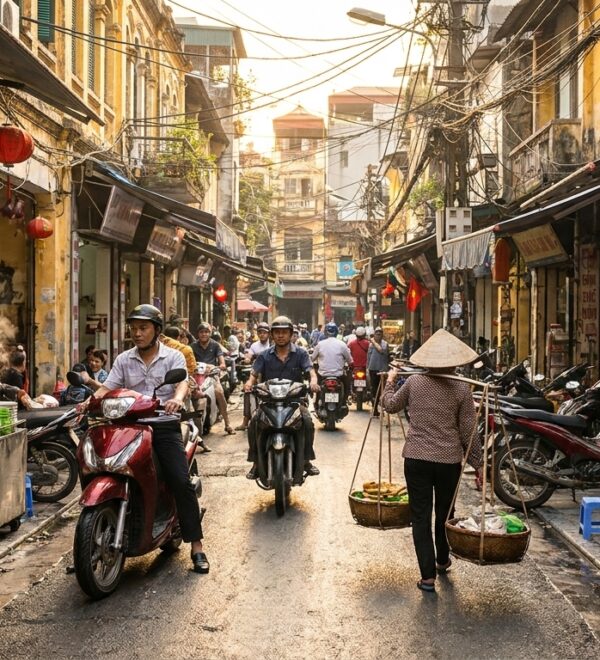
The real Old Quarter eating is on Hàng Mành, Hàng Điếu, and Cầu Gỗ — not the main tourist drags nearest the lake. Walk half a block off Hoàn Kiếm Lake in any direction, and you’ll start finding plastic stools and no English menus. That’s where you’re eating.
Hải Bà Trưng District — Where Locals Actually Go for Breakfast
A 10-minute Grab ride from the Old Quarter, Hải Bà Trưng is where working Hanoians eat before 8 AM. Phở Thìn is here. So are dozens of smaller, nameless phở and bún stalls that fill by 7 AM and close by 9.
You will almost certainly be the only Westerner in the room. Nobody will bring you an English menu because there isn’t one. Look at what the person next to you is eating. Point. That’s the whole ordering system. It works.
⚠Real Talk
Hai Ba Trung prices are the same or slightly lower than the Old Quarter. But the experience is completely different — you’re eating in a neighborhood that exists because Hanoians live there, not because tourists visit it. That distinction matters more than the 5,000 VND difference in a bowl of phở.
What to Know Before You Sit Down — The Practical Stuff
Cash only, always. The stalls above do not have card readers. Find an ATM first, then eat. The closest ATM to a plastic stool is usually around the corner — plan for this before you’re hungry and impatient.
Point and commit. Most street stalls make one or two things. Sometimes just one. You don’t need to “order” in the traditional sense — sit down and food appears. If someone asks you something and you don’t understand, nod and see what shows up. This works 90% of the time.
Eat fast, leave fast. These stools turn over. Don’t sit on your phone after your bowl is empty while three people stand behind you waiting for the seat. Eat, pay, stand up.
The check doesn’t come to you. When you’re done, catch the owner’s eye, stand up slightly. They’ll tell you the price or have it written on a scrap of paper. Pay it. Don’t negotiate. This is not a negotiating situation — it’s a food stall, not a souvenir shop, and the price is already the honest price.
Internet before you leave the hotel. Get an eSIM through Airalo before you land — every address in this article is on Google Maps and you’ll want it working the moment you step out the door. Navigating the Old Quarter to a specific alley address without maps is an unnecessarily frustrating experience. For a deeper dive into where locals actually shop and browse, the Hanoi markets guide covers the best spots by district.
My Biggest Street Food Mistake in Hanoi
My first month here, I walked into Phở Thìn at 13 Lò Đúc and ordered phở gà.
Phở gà is chicken pho. Phở Thìn is a beef pho establishment. They do not serve chicken pho. The woman behind the counter — who has been making phở since before I was born and has the forearms and the expression that proves it — looked at me with the particular patience of someone who has seen this mistake many times and has decided that embarrassing the customer is not the most efficient response.
She didn’t say anything. She corrected my order slip to phở bò (beef), and three minutes later I had the right bowl in front of me. She charged me the correct price. She never mentioned it again.
The lesson: in Hanoi, food shops are specialists. A bún chả stall makes bún chả. A phở shop makes phở. They are not trying to be everything. Know what you’re walking into, or look at what the person next to you is eating and point at that.
What Travelers Actually Say: The Consensus
The consistent traveler feedback on Hanoi street food: the discovery moment. Almost everyone describes a point — usually on day two or three — when the food finally clicked. The mildness that felt underwhelming on day one becomes precision on day three. The plastic-stool setup that felt chaotic at first starts reading as intentional. Multiple travelers note that their most memorable Hanoi meal cost under 50,000 VND and had no photos online to find it by — they found it by walking and pointing.
The most common mistake reported: eating too many meals on the tourist-facing streets. Phố Cổ (the Old Quarter) has concentrated food options but not always the best versions of anything. The bún chả on a side street in Ba Đình or the phở in a no-name alley near Đống Đa consistently gets more enthusiastic reviews than anything adjacent to Hoan Kiem Lake. The food quality gap between “where tourists eat” and “where locals eat” in Hanoi is wider than almost any other city in Vietnam. For everything else about the city, our Hanoi travel guide has the full picture.
⚠Real Talk
Americans who arrived expecting Vietnamese-American food were disappointed on day one. Americans who arrived expecting something different — and gave it two or three meals before forming an opinion — overwhelmingly describe it as one of the best food cities in Asia. The gap is calibration, not quality. Go in without a fixed expectation of what Vietnamese food “should” taste like, and you’ll eat extremely well.
Timing: When to Go and When to Stay in Bed
6–8 AM: Phở, bánh cuốn, xôi (sticky rice with toppings). The best stalls are already full by 7. Set the alarm.
10 AM–2 PM: Bún chả, bún bò, bánh mì. Peak lunch rush is 11:30 AM–12:30 PM — arrive before or after, or accept that you’re eating standing up.
5–8 PM: Evening grill stalls start coming alive, bánh mì carts restock, bia hơi corners fill up. Tạ Hiện Street (Beer Corner) in the Old Quarter buzzes from 7 PM — a glass of draft bia hơi (say: bee-ya hoy) costs 7,000 VND ($0.30). That’s thirty cents for a cold beer on a plastic stool in the middle of Hanoi. Sit with it for a minute.
After 10 PM: Options thin quickly. A few late-night stalls on Đinh Liệt Street, some convenience stores. Manage expectations and eat dinner before 9.
FAQ — Hanoi Street Food for Americans
How much should I budget for a day of street food in Hanoi?
A realistic full day — breakfast phở, a mid-morning bánh mì, bún chả for lunch, afternoon egg coffee, and a light dinner — runs 200,000–350,000 VND ($8–$14 USD). If you’re spending significantly more than that without knowingly going to a restaurant, you’ve drifted into tourist-menu territory.
Do I need to speak Vietnamese to eat street food?
No. You need: to point, to nod, and to pay whatever number someone shows you on their phone or writes on a piece of paper. Learn phở bò, bún chả, and bánh mì as words before you land, and you’re 80% covered for the whole trip.
Where can vegetarians eat street food in Hanoi?
Look for signs with the word chay (say: chai — vegetarian/Buddhist food). Phở chay and bún chay exist and are genuinely good — the broth is built on mushrooms and aromatics rather than bones. Buddhist vegetarian restaurants are common near pagodas.
Should I do a street food tour or go solo?
Solo if you’ve read this guide and are comfortable navigating by Google Maps. If you land feeling overwhelmed and want someone to handle the ordering and context for you, a half-day walking food tour through GetYourGuide is a legitimate option — use it as an orientation, then go back to the places you loved on your own terms.