By October I’d developed opinions about rain. Strong ones.
The honest take on Hanoi‘s rainy season is that it’s more manageable than the warning articles suggest and less pleasant than the “embrace the rain” romantics will tell you. It’s a specific type of experience that works well for some travelers and badly for others, and the difference usually comes down to one thing: whether you’re willing to adjust your schedule to the weather instead of fighting it.
✓Quick Answer
Hanoi rainy season (May–October) is manageable if you plan mornings for outdoor activities and afternoons for indoor sites. Peak rain June–August brings daily downpours around 3pm. Fewer tourists, cheaper prices, and atmospheric scenery are real advantages.
What Hanoi Rainy Season Actually Feels Like
May through October is the rainy season in northern Vietnam. The peak is June through August — this is when the rains are hardest and most reliable. By September they start tapering, and October can be genuinely beautiful: cooler, green, dramatic clouds over Long Bien Bridge, the city cleaned and saturated.
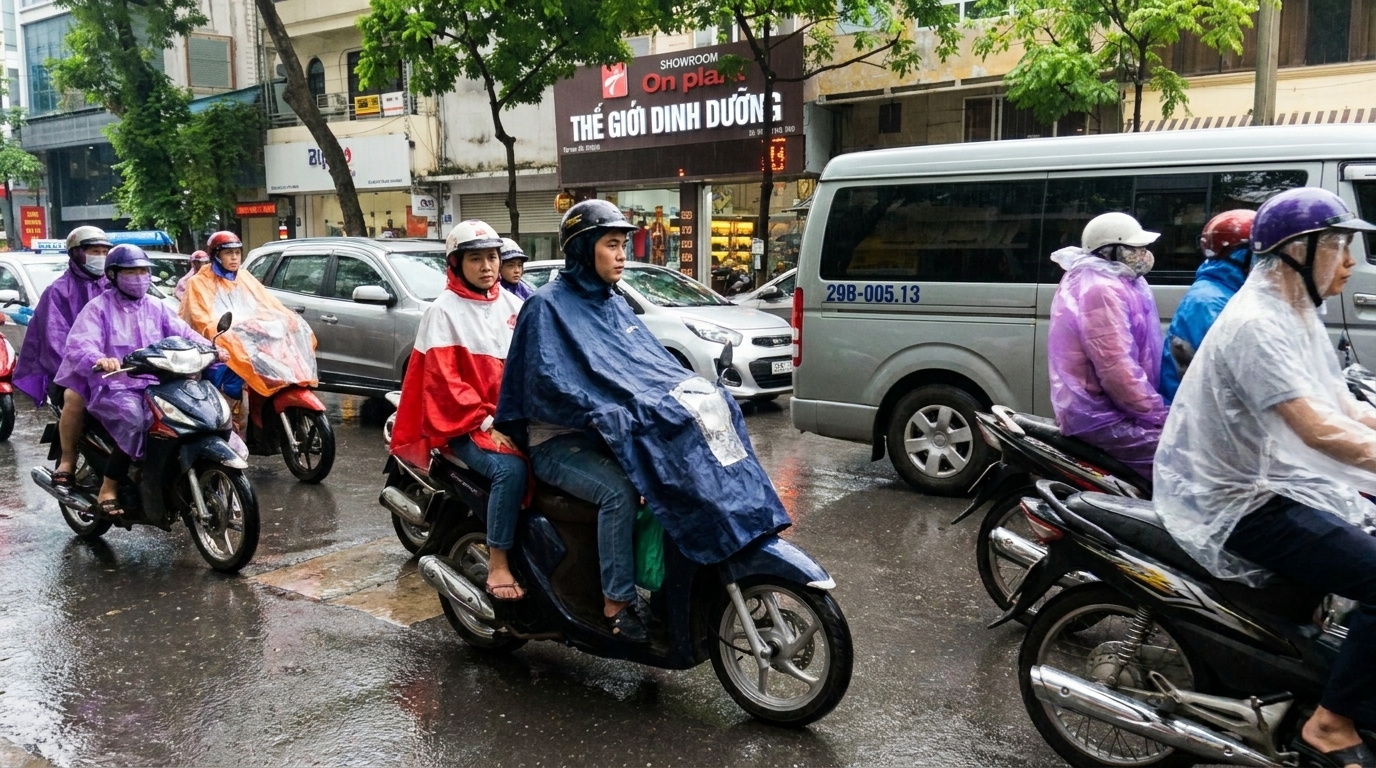
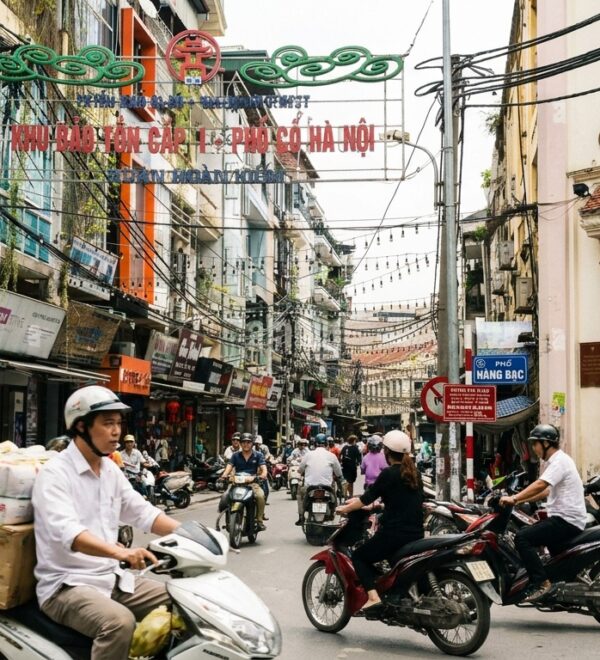
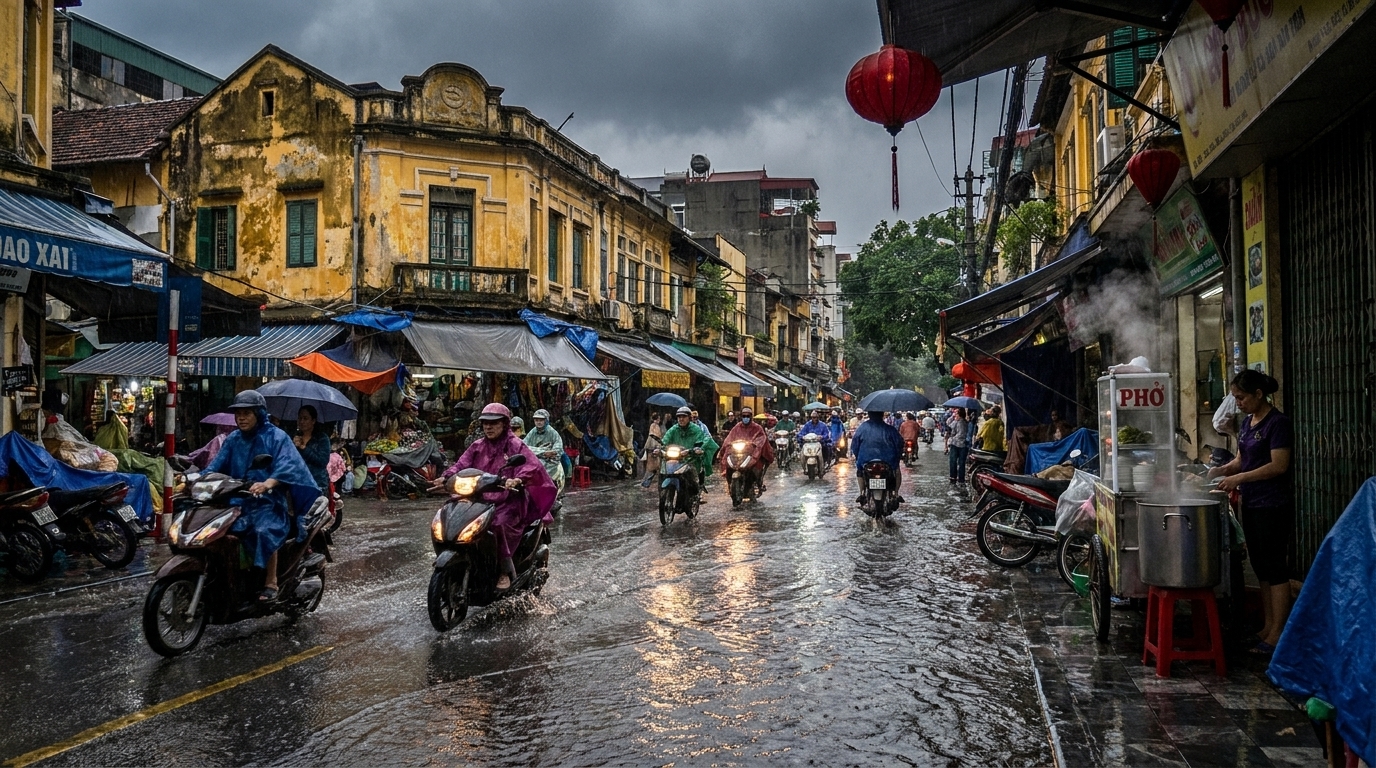
The pattern, most days: morning clear or lightly overcast. Around 11am–1pm, the humidity becomes a physical presence — the air sits on you, heavy and close. By 3pm, the sky opens. Sometimes for 30 minutes. Sometimes for two hours. The rain sounds like an endless drum solo on the tin roofs of the Old Quarter. Streets flood. Scooters slow down. Vendors pull tarps across their stalls. The whole city waits.
After the rain: steam rises from the hot pavement and the air carries wet concrete and pho broth and something fungal and specific to monsoon Hanoi. Hoan Kiem Lake fogs over beautifully. Everything smells alive. For a full country-wide breakdown, our Vietnam best time to visit guide covers every region’s seasonal patterns.
This is the version nobody photographs but everyone who stays remembers.
Month-by-Month: What Rainy Season Actually Means
The months are not equal. “Rainy season” as a label collapses five very different months into one warning label.
May: The Transition
The rains start arriving but haven’t committed. Some days are dry. The heat builds toward summer but hasn’t peaked. May is arguably the most uncomfortable month of the year — too hot and humid to be pleasant, too unpredictable to plan around. The Temple of Literature courtyard in late May smells like fresh-cut grass and approaching storm. Crowding is already thinning from peak season. Daily budget drops noticeably.
June–August: Peak Monsoon
The reliable downpour window. Count on rain every afternoon between 2pm and 5pm. Flooding near Hang Bac and Dong Xuan Market is regular — ankle-deep within 30 minutes of a heavy shower. The beer hoi stalls on Tạ Hiện Street stay packed; everyone just waits it out under the eaves with 8,000–10,000 VND (~$0.35) glasses of Bia Hoi. The city smells like wet garbage mixed with pho broth, which sounds worse than it is — after a week you stop noticing and it becomes the smell of summer.
This is also when prices are lowest and crowds are thinnest. The Temple of Literature on a rainy July weekday has maybe 20 people. That’s the real benefit.
September: Tapering
Rain frequency drops. Still warm but not suffocating. The rice paddies on day trips toward Ninh Binh are at their most vivid green — worth timing a day trip to Ninh Binh for this specific window. Crowds start recovering but haven’t reached peak season levels. Genuinely good month if you can handle occasional heavy rain.
October: The Sweet Spot
Cooler. Drier. Long Bien Bridge in dramatic morning light. The Hanoi markets operate without the oppressive heat that makes them uncomfortable in July. The coffee shop windows fog with the temperature difference between inside and out. If you’re flexible on when to visit, October is the answer — technically still rainy season but none of the downsides.
⚠Real Talk
The blogs that tell you to “avoid Hanoi in rainy season” are usually written by people who spent a week there and got unlucky with two straight days of rain. The people who actually live here develop a different relationship with it. Five years in, I own a specific pair of sandals for flood walking and I’ve stopped being annoyed by the 3pm downpour. It’s just how afternoons work from June to August.
The Real Benefits (Not Just the Romanticized Ones)
I’ll be direct about why you might actually want to visit during rainy season:
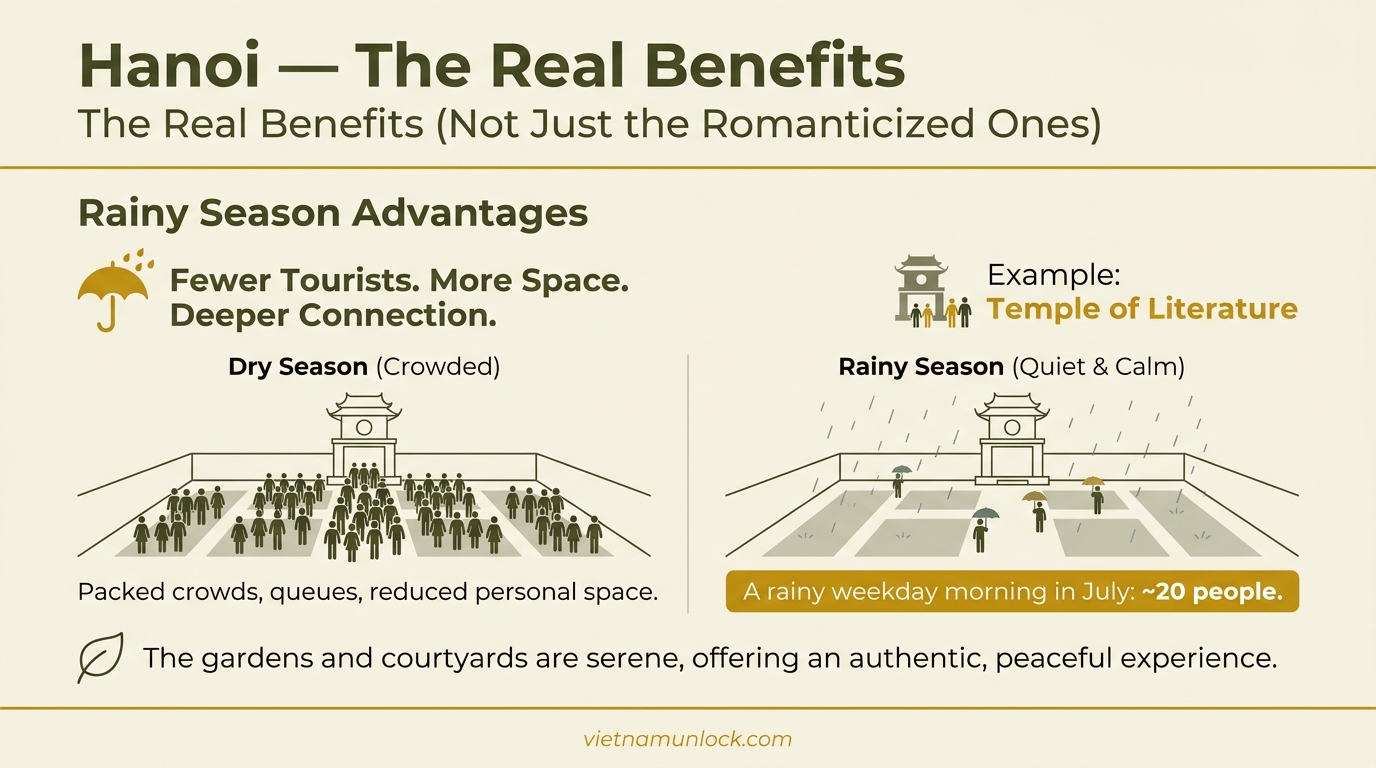
Fewer tourists. The Temple of Literature on a rainy weekday morning in July has maybe 20 people in it. The gardens are lush and empty. The courtyard smells like damp stone and incense. This is a fundamentally different experience from the 200-person queue of March.
Lower prices. Dorm beds drop to 150,000–200,000 VND (~$6–8) at most Old Quarter hostels. Private rooms at mid-range places run 450,000–500,000 VND (~$18–20) versus significantly more in peak season. Budget daily total in rainy July 2025: around 500,000–600,000 VND (~$20–24) covering accommodation, street food, Grab rides, and a couple of beers.
Street food hits differently. The heat that the rain provides — muggy and post-storm warm — is exactly the weather that makes a bowl of phở at 50,000 VND (~$2) from a cart near Hoan Kiem register differently than it does in dry-season heat. The steam off the bowl, the dampness in the air, the plastic stool on still-wet pavement. The Hanoi street food is the same — the context around it is different.
What to Do With the Rain
Morning (6am–Noon): This Is Your Time
The morning window before the rains arrive is when Hanoi works best in wet season. The air is cooler, the markets are active, the sights are at their least crowded.
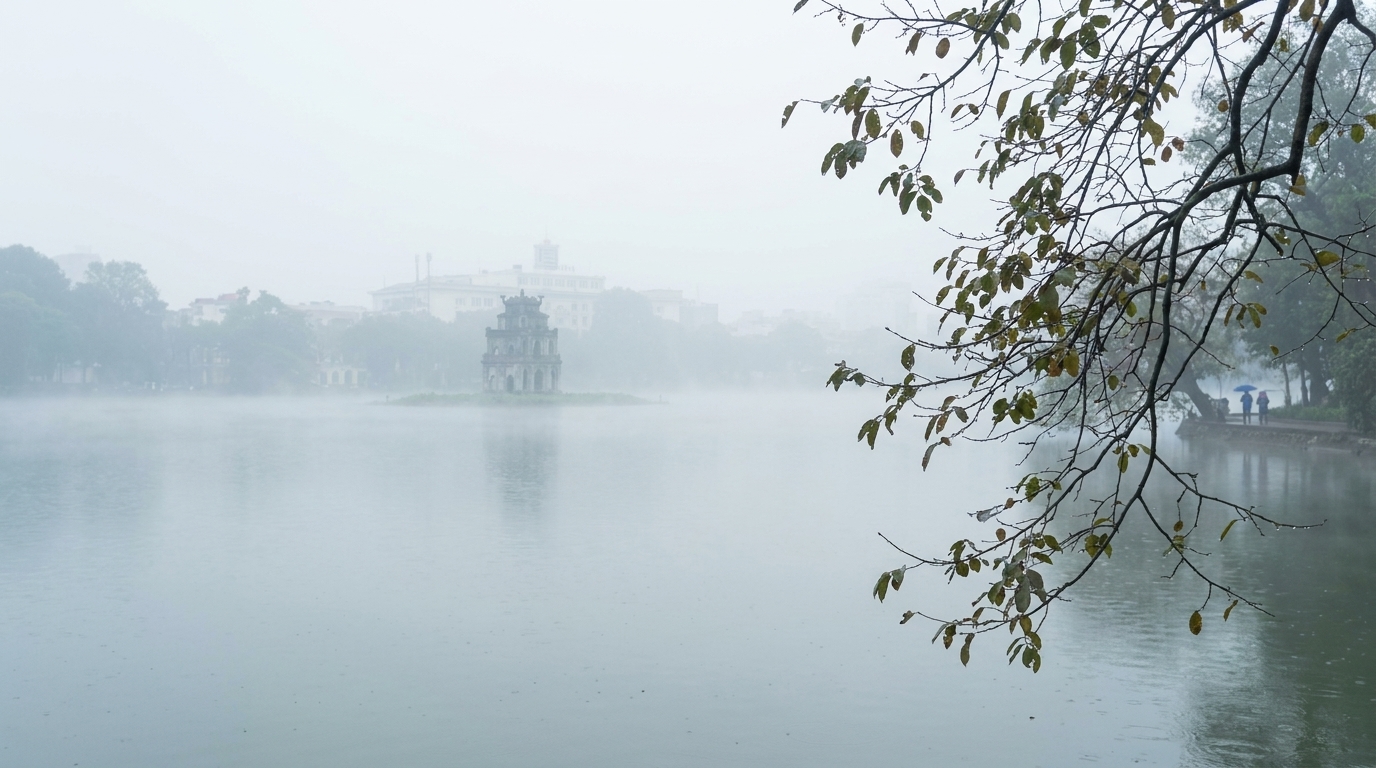
Hoan Kiem Lake from the west bank at dawn — the Turtle Tower sits in morning mist that burns off by 8am. The reflection is the one you’ve seen in photographs. The east side has wind-driven rain during showers; the west is sheltered.
Quan Thanh Temple area is quietest in the city at this hour. After a night’s rain, the courtyard smells like incense and wet stone in a combination that seems designed specifically to put you in a meditative state you didn’t ask for.
Old Quarter markets before 10am — under the awnings on the small streets around 21.0285° N, 105.8512° E, vendors set up with hot ginger tea that some of them will hand you if you look cold and foreign. This is the best window to explore the Old Quarter streets properly — before tour groups descend and while the alley vendors are still in a good mood.
Afternoon: Work With the Pattern
Plan indoor activities for the 2–5pm window. Hoa Lo Prison (Hỏa Lò — say: hwah loh — 60,000 VND/~$2.40 entry) is one of Hanoi’s most significant sites and infinitely better in quiet rain-day conditions than packed dry-season afternoons. The Vietnam Museum of Ethnology (40,000 VND/~$1.60) is worth two hours in any weather — the covered outdoor exhibits hold up even in moderate rain.
If you get caught in the rain: duck into any cafe. The Hanoi coffee culture was practically built for waiting out storms — phin coffee takes six minutes to drip, and the rain usually doesn’t last longer than 90 minutes at peak. Wait it out.
The one genuinely difficult moment: flooding. Near Hang Bac Street and around Dong Xuan Market, the storm drains overflow within 30 minutes of heavy rain. Ankle-deep water is common. I learned this the first August I was here, walking home from the Night Market in white canvas shoes at 9pm. I carried those shoes. Sandals are the correct footwear for Hanoi in rainy season, full stop.
Evening: The Hidden Upside
After the rain passes — usually by 6pm — the evening in Hanoi is different. The air is cooler. The streets are washed. The beer hoi stalls on Tạ Hiện Street are three times busier than they were at noon, everyone who waited out the storm now emerging together. Beer is 8,000–10,000 VND (~$0.35) per glass. The sky turns purple over the rooftops and the whole Old Quarter has a quality of light that only exists after a hard rain in a dense Asian city. It’s not romanticized — it’s just genuinely good.
ℹKnow Before You Go
Power outages happen during heavy storms, particularly in West Lake. If you’re staying there, your hotel’s AC may go off for 30–60 minutes during the worst downpours. The West Lake path also goes unlit and muddy — don’t walk it after dark during rain. At least one ankle-twist incident is documented per cycle of traveler forums.
What to Pack for Rainy Season Hanoi
This is the list nobody gives you because it’s too obvious. But I’ve watched enough tourists wade through Hang Bac in white sneakers to write it anyway.
Closed-toe sandals you don’t mind wetting. Not flip-flops — those float off in ankle-deep flood water. Closed-toe sandals with a strap, or Tevas. You will walk through standing water at least twice.
A poncho, not an umbrella. You’re on the back of a motorbike or walking through narrow alleys. An umbrella is useful about 30% of the time. The folded plastic ponchos sold at every Old Quarter corner stall for 20,000–30,000 VND (~$0.80–1.20) are genuinely fine for short downpours.
Quick-dry clothes. The humidity means regular fabric doesn’t dry between wears. This matters more in June–August than any other month in Vietnam.
A waterproof bag cover. Your camera or laptop on the back of a Grab bike in a sudden downpour. Just get the cover — costs 30,000–50,000 VND (~$1.20–2) at any outdoor gear stall near Hang Gai Street.
Staying Safe: What’s Actually Different in the Rain
Transport
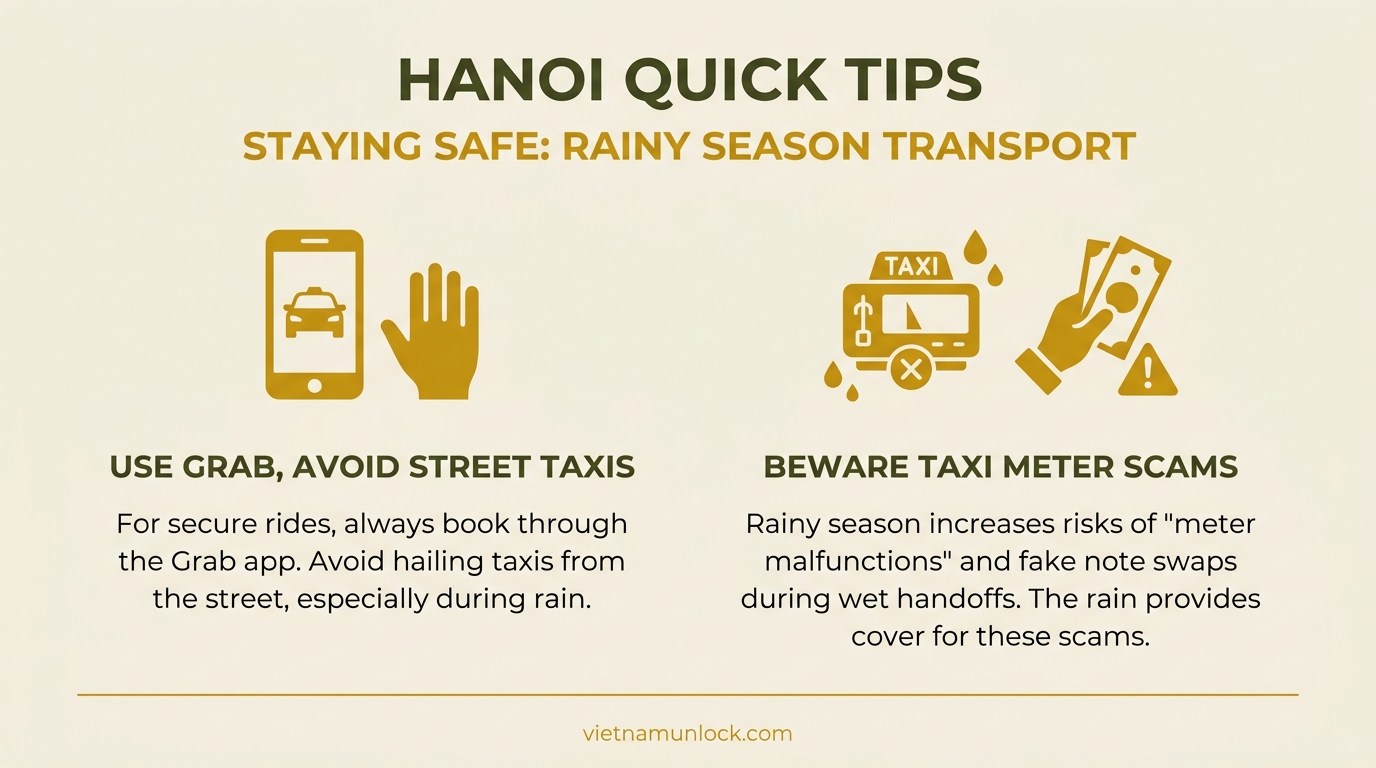
Use Grab, not street-hail taxis. In rainy season specifically, taxi meter scams increase — the rain provides cover for “meter malfunctions” and fake note swaps during wet handoffs. The Grab app shows the price before you get in. Airport bus 86 is 40,000 VND (~$1.60) to the city center and runs in rain. For the full rundown on what to avoid, read the Hanoi motorbike scams guide.
Don’t cross Long Bien Bridge on foot during active rain. There is no pedestrian path separated from the moto lane and bikes don’t slow down in the wet.
The Shoe Shine Scam
It intensifies in rainy season because the setup writes itself: a guy “accidentally” steps in a puddle that splashes your shoe, then apologizes and offers to clean it, and charges 300,000 VND (~$12) for a job that costs 50,000 VND (~$2) at actual shoe repair stalls. Say no immediately when anyone offers to clean your shoes unprompted. This pattern is [RECURRING across 2025–2026 Reddit reports] — multiple r/VietnamTravel threads document the exact same mechanic.
Cyclo Pricing
Rain inflates cyclo quotes from the already-inflated tourist rate. Fair price for a 30-minute Old Quarter cycle is 100,000–150,000 VND (~$4–6). Rainy-day quotes have gone as high as 500,000 VND (~$20). Agree on a specific price and exact route before getting in.
↗Insider Tip
Walk against the flow of motorbike traffic in the rain — counter-intuitive but it gives you better visibility of oncoming bikes and reduces the chance of being splashed. The expat community passes this one around but it almost never makes it into travel guides.
What Rainy Season Is Actually Good For
Train Street through mist at 7am on a rainy morning is the version that doesn’t get photographed for brochures. The wet tracks, the fog, the vendors with their hoods up — it’s more real and more interesting than the dry-season crowd scene. The northbound train light is golden in that window.
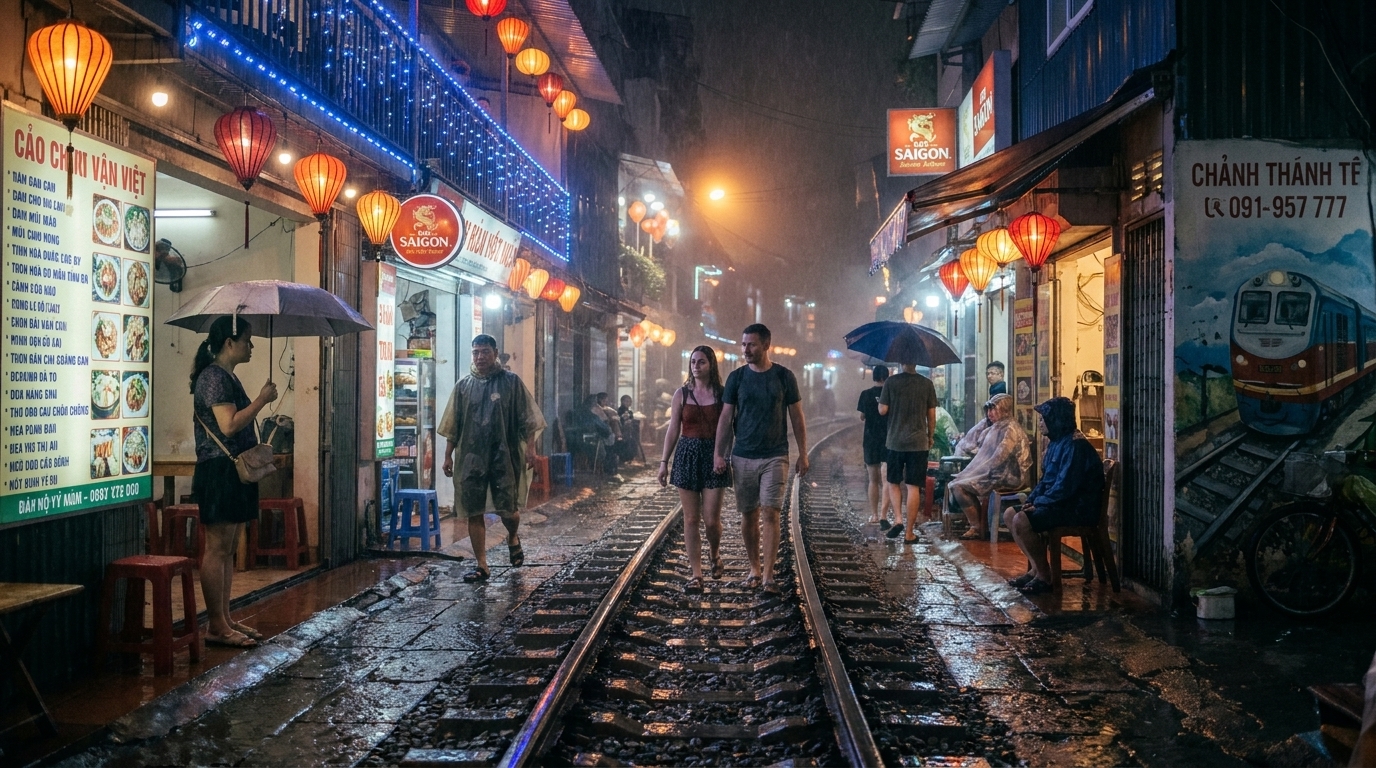
The unmarked pho alley behind 52 Hàng Bông Street (look for the blue tarp) is what the Old Quarter delivers when the weather keeps the tour groups back at their hostels. 30,000 VND (~$1.20) per bowl, dry under the awning, steam rising off everything. I’ve been going here since 2022 and it is exactly as good as it sounds.
West Lake in rain is the specific sensory experience that neither the weather warnings nor the romanticized rain essays quite capture — the rain on lotus leaves sounds like soft applause, the earthy scent from the lake path is deep and fungal and completely different from anything the city smells like in dry season. Worth finding the unmarked path off Nghi Tam road (21.052° N, 105.802° E) for the morning version of this.
Day Trips in Rainy Season: What Still Works
Not all day trips from Hanoi hold up equally in wet season. Practical breakdown:
Ninh Binh: Works well in light rain — the caves are covered, the boat tours run, and the flooded rice paddies turn a shade of green that doesn’t exist in dry season. Heavy rain can flood the approach roads. Go on days with clear mornings. See the Ninh Binh from Hanoi guide for transport options that run regardless of weather.
Klook has the widest selection for Vietnam and is usually the cheapest. KKday is strong on day trips and local experiences.
ther. Check sea conditions 48 hours out. The bay itself is more dramatic in mist — if it’s light rain only, it’s worth going.
Perfume Pagoda: Avoid in heavy rain. The boat approach and the steps to the main cave become hazardous. Save this one for dry season.
What Travelers Actually Say (Consensus 2025–2026)
Across Reddit r/VietnamTravel and TripAdvisor 2025–2026, the pattern is consistent:
People who came with rigid outdoor-heavy itineraries left disappointed. People who adjusted to the morning-window system largely loved it. The split is almost exactly along those lines.
“Rainy season Hanoi 2025: pros — fewer tourists, cheap street eats; cons — motos splashing mud puddles everywhere, air thick with mildew. Pack quick-dry everything.” — u/HanoiHabitue, r/VietnamTravel
“Everyone says avoid Hanoi rainy season but honestly, it’s peak vibe — empty alleys, dramatic clouds over Long Bien Bridge. Haters just hate getting wet.” — u/ContrarianCycist, r/VietnamTravel (500+ upvotes)
The consistently positive thread: the city feels more lived-in, less performative, in monsoon. The consistently negative: the flooding near Dong Xuan is genuinely inconvenient, not just “atmospheric.” Both are true.
Frequently Asked Questions
Does rain affect things to do in Hanoi?
Rainy season Hanoi is a different city, not a worse one. Adjust for the 3pm downpour, wear the sandals, and stay off Long Bien Bridge after noon.