Home
›
Ha Noi
›
Hanoi Coffee Culture: Best Local Cafes Off the Tourist Trail
Hanoi Coffee Culture — Vietnam Unlock
Hanoi Coffee Culture: Best Local Cafes Off the Tourist Trail
Six in the morning on Nguyen Huu Huan Street. The air smells like charred robusta and something else — rain on hot pavement, maybe, or the ghost of last night’s street food still clinging to the walls. A woman in a conical hat sets a metal phin filter on a glass of condensed milk. The coffee hasn’t started dripping yet. She’s already moved on to the next customer.
Phin drip coffee at a street stall costs 20–30k VND (~$1) — ignore the chain cafes charging 5x that
Giang Cafe invented egg coffee in 1946 — go at 6–8am before the tour groups land
Nguyen Huu Huan Street is your baseline: a dozen real local cafes, no tourist menus
The robusta here hits harder than anything back home — jitters are real, don't say I didn't warn you
Scam alert: "original egg coffee" knockoffs near Giang charge 200k and switch your cup
Bottom line: Hanoi runs on coffee — slow down, find a plastic stool, and let the phin drip
✈ Search Flights to Vietnam
Last updated: May 2026 — prices and cafe information verified
Six in the morning on Nguyen Huu Huan Street.
Nobody here is in a rush. That’s the thing about Hanoi coffee culture that no blog photo prepares you for.
I’ve been living in this city for five years. I’ve had the egg coffee, the coconut coffee, the tasting flight at the fancy French Quarter place, and roughly 2,000 cups of black iced drip at no-name stalls where the menu is a handwritten sign and the bill is whatever feels right that morning. This is what I’ve learned.
What Makes Hanoi Coffee Culture Different
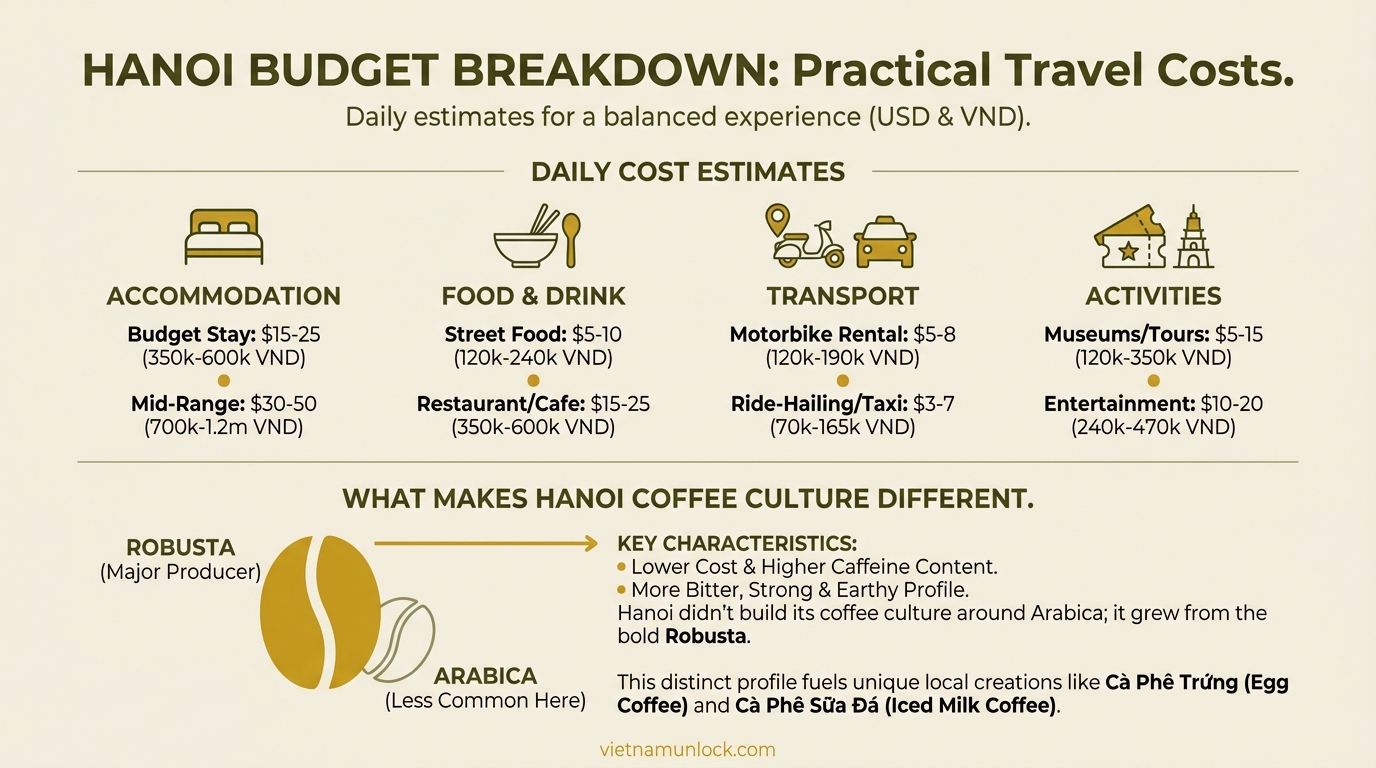
Vietnam is one of the world’s largest coffee producers — mostly robusta, which is lower-cost, higher-caffeine, and more bitter than the arabica you’re used to. Hanoi didn’t build its coffee culture around espresso machines. It built it around time.
Vietnam is one of the world’s largest coffee producers
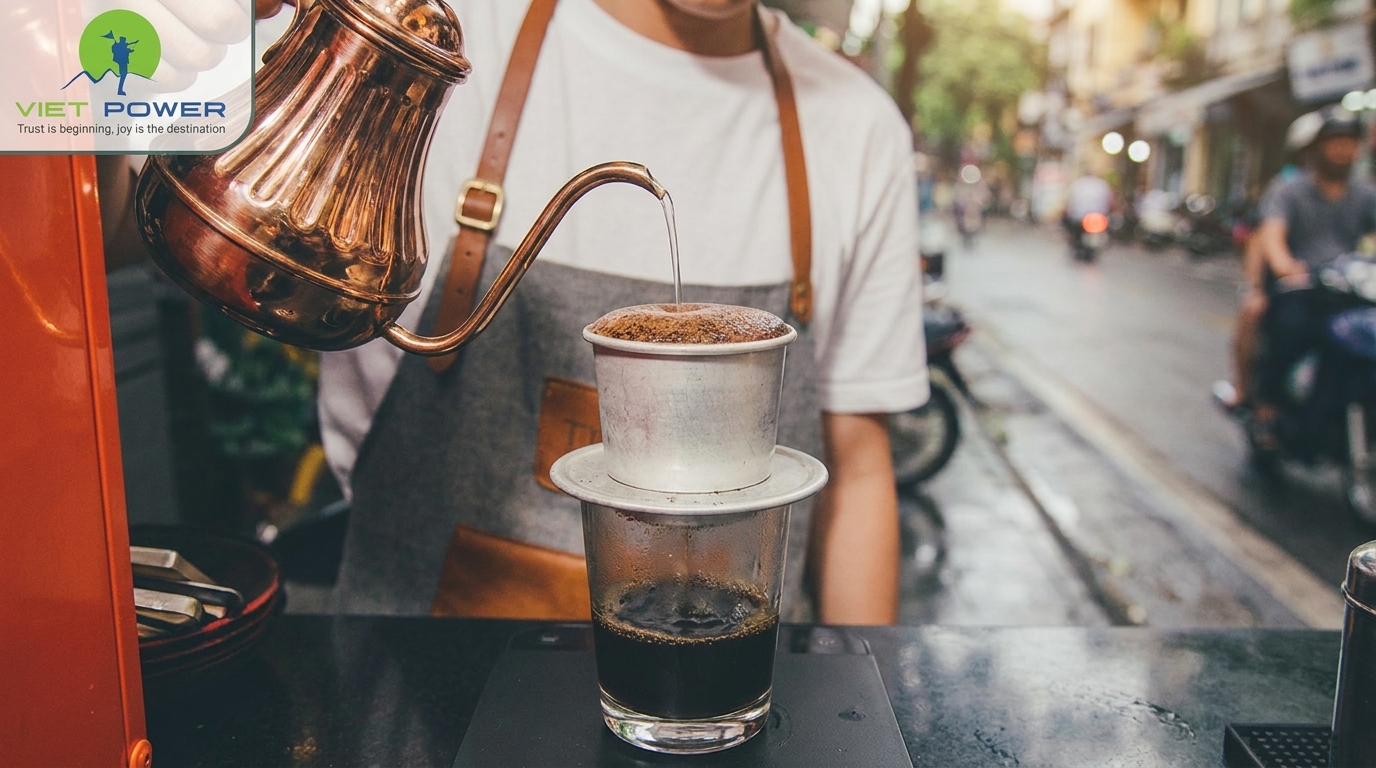
The phin filter — a small aluminum drip device that sits on top of your glass — takes four to six minutes to drain. That’s not an accident. It’s a design philosophy. You sit. You wait. You watch the street.
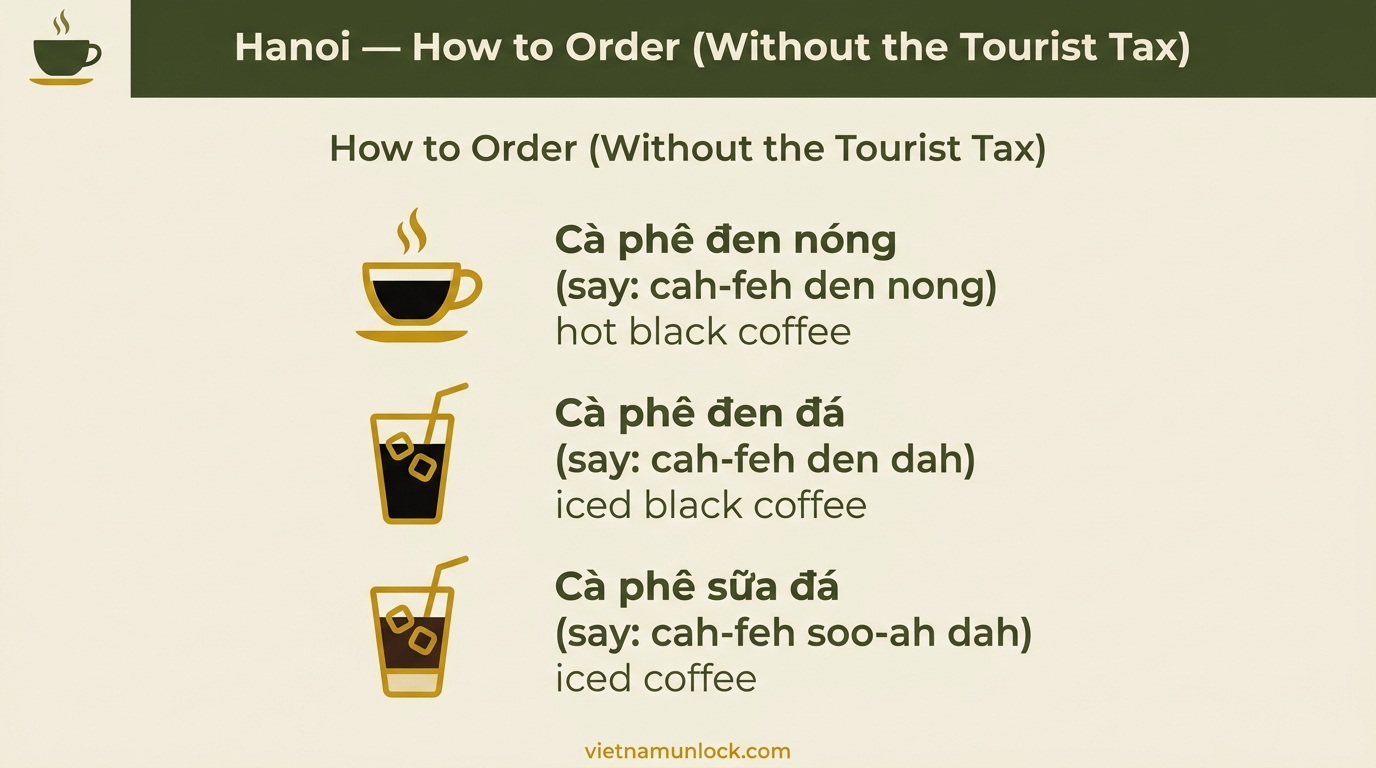
Cà phê (say: cah-feh) means coffee. Cà phê đen (say: cah-feh den) is black coffee. Cà phê sữa đá (say: cah-feh soo-ah dah) is the one you’ve seen in every Instagram post: iced coffee with sweetened condensed milk, robusta-dark, clinking with ice, about 35,000 VND (~$1.40) at any street cart worth visiting.
The caffeine is real. Don’t order two.
The Coffees You Actually Need to Try
COFFEE MENU 2026
Hanoi Coffee Types — Prices & Where to Get Them
Coffee
Street Stall
Cafe
Best At
Cà phê sữa đá ★
20,000–35,000 VND (~$1)
40,000–55,000 VND (~$1.60–2.20)
Nguyen Huu Huan St
Cà phê trứng
—
40,000–55,000 VND (~$1.60–2.20)
Giang Cafe (39 NHH)
Cà phê dừa
25,000–30,000 VND (~$1)
45,000–60,000 VND (~$1.80–2.40)
Cộng Cà Phê chain
Cà phê đen nóng
15,000–25,000 VND (~$0.60–1)
30,000–50,000 VND (~$1.20–2)
West Lake cart, RuNam
vietnamunlock.com — All prices 2026. Street stall prices apply Mon–Fri before 10am.
Cà Phê Trứng — Egg Coffee
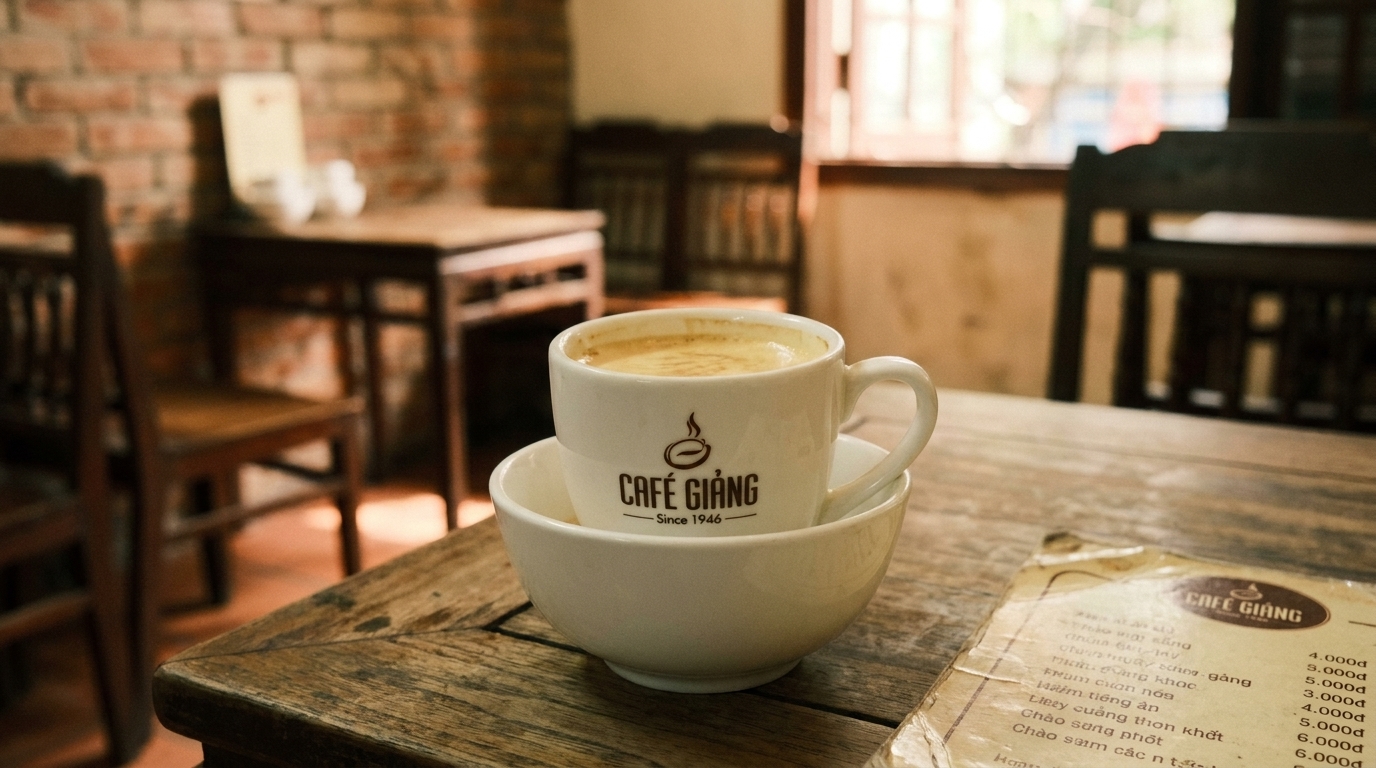
The origins are specific: 1946, a bartender named Nguyễn Giang at the Sofitel Legend Metropole couldn’t source fresh milk during wartime shortages. He whipped egg yolk with sugar into a thick, custard-like foam and poured coffee under it. It worked.
Egg coffee at Giang Cafe — the original since 1946.
That bartender’s son now runs Giang Cafe at 39 Nguyễn Hữu Huân. The egg coffee here costs 50,000 VND (~$2) and tastes like vanilla custard sitting on top of a very serious espresso. The room is narrow, the stairs creak, and they’ve got photos of every celebrity who’s passed through on the walls going back decades.
Go at 6–8am. The golden light comes through the east-facing windows and the tour groups haven’t found their shoes yet.
ℹKnow Before You Go
There are at least three “original egg coffee” operations near Giang that aren’t Giang. One notorious spot near the entrance quotes 50,000 VND, waits until you’re settled, switches your cup to a worse version, then demands 200,000 VND (~$8) and mentions “police” if you argue. Go to the actual address: 39 Nguyễn Hữu Huân, first right off the main drag, up the stairs.
Cà Phê Dừa — Coconut Coffee
This one smells like a beach. Specifically: coconut milk blended with coffee over ice, cold and thick like a coffee milkshake, around 45,000 VND (~$1.80).
The chain version is Cộng Cà Phê — Soviet-era aesthetic, propaganda posters, 80s Vietnamese pop playing at medium volume, clean bathrooms (a blessing). Multiple locations in the Old Quarter. It’s technically a chain, it’s technically Instagram bait, but the coconut coffee is legitimately good and the playlist is legitimately weird in the best possible way.
The non-chain version: ask at any street stall if they do coconut coffee. Some do, some don’t. The ones that do usually charge 25–30,000 VND (~$1–$1.20) and won’t mind if you sit there for an hour.
★Jake’s Pick
Cộng Cà Phê on Triệu Việt Vương, French Quarter — quieter than the Old Quarter locations, better seats, same coconut coffee. Order the coconut coffee slushie in summer. You’ll thank me at 1pm when the heat is making bad decisions for you.
Cà Phê Đen — Black Phin Drip
This is what most Hanoians actually drink. No milk. No ice. Just dark robusta, ground coarse, dripped through a phin into a small ceramic cup. The bitterness is not subtle — it tastes like it was extracted from a very serious place.
Cost: 20,000–30,000 VND (~$0.80–$1.20) at a street stall. If you’re paying more than 40,000 VND (~$1.60) for plain black phin coffee, you’re on the tourist menu.
Nguyen Huu Huan Street: The Baseline
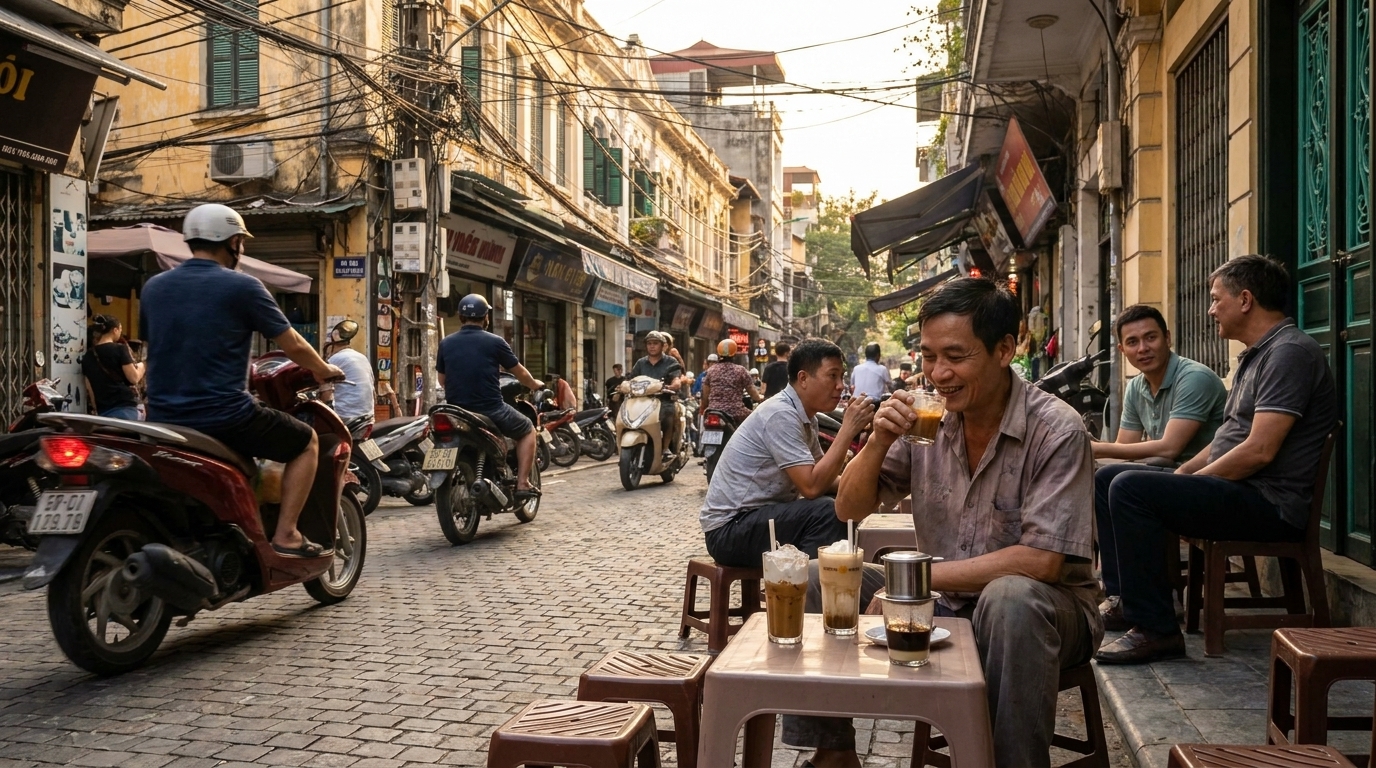
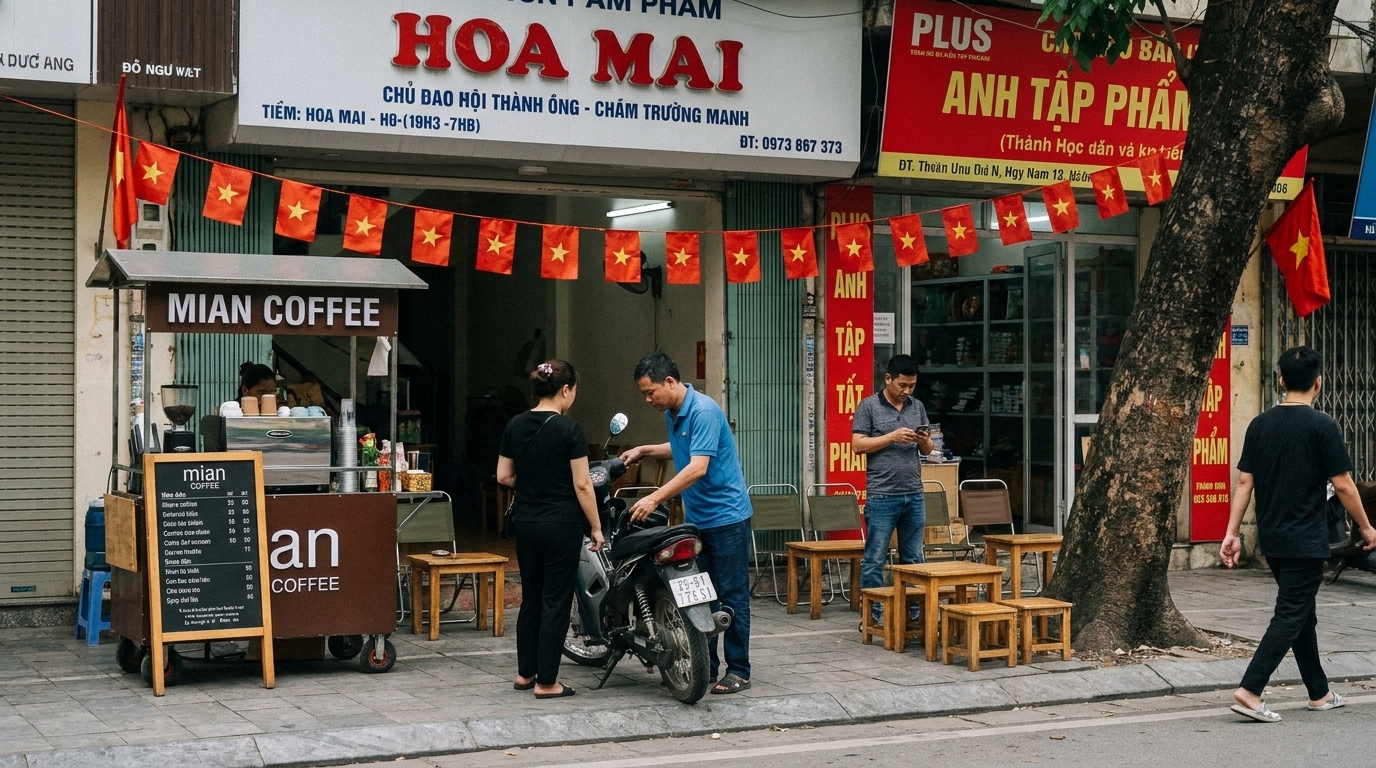
If I could send every first-time visitor to one street for coffee, it would be Nguyễn Hữu Huân in the Old Quarter. Roughly a dozen cafes stacked side by side, most with low plastic stools spilling onto the pavement, none of them bothering to fight for your Instagram. Phin drip: 30,000 VND (~$1.20). Prices on the board.
Nguyen Huu Huan Street, Old Quarter — a dozen cafes side by side, plastic stools on the pavement, prices on a board.
Walk the whole street first. Look at who’s sitting where. Pick the place with the most locals over the age of 50. Sit down. Order cà phê sữa đá and wait.
The street also connects naturally to the Hanoi Old Quarter walk — most of the best coffee spots are within a 10-minute wander of Hoan Kiem Lake.
↗Insider Tip
The alley off Hàng Bạc Street in the Old Quarter has two or three plastic-stool spots run by older women who’ve been dripping phin since before you were born. Coffee is 20,000 VND (~$0.80). Nobody speaks English. Nobody needs to. Look for the narrow entrance around 21.0285°N, 105.852°E and follow the smell of charred robusta.
The Aesthetic Cafe Circuit (If You Want It)
There’s a whole sub-scene of design-forward cafes in Hanoi that charge 55,000–120,000 VND for the atmosphere as much as the coffee. Some are worth it once.
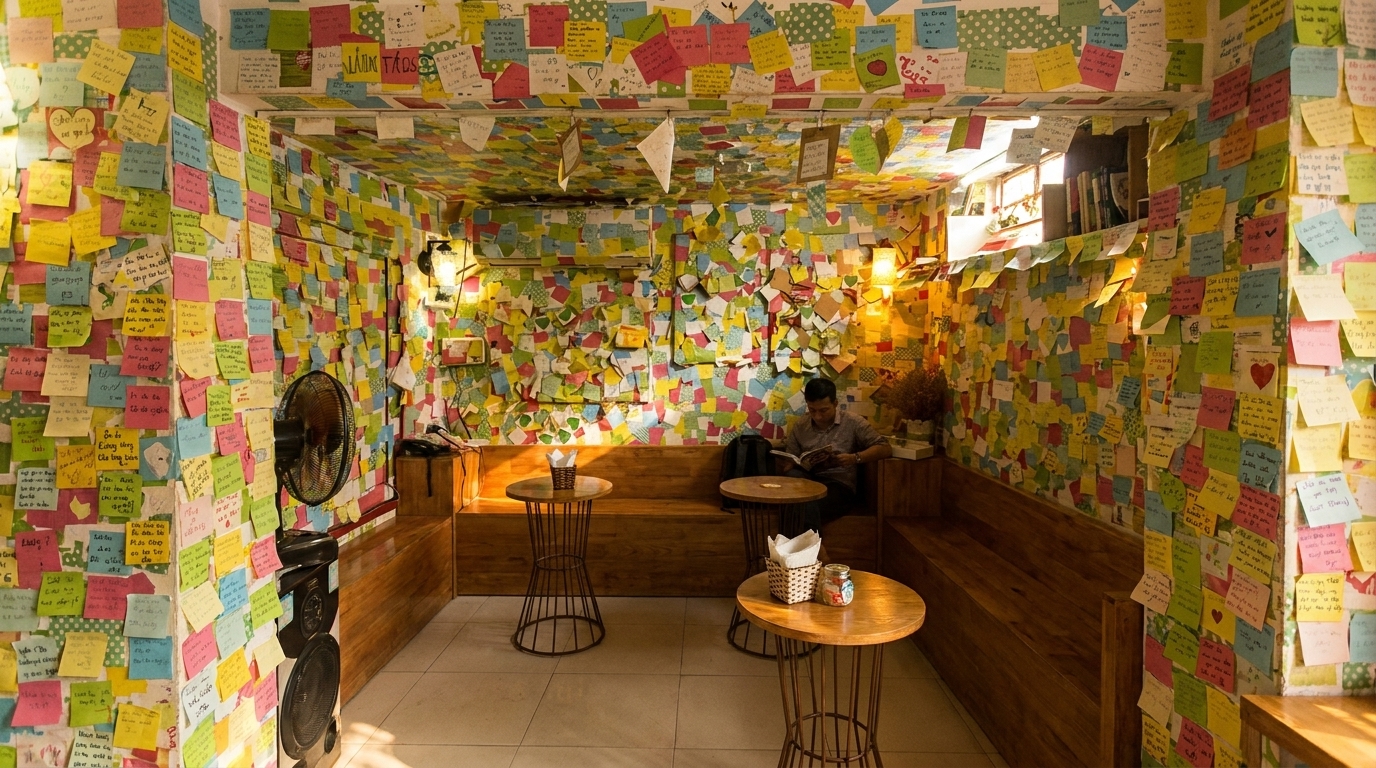
The aesthetic cafe circuit — some worth visiting once.
The Note Coffee at 64 Lương Văn Can is the famous one — covered floor-to-ceiling in sticky notes left by travelers, Polaroids pinned everywhere, coffee from 55,000 VND (~$2.20). It’s earnest in a way I didn’t expect. Best visited at 4pm when the west-side light hits the notes. Avoid weekend afternoons — the queue on the stairs defeats the point.
Loading T Cafe in the Old Quarter is darker: underground electronic beats, phin-style drip, plastic stools that sweat as much as you do, charred bean smell that soaks into your jacket. No Instagram vibe at all. For that reason, I actually like it.
RuNam in the French Quarter: 1930s aesthetic, arabica tasting flight at 80,000 VND (~$3.20), quiet courtyard away from the horn noise. I watched three salarymen read newspapers here at 7am once. Best cafe for a business conversation or extreme introversion recovery.
→Who It’s For
The Note Coffee: solo travelers who want to leave a mark somewhere, people who like earnest tourist things without irony. Skip it if you’re feeling crowded — the stairs get genuinely claustrophobic on weekends. Loading T Cafe: for people who want to feel like they found something. RuNam: for the quiet morning, the arabica drinker, the person who can’t handle more robusta.
The Scam Landscape (Know This Before You Sit Down)
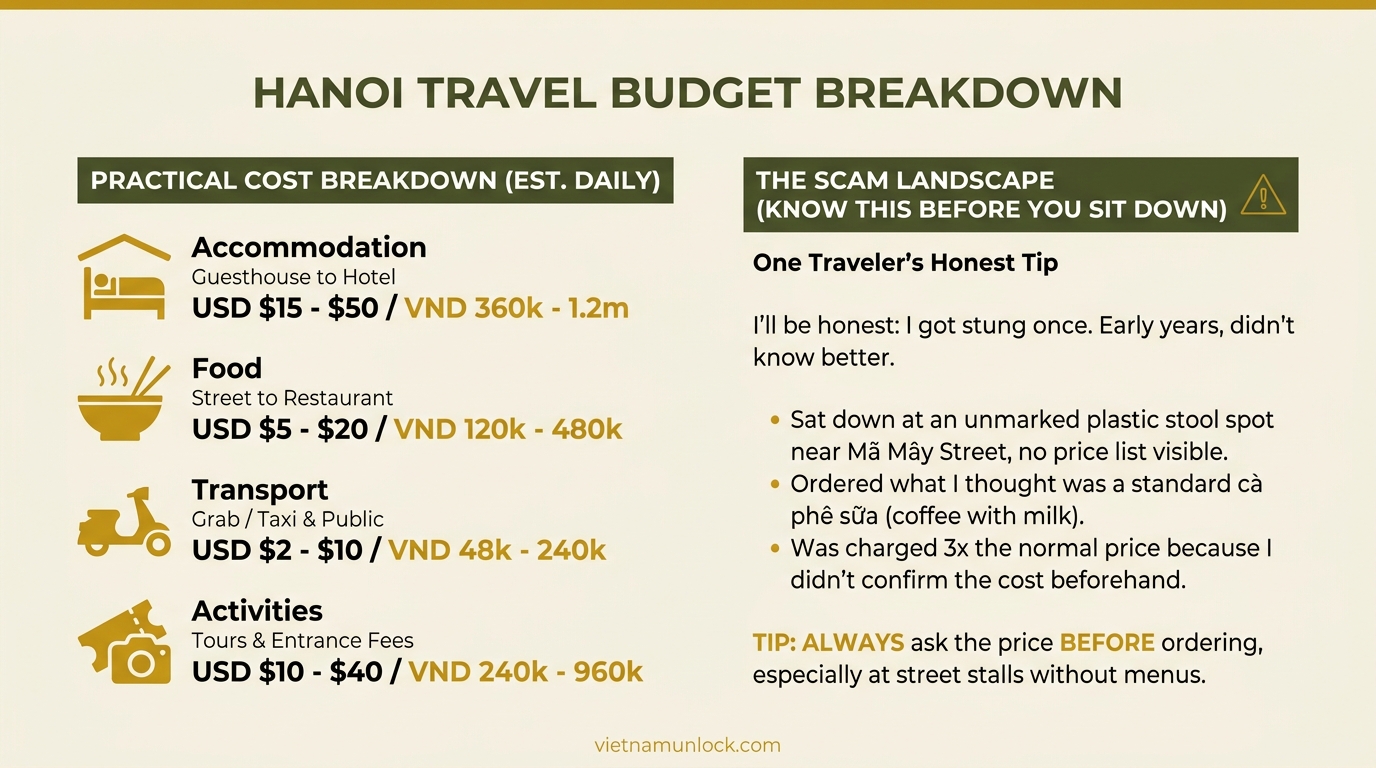
I’ll be honest: I got stung once. Early years, didn’t know better. Sat down at an unmarked plastic stool spot near Mã Mây Street, no price list visible, ordered what I thought was a standard cà phê sữa đá. The guy brought over something in a nice cup. Bill came: 120,000 VND (~$4.80). For a single iced coffee.
I’ll be honest: I got stung once.
I paid it. It wasn’t worth the argument. Lesson learned.
⚠Real Talk
Three patterns to watch for: (1) No price list anywhere visible — that’s a red flag at any stall in the Old Quarter. (2) “Special for you” upgrades mid-order — decline unless you’ve seen the new price. (3) Spots near Hàng Gai or Mã Mây running tourist menus with the same items at 3x the price. The fix: walk one block toward the less photographed part of any street and the prices normalize. More on this in the Hanoi scams guide.
West Lake: The Other Coffee Scene
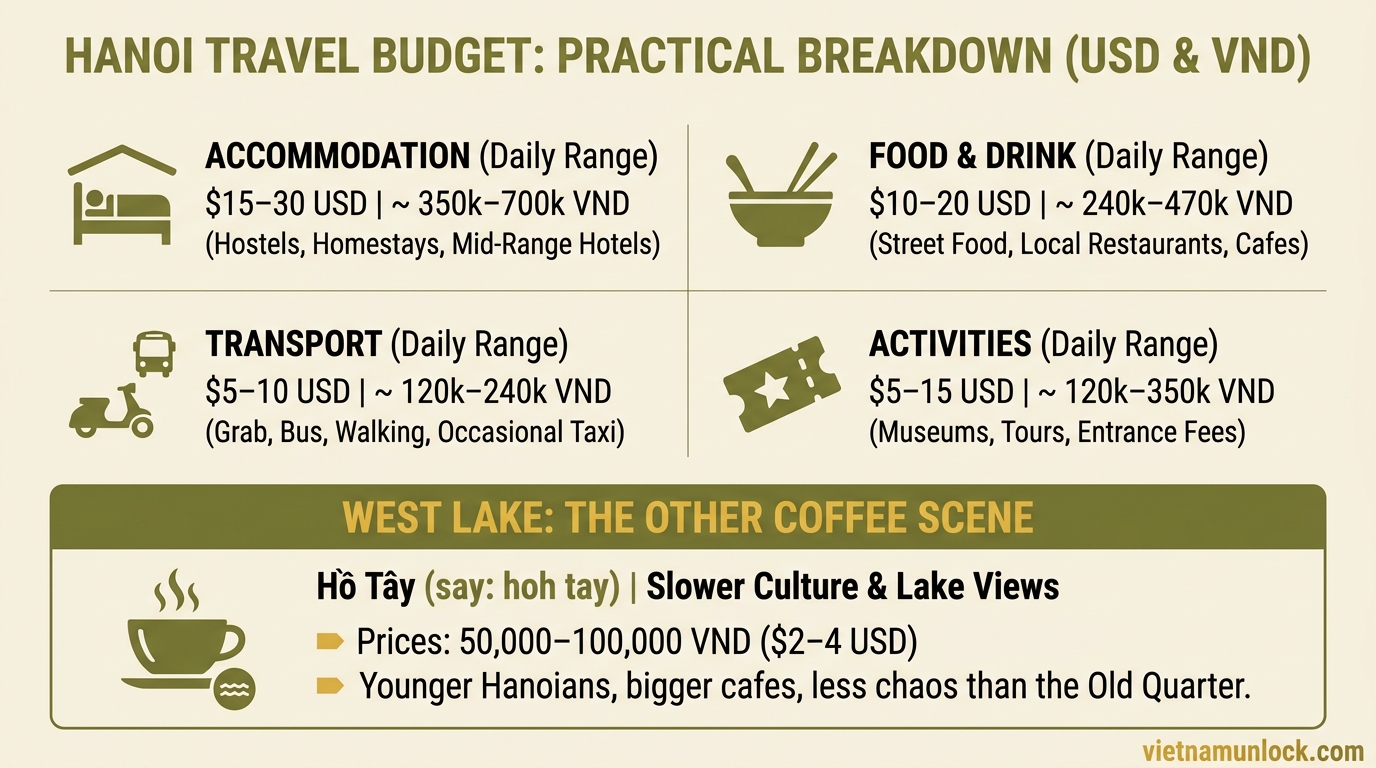
West Lake (Hồ Tây — say: hoh tay) has its own, slower coffee culture. Bigger cafes, lake views, younger Hanoians on dates, prices that run 50,000–100,000 VND (~$2–4). Less chaos than the Old Quarter.
West Lake has its own, slower coffee culture.
There’s an unmarked cart near the lotus ponds on the eastern bank — no GPS coordinates, no name, just a red pagoda nearby and a woman with a thermos and about six plastic stools. Hot cà phê đen is 15,000 VND (~$0.60). She’s been there most mornings for years. If you find it, don’t ruin it.
The mid-range cafes around Trúc Bạch Lake are cleaner and quieter alternatives to the Old Quarter chains. Better for working or reading. Worse for people-watching. Worth considering if you’re staying in the West Lake area of Hanoi.
Before ordering: look for a price list. If there isn’t one visible, ask: “Bao nhiêu tiền?” (say: bow nyew tyen) — “How much?” This one phrase kills most overcharge attempts instantly.
Book Tours & Activities — Hanoi
Klook has the widest selection for Vietnam and is usually the cheapest. KKday is strong on day trips and local experiences.
The best Hanoi coffee experience costs under $2. Go to Nguyen Huu Huan Street, find a plastic-stool spot with a price board, order cà phê sữa đá, and wait for the phin to drip. That’s it. Everything else — egg coffee at Giang, aesthetic cafes, coconut slushies at Cộng — is bonus content.
When to Go
Hanoi coffee culture is a morning thing. The city is loudest at 6–9am: vendors moving inventory, motos weaving, coffee being ordered at a pace that doesn’t allow for indecision. This is the best window to sit at a street stall.
The aesthetic cafes peak at 10am–2pm with the Instagram crowd. Avoid if that’s not your scene; optimal if it is and you want seats.
Late afternoon — 4–6pm — is the second shift. Locals coming off work, quieter street stalls, cooler air in shoulder season. The Note Coffee’s rooftop around 4pm is genuinely worth the price.
Winter (November–February) is the best season for hot coffee culture. Hanoi gets genuinely cold by Southeast Asian standards — 10–15°C in January — and sitting with a hot ca phe den in a narrow Old Quarter alley, watching people in puffer jackets, is the kind of thing that makes you understand why people never leave.
What Travelers Actually Say: The Consensus
The consistent thread across every Vietnam travel community: Giang Cafe is worth it, once, for the egg coffee history. The knockoffs are not. The warnings about fake “original Giang” spots appear in nearly every relevant Reddit thread — visitors are genuinely caught out by this monthly.
On the phin drip experience: “I spent 3 days trying to replicate Hanoi coffee at home and failed. It’s the robusta, the condensed milk ratio, and the fact that you’re sitting on a plastic stool while a city wakes up. You can’t replicate that at home.” That kind of observation comes up over and over. The coffee is part of the context.
On chain cafes vs street stalls: the experienced Vietnam travelers consistently say start at street stalls, then do the aesthetic cafe circuit as a secondary experience. Those who did it the other way — chains first — often feel they missed the actual thing. Cộng is fine; it’s just not the real Hanoi coffee experience.
For the full city picture alongside coffee, the Hanoi things to do guide maps the coffee circuit alongside the Old Quarter, Hoan Kiem Lake, and street food streets into a walkable morning.
Hanoi coffee culture isn’t a single destination. It’s a daily rhythm spread across hundreds of streets, stalls, and narrow staircases. The tourist version — egg coffee at Giang, coconut slushie at Cộng, sticky notes at The Note — is actually fine. Do all three if you want.
But the real version is slower and costs less. It’s a 20,000 VND glass of phin drip on a plastic stool while the city wakes up around you, the condensed milk swirling black and thick, steam curling off the surface before the ice goes in.
If you’re doing a broader Hanoi itinerary, the Hanoi Street Food Guide pairs naturally with the coffee circuit — most of the same streets, most of the same hours. And if you’re trying to plan the whole trip, the Hanoi Travel Guide has the rest of the city covered.
Two things worth sorting before you land: a Vietnam eSIM so you have data the moment you clear customs, and travel insurance — medical costs for uninsured foreigners in Vietnam are significant.
Airalo eSIMs activate instantly. Buy before departure — airport SIM queues in Vietnam can take 30+ minutes.
Frequently Asked Questions
What makes Hanoi coffee culture different from Saigon?
Hanoi coffee culture is slower, more contemplative — locals sit for hours over filtered drip (cà phê phin) or egg coffee. Cafes are often narrow multi-story buildings or hidden alley spaces. Saigon is faster, more commercial, more espresso-forward. Hanoi locals consider their coffee culture more traditional.
What is egg coffee and where can I try it in Hanoi?
Egg coffee (cà phê trứng) is Robusta coffee topped with whipped egg yolk and condensed milk — think warm tiramisu in a cup. The original was created at Giang Café (39 Nguyễn Hữu Huân, Hoàn Kiếm) in 1946. Expect to pay 35,000–55,000 VND (~$1.35–2.10). Go before 10am on weekdays to avoid queues.
Where do Hanoi locals actually drink coffee?
Away from the Old Quarter. Tây Hồ (West Lake) has the best local cafe strip — Xom Cafe, Tranquil Books & Coffee, and the smaller Cong Caphe branches. In the Old Quarter, locals prefer tiny street-side stools on Hàng Hành or Đinh Lễ streets. Avoid the large tourist cafes on Hoan Kiem Lake — overpriced and mediocre.
Is Vietnamese coffee strong? What should first-timers order?
Very strong. Vietnamese Robusta has roughly double the caffeine of Arabica. First-timers: order cà phê sữa đá (iced coffee with condensed milk) — the sweetness cuts the bitterness. If you take it black, order cà phê đen đá. A phin filter takes 5–7 minutes to brew — this is normal, not slow service.
Where to Have the Best Coffee Experience in Hanoi
Three distinct coffee experiences that cover what Hanoi’s coffee culture actually offers:
For ca phe trung (egg coffee): Cafe Giang at 39 Nguyen Huu Huan Street is the original — the drink was invented here in 1946 when milk was scarce and the owner substituted egg yolk whipped with sugar. The narrow shophouse cafe is cramped, the egg coffee arrives lukewarm rather than hot, and the experience is authentic in a way that the dozen imitators around the Old Quarter aren’t. Arrive before 10 AM to get a seat. Cost: 25,000–35,000 VND.
For ca phe da (iced black coffee) the way Hanoians actually drink it: Any street corner plastic stool cafe in the Old Quarter’s alley system. Order “ca phe den da” and get a glass of strong drip coffee over ice for 15,000–20,000 VND. No menu, no English, no atmosphere beyond the street itself. This is the working version of Hanoi coffee culture that the specialty cafes are derived from.
For the specialty third-wave experience: The cafes along Dang Thai Mai Street near West Lake and the boutique roasters in the Tay Ho district serve single-origin Vietnamese coffee with pour-overs and proper filter equipment. Prices run 45,000–80,000 VND. The quality is genuinely high — Vietnam produces excellent Arabica from Da Lat and Gia Lai provinces that most tourists never encounter because they stop at the Robusta-heavy street stalls.
Hanoi Coffee Culture FAQ
What is egg coffee in Hanoi and where is it from?
Ca phe trung (egg coffee) is a Hanoi-specific drink invented at Cafe Giang in 1946 — whipped egg yolk, sugar, and condensed milk poured over strong Vietnamese drip coffee. The texture is somewhere between a dessert and a drink: thick, sweet, and rich. It’s specific to Hanoi; you’ll find it in Saigon cafes that cater to tourists, but the drink originated here and is best at the source. Cafe Giang at 39 Nguyen Huu Huan Street is the original.
What’s the difference between Hanoi coffee and Saigon coffee?
Both are typically Vietnamese drip (phin filter) with Robusta beans, but Hanoi coffee is generally stronger and more bitter, often drunk black or with condensed milk rather than fresh milk. Saigon coffee culture is faster and more varied — more ice coffee variations, more cafe chains, more international influence. Hanoi’s coffee culture is slower: the plastic stool, the alley, the hour-long ca phe da that is also a social activity. The pace of drinking is as much the point as the drink itself.
Is Vietnamese coffee very strong?
Yes — Robusta beans have nearly double the caffeine of Arabica. A standard Vietnamese drip coffee is significantly stronger than a typical Western espresso in caffeine terms, though the taste is less acidic and more bitter. If you’re sensitive to caffeine, ask for “ca phe sua da” (iced coffee with condensed milk) — the milk dilutes the intensity while maintaining the flavor. Avoid drinking more than two cups before noon if you want to sleep that night.
“I moved here on a 3-month trial run. That was 5 years ago. I’ve since been to all 63 provinces, ridden every loop worth riding, and eaten things I still can’t name. This blog is what I wish existed when I landed.”