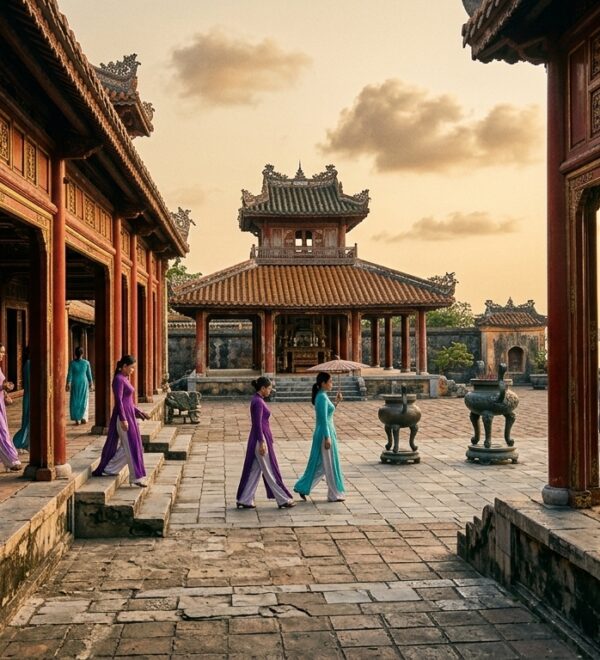
Hue gets less credit than it deserves. Most travelers pass through for a day and a half on the way between Da Nang and Hoi An, see the Imperial Citadel for two hours, eat bún bò Huế at a place with English photos on the menu, and leave thinking they understood it. They didn’t.
Hue is the city that most rewards slowing down. The food is the most distinctive in Vietnam — Hanoians and Saigonese both recognize it as genuinely different from their own. The citadel is massive and historically loaded, not just photogenic. The Perfume River at dusk has that rare quality of actually matching its reputation. And the royal tombs in the forested hills south of the city are more atmospheric than any tourist brochure suggests.
Two full days is the minimum to not feel like you’ve rushed it. Three days and you’re actually starting to understand what this city is. Here’s the guide.
Why Hue Is Different from the Rest of Vietnam
From 1802 to 1945, Hue was the imperial capital of unified Vietnam under the Nguyễn dynasty — the last ruling dynasty before French colonization and then the Republic took over. For 143 years, the Forbidden Purple City sat inside the Imperial Citadel, housing thirteen emperors and the elaborate court culture that surrounded them.
That history didn’t vanish when the capital moved. It seeped into everything: the food (hundreds of intricate small dishes developed for royal meals), the architecture (the royal tombs spread across forested hills south of the city), the Buddhism (more active temples per square kilometer than anywhere else in Vietnam), and the people themselves (Hue locals have a reputation for reserve and formality that’s partly real, partly a product of four centuries of court culture).
The 1968 Tet Offensive hit Hue harder than anywhere in Vietnam. The city was occupied for 26 days, the fighting was brutal, and significant parts of the Imperial City were destroyed. The reconstruction is ongoing. Walking through the Forbidden Purple City, you’re walking through both a restoration project and an active historical wound — the mix of grandeur and ruin is what distinguishes it from the Forbidden City in Beijing.
The Imperial Citadel: What’s Actually Inside
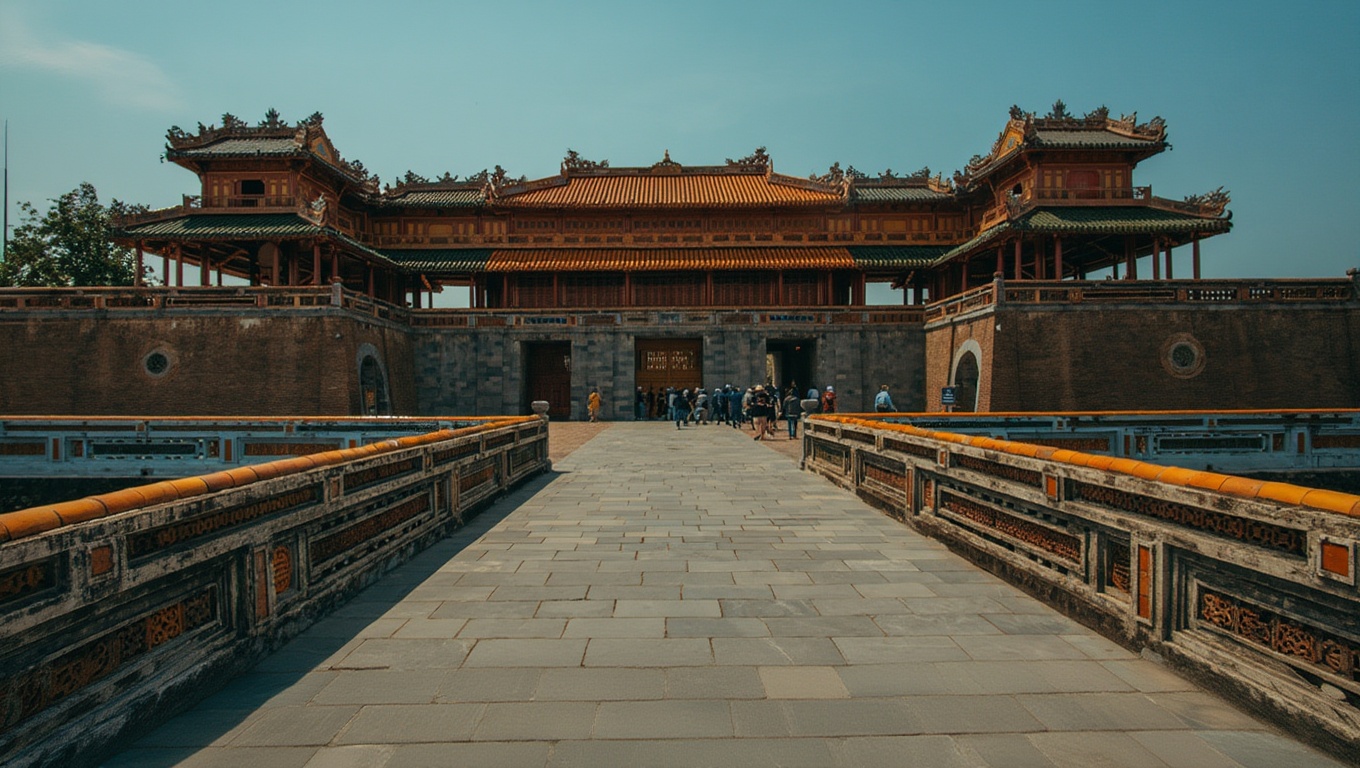
The Hue Citadel complex (Đại Nội) is the one non-negotiable. But “seeing it” takes more time than most visitors allow. The outer walls enclose 520 hectares — this is the full citadel including the moat and outer fortifications. Inside those walls sits the Imperial City, and inside that sits the Forbidden Purple City where the emperor actually lived. Three concentric layers of history.
Entry ticket: 200,000 VND ($8) for the Imperial City. This covers the Ngo Mon Gate, Thai Hoa Palace (the throne room where emperors received officials and foreign dignitaries), the Nine Dynastic Urns cast in 1836 — each representing one emperor — and the pavilions and palaces that have been restored enough to enter. About half of the Forbidden Purple City was destroyed in 1947 during the Franco-Vietnamese War and again in the 1968 Tet Offensive. You’ll see empty overgrown foundations alongside restored sections. Don’t read this as failure; it’s the honest record of what the 20th century did to this place.
How long to spend: minimum 3 hours. Two if you’re walking fast. The audio guide available at the entrance (80,000 VND extra) is actually worth it here — the context on the Nguyen dynasty and what each building functioned as transforms the experience from “old buildings” to “specific history.”
Practical: go at 7:30–8am when the gates open, before tour groups arrive. Come back late afternoon when groups have left and the light drops low across the yellow walls. Midday is the worst time — heat plus crowds makes it genuinely unpleasant from May through September.
The Royal Tombs: Which Ones to Visit
Seven Nguyen emperors built elaborate mausoleums scattered through the hills south of the city, 5–15 kilometers from the citadel. You won’t see all of them, and you shouldn’t try. Three are worth visiting. The rest are minor and too distant to justify the effort.
Tomb of Tu Duc (Lăng Tự Đức) — the most atmospheric: Tu Duc ruled 1847–1883 and spent decades building this complex as both his personal retreat and eventual tomb. Pine forest, lotus ponds, pavilions, his personal library pavilion overlooking a lake. He’s buried in a secret location within the grounds — servants who buried him were executed to keep the secret. This is the one that rewards wandering slowly rather than photographing and leaving. Tickets: 150,000 VND. Time: 1–1.5 hours.
Tomb of Khai Dinh (Lăng Khải Định) — the most visually distinctive: Built 1920–1931, mixing French colonial architecture with Vietnamese motifs, the interior chamber has floor-to-ceiling mosaic work made from ceramic and glass fragments. More theatrical than spiritual. The climb up 127 steps to reach it is part of the experience. Worth 45 minutes. Tickets: 150,000 VND.
Tomb of Minh Mang (Lăng Minh Mạng) — the most symmetrical: Minh Mang ruled 1820–1841 and was the most Confucian of the emperors. The complex runs on a strict axis through lakes, pavilions, gateways, and walled courtyards. Quieter than Tu Duc. Best in morning light when few people are there. Tickets: 150,000 VND. Time: 1–1.5 hours.
| Tomb | Distance from center | Ticket | Time needed | Best for |
|---|---|---|---|---|
| Tu Duc | 7 km south | 150,000 VND | 1–1.5 hrs | Atmosphere, pine forest, ponds |
| Khai Dinh | 10 km south | 150,000 VND | 45 min | Interior mosaics, dramatic steps |
| Minh Mang | 12 km south | 150,000 VND | 1–1.5 hrs | Formal Confucian layout, quiet |
Getting there: Grab motorbike (30,000–50,000 VND each way) is the simplest. Many guesthouses rent bicycles at 50,000–80,000 VND/day — this works for Tu Duc and Khai Dinh as a combined route with a stop at Thien Mu Pagoda on the return along the river. In the heat of July or August, cycling is only sensible before 9am. Xe ôm (motorcycle taxi) for a half-day tomb loop runs 150,000–200,000 VND and drivers who do this regularly know the roads and informal shortcuts.
Thien Mu Pagoda and the Perfume River
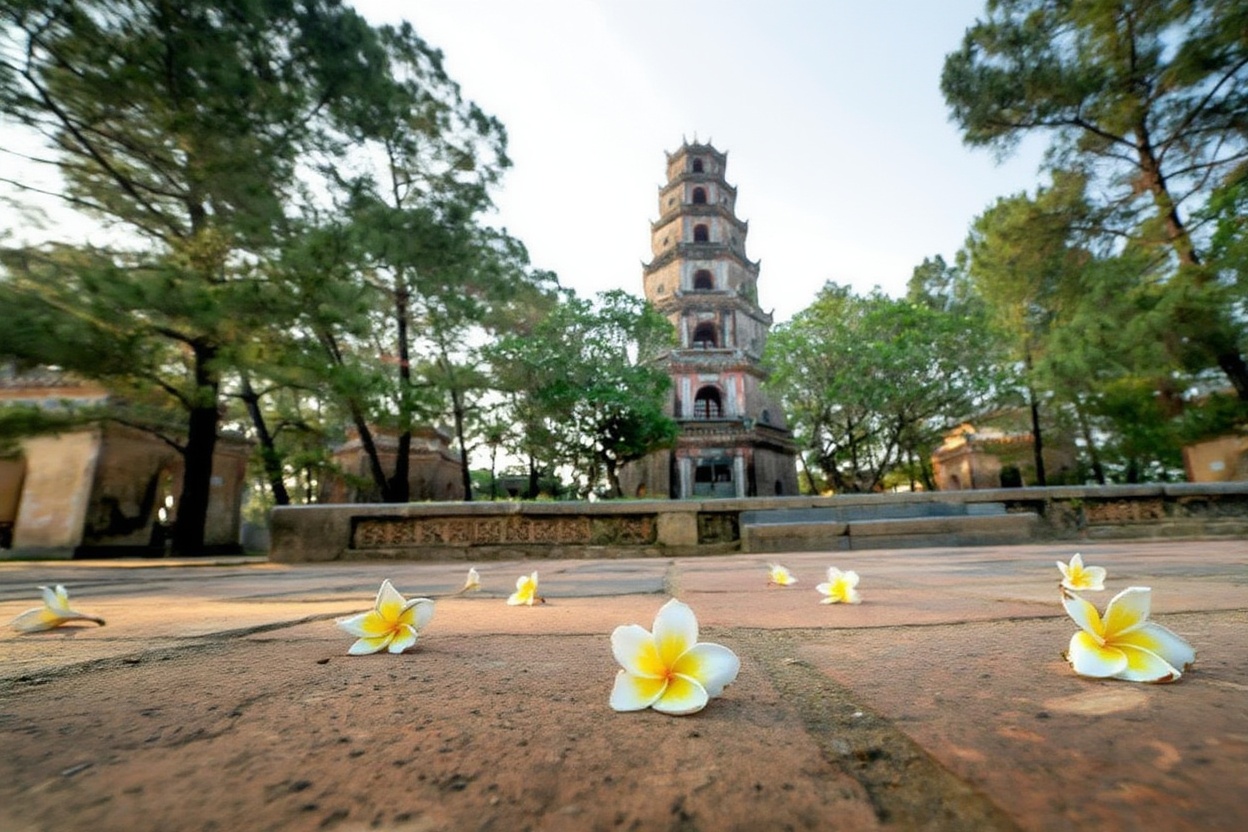
The Thiên Mụ Pagoda sits on a hill above a bend in the Sông Hương (Perfume River), 5km west of the city center. The octagonal Phước Duyên Tower — seven stories, built 1844 — is the most recognizable image of Hue. The complex is an active monastery; monks live and practice here. Free entry. Dress respectfully. Worth 45 minutes of your time.
In the pagoda’s garage there’s a 1963 Austin Westminster motorcycle. It’s the vehicle that carried Thích Quảng Đức to his self-immolation in Saigon — the protest against Diem’s suppression of Buddhism that produced one of the most famous photographs of the 20th century. That motorcycle is quietly sitting in this garage. Worth knowing before you arrive.
Dragon boat rides on the Perfume River leave from Toa Kham dock: 100,000–200,000 VND per hour, going upstream past Thien Mu to the tombs. Pleasant rather than essential. Walking the riverbank south of the Phú Xuân Bridge at golden hour gives a similar quality of experience.
Hue Food: The Most Underrated Cuisine in Vietnam
Hue was an imperial capital for 143 years, and court cuisine developed into something precise, elaborate, and very regional. Vietnamese food culture acknowledges three distinct traditions: Hanoi (subtle, clear broths, restrained), Hue (spicy, complex, intricate presentation), and Saigon (bold, southern-influenced). Hue’s food is the most shaped by specific geography — the Perfume River clams, the local shrimp paste called mắm ruốc, and the court kitchen’s obsession with presentation created a cuisine that genuinely doesn’t translate well when made outside the city.
Bún bò Huế — the flagship dish. Beef noodle soup with lemongrass, shrimp paste, and pork knuckle. The broth should hit with lemongrass first, then the funk of shrimp paste underneath. If it smells mostly of plain pork bones, the kitchen is simplifying for tourists. Eat it before 9am. Price: 35,000–55,000 VND at proper local spots. The tourist strip around Trần Hưng Đạo Street near the backpacker guesthouses serves a milder, more expensive version — worth avoiding.
Bánh khoái — a crispy rice flour pancake filled with shrimp, pork, and bean sprouts, served with a thick peanut-sesame sauce. Different from the southern bánh xèo — smaller, crunchier, and the sauce carries the dish. Eat at Lạc Thiện restaurant at 6 Đinh Tiên Hoàng Street: operated by a deaf family for decades, the owners communicate via whiteboard and the bánh khoái is the best in the city. A full set with all the condiments and rice paper for wrapping: 60,000–80,000 VND.
Cơm hến — cold or room-temperature rice topped with tiny Perfume River clams, pork crackling, peanuts, sesame, and 10–15 small condiment dishes arranged around it. The assembly is the point. Locals eat it as breakfast on Cồn Hến island (a sandbar in the river accessible by a short bridge). A bowl: 25,000–40,000 VND. First-timers often find it confusing because there’s no clear protocol for mixing — you add condiments until it tastes right to you.
Bánh bèo, bánh nậm, bánh lọc — three royal kitchen-origin rice flour steamed dishes, usually ordered as a set. Bánh bèo (water fern cake) is a small white steamed rice cake topped with dried shrimp and crispy pork fat. Bánh nậm is a flat rice cake wrapped in banana leaf. Bánh lọc is a translucent tapioca dumpling with a whole shrimp inside. A set of all three at a proper household restaurant in Vỹ Dạ neighborhood: 60,000–100,000 VND.
Where to eat like a local: Take a Grab away from the tourist strip. The Vỹ Dạ neighborhood on the east bank of the Perfume River has household restaurants serving bánh bèo and cơm hến without the tourist markup. Đặng Huy Trứ Street on the south bank has cơm hến specialists. For bún bò Huế: look for a place with plastic stools, no English on the sign, steam rising from a single large pot, and Hue women eating there at 7am. That’s the right place.
When to Visit Hue
Hue has the most volatile weather of any major city in Vietnam. It sits in central Vietnam where the Trường Sơn mountain range and monsoon systems combine to create intense seasonal swings.
February–April (best): Dry season at its most reliable. Temperatures 20–28°C. Past the winter drizzle but before summer heat. The Hue Festival runs in even-numbered years in late April — a major cultural event if your dates align.
May–August (hot): Temperatures climb to 35–38°C by July. Humidity is punishing. Not impossible to visit but the Imperial City at noon in August is an endurance test. Go early, go late, avoid 11am–3pm outdoors.
September–November (avoid): Typhoon and flood season. Hue floods badly in wet years — the Perfume River rises and low areas of the city go underwater. October and November are the worst months. This is not abstract weather inconvenience; it’s genuinely disruptive to travel.
December–January (quiet): Temperatures 15–20°C, persistent drizzle, grey skies. Off-season pricing. Some travelers find the misty, slightly melancholy quality appealing. Not ideal for outdoor sightseeing but the food scene is active year-round.
Getting to and Around Hue
From Da Nang (100km): Train is the best option — 70–100 minutes, the coastal route through the Hải Vân Pass is genuinely scenic. Tickets: 90,000–160,000 VND ($3.60–$6.40). Alternatively, hire a car with the Hải Vân Pass road stop included (the pass itself is the Top Gear road, worth experiencing on the way).
From Hanoi (690km): Overnight train (SE1/SE3) departs Hanoi around 7–9pm, arrives Hue early morning. Soft sleeper: 600,000–900,000 VND. The Reunification Express through central Vietnam at night with the coast appearing in morning light is a worthwhile experience. Flight: 75 minutes, from 700,000 VND on budget carriers.
Getting around within Hue: The citadel area is walkable from north-bank accommodation (20–30 minutes). The royal tombs require a vehicle. Xe ôm for a half-day tomb loop: 150,000–250,000 VND total. Grab is available. Bicycle rental from guesthouses: 50,000–80,000 VND/day — works for the flat city center and river routes, challenging for the tomb hills in summer heat. Motorbike rental: 120,000–200,000 VND/day.
Where to Stay in Hue
The north bank puts you closest to the Imperial City — walk to the east gate at 7:30am without needing a vehicle. The south bank is closer to restaurants, transport, and the tour operator cluster. The Phú Xuân Bridge takes 10 minutes to walk across; the practical difference is smaller than it sounds.
| Budget | Price range | What you get |
|---|---|---|
| Budget | 150,000–350,000 VND ($6–14) | Clean mini-hotel or guesthouse, private bath, fan or basic AC |
| Mid-range | 400,000–900,000 VND ($16–36) | AC, better bathroom, sometimes breakfast included, decent Wi-Fi |
| Mid-range+ | 900,000–2,500,000 VND ($36–100) | Boutique hotels, pool, full breakfast, river views possible |
The best mid-range strip is Lê Lợi Street along the Perfume River — walking distance to the citadel and night market, upper-floor rooms overlook the water. La Résidence Hue Hotel & Spa (a restored French colonial villa on the river) is genuinely one of the best heritage hotels in central Vietnam if you’re going to spend once: 3,000,000–5,000,000 VND/night.
Two Days in Hue — A Working Itinerary
Day 1: Citadel, pagoda, river
7am — Bún bò Huế breakfast at a local spot on the south bank (find the steam, find the plastic stools)
8am — Imperial Citadel: arrive at gate, buy tickets, spend 3–4 hours walking properly with the audio guide
Noon — Lunch near the citadel: bánh bèo and bánh lọc set at a household restaurant
2pm — Thien Mu Pagoda by Grab (25,000 VND) — 45 minutes
4–5pm — Walk or Grab back along the Perfume River at golden hour
Evening — Night market on Trần Hưng Đạo Street for bánh khoái and Hue snacks
Day 2: Royal tombs and food deep-dive
7am — Early breakfast (cơm hến or bún bò)
7:30am — Tu Duc Tomb by xe ôm or Grab, before tour groups arrive — 1 hour
9:30am — Continue to Khai Dinh Tomb (8km), 45 minutes
11am — Optional: Minh Mang, or return to city for lunch
Noon — Lunch on Đặng Huy Trứ Street — local cơm hến spot
Afternoon — Free: walk the south bank neighborhoods, visit Đông Ba Market
Evening — Dinner at Lạc Thiện (6 Đinh Tiên Hoàng): bánh khoái, the full Hue set
Practical Details for Hue
ATMs: Available throughout the city center. Vietcombank and Agribank branches have the most reliable machines for foreign cards. Typical fee: 50,000–66,000 VND per transaction. Stock up before heading to the tombs — there are no ATMs near the tomb sites.
SIM card: Buy at Phu Bai Airport (official carrier booths in arrivals) or at a mobile shop in the city center. Viettel or Mobifone with 30GB+ data: 100,000–200,000 VND for 30 days.
Dress code: Covered shoulders and below-knee clothing for the Imperial City and active temple sites. This is enforced — guards turn back inappropriate dress. If you arrive in shorts and a tank top, expect to hire a wrap (20,000–30,000 VND) at the entrance or head back to your guesthouse.
Day trip option: The Demilitarized Zone (DMZ) — Ben Hai River border, Vinh Moc Tunnels, Khe Sanh Combat Base — is 70km north of Hue and runs as a full-day organized tour for 300,000–500,000 VND per person including transport and guide. More compact and accessible than the Cu Chi Tunnels near Saigon. The Vinh Moc tunnel system, where a village lived underground during US bombing for years, is the highlight.
Frequently Asked Questions
How many days do I need in Hue?
Two full days is the floor — one day for the citadel, one for royal tombs. Three days adds a DMZ day trip (70km north), deeper food exploration, and the chance to slow down rather than rush between sites. Travelers who feel they “did Hue” in one day saw the entrance to the experience, not the experience. If you’re forced to choose between cutting Hue short and cutting Da Nang short, cut Da Nang.
Is Hue safe to visit?
Yes, Hue is one of the quieter and safer cities in Vietnam for travelers. The main concerns are standard Vietnam tourist issues: motorbike bag snatching (carry bags on the side away from traffic), xe ôm overcharging near tourist sites (agree on price before), and inflated restaurant prices near tourist guesthouses. Hue is noticeably lower-pressure than Hanoi or HCMC in terms of aggressive hawking.
Is the food in Hue very spicy?
By Vietnamese standards, yes. Bún bò Huế has real heat — fresh chilies and shrimp paste create a kick that pho doesn’t. The steamed rice dishes (bánh bèo, bánh lọc) are milder. You can ask “ít cay” (less spicy) anywhere and they’ll adjust. The tourist-strip restaurants have already pre-adjusted to a tamer version, which is one more reason to eat where locals eat.
Can I visit Hue as a day trip from Da Nang?
Technically yes, practically it’s a mistake. Train: 70 minutes each way. You arrive at 9am, need to leave by 4pm — that’s 5 effective hours. The Imperial City alone warrants 3–4 hours. Add lunch and one tomb: full day. You leave having seen approximately 40% of what makes Hue worthwhile. Staying one night minimum gives you the early morning citadel experience and the evening food scene — both significantly better than midday.
Do I need a guide for the Imperial Citadel?
The audio guide (80,000 VND at the entrance) is worth it — the context on the Nguyen dynasty and what each building was used for transforms empty pavilions into legible history. An in-person guide (hire through your guesthouse or reputable tour operator, 300,000–500,000 VND for 3 hours) adds more detail and can take you to sections that aren’t on the standard route. Independent is doable but you’ll understand less than you should.
What’s the best thing to eat in Hue?
Bún bò Huế at 7am at a place that has no English on the sign. If that’s too adventurous for day one, start with the bánh khoái set at Lạc Thiện (6 Đinh Tiên Hoàng Street, staff communicate via whiteboard, the peanut-sesame sauce is the point). Then work your way toward cơm hến for breakfast on day two. The worst Hue food experience is the tourist-strip restaurants — they’ve simplified the spice and complexity to make it palatable for the most cautious visitors.