Last updated: May 2026 — Imperial City entry prices, royal tomb opening hours, and bicycle rental rates verified.
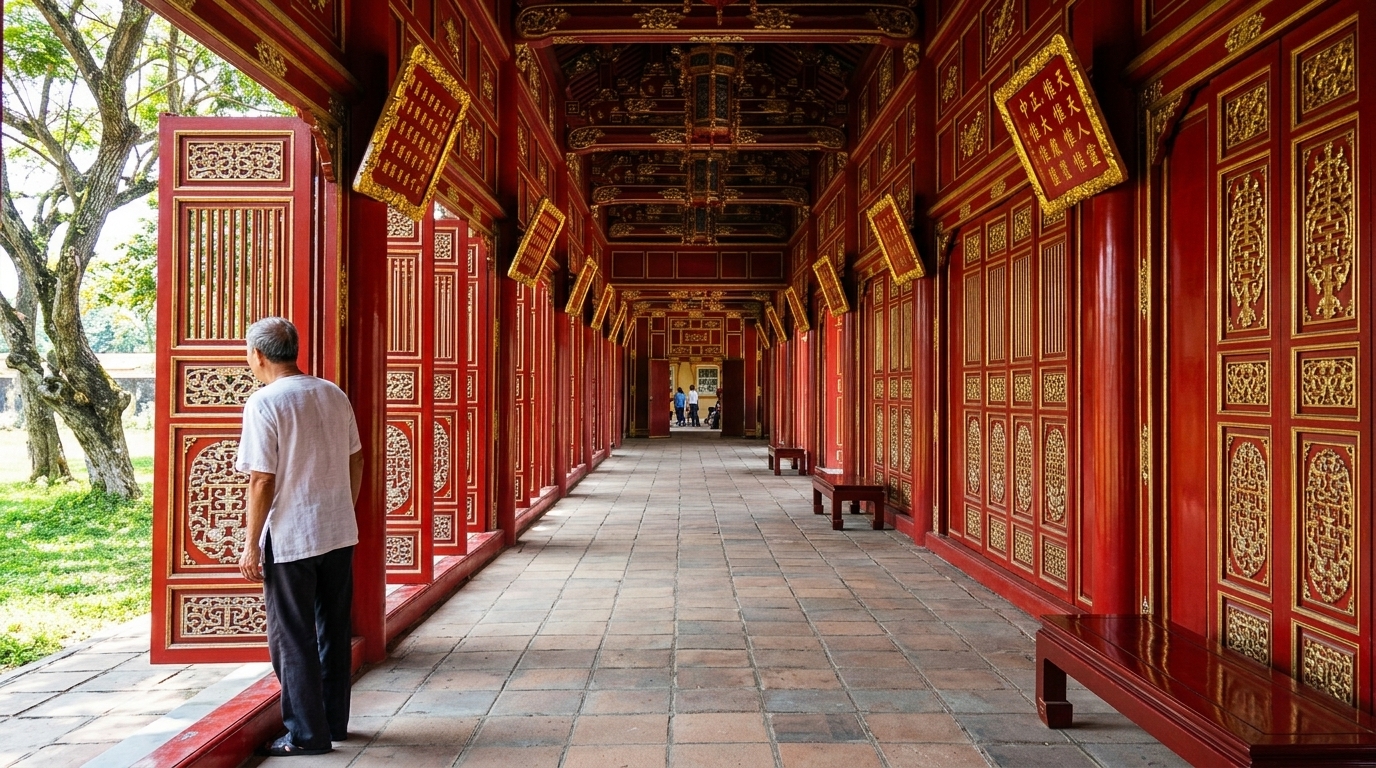
By noon I’d retreated to the only tree with real shade in the outer courtyard, sweating through my shirt, watching tour groups file past with matching hats and numbered flags. I missed the Imperial Theater entirely — turned back fifty meters from the entrance because the path was fully exposed and I genuinely couldn’t face it.
That’s the wrong way to do Hue. Here’s the right one.
Hue is Vietnam’s former imperial capital — the seat of the Nguyen dynasty from 1802 to 1945, sitting along the Perfume River (Sông Hương, say: song hwong) about halfway between Hanoi and Ho Chi Minh City. It’s compact enough to walk, dense enough to take three days, and consistently underserved by travelers who give it a single rushed afternoon between Da Nang and Hội An.
The things to do in Hue Vietnam are genuinely varied — not just the usual UNESCO circuit. Here’s what’s actually worth your time, what’s overrated, and how to do it without melting.
1. The Imperial City (Đại Nội) — Do This First, Do It Early
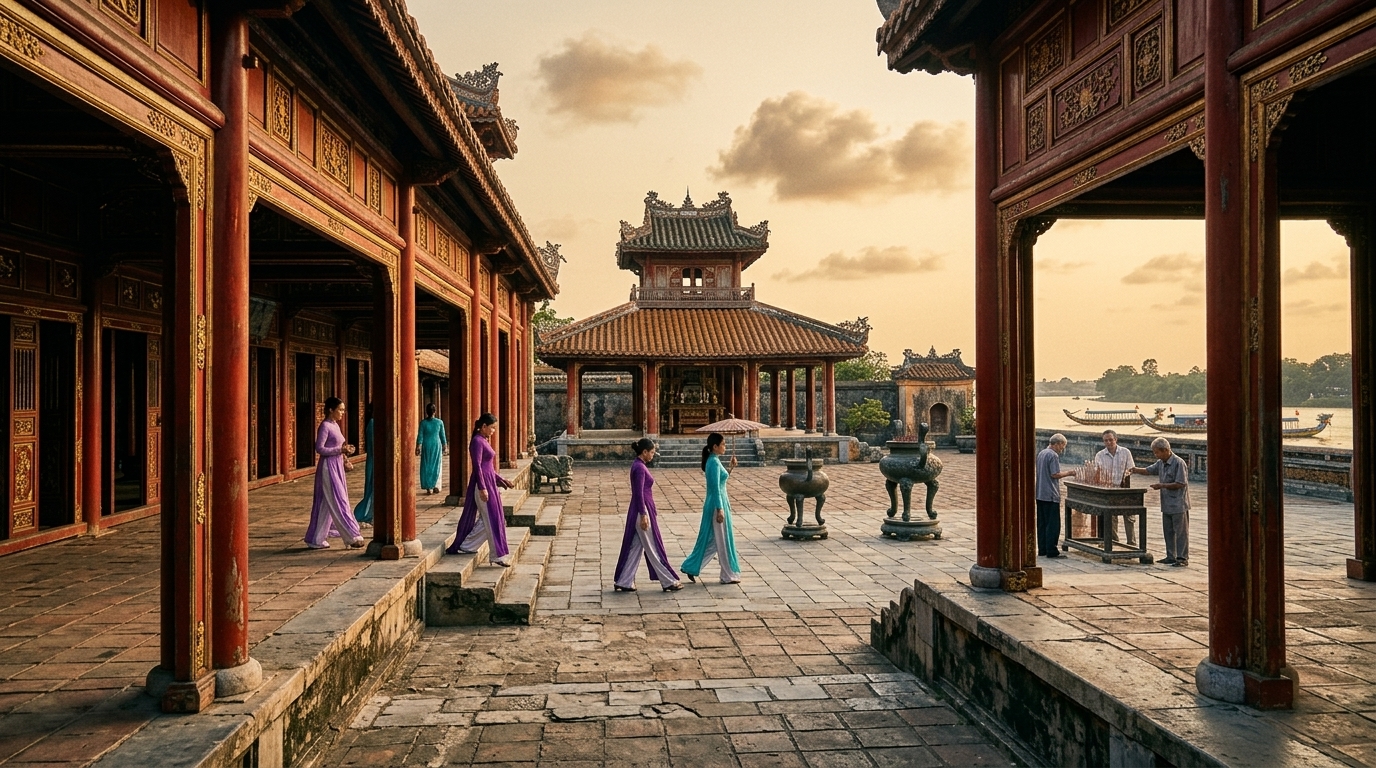
The Citadel and Imperial City at 16.4698° N, 107.5796° E is the non-negotiable anchor of any Hue visit. Entrance is 200,000 VND (~$7.60) and covers the outer citadel walls, the Ngo Mon Gate, the Palace of Supreme Harmony, the inner palace complex, and the Imperial Theater.
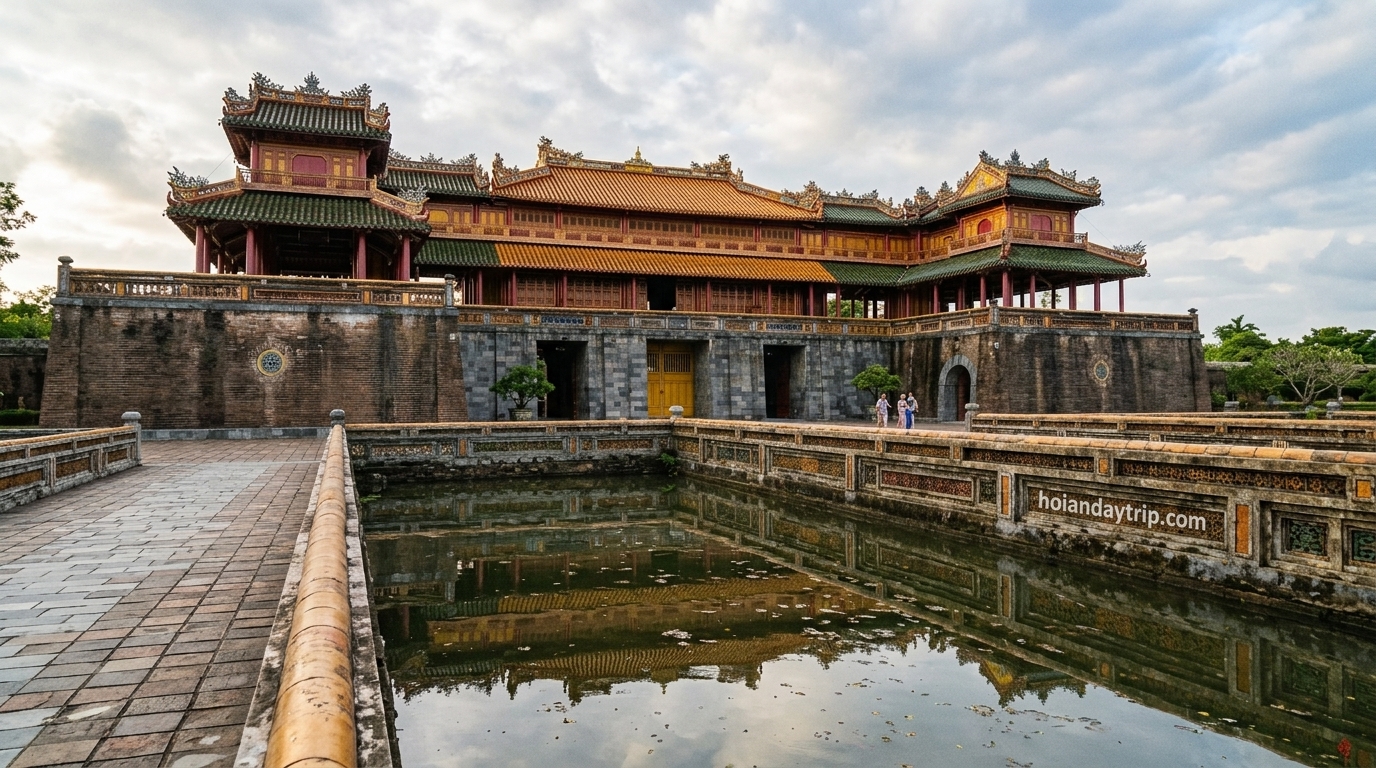
On paper, two to three hours. In practice — if you go at the right time — you’ll want four.
The right time is 7:30am when the gates open. The air is still cool enough to breathe. The tour buses haven’t arrived. The outer courtyards are empty except for groundskeepers and the occasional monk. The smell is old stone, morning dew, and something faintly floral — jasmine incense burning in the side shrines — that disappears completely once the heat takes over.
↗Insider Tip
The Imperial Theater (Duyệt Thị Đường) runs free traditional court music (Nhã nhạc) performances from 9–11am and 2:30–4:30pm daily. It’s genuinely good, not tourist-trap good. Plan your timing to catch the morning show before the crowds descend.
What to prioritize inside: the Ngo Mon Gate for photos (and the view down to the flag tower), the Palace of Supreme Harmony for the throne room, the nine dynastic urns behind the palace — each cast in bronze, each weighing over a tonne, each decorated differently. Then work counterclockwise to the Imperial Theater before the heat sets in.
What to skip: the museums tucked in the outer buildings move slowly and repeat themselves. Unless you’re specifically interested in Nguyen dynasty court objects, browse one and move on.
⚠Real Talk
Most of the inner imperial city — the Forbidden Purple City (Tử Cấm Thành) — was destroyed in 1947 during the French war and again in 1968’s Tet Offensive. What you see now is a combination of 19th-century original, ongoing restoration, and empty foundations with interpretive signs. Manage expectations accordingly: this isn’t Angkor Wat. It’s a ruin undergoing careful reconstruction. Still worth it — just know what you’re walking into.
2. The Royal Tombs — Pick One, Don’t Try All Five
There are seven royal tombs scattered across the pine-forested hills south of Hue city. Most are 6–10km from the center. Admission is 150,000 VND (~$5.70) each, and trying to do more than two in a day is a recipe for tomb fatigue — they blend together in your memory.
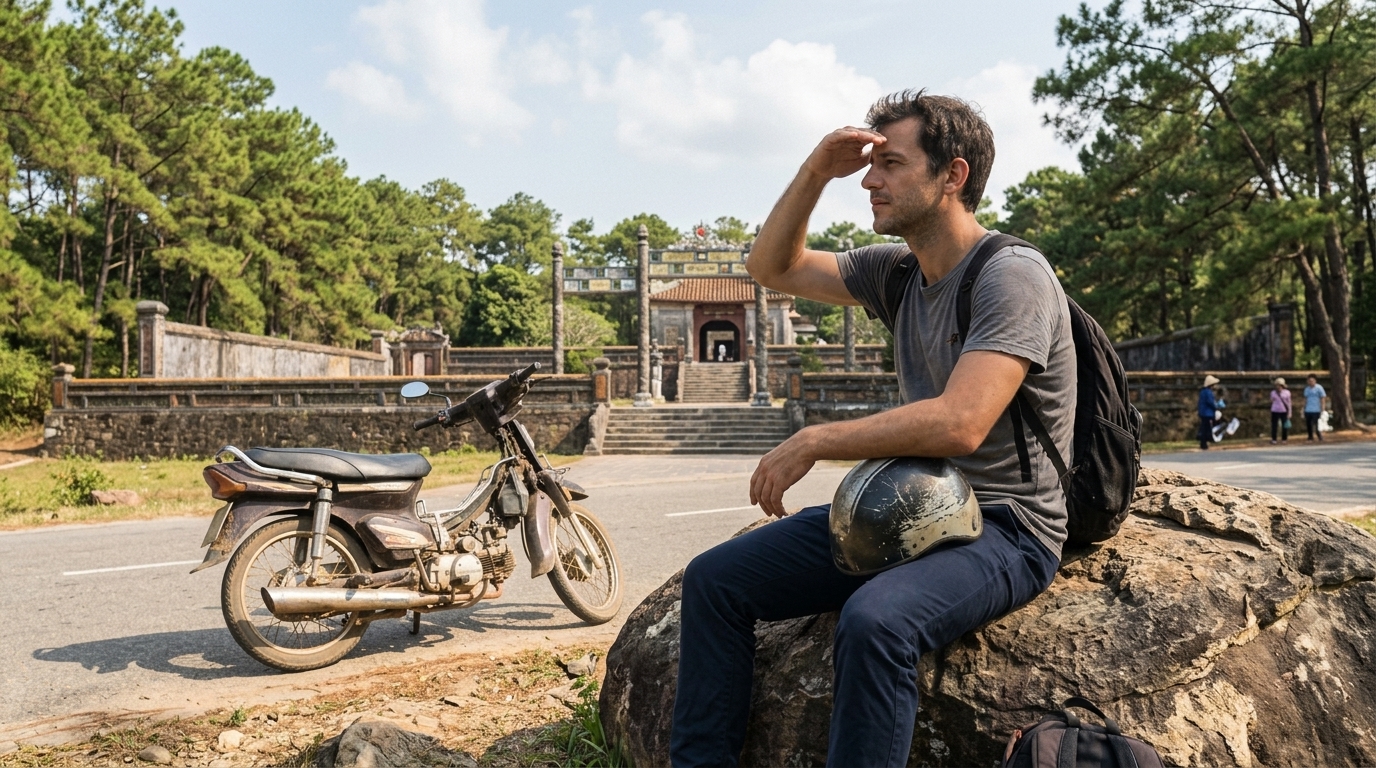
Here’s the breakdown of the three worth visiting:
Tu Duc Tomb at 16.4587° N, 107.5487° E is the one I keep going back to. The emperor lived here for fifteen years while alive — not just as a burial site — so it’s more like a palace retreat than a mausoleum. The grounds are wild in a way the other tombs aren’t: frangipani trees dropping blossoms onto a lotus lake, bamboo groves, an atmosphere of deliberate melancholy that doesn’t feel performed. The sound is birdsong and wind, not traffic.
Minh Mang Tomb at 16.4484° N, 107.5510° E is the most classically impressive — formal axes, stone mandarins, an actual moat. If you’re only going to one tomb and want the most “complete” traditional Vietnamese royal architecture experience, this is it.
Khai Dinh Tomb at 16.4376° N, 107.5877° E is a genuinely strange outlier — built 1920–1931 under French colonial influence, it’s a fusion of European Baroque and Vietnamese Imperial that either works beautifully or feels wrong depending on your mood. The interior is encrusted with porcelain and glass mosaic. Worth 45 minutes if you’re already making the tomb circuit; not worth a standalone trip unless you’re into architectural oddities.
→Who It’s For
Do all three tombs if you have two full days and a motorbike or hired driver. Do just Tu Duc if you’re short on time. Skip the tombs entirely if history and architecture genuinely bore you — no judgment, but there’s nothing here for a casual visitor who’d rather be on a beach.
3. Thien Mu Pagoda — Free, Beautiful, Usually Underestimated
Thien Mu Pagoda (Chùa Thiên Mụ, say: choo-a tyen moo) sits on a low hill above the Perfume River at 16.4537° N, 107.5436° E. Entry is free. The seven-story Phuoc Duyen Tower visible from the river is the most photographed landmark in Hue and also the city’s de facto symbol.
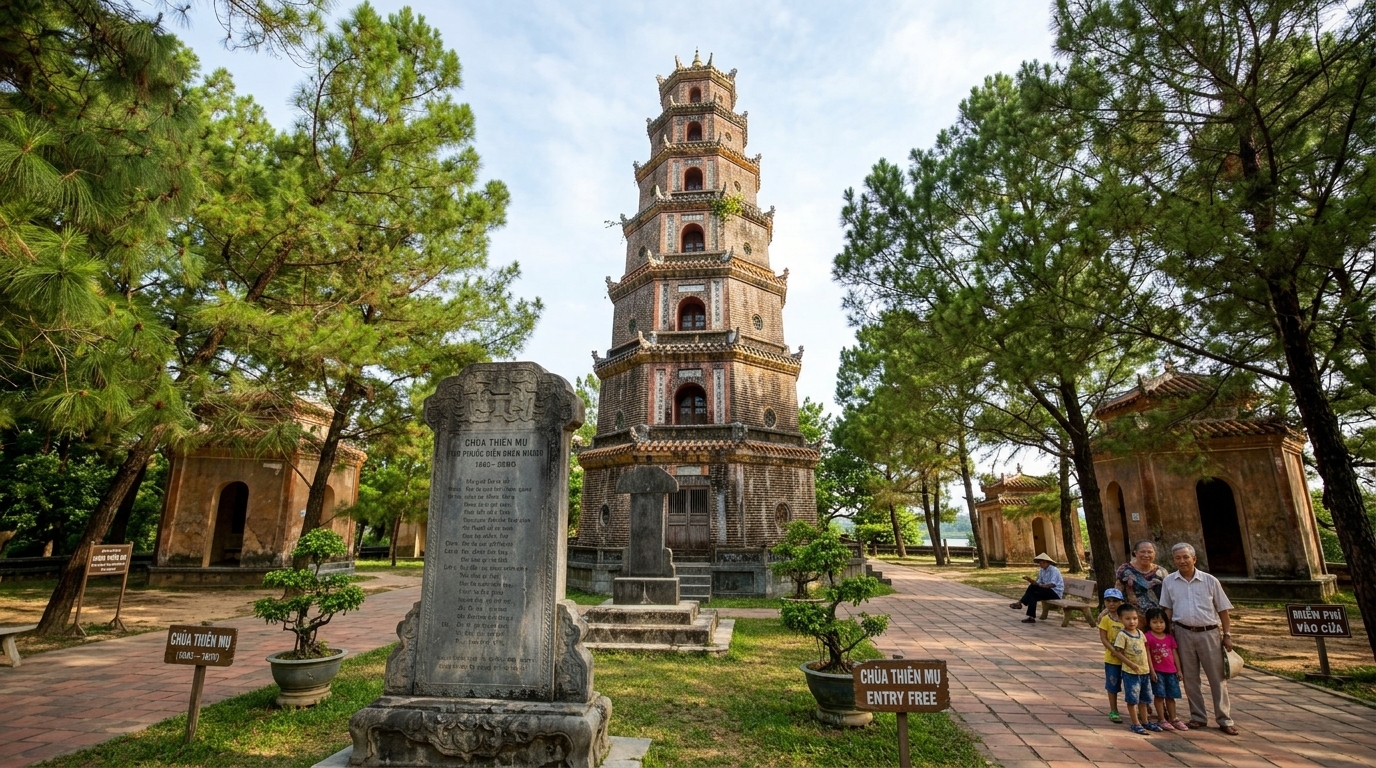
It’s also genuinely active — monks live and practice here. Visit before 9am and you’ll hear chanting from inside the main hall, low and rhythmic, mixing with the smell of sandalwood incense that hangs heavy in the still morning air. The garden behind the tower drops toward the river. Sit on the steps. It takes about thirty minutes if you rush; an hour if you don’t.
The Austin Morrison certified method for getting there: rent a bicycle from your guesthouse (25,000–40,000 VND/day, ~$1–1.50), ride along the south bank of the Perfume River toward the pagoda. The road is flat, shaded, and quiet by Hue standards. This takes twenty minutes and costs almost nothing.
⚠Real Talk
The dragon boat tours on the Perfume River that stop at Thien Mu charge 150,000–250,000 VND per person (~$5.70–9.50) and move at the pace of a guided tour. You’re on a fixed schedule, you can’t linger, and you end up at a temple market at the end that’s a fairly transparent sales stop. If you want the river view, hire a private sampan (negotiate, ~200,000–300,000 VND for 2 hours, ~$7.50–11.50) or just bike it.
4. Hue Street Food — Eat Your Way Through the City Before Anything Else
Hue has one of the most distinct and underrated regional cuisines in Vietnam. The Nguyen emperors demanded variety and refinement; the city responded with dozens of tiny dishes — snack-sized portions in elaborate presentations — that bear almost no resemblance to Saigon or Hanoi food.
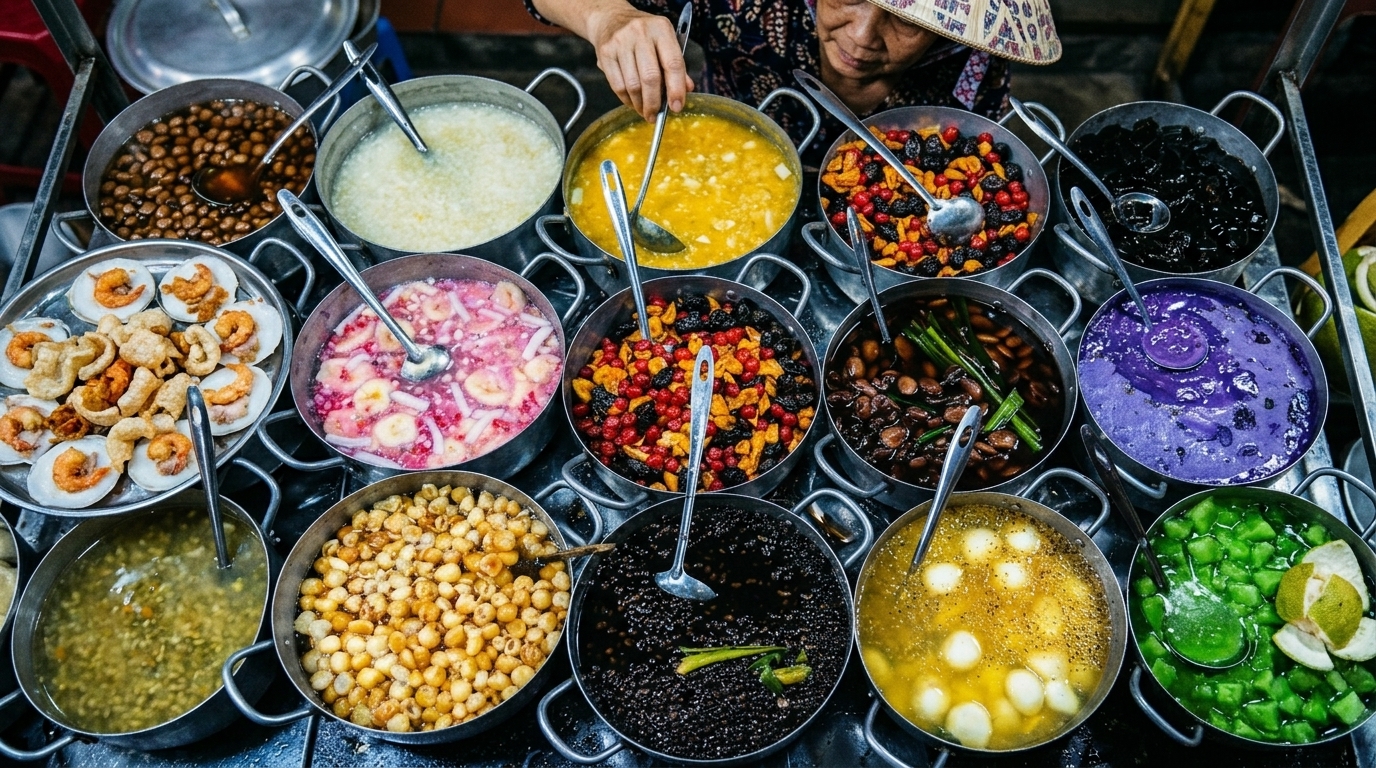
The essential dishes, in order of importance:
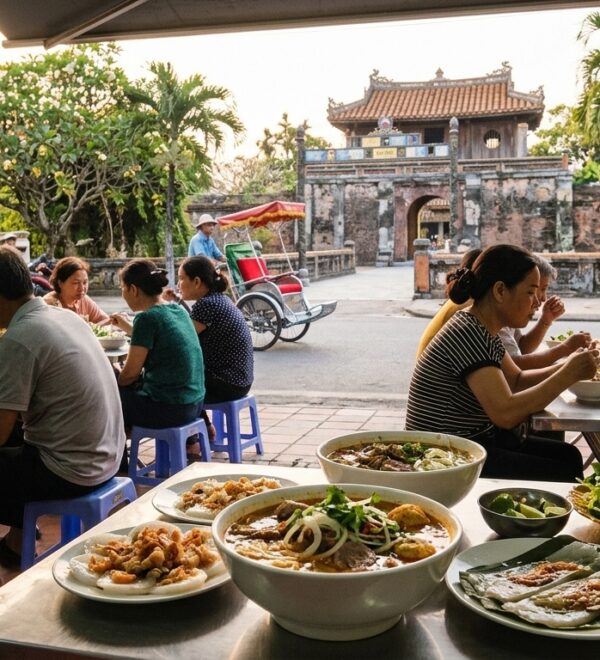
Bún bò Huế (say: boon baw hway) — the city’s signature noodle soup. Thicker than phở, spicier, with a lemongrass-forward pork and beef broth that builds slowly at the back of the throat. Often served with pork knuckle, congealed pork blood, and a plate of fresh herbs. Anywhere from 30,000–60,000 VND (~$1.15–2.30) for a full bowl. Eat this for breakfast. Preferably at a plastic stool, before 8am, while watching motorbikes dodge market traffic on the way to Dong Ba.
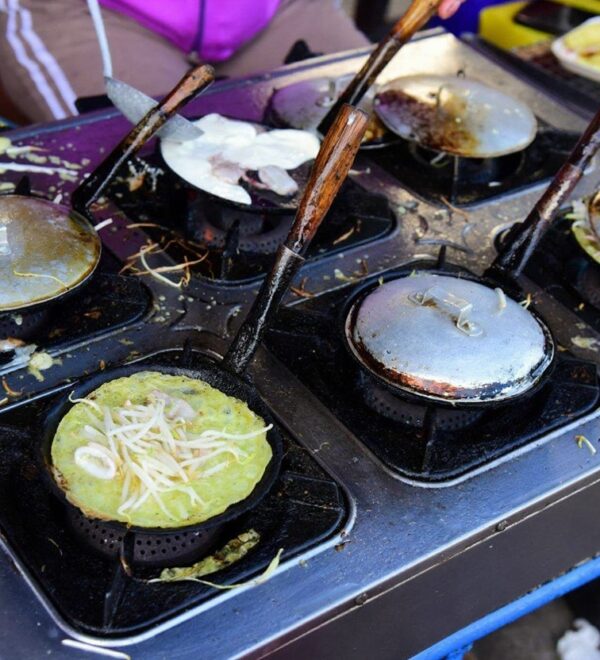
Bánh bèo (say: ban bay-oh) — small steamed rice cakes with dried shrimp and scallion oil, served in tiny ceramic dishes. You get six to eight at a time. They’re quiet and delicate and absolutely nothing like what you’d expect Vietnamese food to be. 25,000–40,000 VND (~$0.95–1.50) per serving.
Bánh lọc (say: ban lawk) — small tapioca dumplings with a filling of shrimp and pork, chewy and translucent, wrapped in banana leaf. Eaten with a chilli fish sauce. 20,000–35,000 VND (~$0.75–1.35).
Cơm hến (say: kum hen) — baby clams tossed with cold rice, herbs, peanuts, fried pork skin, and shrimp paste. The shrimp paste (mắm ruốc) smell hits hard — pungent, funky, unmistakably Hue. It’s one of those dishes that either unlocks something for you or doesn’t. 25,000–40,000 VND (~$0.95–1.50).
↗Insider Tip
For bún bò Huế: look for a spot with plastic stools and a line before 7am — the local institutions run 30,000 VND a bowl and open at dawn. Ask your guesthouse which one is closest; the best ones change but the format doesn’t. For bánh bèo and bánh lọc: the stretch of Phạm Hồng Thái street near Trường Tiền bridge has several family-run spots that serve all the Hue specialty snacks side by side. Go hungry, order one of everything.
One observation about Hue food culture: portion sizes are small by design. Imperial cuisine wasn’t about quantity — it was about variety. Budget for four or five separate small dishes across a morning market wander rather than one large sit-down meal. Your stomach and your wallet will both thank you.
5. Dong Ba Market and Walking the Old City
Dong Ba Market at 16.4669° N, 107.5889° E is the largest covered market in Hue and genuinely worth a wander — not for buying things, but for watching how the city actually functions. The ground floor is produce, fish, and meat. The upper floor is fabric, household goods, and dry goods. The smell is wet fish and chilli paste and dried shrimp, layered under a low ceiling that traps the heat in a specific, overwhelming way.
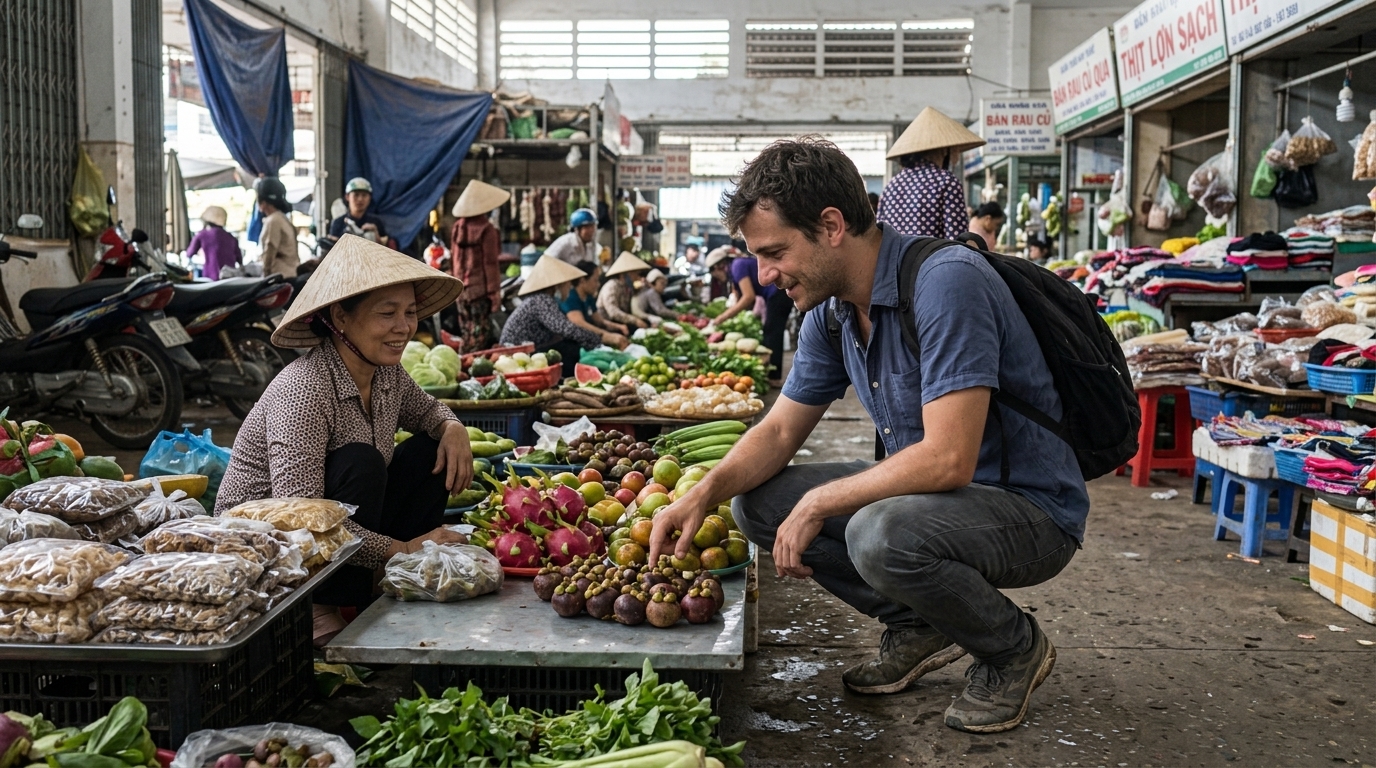
Go between 6–8am when it’s in full swing. Don’t be the person who takes photos of vendors without asking. Don’t attempt to haggle over food — the prices are already local prices, and you’ll just be a nuisance.
After the market: walk across the Trường Tiền Bridge to the south bank, where Hue’s French colonial architecture is better preserved. The stretch along Lê Lợi Street by the river has the atmosphere that photos of Hue always try to capture — wide boulevards, jacaranda trees, colonial buildings faded to soft yellows and greens. It’s quieter than the citadel side and almost entirely tourist-free on a weekday morning.
The walking street (Nguyễn Đình Chiểu) near the hotel strip is fine for an evening coffee but not the Hue experience worth seeking. It exists for tourists. The riverside does not.
6. Hue on Two Wheels — The Best Way to See It All
Hue is the right size for a bicycle — big enough that walking everything is tiring, small enough that biking anywhere takes under twenty minutes. Almost every guesthouse and hostel rents them for 25,000–50,000 VND/day (~$1–2).
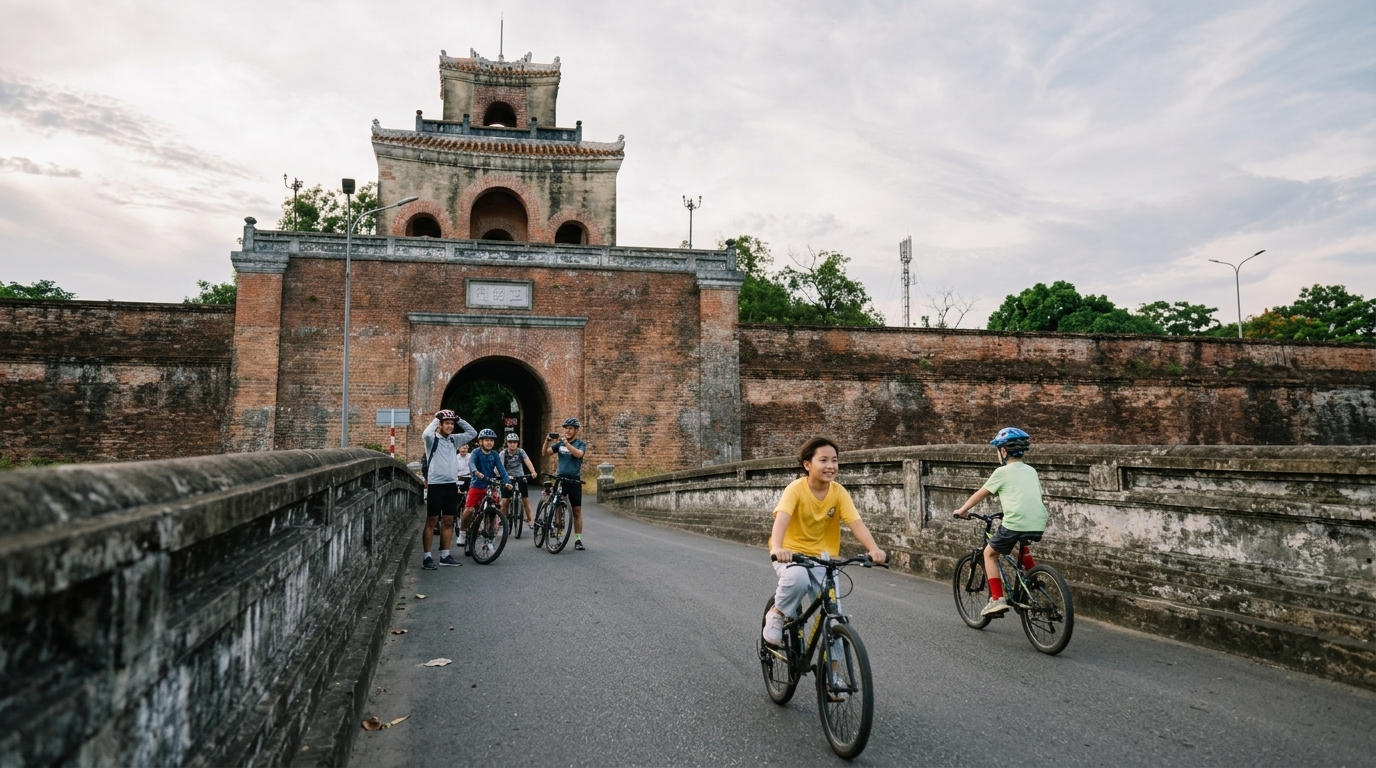
The standard bicycle loop most people do: Citadel in the morning → cross the river → Thien Mu along the south bank → Tu Duc Tomb (8km from center, manageable but hilly) → back to the city center for market food and evening. Total distance: 25–30km. Doable in a full day if you start at 7am.
If you want something motorized: a semi-automatic motorbike rents for 120,000–180,000 VND/day (~$4.55–6.80). The road to the tombs (Highway 49) is straightforward. Khai Dinh and Tu Duc are both well signposted from the main road. Minh Mang requires a left turn onto a smaller road about 12km south — follow the signs, or use Google Maps offline.
Hired xe ôm (motorbike taxi, say: say-ohm) drivers can also do a half-day tomb circuit for 200,000–300,000 VND (~$7.50–11.50) for the whole tour, negotiated upfront. This works well if you want someone who knows the roads and doesn’t mind waiting while you wander. Ask your guesthouse for a recommendation — the quality varies significantly.
7. Day Trips from Hue — One Option Worth It, One Overrated
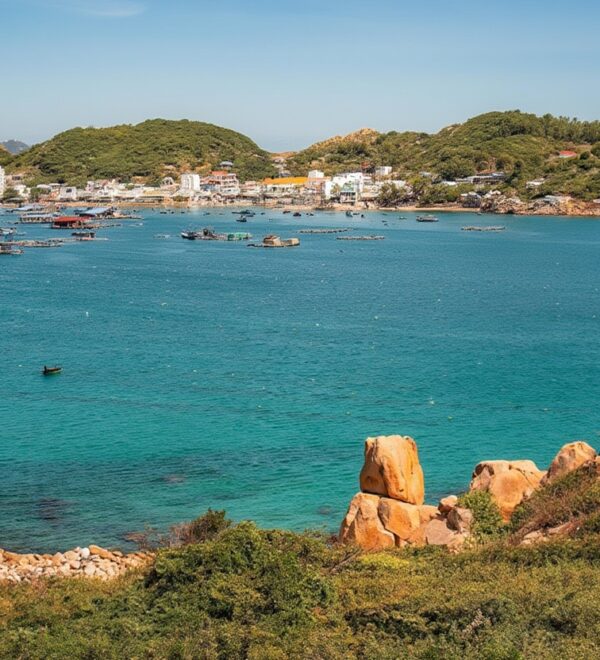
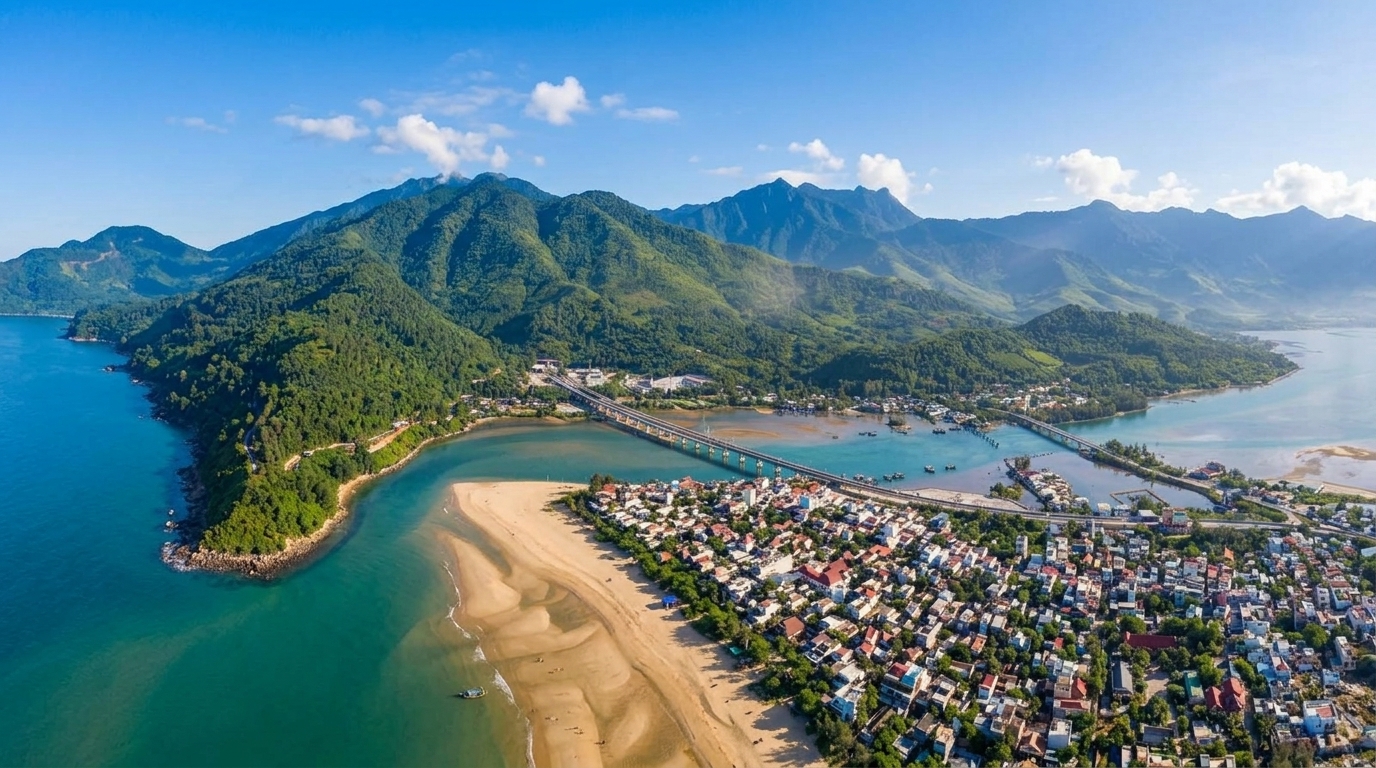
Lăng Cô Beach — 45km south, just before the Hải Vân Pass. A long curving bay with calm water, almost no development, and the kind of empty weekday vibe that makes you wonder why you’ve been stressing about crowded beaches anywhere. Getting there: hire a car or motorbike and drive over the Hải Vân Pass — the views are genuinely extraordinary. The pass road is one of the better drives in central Vietnam: you’re on a two-lane mountain road with the South China Sea dropping away on one side and jungle on the other. Takes 45 minutes each way. Do NOT take the tunnel — it bypasses the entire point of the drive.
Bach Ma National Park — 40km south, up a winding mountain road. A former French hill station at 1,450 meters, cooler by 10–15°C than Hue city, with waterfalls, forest trails, and almost no other visitors on weekdays. The catch: public transport doesn’t reach it, renting a motorbike and navigating 20km of steep switchbacks alone is genuinely tiring, and organized tours run about 700,000–900,000 VND/person (~$26–34). Worth it if you have a full day and want a break from monuments. Skip if you’re tomb-fatigued and just want to lie somewhere cool.
→Who It’s For
Lăng Cô: anyone who can handle a motorbike or hire a car. Bach Ma: hikers and nature people who find temples repetitive by day three.
8. Practical Hue Notes — When to Go, How Long, What to Know
When to visit: February–April and August–September are the sweet spots — warm, mostly dry, manageable crowds. October–December is Hue’s rainy season, and it’s not gentle: the city sits in a geographic bowl between mountains and coast that funnels rain in from both directions. November is historically the wettest month in central Vietnam. Flooding in the old city happens most years. Possible to visit, but check the forecast and have low expectations for the tombs in a downpour.
How long to stay: Two nights minimum. One day for the Imperial City and a morning market food tour. One day for two tombs, Thien Mu, and the river road. A third day if you want a day trip or want to move slowly. One day — which is what most Da Nang → Hoi An itineraries allow — means you’ll see approximately 40% of what Hue is actually about.
Climate: Hue is noticeably more humid than Hanoi and noticeably hotter than Da Nang in summer. May through August regularly hits 38–40°C with high humidity. This matters: the tombs and the Imperial City are largely exposed. A 7:30am start isn’t a suggestion — it’s how you stay functional. Carry more water than you think you need.
Getting there: Hue has a domestic airport (Phú Bài, about 14km from the city center). Flights from Hanoi or Saigon take 75–90 minutes and run from around 700,000 VND (~$26) one-way on Vietnam Airlines or Vietjet if booked ahead. The sleeper train from Hanoi is 12–14 hours and costs 517,000–1,625,000 VND (~$20–62) depending on class — the overnight soft sleeper is one of the better train experiences in Vietnam, especially the stretch through mountain tunnels before Hue. Book on the Vietnam Railways site or via 12Go Asia.
Getting around: Grab works in Hue city. Xe ôm for short trips. Bicycle or motorbike rental for anything involving the tombs.
If you’re building a central Vietnam loop and wondering how much time to allocate between Da Nang and Hoi An, our complete Hue travel guide goes deeper on logistics, accommodation, and the full city structure.
What Travelers Actually Say: The Consensus
The recurring frustration in Hue reviews: not enough time. Travelers who allocated one day consistently wish they’d stayed two. The Imperial City alone takes 3–4 hours done properly — add a tomb, the Perfume River road, and dinner at a local bún bò spot, and one day becomes a sprint with no breathing room. The most satisfied travelers gave Hue two nights and didn’t rush between sights.
The Imperial City gets mixed reviews that split almost entirely along timing lines. People who arrived at 7:30am describe it as one of the great historical sites in Southeast Asia. People who arrived at 11am in July describe overwhelming heat, packed tourist groups, and a sense that the scale was impressive but the experience was exhausting. Same complex, different verdict based entirely on when you showed up.
⚠Real Talk
Hue has a genuinely bad reputation among budget travelers who passed through on an overnight bus from Da Nang. A few hours in the heat, one bowl of bún bò at a tourist cafe, and back on the bus. That’s not a Hue experience — that’s a layover. Two nights minimum, early starts, local street food in the morning. Everything else is just a transit stop with a history lesson.
Two things worth sorting before you land: a Vietnam eSIM so you have data the moment you clear customs, and travel insurance — medical costs for uninsured foreigners in Vietnam are significant.
Airalo eSIMs activate instantly. Buy before departure — airport SIM queues in Vietnam can take 30+ minutes.
Getting to Hue
Hue sits on the main rail and road corridor between Hanoi and Ho Chi Minh City — getting here is straightforward from either direction.
From Da Nang: 100km north, 2.5–3 hours by bus (80,000–120,000 VND / ~$3.05–4.57), or 2 hours by express train (130,000–300,000 VND / ~$4.95–11.40). The train hugs the coast past Hai Van Pass — worth taking in daylight at least once.
From Hoi An: Bus connections via Da Nang, 3–4 hours total, 150,000–200,000 VND (~$5.70–7.60). Direct open-tour buses from Hoi An to Hue available at any guesthouse booking desk.
From Hanoi: Overnight train 13–16 hours (300,000–700,000 VND / ~$11.40–26.60 for hard to soft sleeper). Fly to Phu Bai Airport (HUI) in 1.5 hours from $25–60 on VietJet or Vietnam Airlines. Airport is 15km south — Grab runs 80,000–150,000 VND.
Where to Stay in Hue
Best base: south bank of the Perfume River, around Pham Ngu Lao and Hung Vuong streets — walkable to the Citadel, surrounded by guesthouses and restaurants at every price point.
Budget (200,000–400,000 VND/night, ~$7.60–15.20): Doi Cung Street area popular with backpackers — central location, clean AC rooms.
Mid-range (600,000–1,500,000 VND/night, ~$22.80–57): Riverfront hotels on Le Loi Boulevard with Perfume River views. La Residence Hue — a converted French governor’s villa — is the standout at this tier.
Village stay: Thuy Bieu village homestays (5km south) run 400,000–800,000 VND/night (~$15.20–30.40) with breakfast in traditional garden houses.
FAQ — Things to Do in Hue Vietnam
Is the Hue Imperial City worth visiting?
Yes, but go early. The complex is at its best before 9am — cooler, quieter, and with better light for photos. The 200,000 VND (~$7.60) entry covers the full complex including the Imperial Theater, which alone justifies the price if you catch a Nhã nhạc performance. Most people who say the Imperial City was “disappointing” went at noon in a tour group.
Klook has the widest selection for Vietnam and is usually the cheapest. KKday is strong on day trips and local experiences.
tomb is best in Hue?
Tu Duc for atmosphere, Minh Mang for architecture, Khai Dinh for something genuinely different. If you only have time for one: Tu Duc. It’s the most human — built by an emperor who actually lived there, with gardens and lotus ponds and a feeling of lived-in peace that the formal tombs don’t have.
What’s the best Hue food to try?
Bún bò Huế (spicy beef noodle soup) for breakfast, bánh bèo (steamed rice cakes) for a mid-morning snack, and cơm hến (baby clams with rice) for lunch if you’re feeling adventurous. Hue food is built around small dishes meant to be eaten in variety — order multiple small plates rather than one large meal.
Is Hue safe for solo travelers?
Yes. Hue is one of the more relaxed cities in central Vietnam — smaller than Da Nang, less tourist-saturated than Hoi An. The standard Vietnam safety precautions apply (watch your phone on motorbikes, don’t leave bags visible in vehicles), but Hue doesn’t have a notable scam scene compared to Hanoi or Saigon. The xe ôm drivers at the tombs quote tourist prices — agree on the price before getting on.
Can you do Hue as a day trip from Da Nang?
Technically yes — it’s 100km north on the train or road. Practically, a day trip gives you time for the Imperial City and one tomb at most, with a rushed food stop. If you’re going to make the trip, spend the night. The difference between a day trip and two nights is the difference between checking a box and actually knowing what Hue is.