
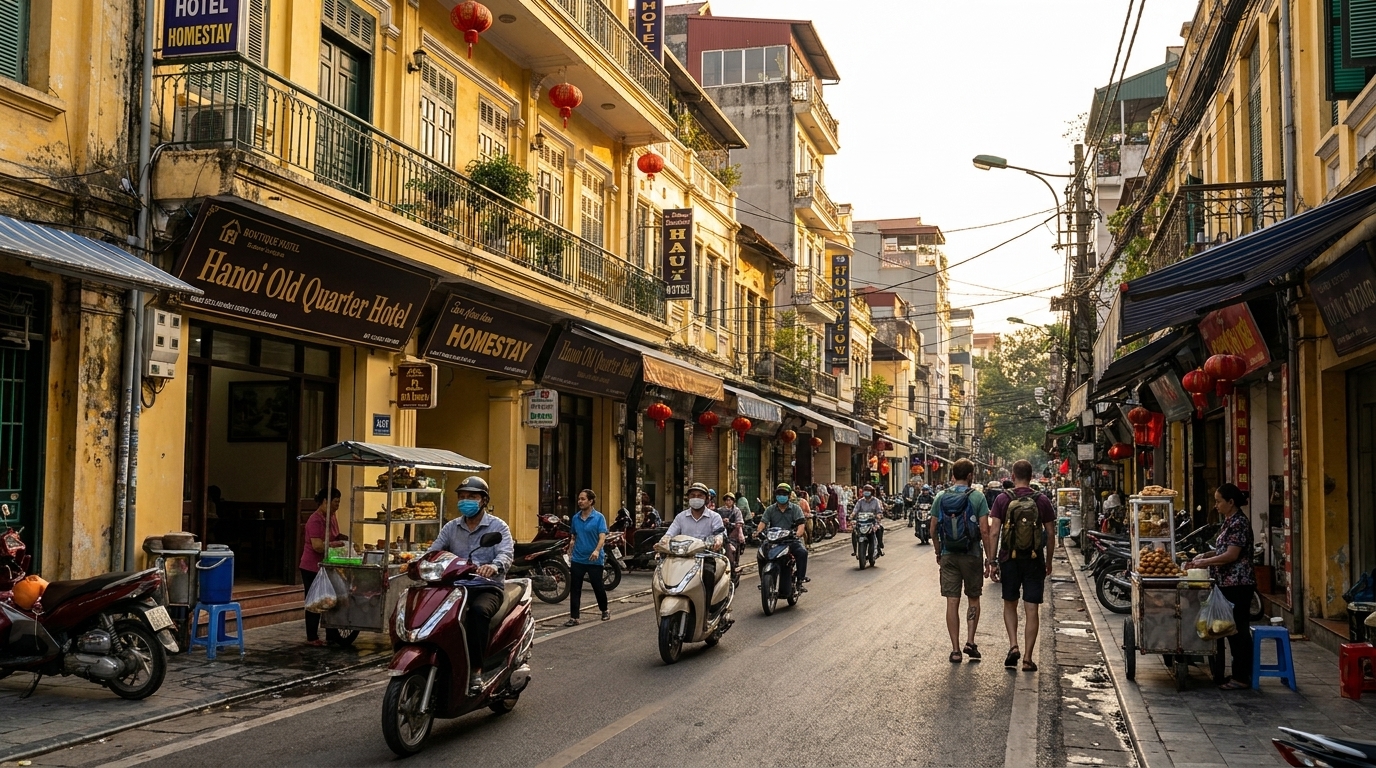
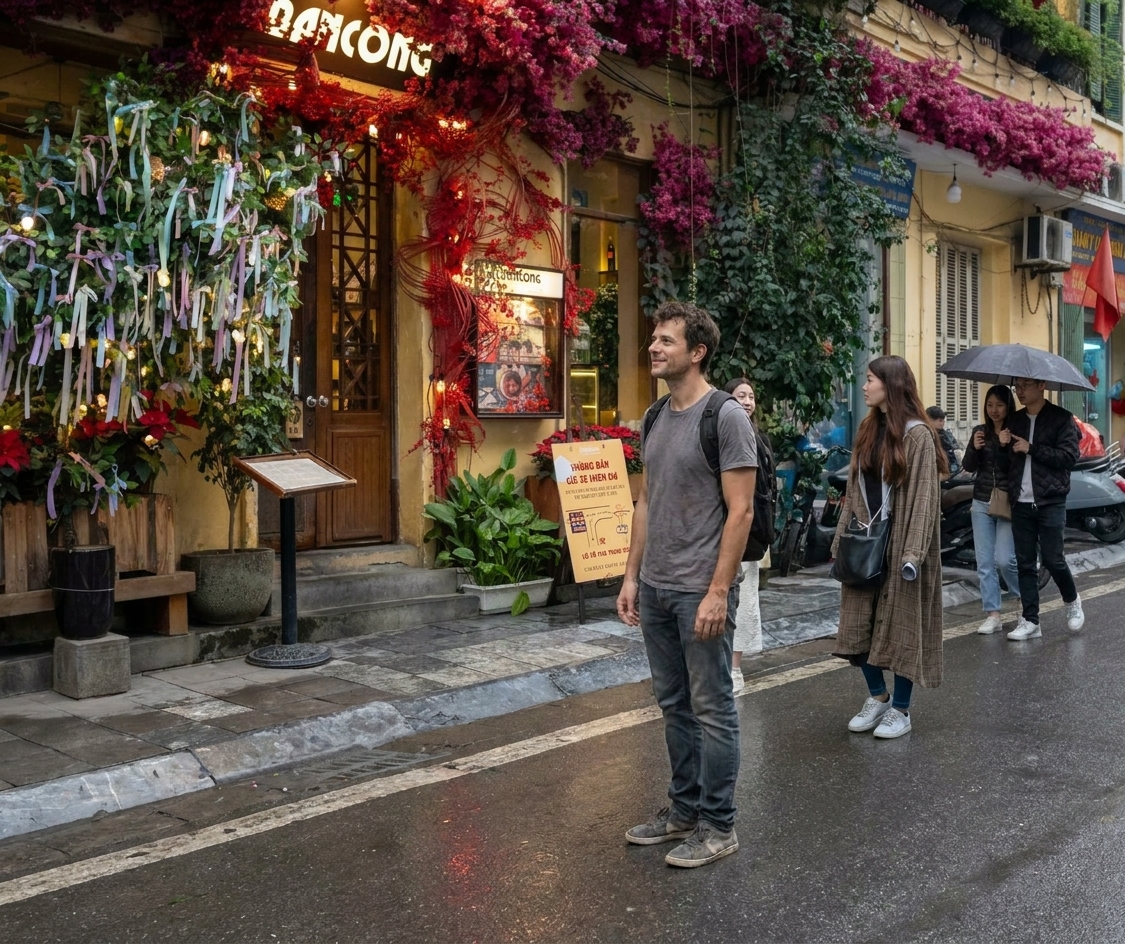
I went through this shift myself. When I first arrived in Hanoi in 2021, I booked straight into the Old Quarter, which was obviously right. Two years later I moved near Trúc Bạch Lake. Now I’m entrenched in the Tây Hồ (West Lake) expat belt and I can no longer pretend I’m objective about this.
So here’s what I’ll tell you instead: it depends on who you are and how long you’re staying. This is what each area actually feels like to live in.
✓Quick Answer
First-time visitors staying 3–5 days: book the Old Quarter — walkable, cheap ($20–50/night), and the chaos is part of the experience. Staying 7+ days, working remotely, or returning for a second visit: consider West Lake — 30–50% pricier but genuinely restorative. French Quarter is the quiet middle ground.
The Old Quarter: Chaotic and Correct for Most First-Timers
The Old Quarter is one square kilometer of the most densely layered urban experience in Southeast Asia. Thirty-six original trade streets, each historically named for what was sold there — silk, tin, bamboo, paper — mostly selling something else now but keeping the names. The buildings lean toward each other overhead. The wiring is an art installation you’re not supposed to touch.
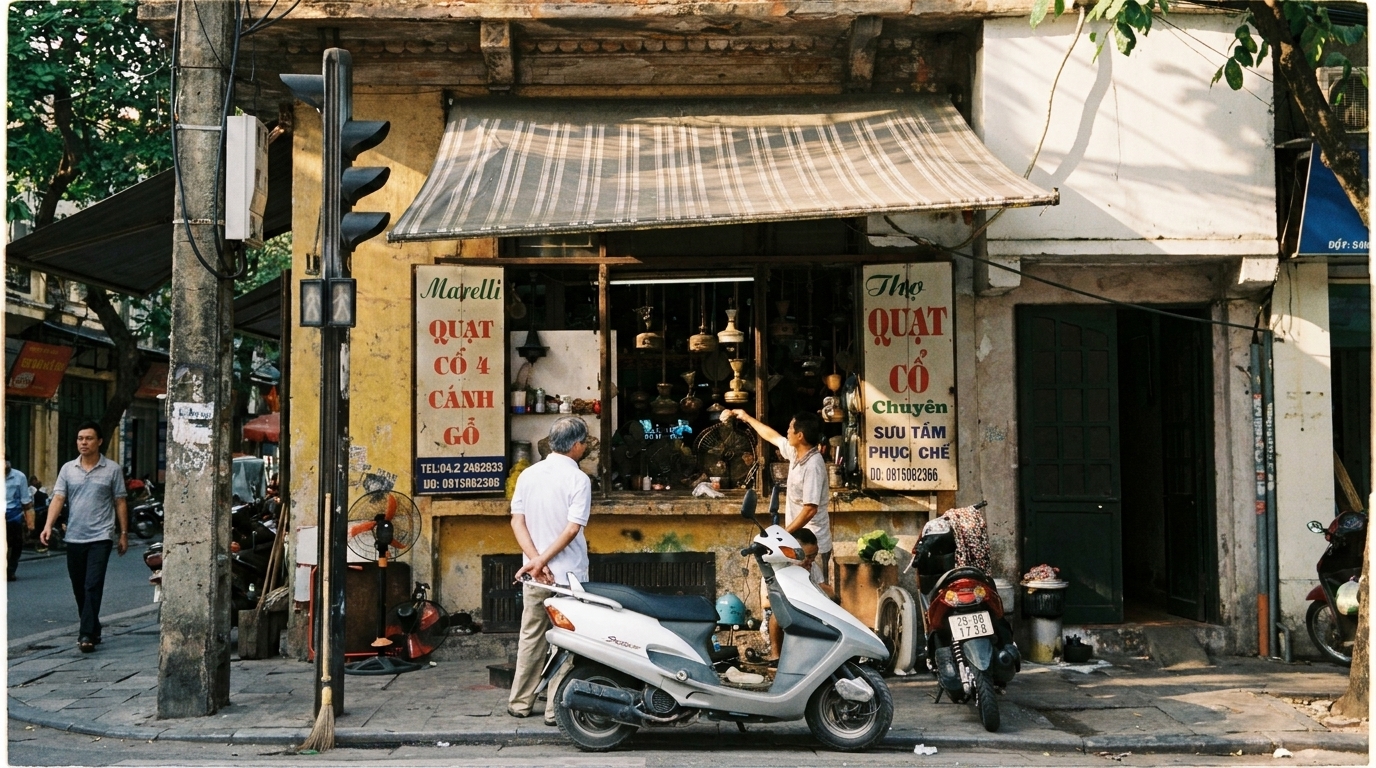
A guy straps two dinner tables to his scooter at 7am while the woman beside him keeps a charcoal fire alive on the pavement, watching a small boy wave at you from the doorway while brushing his teeth in his pyjamas. That’s the Old Quarter at a quiet moment.
It’s loud. It’s intense. It smells like charcoal and street food and something unidentifiable and specific to these streets. And there is a good chance you won’t like it on first sight — and then you will be completely unable to stop thinking about it.
The Old Quarter guide covers the 36 streets in detail — which ones are actually interesting, which are tourist-only, and which alleys the guides don’t mention.
Old Quarter: The Numbers (2026)
Dorm beds: 200,000–375,000 VND (~$8–15)/night. Budget private rooms: 500,000–1,000,000 VND (~$20–40)/night, usually small, usually without natural light in the cheaper options, usually fine. Mid-range 3-stars: 1,000,000–1,750,000 VND (~$40–70)/night. Breakfast often included above $35.
Specific names: Hanoi Little Town Hostel (dorm from 150,000 VND/~$6), Mad Monkey Hostel (180,000 VND/~$7.20 for 10-bed dorm), Hanoi La Siesta Classic (doubles around 600,000 VND/~$24).
Walking: excellent. Hoan Kiem Lake is 5 minutes. The Night Market runs Friday–Sunday. Most Old Quarter restaurants and cafes are within 10 minutes on foot.
Noise: constant. The streets don’t really quiet down until around 1am, and by 6am the vendors are setting up again. If you sleep lightly, bring earplugs — not a suggestion, a requirement.
→Who It’s For
The Old Quarter is right for first-time visitors, people staying 3–5 days, solo travelers who want to be in the middle of everything, and budget travelers where the price difference matters. It’s wrong for: anyone who needs reliable sleep, people who find constant sensory input draining rather than energizing, and anyone staying more than a week who plans to do actual work.
West Lake (Tây Hồ): Where Hanoi Locals and Expats Actually Live
West Lake is Hanoi’s largest lake — 17km of shoreline, pagodas, morning joggers, evening sunsets that light the water the color of hammered copper. The Tây Hồ district surrounding it has been slowly filling with expats, boutique cafes, international restaurants, and the kind of quiet that makes you forget you’re in a city of 8 million people.
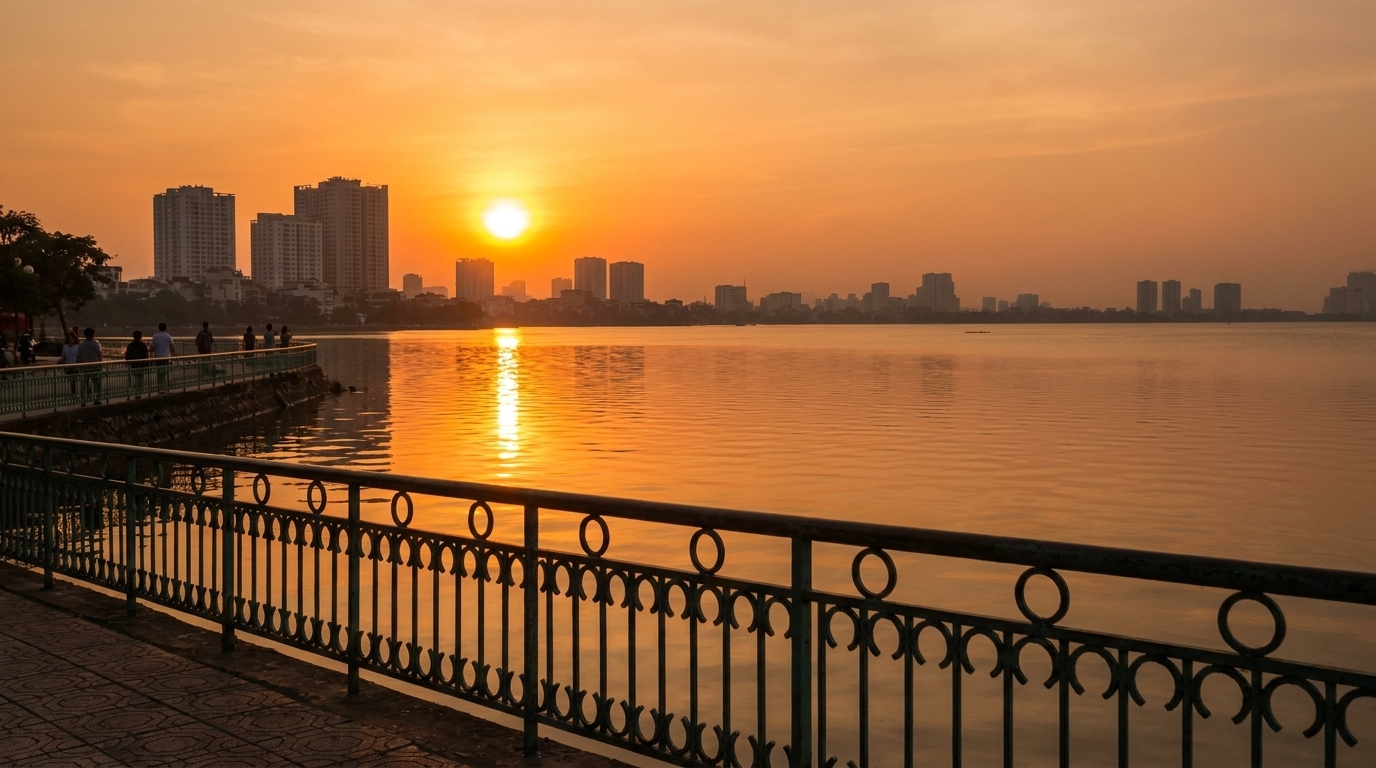
Most tourists skip it entirely. Most long-term Hanoi visitors eventually migrate to it.
The PanPacific Hotel’s Summit Lounge has a rooftop terrace where you can see the whole lake and city spread out below you. One drink, an hour of nursing it while the sun goes down over the water, and you’ll understand why the expats never leave this neighborhood. (It’s expensive — if that matters, order the cheapest thing and make it last.)
Tran Quoc Pagoda sits on a small island connected by a causeway — the oldest pagoda in Hanoi, the reflection of it in the lake at sunset is the kind of photograph you don’t need to filter. Free to enter. Worth it at golden hour specifically.
The coffee culture around West Lake is genuinely different from the Old Quarter — rooftop cafe terraces, specialty brewing, the kind of place where a work-from-anywhere laptop setup actually functions without noise. If you’re spending more than a week in Hanoi for any reason other than pure tourism, West Lake is where you actually live, not where you visit.
West Lake: The Numbers (2026)
Dorm beds: 300,000–500,000 VND (~$12–20)/night. Budget private: 875,000–1,375,000 VND (~$35–55)/night. Mid-range 3-star: 1,500,000–3,000,000 VND (~$60–120)/night. Long-term apartments: listed around $550/month on Airbnb, negotiable to $350–450/month through Facebook groups and local agents.
West Lake cafes charge 75,000–175,000 VND (~$3–7) for a coffee. Boutique restaurants run 375,000–750,000 VND (~$15–30) per person. The price premium over the Old Quarter is real — roughly 30–50% more across categories.
Transport: you’ll need Grab for everything. West Lake to the Old Quarter is 20 minutes by taxi, 40 minutes if traffic is having a moment. Budget 50,000–80,000 VND (~$2–3.20) each way. If you’re doing heavy Old Quarter sightseeing every day, the taxi costs add up and partially cancel the calm-premium you paid for.
★Jake’s Pick
The Trúc Bạch Lake area — between West Lake and the Old Quarter — is the underrated sweet spot. Quieter than the Old Quarter, 10 minutes closer to the sights than West Lake proper, and slightly cheaper than the prime Tây Hồ addresses. Not many hotels promote themselves this way, but search by map position rather than neighborhood label.
The French Quarter: The Third Option Nobody Asks About
Between the Old Quarter and West Lake, geographically and in every other sense, is the French Quarter — Hoàn Kiếm and Hai Bà Trưng districts. Wider streets, lower buildings, better infrastructure from the colonial era, and the Opera House and a cluster of the city’s better hotels.
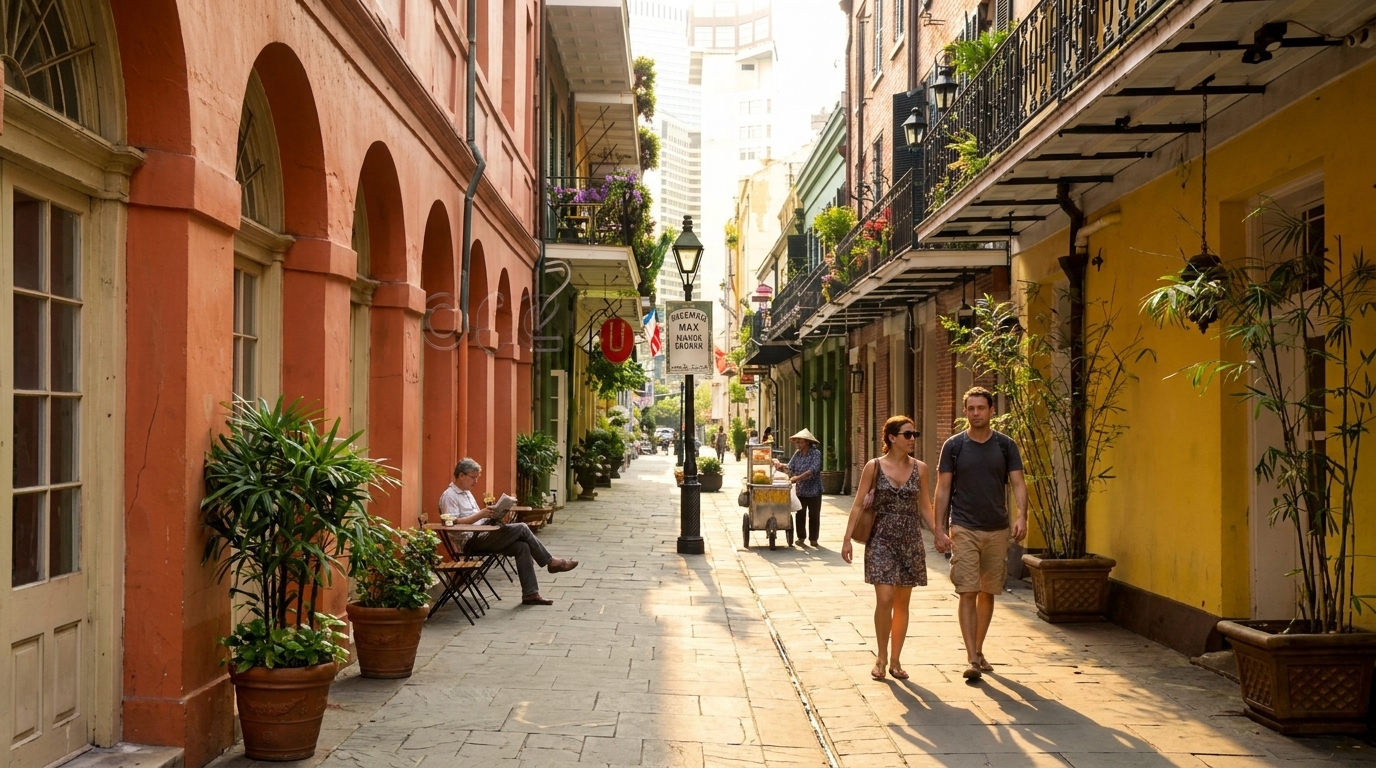
Noise level: noticeably lower than the Old Quarter, noticeably higher than West Lake. Walking to major sights: 15–20 minutes. Vibe: quieter but not quiet, urban but not chaotic.
Budget private rooms: 625,000–1,250,000 VND (~$25–50)/night. Mid-range: 1,250,000–2,500,000 VND (~$50–100)/night. A reasonable compromise if neither extreme feels right.
The Honest Comparison
I’ll be direct about what five years of living in Hanoi and the 2025–2026 traveler data actually says:
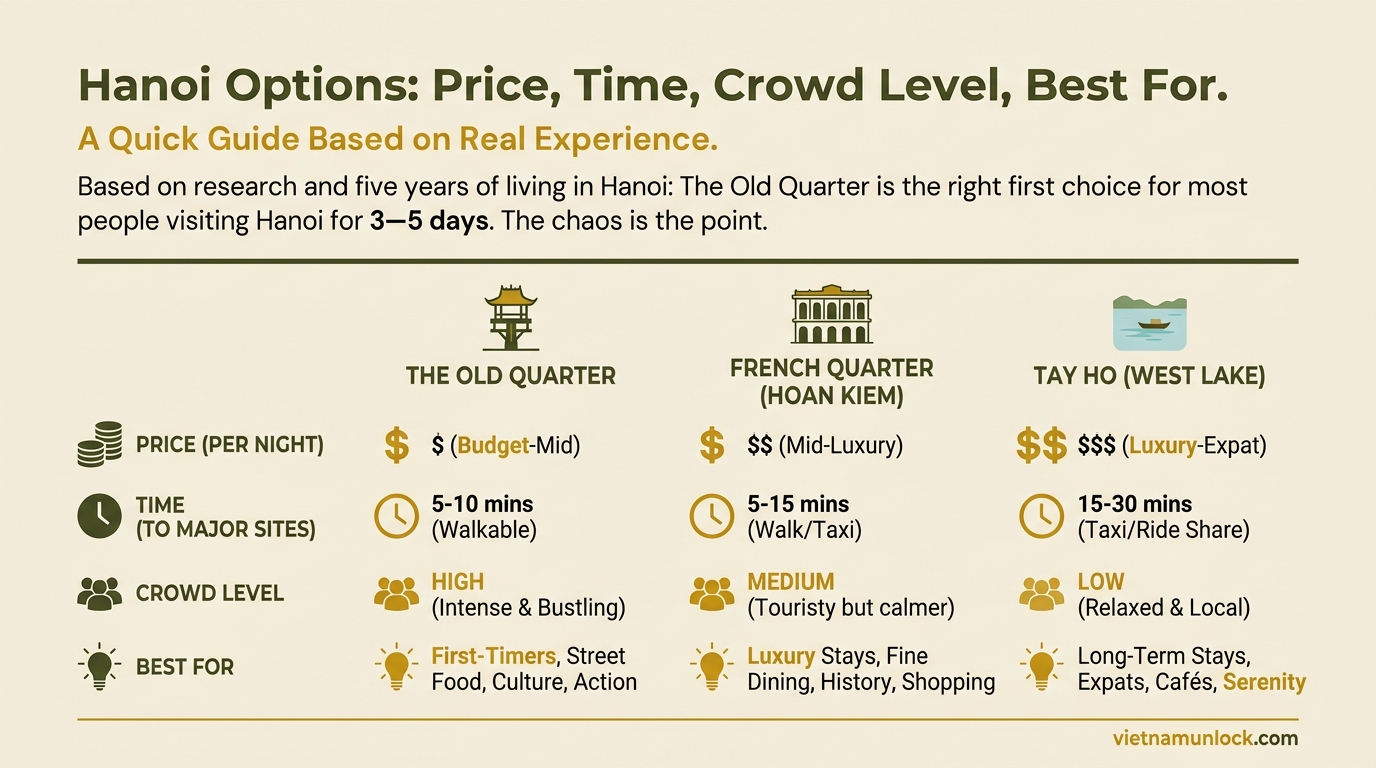
The Old Quarter is the right first choice for most people visiting Hanoi for 3–5 days. The chaos is the point. You’re close to everything. The price is right. You can sleep when you get home.
West Lake is the right choice for anyone staying a week or more, anyone who works remotely, anyone on their second or third Vietnam trip, and anyone who already knows they find constant sensory input exhausting rather than exciting.
The French Quarter is the right choice for people who want a middle path — which is sometimes the genuinely best option, not a compromise.
⚠Real Talk
There’s a version of the “Old Quarter vs West Lake” debate that treats West Lake as aspirationally superior because it’s where expats live. It’s not superior — it’s different. The Old Quarter is genuinely wonderful if you’re there for the experience of Hanoi as a city. West Lake is genuinely wonderful if you want Hanoi as a base. Neither is wrong. The people who feel burned usually made the choice for the wrong reasons.
Practical Notes Before You Book
Noise in the Old Quarter is not evenly distributed. Streets like Tạ Hiện (Beer Street) and Mã Mây are significantly louder than streets two blocks away. Ask specifically which street the hotel is on and cross-reference it on Google Maps before booking. The difference between a room on Hàng Gai and a room on Tạ Hiện at midnight is significant enough to ruin a trip for a light sleeper.
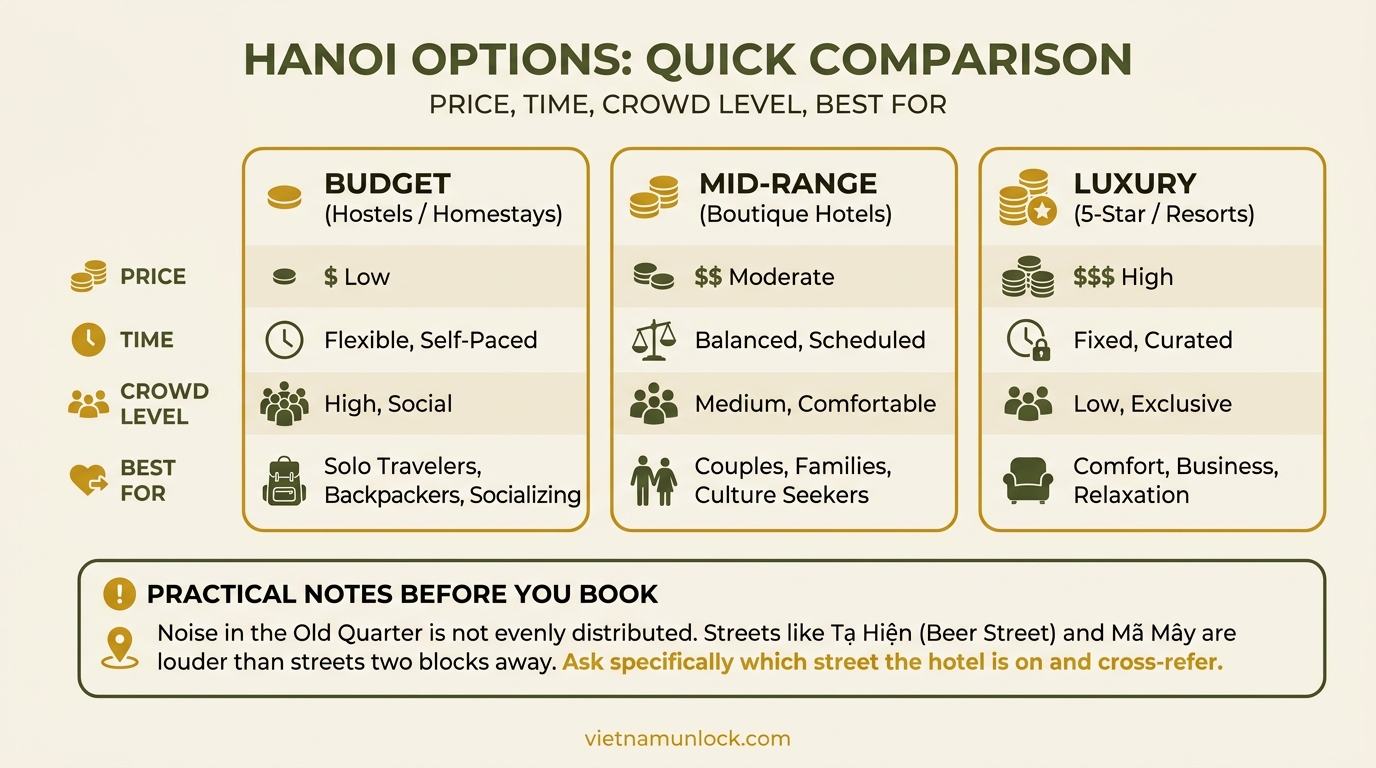
West Lake hotel prices cluster around the lake’s eastern shore (more expensive, better views) and the residential streets behind (cheaper, 5-minute walk to the water). The view premium is real but optional.
For the full breakdown on what to actually do while you’re in Hanoi, the things to do in Hanoi guide maps the Old Quarter’s key streets, Hoan Kiem Lake, and the West Lake pagoda walk in detail. And if you’re planning day trips from Hanoi — to Ninh Binh, Ha Long, or Sapa — both neighborhoods are equally convenient for early-morning departures.
What Travelers Actually Say (Consensus 2025–2026)
The pattern across Reddit r/VietnamTravel 2025–2026 is consistent: people who chose the Old Quarter for the wrong reason (expecting calm) left frustrated. People who went in knowing it was chaotic and embraced it loved it. West Lake complaints are almost exclusively “too far from everything” — which is technically true and only a problem if you didn’t know it going in.
“Old Quarter: chaotic, noisy, zero sleep, best food I’ve ever had, would go back immediately. West Lake: finally got work done, slept eight hours, missed the energy of the Old Quarter. Split your time.” — u/HanoiTwiceNow, r/VietnamTravel, March 2026
“Stayed Old Quarter for 4 days, West Lake for 3 — West Lake was the one I actually want to move to.” — u/ExpatsOnTheMove, r/solotravel, 2025
The split-stay approach (Old Quarter first, West Lake second) comes up consistently in threads for trips of 7+ days and gets near-universal positive feedback from travelers who tried it.
Frequently Asked Questions
Can I split my stay between Old Quarter and West Lake?
First-time visitor in Hanoi for 4 days: book the Old Quarter, deal with the noise, walk everywhere, eat everything, stay until you’re too tired to function. That’s the right trip.
Two things worth sorting before you land: a Vietnam eSIM so you have data the moment you clear customs, and travel insurance — medical costs for uninsured foreigners in Vietnam are significant.
Airalo eSIMs activate instantly. Buy before departure — airport SIM queues in Vietnam can take 30+ minutes.
Frequently Asked Questions
Should I stay in Hanoi Old Quarter or West Lake?
Depends on your style. Old Quarter: walkable, everything within 10 minutes, loud until midnight, cheaper (budget hostels from $8/night, mid-range $35–60). Best for first-timers. West Lake (Tay Ho): quieter, better restaurants, more expat-friendly, requires Grab to reach Old Quarter (~15,000–25,000 VND each way). Best for longer stays.
Is West Lake safe for tourists?
Yes — it’s one of Hanoi’s safest and most livable neighborhoods. The Tay Ho district has the highest concentration of expats and long-term residents outside the city center. Streets around the lake are well-lit, walkable at night, and have very low petty crime compared to the Old Quarter.
Where is the best location to stay near West Lake in Hanoi?
The stretch from Quảng Bá village to Xuân Diệu street has the best density of good accommodation and restaurants. Avoid blocks directly on Nhật Chiêu — loud bars until 2am on weekends. For lake views, the north side (near Tây Hồ street) has better budget options; the south side is the luxury zone.
Specific Streets to Know in Each Area
Old Quarter streets worth knowing:
Hàng Bạc (Silver Street) — jewelry and goldsmith shops at the south end, good cafés toward the middle. Less touristy than Hàng Gai. Phố Cổ’s grid of “Hàng” streets each historically sold one type of good — Hàng Đào (silk), Hàng Mã (paper goods), Hàng Bông (cotton). Most have diversified into mixed retail but the original trade specialty often survives in a few remaining shops.
Tạ Hiện Street — the most concentrated beer street in the Old Quarter. 6 PM onward is Bia Hơi hour — plastic stools, 5,000 VND fresh draft beer, the intersection of backpackers and local workers. Loud, chaotic, fun. Not for everyone, essential to see once.
Đinh Liệt Street — phone shops, SIM cards, good street food in the morning. Less tourist-facing than the main drags.
West Lake streets worth knowing:
Đặng Thai Mai Street — the café strip along the eastern edge of West Lake. Vietnamese coffee shops with lake views, popular with young Hanoians and expat remote workers. The quality-to-price ratio here is high — a cà phê trứng (egg coffee) with a lake view costs the same as one in a cramped Old Quarter alley.
Xuân Diệu Street — restaurant row on the western shore. International food (Japanese, Korean, Italian) alongside Vietnamese options. Higher price points than the Old Quarter but suited for a proper sit-down dinner rather than a plastic-stool meal.
Nghi Tàm Village — a narrow street running along the western edge of West Lake with flower nurseries, local food stalls, and a more village-within-a-city character that disappears if you stay strictly on the main boulevards.
Getting Between the Old Quarter and West Lake
The two areas are about 4km apart — a 15-minute Grab (30,000–50,000 VND) or a 40-minute walk via the Long Biên Bridge area. There’s no direct metro connection yet (Hanoi’s metro currently serves different corridors). Most travelers staying in one area visit the other as a half-day trip rather than needing to commute between them.
If you’re based in the Old Quarter and want a West Lake afternoon: Grab to Đặng Thai Mai, walk the eastern lake shore, coffee at one of the lakeside cafés, dinner on Xuân Diệu, Grab back. That’s 4–5 hours and a completely different register than the Old Quarter morning.
If you’re based in West Lake and visiting the Old Quarter: Grab is the easiest. The walk is possible but involves unpleasant sections of Hàng Giấy and Phan Đình Phùng before the character picks up. The Ba Đình district between them has the Ho Chi Minh Mausoleum complex and Temple of Literature — both worth including in a West Lake → Old Quarter walk if you have 3+ hours.
Seasonal Considerations for Each Area
Summer (June–August): West Lake’s breezes make it noticeably more comfortable than the Old Quarter’s dense streets. The Old Quarter at midday in July is hot, congested, and unpleasant for any length of outdoor time. West Lake cafés with lake views become significantly more appealing in this context.
Autumn (October–November): The Old Quarter is at its best — cool mornings, the September rains are done, the streets have their most atmospheric quality. If you’re choosing timing partly around the neighborhood experience, October is when the Old Quarter earns its reputation.
Winter (December–February): Both areas have their version of winter appeal. The Old Quarter’s covered alley cafés and narrow streets trap warmth and have a specific fog-and-coffee character in January. West Lake in winter morning fog is genuinely striking — the shore disappears, the Trấn Quốc Pagoda appears on its island like a composition.
Who Should Stay Where — Final Framework
After several stays across both areas, the honest framework is simpler than most guides make it:
Stay in the Old Quarter if: you want easy access to the main sights and street food, you’re on a budget, you want the central Hanoi experience, you’re staying 2–3 nights as part of a longer Vietnam trip.
Stay in West Lake if: you’re staying 5+ nights, you work remotely and need a calmer environment, you prioritize cafe-working and restaurant quality over convenience to tourist sights, or you’ve already done the Old Quarter and want a different Hanoi.
Stay in Ba Đình if: you specifically want walkable access to the Ho Chi Minh Mausoleum area, Temple of Literature, and Vietnam Museum of Ethnology — a specific interest in historical and cultural sites rather than the Old Quarter streetlife.
Where to Stay in Hanoi FAQ
Is the Old Quarter safe at night?
Yes. The Old Quarter is busy until midnight or later on weekends and has enough pedestrian and vehicle traffic that personal safety isn’t a concern. Petty theft (phone snatching from bags, pickpocketing in tight crowds) is the main risk — keep your phone in a front pocket and bags zipped in the Tạ Hiện beer area. The streets themselves are lively and well-lit until late.
Is West Lake better for families?
Generally yes — wider pavements, parks around the lake, less street traffic than the Old Quarter, and quieter environments for kids. The Old Quarter works for families but requires more vigilance about motorbikes on the narrow streets and more noise at night. West Lake’s Tây Hồ district has good international restaurants that work for varied palates.
How far is the Old Quarter from Hanoi Airport?
Nội Bài Airport is 35km north of the Old Quarter — 35–50 minutes by Grab (250,000–380,000 VND depending on traffic). West Lake is slightly closer, around 30–40 minutes and 220,000–350,000 VND. The airport bus 86 runs to a stop near Hoàn Kiếm Lake for 45,000 VND but takes 60–90 minutes. For most travelers, the Grab is the better value once you factor in time.