What Ban Gioc Actually Is
Vietnam has a lot of waterfalls. Most of them are nice. Ban Gioc is different.
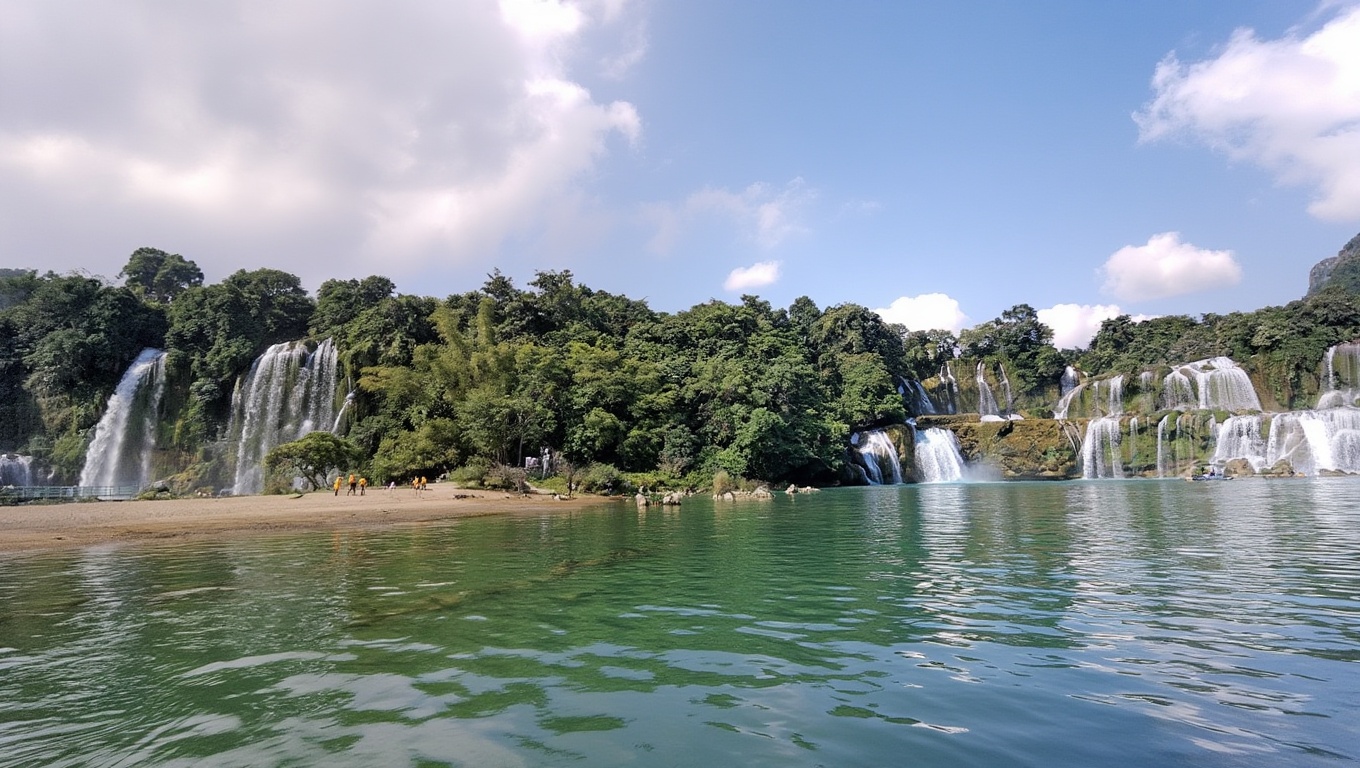
It’s the largest waterfall in Vietnam and one of the largest on any national border in Asia — wider than Niagara when the water is high, though nobody ever seems to say that out loud. It runs across the border with China: the left two-thirds belong to Vietnam, the right third to China, where it’s called Detian Falls and draws a different crowd entirely.
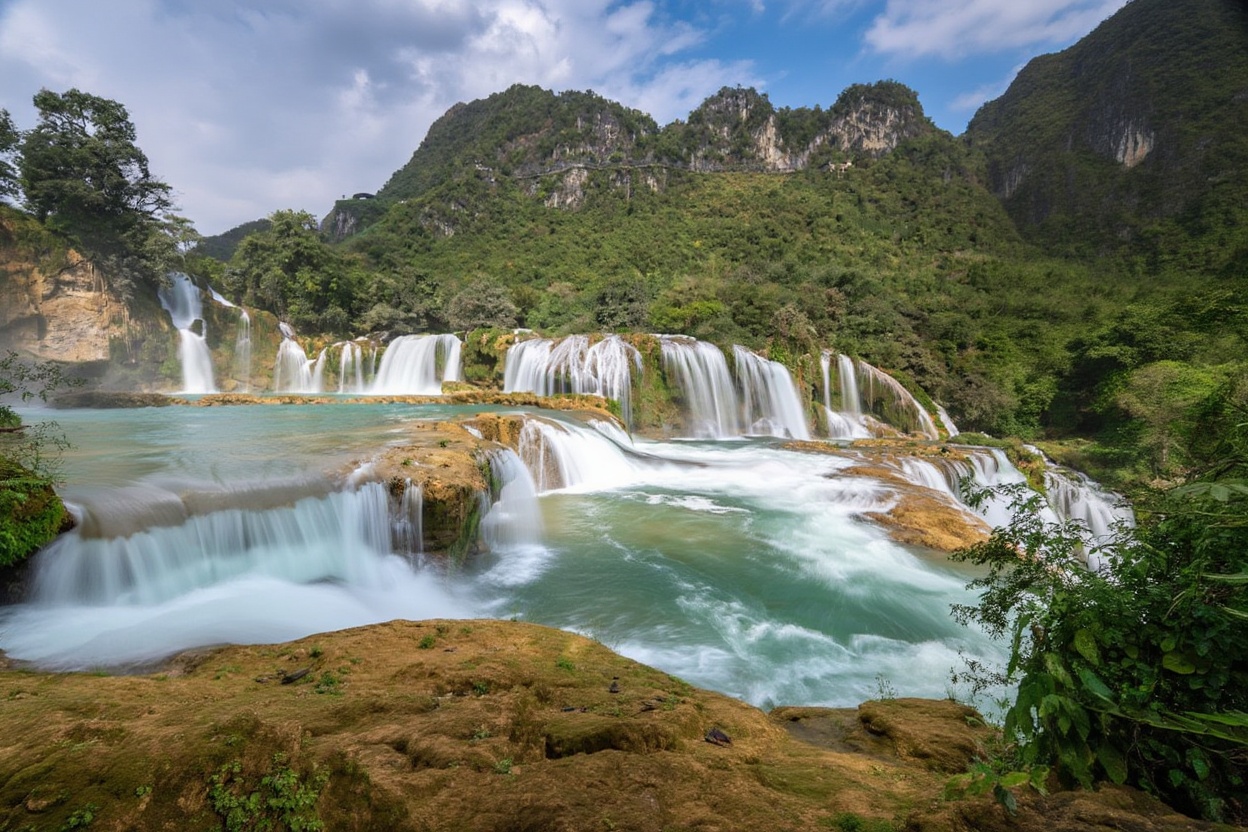
On a clear October morning, with the water still high from rainy season and nobody else on the bamboo raft with you, the mist hits your face before you hear anything clearly. Then the sound becomes the only thing. It earns its reputation.
I’m not going to reach for the easy adjective. What I’ll say is: I’ve seen a lot of waterfalls in Vietnam and Cao Bang is the only one where I got back on my motorbike, rode 200 meters down the road, and turned back to look again.
The China Border Thing — What It Actually Means
The falls straddle the border. You’ll see it clearly from the Vietnamese viewing area: the right side of the falls has Chinese infrastructure — a resort, tour boats, a proper staircase down to the water. On quiet days you can hear the Chinese tour guides across the river.
> **Quick Answer:** You don’t need any special permit or documentation to visit Ban Gioc on the Vietnamese side. Standard tourist visa covers you. You cannot cross into China here — that requires a separate Chinese visa through an official border crossing, which is not at Ban Gioc.
The border itself adds something to the experience that’s hard to articulate. There’s a marker in the water. Two countries sharing a waterfall. Vietnamese soldiers doing rounds on the bank. None of it is tense — it’s just quietly surreal in a way that most natural attractions aren’t.
Don’t try to photograph the soldiers. Don’t wade toward the border marker. Everything else is fine.
The Bamboo Raft: Do It
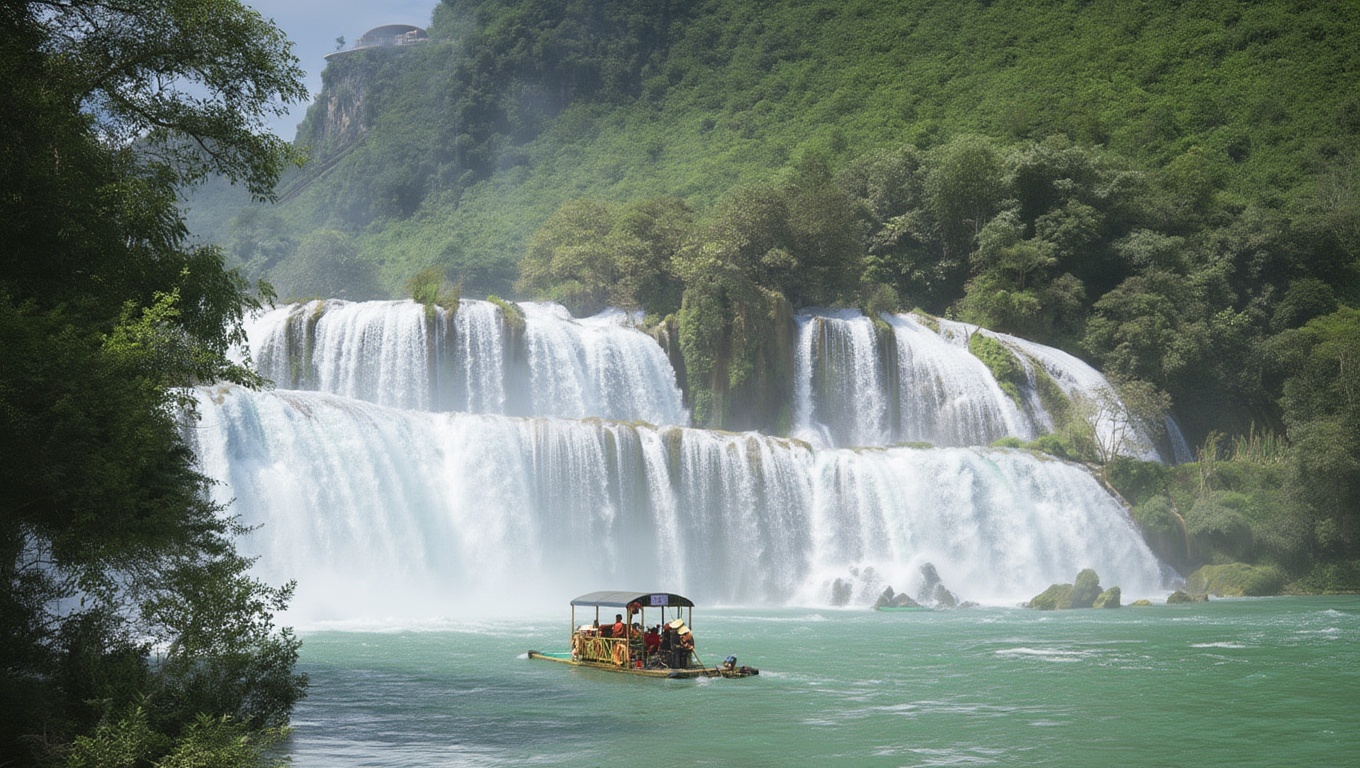
From the main viewing platform, the falls are impressive. From a bamboo raft at the base, they’re something else entirely.
The rafts are operated by local boatmen — families who’ve been working this stretch for decades. You board from a small dock near the entrance, and they pole you out into the pool at the base of the falls. The water is cold even in July. The sound becomes physical at close range — not loud exactly, more like pressure.
> **Quick Answer:** Bamboo raft cost: 80,000–100,000 VND per person (≈ $3.20–4). The ride takes 20–30 minutes. Bring a dry bag for your phone — you will get wet. There’s no hard sell; vendors approach you at the entrance but a polite “không” ends it.
Worth noting: the raft gets you to a specific pool below the main cascade, not directly underneath the falls. You’re close — maybe 40–50 meters from the base — and the view from water level looking up at the three tiers is completely different from the bank view. It’s worth the 90 minutes of your morning to do this properly.
If you’re going on a budget or genuinely short on time, the bank view alone is still worthwhile. But if you’re coming all the way from Hanoi, the raft is the difference between seeing the waterfall and being at it.
When to Go: Honest Breakdown by Month

> **Quick Answer:** Best months: October and November. High water from rainy season, clear skies, cool temperatures. Second best: February–March (clear and cool, lower water). Avoid July–August if riding a motorbike — roads to Trung Khanh can be slick.
The waterfall has two distinct versions depending on season:
High water (July–November): The falls are at maximum width — all three tiers running full. July and August give the most volume but the road from Cao Bang city can be compromised by rain. September is typhoon-adjacent in northern Vietnam; some years it’s fine, some years it’s not. October and November are the sweet spot: water still high, roads clear, weather stable, and the rice terraces in the surrounding hills turn gold before harvest.
Low water (December–June): The falls shrink noticeably, particularly the side cascades. The main central tier keeps running year-round. February and March are clear-sky months with cool temperatures — good for photography, less dramatic water. April through June gets warm and increasingly humid before rainy season proper starts again in July.
If you have flexibility, October is the single best month. Come in the morning. The light hits the falls from the east until about 10am. After that the mist obscures everything and the day-tripper buses from Cao Bang city have arrived.
Getting to Ban Gioc from Cao Bang City
> **Quick Answer:** 85km from Cao Bang city, northeast toward the Chinese border. By motorbike: about 2 hours, road is paved and generally good. By car: same time, more comfortable. No direct bus from Cao Bang city to Ban Gioc — you need your own transport or a tour.
The road runs northeast from Cao Bang city through Trung Khanh district. It’s paved end-to-end. The scenery starts getting good about 30km out — karst formations rising out of flat paddy fields, small market towns where the main road is the market, the occasional truck carrying limestone blocks.
12Go covers most Vietnam routes — sleeper buses, trains, and island ferries. Compare schedules and book in advance during peak season (Dec–Feb, Jun–Aug).
Options:
Rent a motorbike in Cao Bang city. 150,000–200,000 VND/day. The road is straightforward — you’re on the main highway most of the way, turning off for the last 15km into Trung Khanh district. GPS works fine; the road is well-signed in Vietnamese with English transliterations on some markers. Total riding time about 2 hours each direction if you don’t stop.
Hire a car + driver from Cao Bang city. 1,200,000–1,800,000 VND for a half-day to Ban Gioc and Nguom Ngao. Worth it if you’re three or more people, if someone in the group doesn’t ride, or if the weather looks marginal. Ask your guesthouse to arrange — most have drivers they use regularly.
Join a day tour from Cao Bang city. Several guesthouses and small tour operators in Cao Bang run full-day circuits combining Ban Gioc, Nguom Ngao Cave, and Phong Nam Valley for 350,000–500,000 VND per person. Useful for solo travelers who don’t want to ride alone or navigate independently.
From Hanoi directly. Some operators run Hanoi → Ban Gioc day tours (very long day, not recommended) or 2-day tours that include an overnight in Cao Bang. See our Hanoi to Cao Bang transport guide for all options.
Nguom Ngao Cave: Add This Same Day
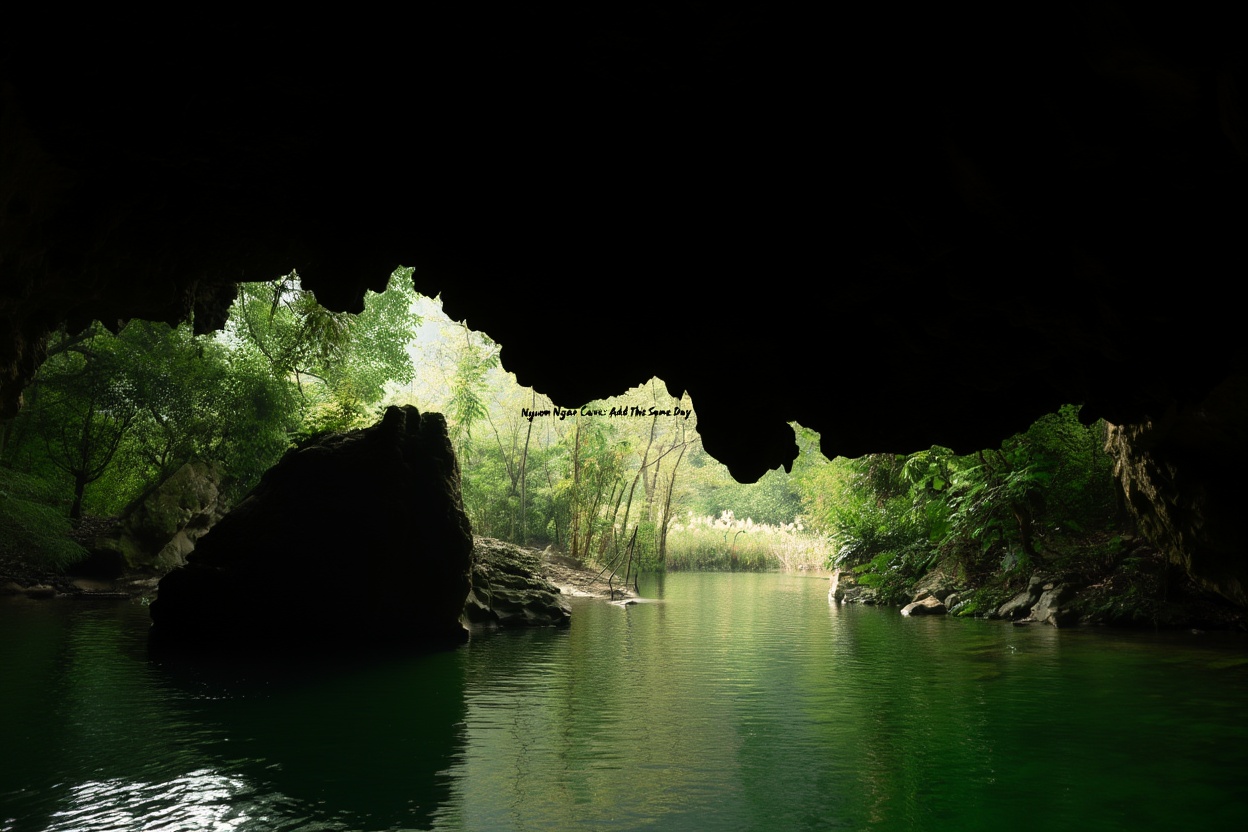
Three kilometers from Ban Gioc. The same road. Combine them — it makes no sense not to.
Nguom Ngao means “Tiger Cave” in the Tày language, named for tigers that sheltered here before disappearing from the region. The cave runs 2.1km of lit passages with side chambers extending further. Stalactite formations are dense enough to border on overwhelming.
> **Quick Answer:** Nguom Ngao entrance fee: 40,000 VND (≈ $1.60). A guide is included. Allow 45–60 minutes. Wear shoes with grip — the floor is wet throughout. The cave air is noticeably cooler than outside (bring a light layer in summer).
The practical sequencing: arrive at Ban Gioc by 7–7:30am for the dawn light, do the raft, spend 2–3 hours total at the falls, then drive 3km to Nguom Ngao for the cave. You’re done by noon, which leaves the afternoon for the drive back to Cao Bang city with stops in Phong Nam Valley.
What to Bring
- Cash only. No card machines at the entrance, at the raft operators, or in Trung Khanh town. Bring enough VND for entrance fees, raft, lunch, and petrol if you’re riding.
- Dry bag or waterproof case. The raft gets you close enough that mist is constant. Your phone will get wet if it’s out.
- Light waterproof layer. Even in dry season, the mist at the base of the falls is significant at close range. In rainy season, the road back to Cao Bang can get wet without warning.
- Water and snacks. There are food stalls near the entrance (grilled corn, bánh, drinks), but supply is limited and prices are slightly elevated for the tourist trade. Bring your own water for the motorbike ride at minimum.
- Sunscreen. The viewing area is open and exposed. October sun is still strong.
The Crowds Situation
Real Talk: Ban Gioc gets two different kinds of crowds — Vietnamese domestic tourists (mostly weekends, Vietnamese public holidays) and Chinese tour groups (year-round, arriving mid-morning by coach).
The Vietnamese tourist crowd is manageable and generally stays on the main viewing platform. The Chinese tour groups are large, arrive fast, and occupy the raft queue. The fix is simple: arrive before 9am. By 10:30am on a typical weekday, the raft queue has lengthened and the viewing platform is noticeably busier. By that point, you should already be driving to Nguom Ngao.
On Vietnamese public holidays (April 30 / May 1, September 2, Tet) and long weekends, both sides are packed by 9am. Not impossible, just more crowded than the photos suggest. Weekday visits in October and November are the version most worth planning for.
Ban Gioc — What Things Cost
| Item | VND | USD |
|---|---|---|
| Entrance fee | 45,000 | $1.80 |
| Bamboo raft (per person) | 80,000–100,000 | $3.20–4 |
| Nguom Ngao Cave entrance | 40,000 | $1.60 |
| Motorbike rental (Cao Bang city) | 150,000–200,000/day | $6–8 |
| Car + driver half-day (both sites) | 1,200,000–1,800,000 | $48–72 |
| Day tour from Cao Bang city | 350,000–500,000/person | $14–20 |
| Lunch near entrance (local stalls) | 50,000–80,000 | $2–3.20 |
Prices May 2026. Entrance fees set by Cao Bang province authority — confirm on arrival.
The Tày and Nùng Communities Around Ban Gioc
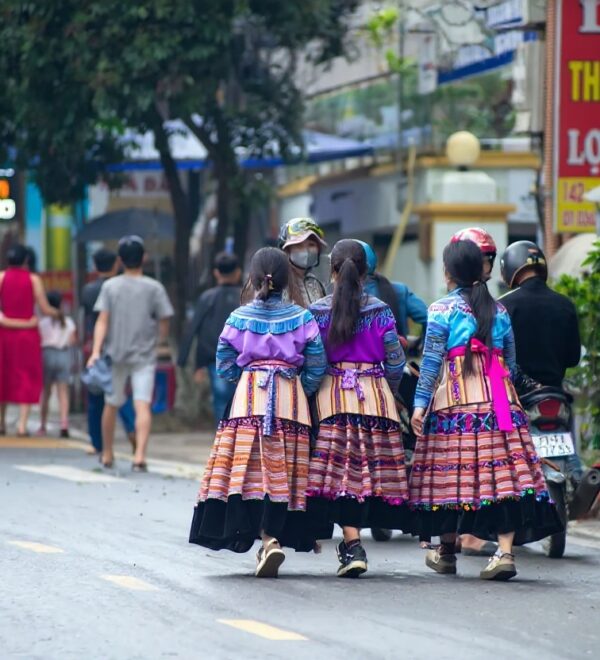
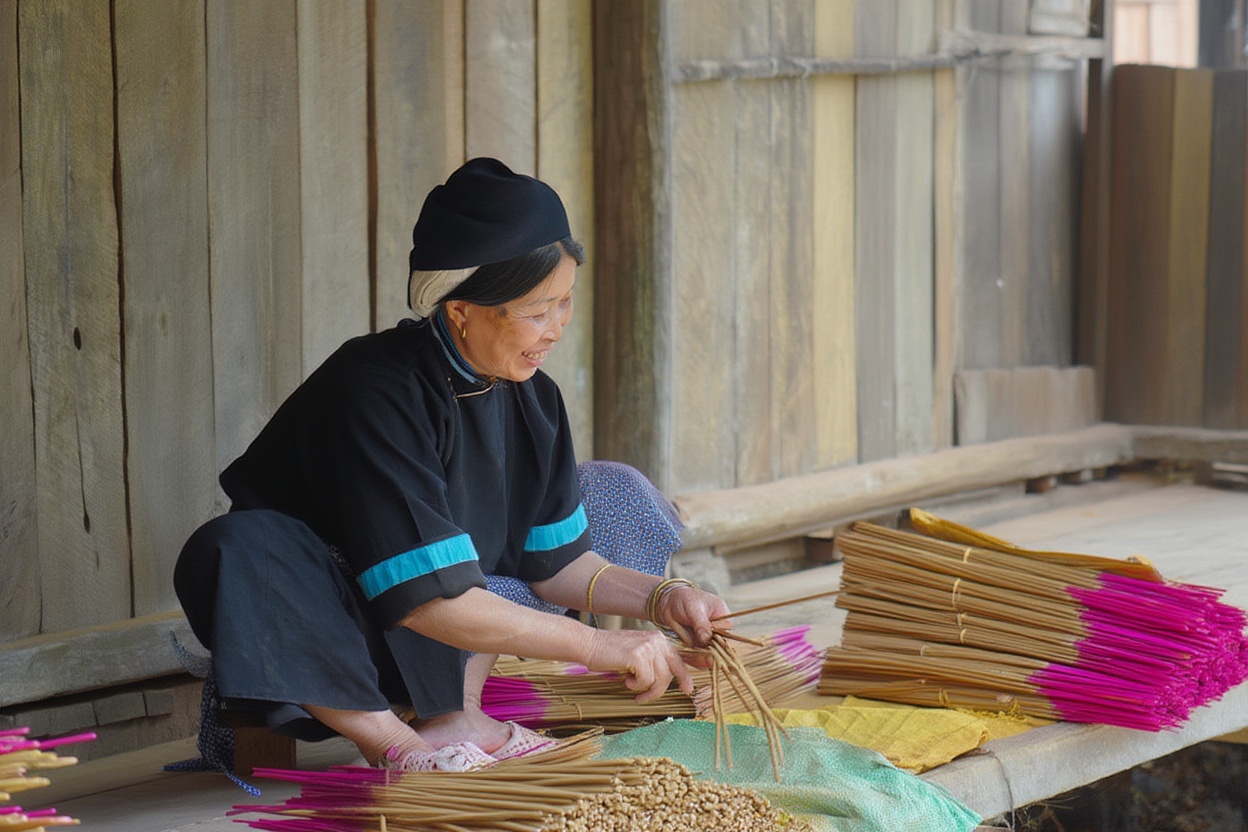
Trung Khanh district — the area surrounding Ban Gioc — is majority Tày and Nùng ethnic minority, not Kinh Vietnamese. This matters for how you experience the place.
The Tày and Nùng communities in this part of Cao Bang have been farming this borderland for centuries, well before the waterfall became a tourist site. The language you’ll hear in the market is not Kinh Vietnamese — it’s a Tai-Kadai language that sounds completely different. Most people over 50 speak minimal standard Vietnamese; younger generations are bilingual.
The stilt houses visible along the road between Cao Bang city and Ban Gioc are traditional Tày architecture — wood frame, raised floor, the design adapted to the flooding patterns of the paddy valleys. If you’re staying in Phong Nam Valley, your homestay is almost certainly a Tày family home.
A few practical notes that come from this:
- Menu items near Ban Gioc are often in Vietnamese only — no English menus, and the food names are different from Kinh cuisine. Thịt lợn sấy (smoked pork) and bánh khảo (sweet sesame-peanut cake, a Tày specialty) are worth seeking out specifically.
- The bamboo raft operators at Ban Gioc are overwhelmingly from local Tày families. Tipping is not mandatory but appreciated — 20,000–50,000 VND is appropriate.
- Photography of local people: ask first. A gesture toward your camera and a questioning look is universally understood. Most people will either agree or decline clearly. Don’t photograph people without consent, especially in the market and at religious sites.
The Tày and Nùng presence in Trung Khanh is one reason the area feels different from Ha Giang (which is predominantly H’mong) or Sapa (mixed H’mong, Dao, Giáy). The landscapes are similar — karst, rice paddies, river valleys — but the culture running through it is entirely distinct.
The Road Between Cao Bang City and Ban Gioc
Eighty-five kilometers sounds like nothing. On Vietnamese mountain roads, distance and time don’t correlate the way you’d expect.
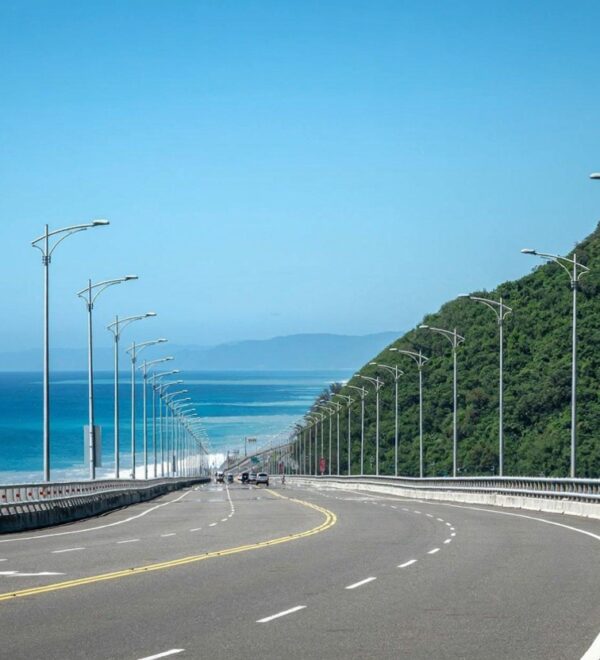
The route runs northeast from Cao Bang city toward the Chinese border on Route 34. The first 30 kilometers are flat and fast — paddy fields on both sides, occasional market towns, the kind of road you can average 60km/h on without trying. Then the karst starts rising.
By the time you’re in Trung Khanh district, the road is narrower, the limestone formations are close on both sides, and you’ve slowed down not because you have to but because you want to. This section — the last 30km into Ban Gioc — is worth the motorbike over the car, assuming the weather is clear. The views don’t translate through a car window.
Stops worth making on the way:
- Phong Nam Valley (about 40km from Cao Bang city): A flat valley ringed by karst, visible from the road on a clear day. Pull over. Take five minutes. If you’re staying the night before Ban Gioc, there are homestays here.
- Trung Khanh town market (12km from Ban Gioc): The local market is active in the morning and has food stalls. Stock up on water and snacks before the last stretch. The town also has the nearest ATM to Ban Gioc — cash only at the falls, so check your wallet here.
- Viewpoints along Route 34: Several unsigned pullouts offer views down into river gorges as you approach the border. None have signage. You’ll know them when you see them.
On the return: the light changes completely in the afternoon. The road you rode into in morning mist looks different at 3pm with full sun on the limestone. If you have time, slow the return and stop somewhere new.
Ban Gioc vs Other Vietnam Waterfalls
People sometimes ask how Ban Gioc compares to Silver Falls in Sapa or the waterfalls in Ha Giang. The honest answer: it’s not comparable. Ban Gioc is an order of magnitude larger than any waterfall in Ha Giang province, and the border-straddling geography makes it unlike anything else in northern Vietnam.
The closest comparison internationally might be Niagara in terms of width-to-height ratio and the border dynamic — but Ban Gioc hasn’t been developed into a theme park. There’s no casino on the Vietnamese side. The bamboo rafts are run by the same Tày families who’ve always run them. No zip lines. No glass platforms. No souvenir shops inside the viewing area perimeter. That’s changing slowly — a resort went up on the Chinese side years ago, and Vietnamese tourism development typically follows — but for now it’s still operating at a human scale that makes the experience feel earned rather than delivered.
If you’ve done the big waterfalls in Laos (Kuang Si, Tad Fane) or Thailand (Erawan), Ban Gioc is in a different category — not because it’s more beautiful in some abstract sense, but because the border geography makes it specific in a way that those waterfalls aren’t. You’re not just at a waterfall. You’re at the edge of two countries sharing one of the better arguments for why natural borders are a fundamentally strange concept.
FAQ
- Can I swim at Ban Gioc Waterfall?
- No — swimming is not permitted in the main pool. The bamboo raft gets you close to the water but you stay on the raft. The current near the border zone is also not something to test.
- Is it worth going in the rain?
- Yes and no. High water makes the falls more dramatic. But the road from Cao Bang city can be slippery in heavy rain, and the mist at the base thickens to the point where you can’t see clearly. Light rain: go. Heavy rain or active storm: wait a day.
- How long should I spend at Ban Gioc?
- 2–3 hours minimum if you’re doing the raft. Budget 3–4 hours if you want to eat lunch at the entrance stalls and take your time walking the viewing paths. Then 1 hour at Nguom Ngao. Full half-day from Cao Bang city and back is the realistic plan.
- Are there guesthouses near Ban Gioc?
- A few, in Trung Khanh town (12km from the falls) and one or two homestays closer to the entrance. They’re basic — functional beds, no frills. If you want to catch the falls at dawn without the 2-hour pre-dawn ride from Cao Bang city, staying in Trung Khanh is worth it. Book ahead — inventory is very limited.
- Do I need a guide for Ban Gioc?
- No. The site is well-marked, the raft operators speak enough to communicate the basics, and the route from Cao Bang city is straightforward with GPS. The cave at Nguom Ngao includes a guide in the entrance fee. Independent travel here is genuinely straightforward. If you want context on the local Tày culture, a Cao Bang city guesthouse owner who is Tày themselves will give you more useful background than any tour script.
- Is Ban Gioc suitable for children?
- Yes — the main viewing area is flat and accessible. The bamboo raft is stable enough for kids who are comfortable on water. Nguom Ngao Cave has uneven, wet floors that require reasonable footwear and some care with younger children. The road from Cao Bang city is fine for family car travel; motorbike with children is not advisable on the mountain sections.
Two things worth sorting before you land: a Vietnam eSIM so you have data the moment you clear customs, and travel insurance — medical costs for uninsured foreigners in Vietnam are significant.
Airalo eSIMs activate instantly. Buy before departure — airport SIM queues in Vietnam can take 30+ minutes.
Planning Cheat Sheet
- From Cao Bang city: 85km northeast, 2 hours by motorbike or car
- Opening hours: 7am–5:30pm daily
- Best time to arrive: 7–8am (before tour groups)
- Entrance: 45,000 VND — cash only
- Bamboo raft: 80,000–100,000 VND — do it
- Combine with: Nguom Ngao Cave (3km away, 40,000 VND)
- Best months: October–November for high water + clear sky
- Full Cao Bang context: Cao Bang Travel Guide
- Getting there from Hanoi: Hanoi to Cao Bang transport options