Last updated: May 2026 — prices and logistics verified May 2026.
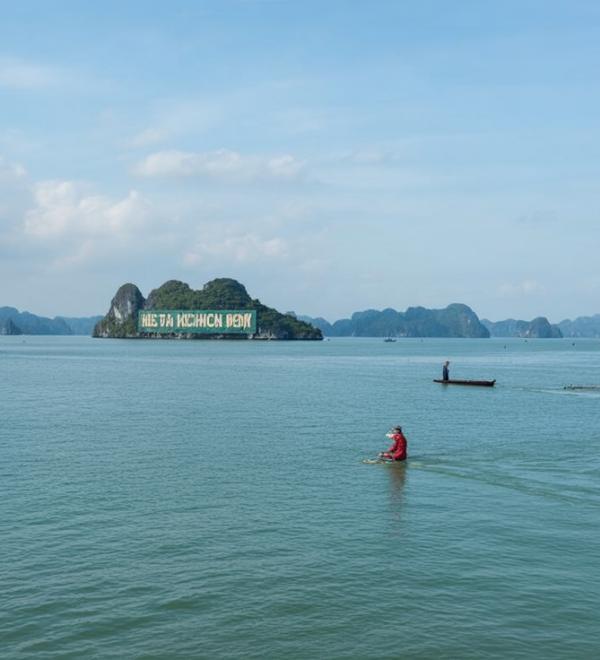
Ha Long Bay is not the problem. How most people see it is. The limestone archipelago — 1,600+ islands and islets rising from emerald water across 1,553 km² of UNESCO World Heritage coastline — is genuinely one of the most dramatic landscapes in Southeast Asia. What you find on a $28 day tour and what you find waking up on a junk boat at 6am when the mist is lifting off the water are the same geological fact and completely different experiences.
This is a guide to which ha long bay tours actually deliver what the photographs promise, and which ones use those photographs to sell you something else.
Day Trip vs Overnight: The Core Decision
Before comparing prices or companies, make this decision: day trip or overnight. It changes everything about what you actually experience.
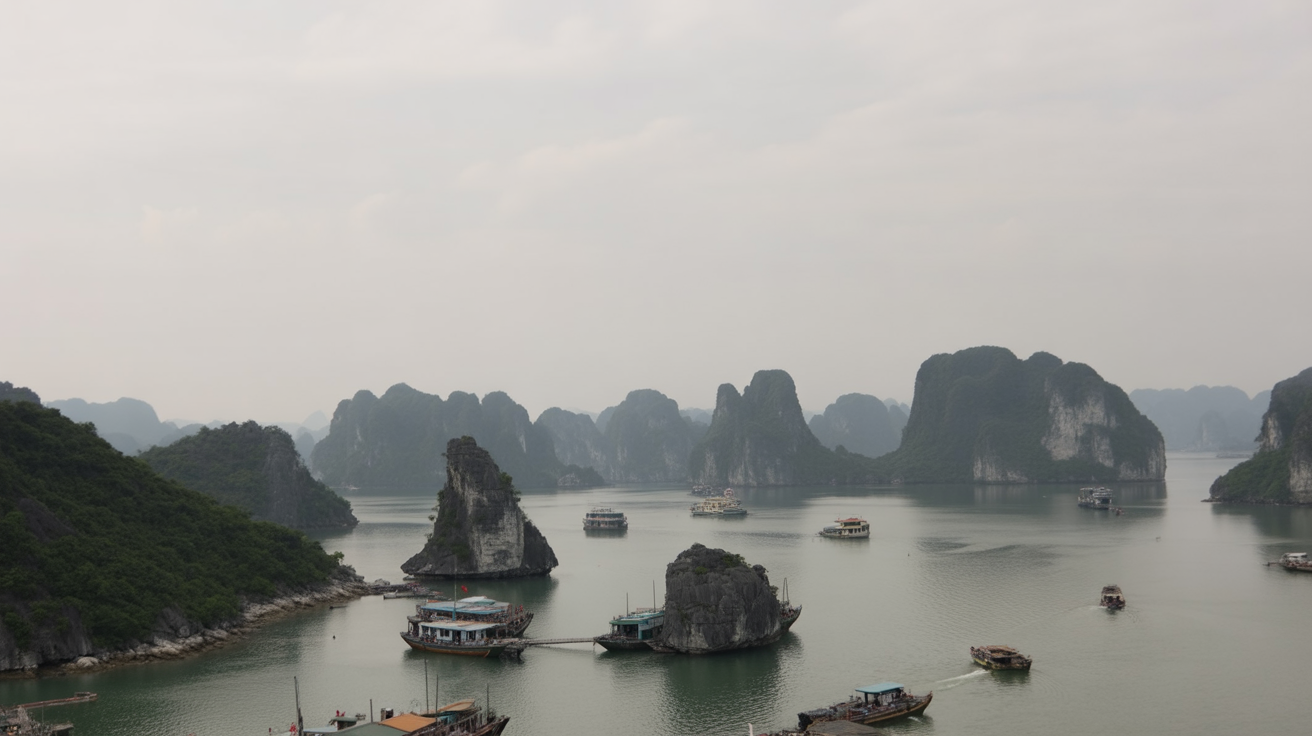
The day trip arrives at the bay at roughly the same time as every other day trip from Hanoi — which means the pier, the caves, and the most famous viewpoints are all experiencing peak load between 11am and 2pm. Sung Sot Cave (say: soong soat), the most-visited cave in the bay, sees thousands of visitors during that window. You will be moving in a single-file queue through a cave with a light show.
An overnight cruise anchors somewhere in the bay before the day boats arrive and leaves after they depart. You get the same caves — often better caves — without the queue.
⚠Real Talk
The “overcrowded with boats and tourists — theme park feel” review isn’t wrong. It describes a specific Ha Long Bay experience: the day tour version, during peak hours, at the most-visited sites. It doesn’t describe the experience of sitting on the bow of a junk boat at 6am watching sunrise karsts emerge from mist with nobody around. Those are the same bay and completely different trips.
Ha Long Bay Day Tours: When They Make Sense and When They Don’t
Day tours are not always the wrong answer. They make sense if you have a single free day in Hanoi, can’t justify the cost of an overnight, or are traveling with people who won’t tolerate two nights on a boat. They don’t make sense if you have the time and budget for the overnight version.
What a Ha Long Bay day tour actually includes:
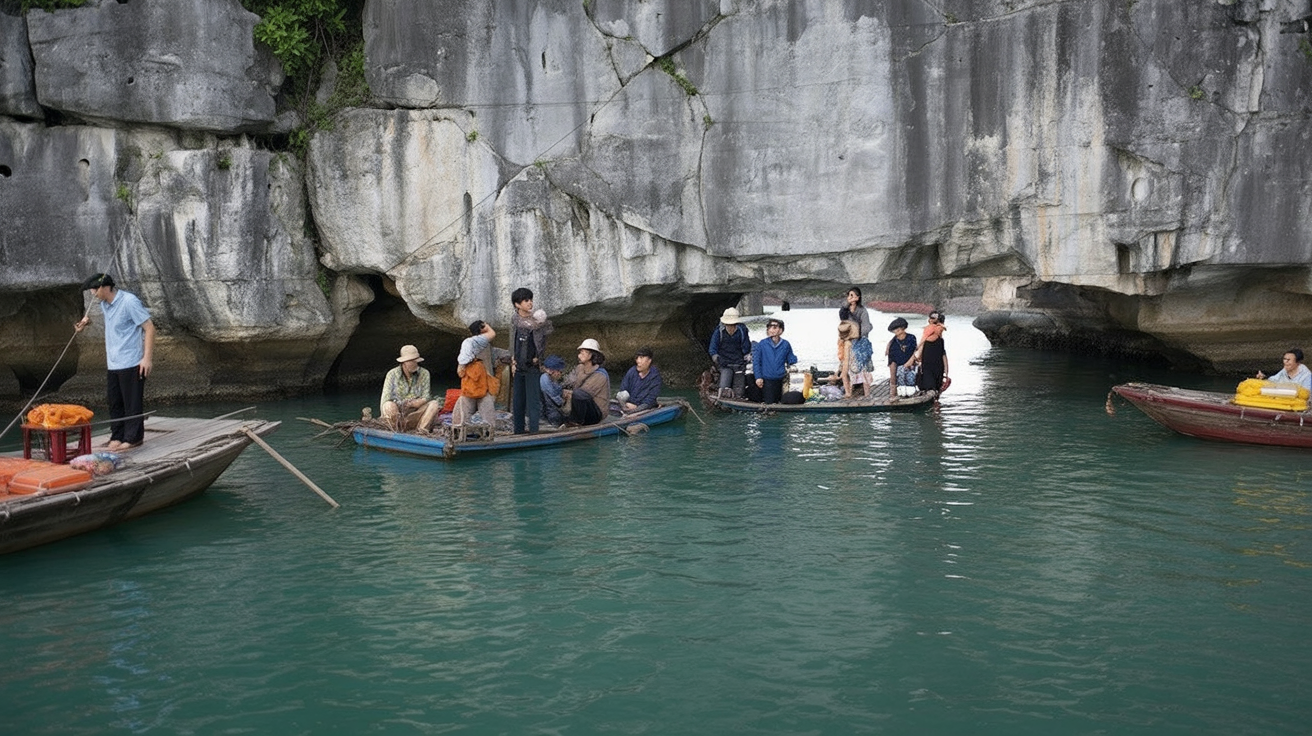
Most day tours run 10–11 hours door-to-door from Hanoi: 7:30am bus pickup, 3.5-hour drive to Tuan Chau or Hon Gai pier, 4 hours on the boat (lunch included, usually a seafood spread), one cave visit (almost always Sung Sot), one bamboo boat ride through an archway or small lagoon, 3.5 hours back to Hanoi. You’re on the water for roughly a third of the total day.
What you won’t get on a day tour: sunrise on the water, kayaking in the less-visited areas, any sense of being away from the crowd, access to the floating fishing villages, or the Bai Tu Long Bay section that most overnight cruises include after day one. Jumping off the boat is now banned across the bay — an enforcement introduced in recent years — so if “swimming from the boat” was part of your picture, adjust expectations regardless of tour type.
Day tour prices (2026): 900,000–2,100,000 VND (~$34–80) per person from Hanoi, transport included. The difference between the cheapest and most expensive day tour is primarily the boat quality and the size of your group — the itinerary is almost identical. Budget day tours run groups of 30–50 people; mid-range runs 20–30; premium day tours cap at 8–12.
→Who It’s For
Day tours work for: travelers with one spare day, people who get badly seasick (overnight is worse), families with young children who won’t sleep well on a boat, anyone on a strict budget who still wants to see the bay. Skip them if: you have 2+ days and a $180+ budget for the overnight.
1-Night vs 2-Night vs 3-Night: What You Actually Get
Once you’ve decided on overnight, the next question is duration. The difference between formats is not just more of the same — each day adds something meaningfully different.
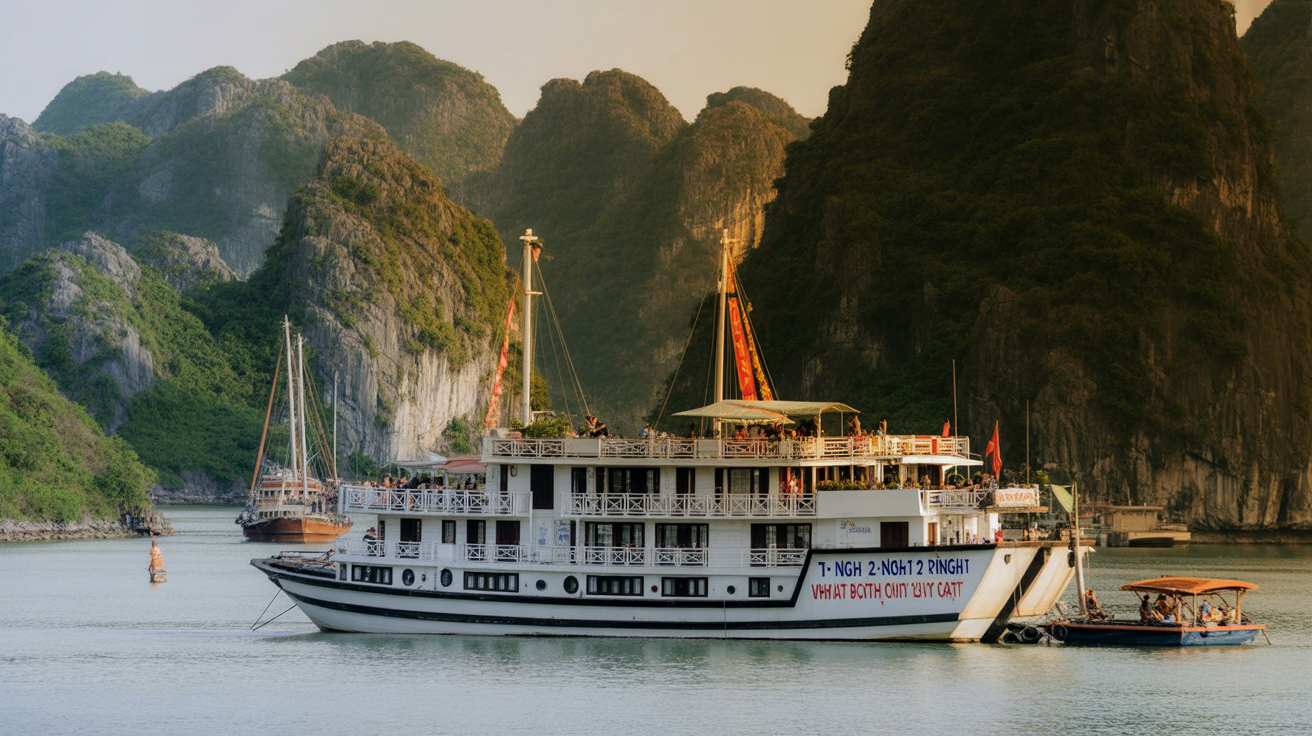
1-night / 2-day: The minimum overnight. You arrive at the pier around noon, have an afternoon on the water with cave visit and kayaking, anchor for the evening (dinner on board, squid fishing at night), wake up for tai chi at sunrise, have a morning activity (cooking class or second kayak), and return to Hanoi by 3–4pm. It’s good. Most people feel they’ve just got comfortable when they’re heading back. If 2 nights isn’t possible, 1 night is still far better than a day tour.
2-night / 3-day: The standard recommendation. Day 1 covers the main Ha Long Bay sites — Sung Sot Cave, Titov Island viewpoint, kayaking in a lagoon. Night 1 anchors in a quieter area of the bay. Day 2 moves toward Bai Tu Long Bay or less-visited islands — different caves, floating fishing villages, deeper into the archipelago. Night 2 stays further in. Day 3 is a morning return. Two nights is when the bay stops feeling like a tour and starts feeling like a place you’re in. It’s the format I’d take if I were doing it again.
3-night / 4-day: Available with some operators, usually extending into Bai Tu Long Bay. Right for serious kayakers, underwater photographers, or anyone who specifically wants more time. Most travelers don’t need this unless Ha Long Bay is the primary reason for the whole trip.
Budget, Mid-Range, and Luxury Cruises: What Changes
The price difference in Ha Long Bay cruise tours is real and matters for specific things. It does not matter for the scenery — the limestone karsts look the same from a budget junk and a luxury vessel. It matters for everything else.
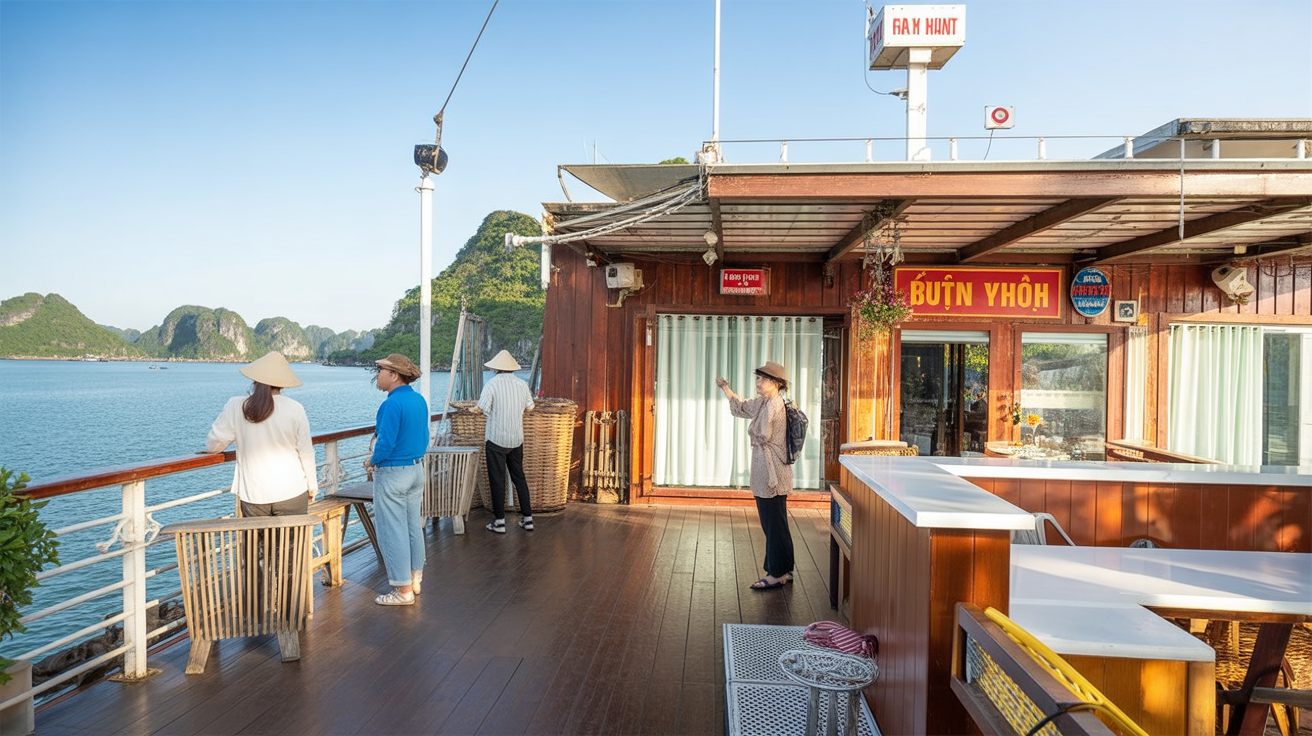
Budget cruises (900,000–4,700,000 VND / ~$34–180 per person for 2D/1N):
Boats like Carina Cruise, Rosy Cruise, and the generic tour-agency packages in this range. You’ll share a boat with 20–40 strangers. Cabins are functional — double bed, private bathroom, air conditioning — but small and thin-walled. Meals are buffet style and adequate. The guides are competent; the activities are identical to more expensive boats. The problem isn’t dishonesty — it’s density. When 40 people are trying to kayak at the same time, it takes a while to get on the water.
Mid-range cruises (4,700,000–9,200,000 VND / ~$180–350 per person for 2D/1N):
Era Cruise, Ambassador Cruise, Pelican Cruise, Alova Gold Cruise. Groups of 12–20 passengers. Better cabins (some with windows over the water), set-menu meals with proper courses, more personalized guide attention. The activities are similar but the logistics are smoother. This is the sweet spot for most travelers — meaningful upgrade from budget without the full luxury price jump.
Luxury cruises (9,200,000–20,000,000+ VND / ~$350–760+ per person for 2D/1N):
Paradise Cruises, Indochina Junk (Dragon Legend, Violet), Bhaya Cruises. Private balconies, spa, fine dining with multi-course menus, groups of 8–16, private beach access on some itineraries. The Indochina Junk 3-day itinerary includes Ha Long Bay day 1, Bai Tu Long Bay day 2 with a private beach BBQ, and a floating fishing village visited by bamboo boat — that specific combination of sites is notable. Worth it for a honeymoon or a once-in-a-lifetime trip; overkill for a standard Vietnam itinerary stop.
★Jake’s Pick
Era Cruise or Ambassador Cruise for the 2-night format — mid-range price, group size stays manageable (14–18 passengers), and the combination of Ha Long Bay day 1 and Bai Tu Long Bay day 2 is specifically better than spending both days in the main Ha Long section. Book directly through the cruise website for the same price as agency bookings, minus the middleman margin.
Ha Long Bay vs Lan Ha Bay Tours: The Less-Obvious Option
Ha Long Bay gets the UNESCO status and the brand recognition. Lan Ha Bay (say: lan ha) sits immediately south, connected to Cat Ba Island, and has essentially the same karst landscape with a fraction of the boat traffic. Where Ha Long Bay can have hundreds of cruise vessels anchored overnight, Lan Ha Bay might have five to fifteen.

Lan Ha Bay tours operate from Cat Ba Island — which means you travel to Cat Ba first (bus + ferry from Hanoi, ~3.5–4 hours), then take a boat out onto Lan Ha Bay. The logistical extra step puts most package tourists off, which is exactly why it stays quieter. Lan Ha Bay day tours from Cat Ba cost 400,000–800,000 VND (~$15–30) per person; overnight cruises start around 2,600,000–5,200,000 VND (~$100–200) for 1-night.
Swimming is actually possible in Lan Ha Bay — the water is cleaner than in the heavily trafficked sections of Ha Long Bay proper. Kayaking is freer, including through cave arches that would be queued in Ha Long. The trade-off: fewer boat amenity options, and Cat Ba Island itself is a base worth spending time on rather than treating as just a pier stop.
The honest comparison: if you want a pure overnight bay cruise experience with good onboard service and you can tolerate some boat traffic, Ha Long Bay 2-night mid-range is the right answer. If you want fewer boats, more kayaking freedom, swimming, and don’t mind the Cat Ba routing, Lan Ha Bay is better. These aren’t ranking differences — they’re preference differences. See the full Lan Ha Bay guide for the specifics on getting there and which operators to use.
How to Book Ha Long Bay Tours: What to Avoid
Three booking routes exist: through your Hanoi hotel or hostel, through an online travel agency (GetYourGuide, Viator, Klook), or directly through the cruise company website.
Through your Hanoi accommodation: Convenient, price is typically standard market rate. The guesthouse takes a commission so the price might be marginally higher than direct, but the convenience and someone to call if something goes wrong is usually worth it. Ask explicitly which company the tour runs with — the generic “overnight cruise 2-night” booking often masks which actual boat you’re on.
Direct booking: Best price, most transparency about exactly which boat and which cabin category. Era Cruise, Ambassador Cruise, and Paradise Cruises all have English-language booking directly on their websites. You know exactly what you’re getting. The downside is that if you need a refund or change, you’re managing it yourself.
Street tour offices in Ha Long city: Avoid. Ha Long city’s tourist strip is not the same product as a Hanoi-booked cruise. The boats operating out of Ha Long city for walk-in tourists are a different and generally lower-quality tier than the cruise companies booking from Hanoi. If you’re already in Ha Long city and need a last-minute boat, call a cruise company directly rather than walking into a tour office on the strip.
ℹKnow Before You Go
Cruise pricing is per-person and almost always includes the Hanoi→pier→Hanoi limousine van transfer. When comparing prices, check whether transport is included — the van is worth 350,000–500,000 VND (~$13–19) per person and some budget operators quote boat-only prices that look cheaper until you add transport. Also confirm whether cave entry fees (typically 150,000–250,000 VND / ~$6–9 per cave) are included or charged separately.
What’s Actually Worth Doing on the Water
Ha Long Bay activities are mostly variations on two things: looking at limestone from the water (good) and walking through limestone (also good but often crowded). A few stand out:
Kayaking through a fishing village: The Vung Vieng floating fishing village in Bai Tu Long Bay — accessible on longer cruises — involves transferring to small bamboo boats paddled by local residents through a community of floating houses, fish farms, and traditional boats. It’s the moment most people cite when they say Ha Long Bay changed how they see the trip. The equivalent in Ha Long Bay proper exists but feels more rehearsed; the Bai Tu Long version has more of the actual working-village feel.
Sung Sot Cave (Surprising Cave): The most famous, busiest, most spectacular. Go first thing in the morning on an overnight cruise — before the day trip boats arrive — and it’s genuinely impressive: enormous chambers, stalactites the size of trees, and a light that catches the formations at dawn without the sound system. On a day tour at noon with 300 people, it’s a different visit.
Kayaking through Ti Top (Titop) Island lagoon: A calm, enclosed lagoon accessible by paddling under a low arch. On a quiet morning, the reflection of karsts in the still water is the image that justifies the whole trip. On a busy afternoon, it’s a traffic jam of kayaks.
Tai chi at sunrise on the top deck: A staple of overnight cruises. You can skip the organized class and just sit there with a coffee watching the mist lift. That’s also valid.
Practical Costs: Ha Long Bay Tour Budget 2026
What to Expect When You Arrive at the Pier
Most Ha Long Bay cruises depart from one of two piers: International Cruise Terminal at Hon Gai (the newer pier, 25km from Ha Long city center, used by most mid-range and luxury operators since 2021) or Tuan Chau Marina (older pier, 8km from Ha Long city, still used by some budget and domestic-market boats). Your cruise company will specify which one — the limousine van driver knows both.
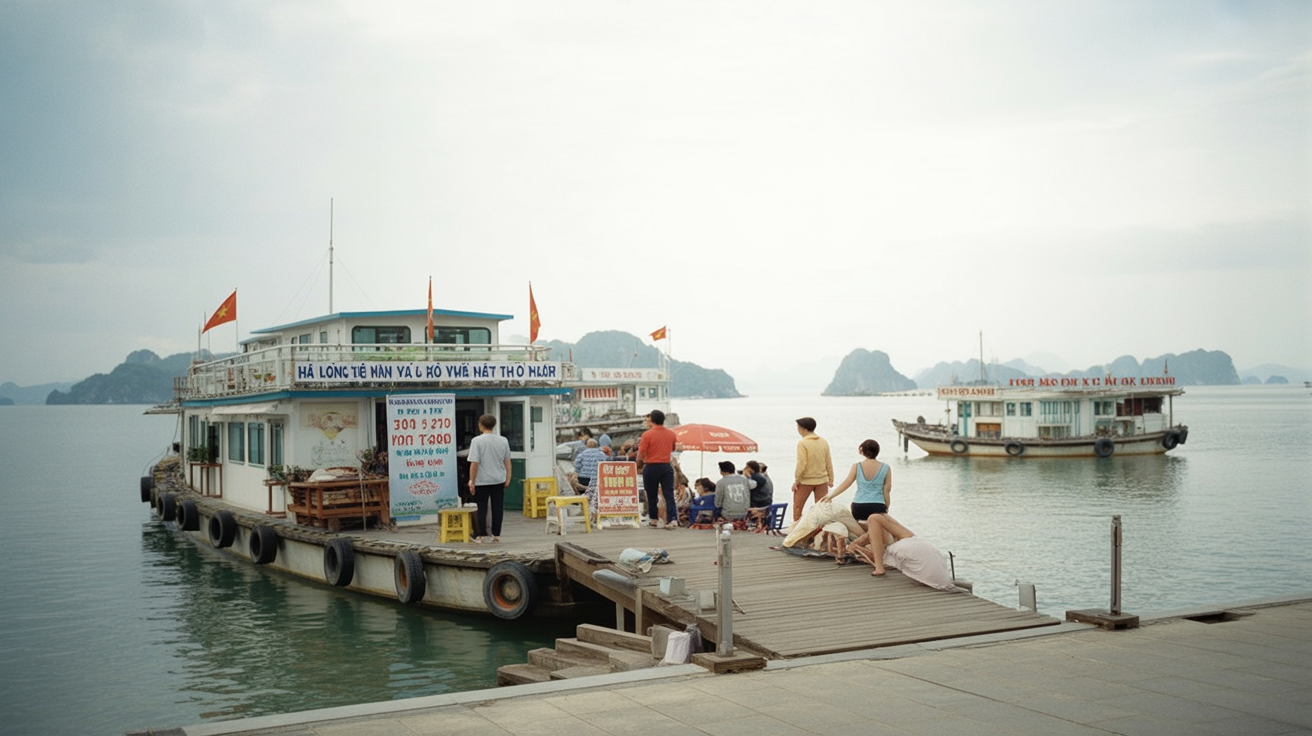
Pier arrival involves: checking in at a dock office, handing over your passport (temporarily, for registration), meeting your guide, and boarding via gangway while porters move luggage. The process takes 20–40 minutes and happens for every boat simultaneously — noon on a summer Saturday has hundreds of passengers checking in at once. Stay with your guide, not your luggage.
A few specific things most first-timers don’t expect:
The bay is immediately impressive. From the moment you’re in open water, the karst landscape is exactly as dramatic as the photographs. Whatever criticisms apply to the cruise industry or the crowds, the geology is the real thing and it hits immediately.
Diesel is part of the sensory experience. All the wooden junk boats run diesel engines; the smell is present when you’re motoring through the bay. It fades when the boat anchors and the engines stop — which is most of the overnight time. If you’re sensitive to fuel smells, request a cabin away from the engine room.
The water color changes with weather and light. On overcast days, Ha Long Bay is grey-green. On clear days at noon, it’s emerald. At dawn with mist on the surface, it’s silver. The photographs you’ve seen are the clear-day-at-noon version. All the versions have their quality — the misty-morning version is, to Jake’s taste, better than the postcard.
Two things worth sorting before you land: a Vietnam eSIM so you have data the moment you clear customs, and travel insurance — medical costs for uninsured foreigners in Vietnam are significant.
Airalo eSIMs activate instantly. Buy before departure — airport SIM queues in Vietnam can take 30+ minutes.
Frequently Asked Questions
What’s the best Ha Long Bay tour for the money?
For most travelers, a 2-night mid-range cruise in the 7,900,000–10,500,000 VND (~$300–400) per-person range hits the sweet spot. Era Cruise and Ambassador Cruise are consistently recommended in this bracket — groups stay under 20 passengers, the 2-night format includes both Ha Long and Bai Tu Long Bay, and the cabins have actual windows. Booking directly on their websites typically saves 10–15% over agency rates.
What’s included in a Ha Long Bay tour?
Standard overnight cruise inclusions: Hanoi → pier → Hanoi limousine van, all meals on board (breakfast, lunch, dinner, plus evening buffet on some boats), cave entry fees (usually — confirm when booking), kayaking, bamboo boat ride, and one cooking class. Alcohol, spa, and premium cave excursions are extras. Cave entry fees for Sung Sot or Thien Cung (say: tyen koong) run 150,000–250,000 VND (~$6–9) each if charged separately.
Can you swim in Ha Long Bay?
In the main Ha Long Bay area, swimming from the boat is officially banned and most cruises enforce this. Some beach stops at Titov Island or Me Cung Island allow swimming in designated areas. Lan Ha Bay has cleaner water and swimming is possible in some spots — the Cat Ba base cruise format is better for anyone who specifically wants to swim.
Should I book a Ha Long Bay or Lan Ha Bay tour?
Ha Long Bay has better onboard services and more cruise options at every price point. Lan Ha Bay has fewer boats, cleaner water, and more kayaking freedom. If you’re doing a standard Vietnam circuit and want the “Ha Long Bay experience,” book Ha Long 2-night mid-range. If you’re already using Cat Ba Island as a base, Lan Ha Bay is the obvious touring ground and the better experience for kayakers. They’re not interchangeable — they’re different trips that happen to share the same geological setting.