Last updated: May 2026 — Old Quarter business hours, bia hoi prices, and Banh Mi 25 wait times verified.
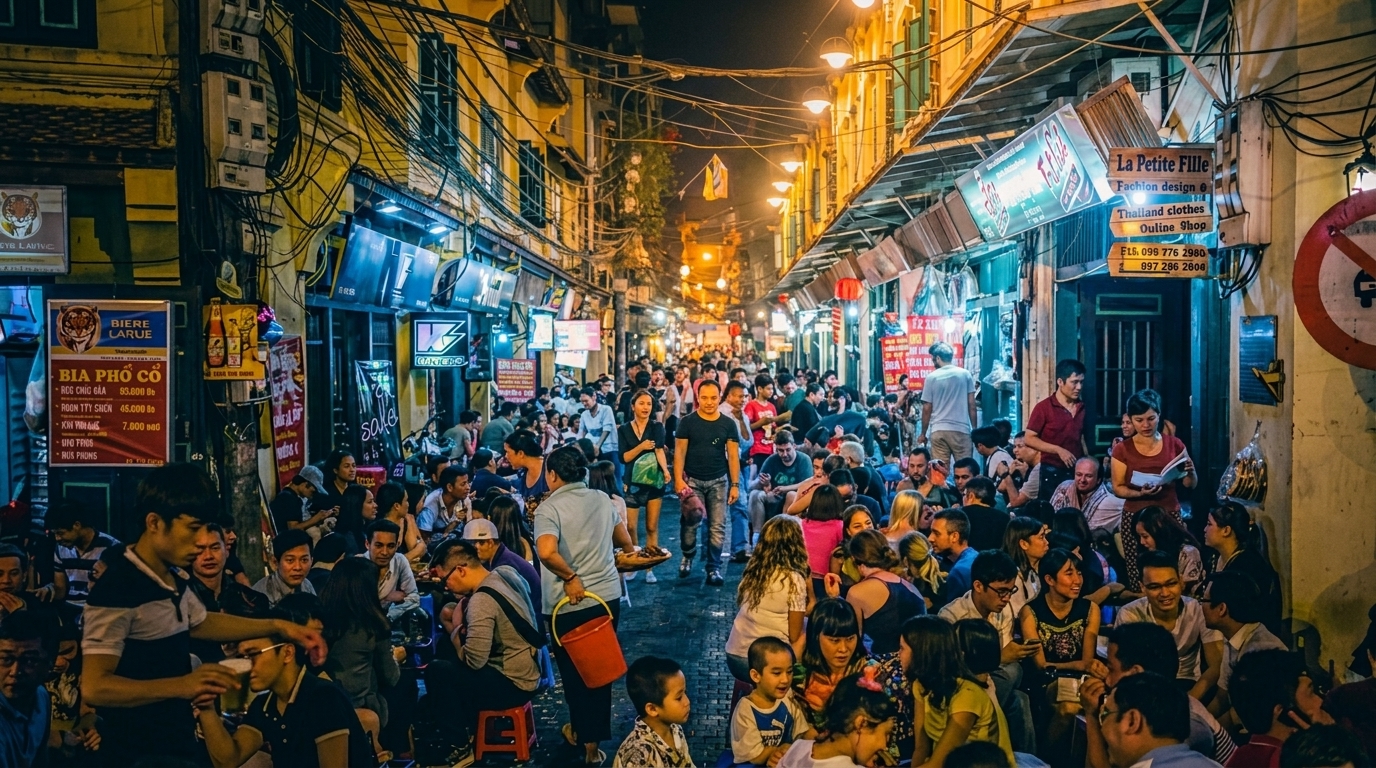
I ended up in a room above Tạ Hiện Street — the beer street, the one that doesn’t stop — for 280,000 VND. The room had no window except one that opened directly onto the street noise. I lay on the bed listening to someone ordering more bia hoi until 2am. At 4:30am, a rooster.
I went back the next year with a reservation. Different experience entirely.
The Old Quarter rewards planning in a way that almost nothing else in Vietnam does. Knowing where to walk, when to walk it, what to eat and where to sleep changes this neighborhood from “overwhelming tourist chaos” to the best 48 hours you’ll spend in the country. Here’s what five years of living fifteen minutes from it has taught me.
What the Old Quarter Actually Is
Thirty-six streets. Each one named after what merchants sold there — starting with Hàng (“goods”) and the commodity. Hàng Gai: hemp, now silk and tailors. Hàng Bạc: silver, now jewelry and currency exchange. Hàng Đường: sugar, now dried fruit and Tết sweets. Hàng Tre: bamboo. Hàng Mã: votive paper offerings still burned at ancestral altars.
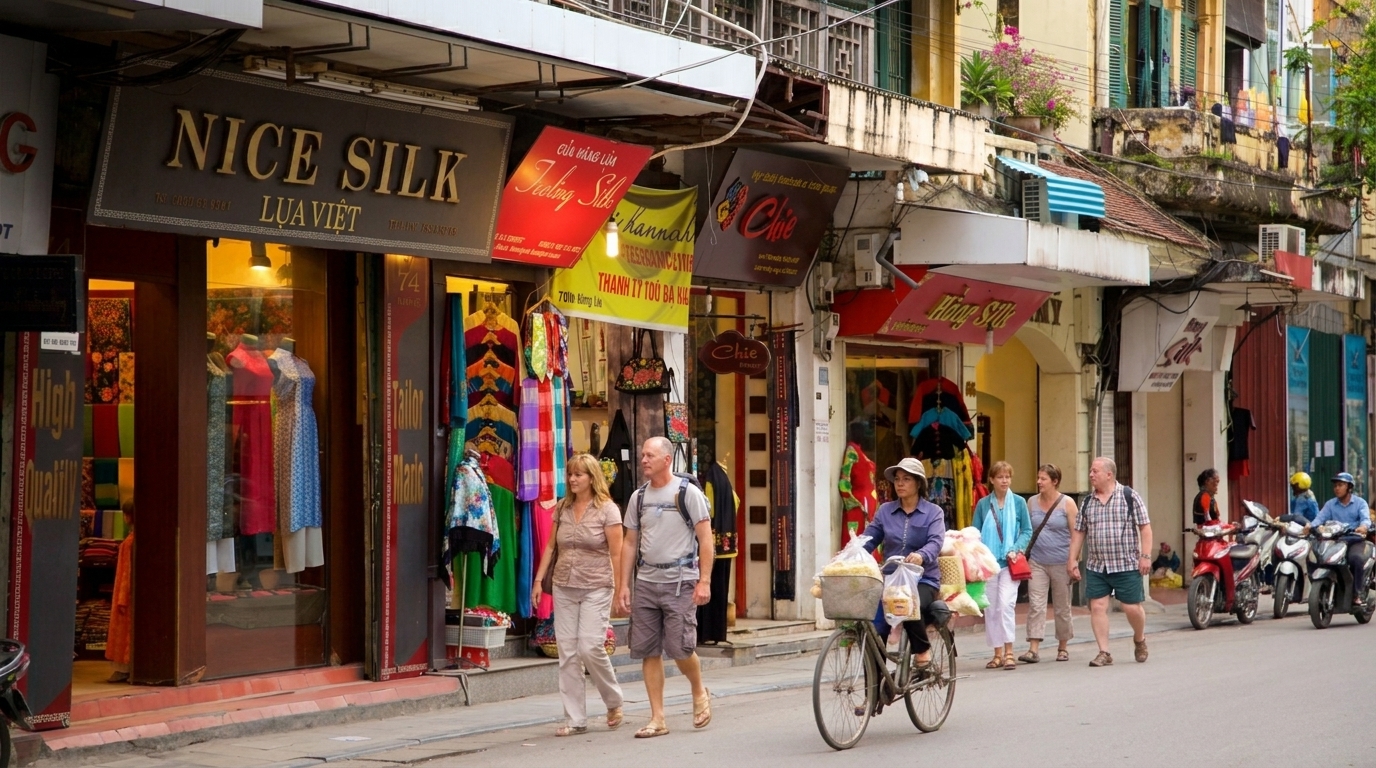
The guild structure goes back to the 13th century. Craftsmen from the same village would cluster on the same street, making the same thing, competing against each other in the open. The street names survived even when the trades changed. Walk Hàng Gai today and you’ll find tailors, silk shops, and lacquerware — nothing remotely hemp. But the logic of the street, the density of one trade on one block, still holds.
This is what separates the Old Quarter from other historic districts in Southeast Asia. It wasn’t built as a market — it grew into one, organically, over seven hundred years. The narrow three- and four-storey shophouses with their tube-house architecture (deep lots, narrow frontages, to minimize land tax) are original structures, not recreations. The chaos is not performed for tourists. It was here before the tourists, and it will outlast them.
✓Quick Answer
The Hanoi Old Quarter (Phố Cổ Hà Nội) covers the Hoàn Kiếm district north of Hoan Kiem Lake. Its 36 streets, each historically named for the trade practiced there, form one of Southeast Asia’s best-preserved medieval merchant quarters. Walk it at 6am for the authentic version. Eat banh mi at Hàng Cá, bun cha at Nguyễn Hữu Huân, and bia hoi at the corner of Tạ Hiện and Lương Ngọc Quyến. Stay on the quieter side streets off the main bar strip.
When and How to Walk It
The 6am Walk — The Version Nobody Warns You About
Set an alarm for 5:45am. This is non-negotiable.
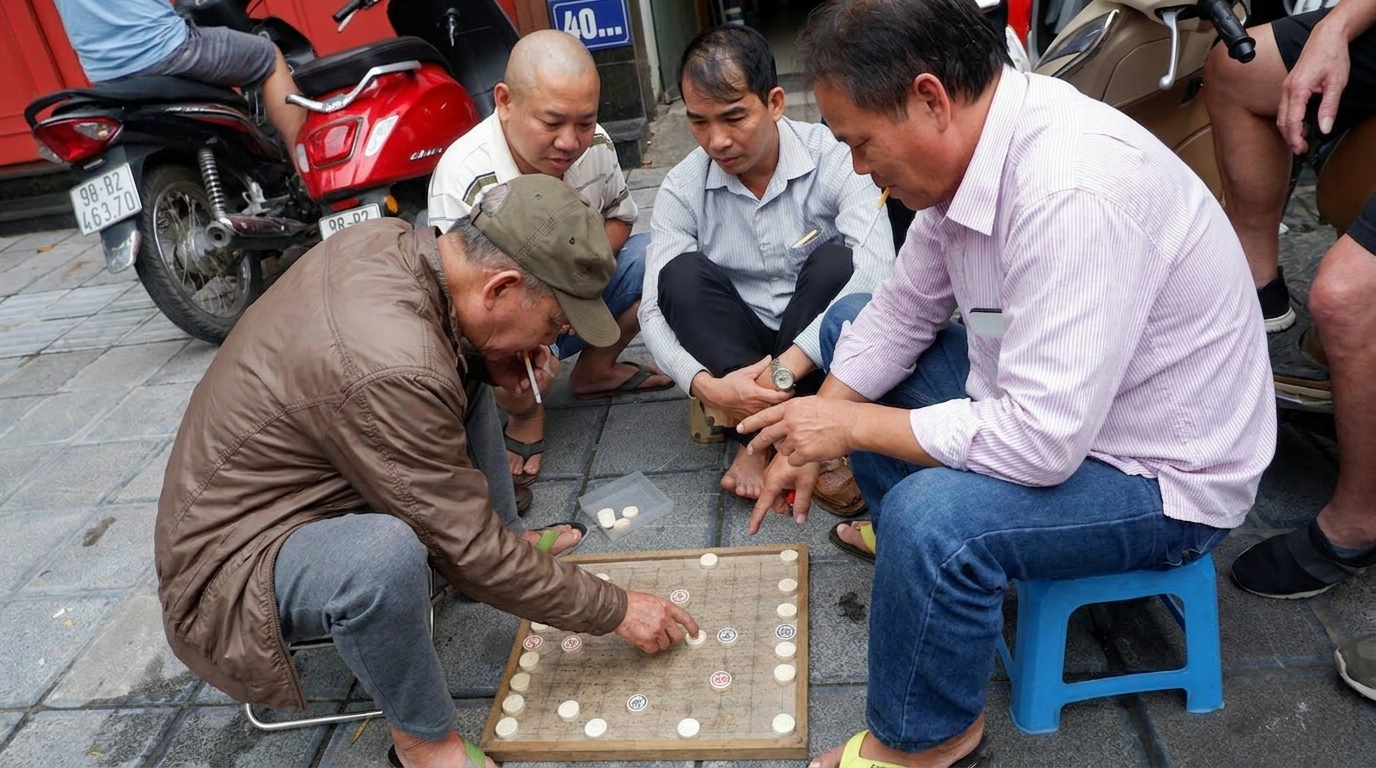
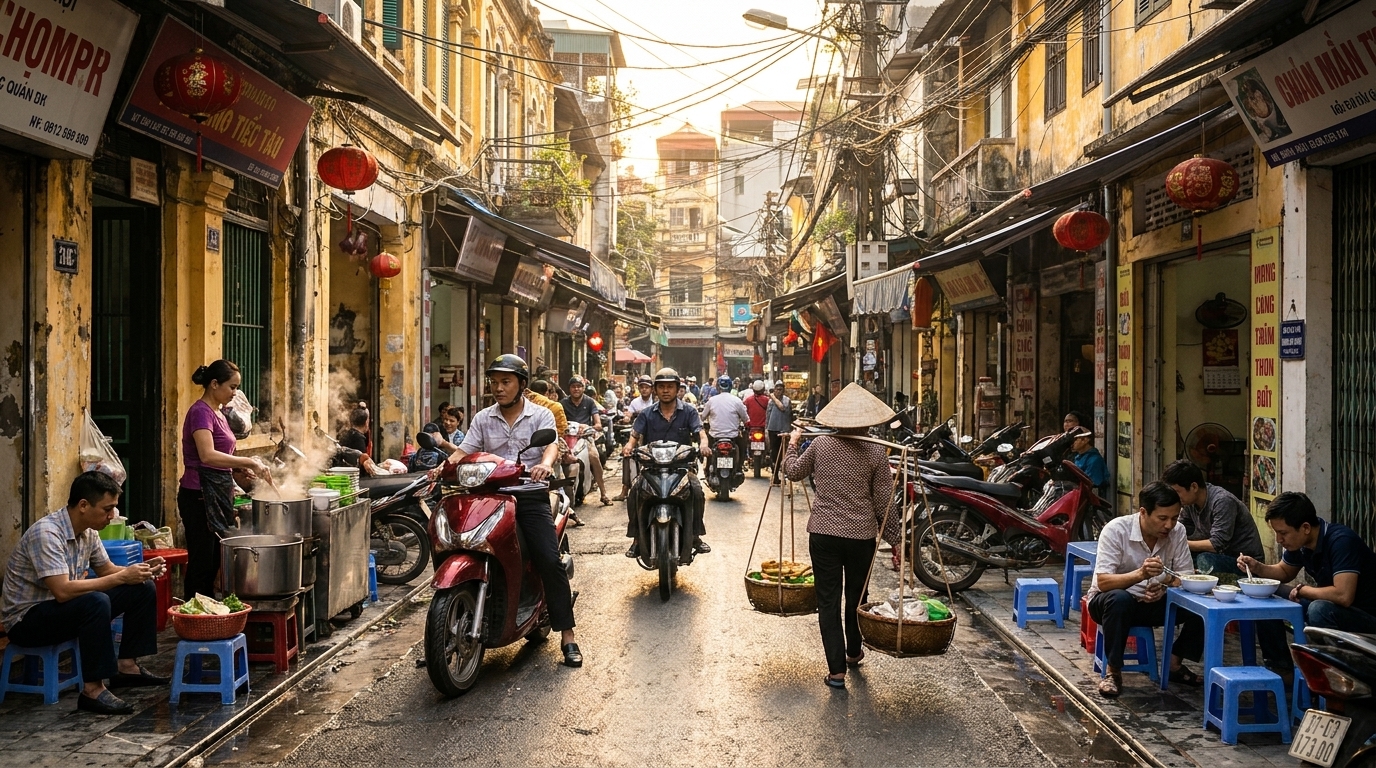
The Old Quarter at 6am is a completely different city from the one tour groups see at 10am. The streets are empty of foreigners. The shophouses haven’t opened yet. Old men are playing chess on upturned crates outside Đồng Xuân Market. Women are doing aerobics to Vietnamese pop in the courtyard behind Ngọc Sơn Temple. The aroma of morning broth — specifically phở, specifically pork bone simmered since 3am — comes through open shutters on streets that are still cool from the night.
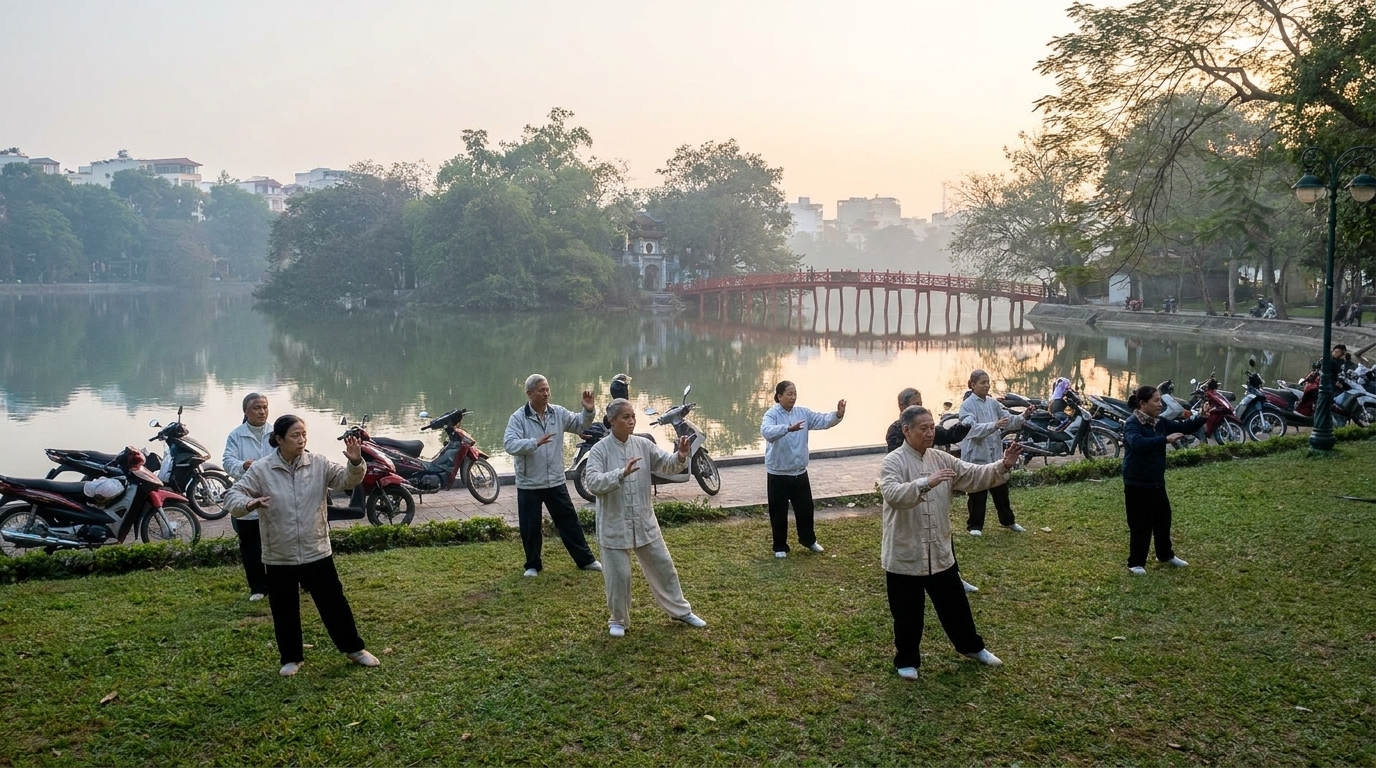
Start at Hoan Kiem Lake. Walk the perimeter. The Thê Húc Bridge (the red wooden bridge to Ngọc Sơn Temple) doesn’t open for tourists until 8am, but you can see it from the lakeside path. Around 6:15am, groups of elderly Hanoians practice tai chi on the grass — not for your camera, not as a performance, just because they do this every morning and have for decades. Cross into the Old Quarter via Hàng Gai and walk north, aimlessly. Turn left, turn right. Get briefly lost. It’s small enough that you can’t get genuinely lost — Hoan Kiem Lake is always south.
Eat breakfast here. See below for what and where.
The Evening Walk — After 7pm
The Old Quarter’s second mode is its night mode, and it’s equally worth seeing — just differently. By 7pm, the cooking smells shift from morning broth to grilled meat and charcoal smoke. The weekend night market (Friday to Sunday, Hàng Đào to Hàng Ngang) sets up. Tạ Hiện Street — beer street — fills with plastic stools and the sound of clinking glasses and people from somewhere between twenty and sixty countries all doing the same thing at the same time.
The night market runs from 6pm to midnight on weekends. It’s touristy, the prices are tourist prices, and some of the handicrafts come from the same factories as the stuff sold on every other Southeast Asian night market. But the atmosphere is genuinely good — narrow streets closed to traffic, lanterns strung overhead, the smell of bánh tráng nướng (grilled rice paper with egg) drifting from every third stall. Walk it for the experience, not the shopping.
The Đồng Xuân Market Detour
North of the tourist-dense streets, past the night market area, Đồng Xuân Market is where the actual commerce happens. It’s a covered market with four floors: ground floor for textiles and clothes, upper floors for household goods, food. The ground floor clothing wholesale section at 5:30-8am is where small shop owners come to restock. There are no English signs. The prices are real prices, not tourist prices. It’s loud, compressed, and utterly unlike the Old Quarter streets you’ve already walked.
The street food stalls around Đồng Xuân’s north entrance — xôi (sticky rice), bánh cuốn (steamed rice rolls), phở — fill with Hanoian workers before 8am and are cleared by 9am. The only way to find them is to walk toward the market and follow the smell.
Where to Eat in the Old Quarter
Morning (6–10am)
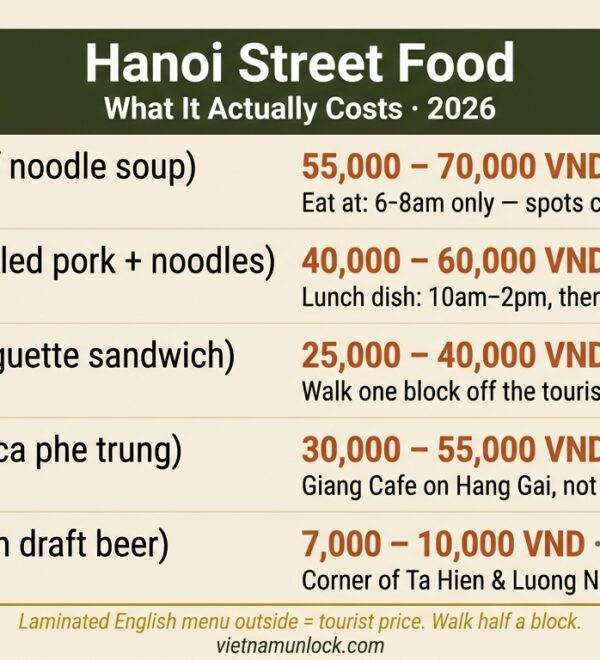
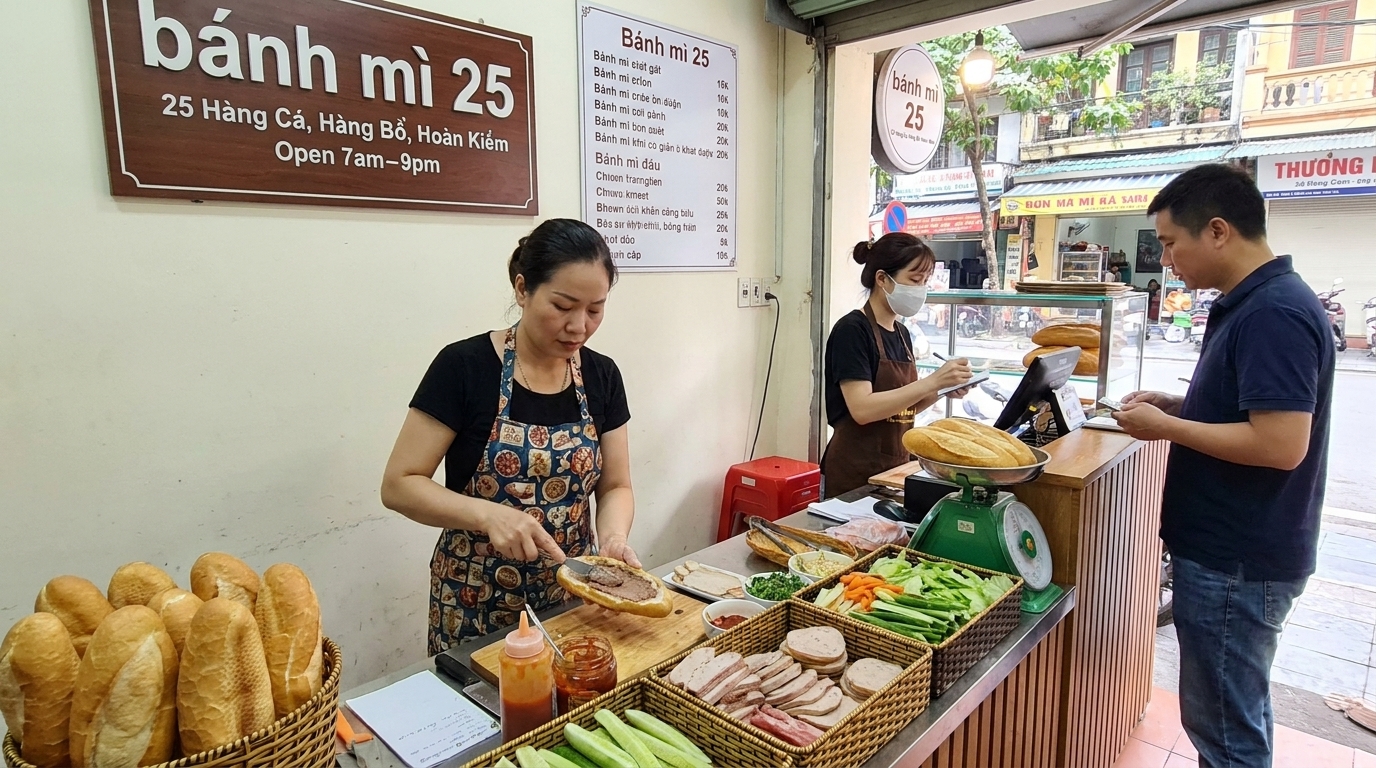
Bánh Mì 25 — 25 Hàng Cá, Hàng Bồ, Hoàn Kiếm. Open 7am–9pm. This is the banh mi everyone recommends and the recommendation is correct. 55,000 VND gets you an avocado banh mi that’s roughly the size of a small baguette loaded with pâté, pickled vegetables, fresh coriander, and chili. There’s a takeaway window and a sit-down spot directly across the alley. Arrive before 9am or expect a queue. The tourist crowds find it around 10am and the queue gets serious.
Bánh Cuốn Bà Hoành — 66 Tô Hiến Thành, Hoàn Kiếm. Steamed rice rolls filled with minced pork and wood-ear mushroom, served with chả lụa (Vietnamese pork sausage) and dipping fish sauce. This is the Old Quarter version of a slow breakfast — order two portions, watch the woman steam each roll individually on cloth over boiling water, pour yourself tea. Open 7–11am only.
Bún Thang Bà Đức — 48 Cầu Gỗ. Enter the alleyway and go up the stairs. No street sign tells you it’s there. Bún thang is a delicate northern Vietnamese noodle soup — thin rice vermicelli, chicken, pork, egg — in a clear broth made from chicken bones and dried shrimp. It’s the dish Hanoians eat during Tết and in the weeks after. Serving it has no tourist logic — it’s too mild, too subtle, too specifically local. The fact that it’s still here, hidden in a walkup above a jewelry lane, is the reason it’s worth finding.
Lunch (11am–2pm)
Bún Chả Đắc Kim — 21 Nguyễn Hữu Huân, Lý Thái Tổ. Open 7am–10pm. Communal tables, tiny plastic stools, fans that don’t quite cut the heat. Order the combo: bún chả (grilled pork patties and belly in a sweetened fish sauce broth, with a plate of rice vermicelli and herbs) plus a Saigon beer. Total: 150,000 VND ($6.50). This is lunch. Don’t order anything else. The grilled pork is done over charcoal on a sidewalk grill out front — the smoke smell reaches you a half-block away.
Bún Chả 74 Hàng Quạt — different location, same idea. The cook works at the back of the alley over charcoal. The space has no resemblance to a restaurant — it looks like someone’s home that also has a grill. That’s because it is.
Afternoon (3–6pm)
Bánh Gối Xuân Hồng — 36 Lê Đại Hành. Hot-filled pyramidal dumplings, fried until the outside is crisp. 20,000–35,000 VND each. Eat immediately — they lose the crispness in about four minutes. Dip the edges into fish sauce, not the whole thing. Best between 3 and 5pm when the oil is fresh. These are a snack, not a meal, but they’re specific enough to the Old Quarter’s street food culture that skipping them is a miss.
Egg coffee — Cà Phê Giang, 39 Nguyễn Hữu Huân, or the original location at 39 Hàng Hành (a courtyard, no street frontage — look for a handwritten sign). Egg coffee is what it sounds like: robusta espresso with a whipped egg yolk cream on top, the cream stiff enough to hold a spoon. Invented in Hanoi in the 1940s when fresh milk was scarce. Served warm or cold. 30,000–55,000 VND. The tourists have found it, yes — Cà Phê Giang is on every list — but the coffee is still made by the original family. Worth it.
Evening (7pm–whenever)
The corner of Tạ Hiện and Lương Ngọc Quyến. This is bia hoi — fresh-brewed draft beer, not bottled, made daily and sold until it runs out. A glass costs 7,000–10,000 VND. Thirty cents. You sit on a plastic stool on the pavement, no table, no menu, no bill — you just drink until you stop. The beer is light, slightly sweet, better cold than warm. Order by holding up fingers. The woman running the cart has seen a thousand people like you and will not be impressed or offended by anything you do.
This corner is not hidden. It’s in every guidebook and on every Vietnam Instagram account. It’s also genuinely one of the best places to sit for an hour in Southeast Asia. Arrive before 8pm for a stool — after 9pm the crowd thickens and the mood shifts from relaxed to loud.
Where to Stay in the Old Quarter
The first decision is noise tolerance. The Old Quarter’s streets sound beautiful during the day and operate until 1–2am near the bar streets (Tạ Hiện, Lương Ngọc Quyến, Mã Mây). Booking a room within a hundred meters of any of those streets means hearing them until they stop. Some travelers love this — others regret it immediately. Choose deliberately.
Budget Hostels
Little Charm Hanoi Hostel — on a side street off Tạ Hiện, which sounds like it would be noisy but is quieter than you’d expect (the building is set back). Dorm beds from 130,000 VND ($5.40/night). The entrance is a living wall of greenery — one of those hostels where you walk in and immediately feel like staying an extra day. Small, clean, not stuffy. Staff speak good English and will sort you out for tours, transport, and SIMs.
g a sudden rain. Book early; this one fills.
Lakeview Backpackers Hostel & Rooftop Bar — the name is accurate. From the rooftop, you can see the green of Hoan Kiem Lake through the gap in the Old Quarter roofline. Communal areas are well-designed, dorms clean, atmosphere genuinely social without being forced. The view at 7am over morning mist on the lake justifies staying here.
Mid-Range (Private Rooms)
Private rooms in the Old Quarter run 600,000–1,100,000 VND ($25–45) per night for something decent with AC. The sweet spot is the streets east of Hàng Gai — Hàng Trống, Đinh Liệt, Hàng Hành — close enough to walk everywhere, far enough from the bar strip to sleep. Search for boutique hotels with “tube house” architecture — the narrow, deep old shophouses converted to rooms. The best ones have rooftop terraces and staff who’ve been there ten years.
Avoid any hotel above a restaurant on Tạ Hiện unless the listing explicitly mentions soundproofing and you believe them.
Getting Around Inside the Old Quarter
Walk. The entire Old Quarter is roughly 1 square kilometer. Every address is reachable on foot in under fifteen minutes from any other address. Motorbikes weave through the narrow lanes constantly — not as transport for you, but because the street network predates cars and the lanes were never designed for anything wider than a loaded bicycle.
Crossing streets: walk steadily, don’t run, don’t stop. The drivers will read your movement and go around you. The freezing-in-the-middle-of-the-road response is what causes problems. Watch a local cross first, then do what they do.
12Go covers most Vietnam routes — sleeper buses, trains, and island ferries. Compare schedules and book in advance during peak season (Dec–Feb, Jun–Aug).
For anything beyond the Old Quarter: Grab. The app works reliably, the prices are fixed, and the motorbike taxis (GrabBike) navigate the narrow streets better than four-wheeled alternatives. Airport: the public bus to Noi Bai costs 45,000 VND and takes 45–55 minutes. Grab from the airport runs about 450,000 VND ($18 USD). The math on the bus is obvious — use it going out, use Grab coming in if you’re arriving late with luggage.
What the Old Quarter Is Not
It’s not the whole of Hanoi. Most visitors spend their entire stay in the Old Quarter and leave thinking they’ve seen Hanoi. They’ve seen one neighborhood — the most compressed, most touristed, most vertical neighborhood in the city. The French Quarter (Ba Đình and the area around the Opera House) is architecturally completely different: wide boulevards, colonial villas, actually navigable pavements. West Lake (Tây Hồ) is where the expats and the upmarket cafés are, quieter and more spread out. Temple of Literature is a thirty-minute walk southwest and requires ninety minutes of your time.
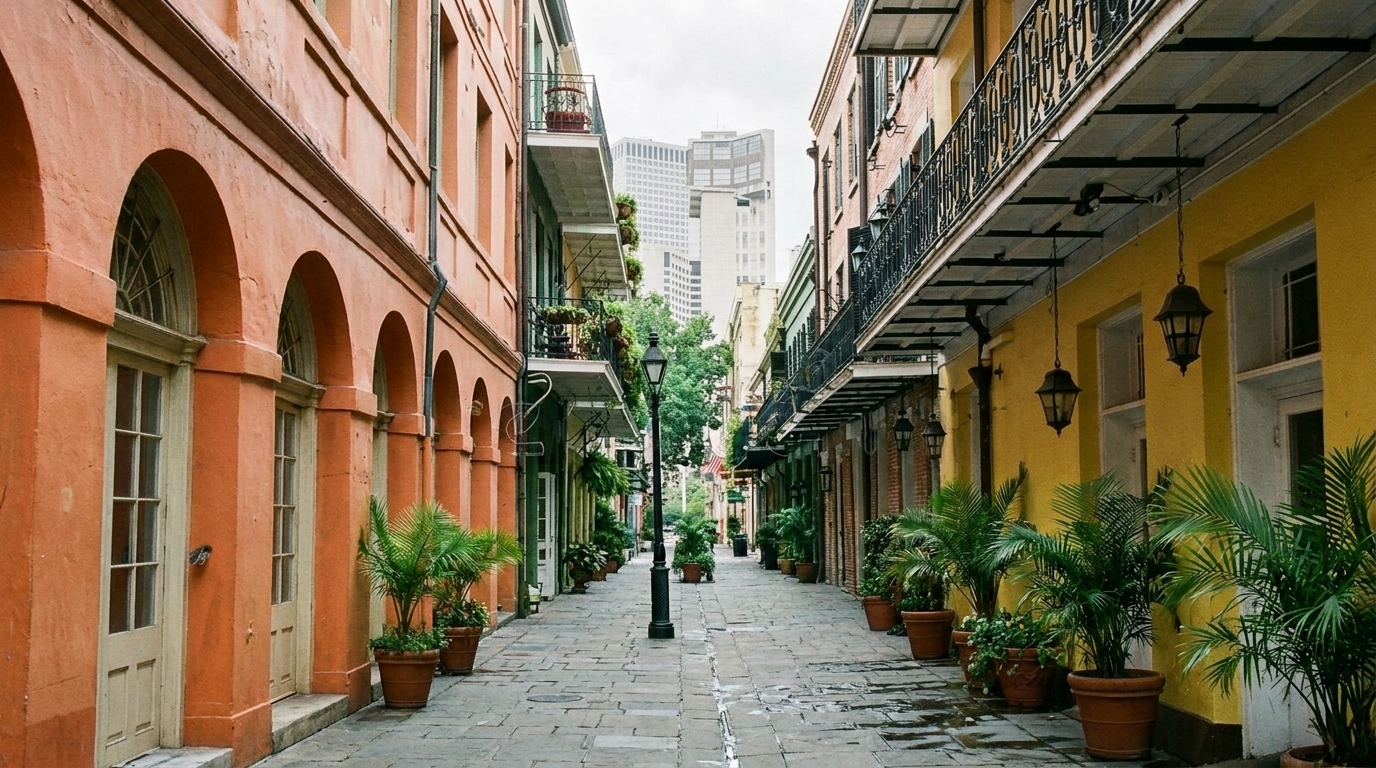
It’s not cheap everywhere. The Old Quarter has two price tiers running simultaneously: street food prices (real) and tourist-facing restaurant prices (inflated). Any menu with English and laminated pages is operating on tourist margin. The actual food — the banh mi stall, the bia hoi cart, the woman spooning phở from a pot on the pavement — is still honest money. The division is clear once you know what you’re looking at.
It’s not quiet at any point between 8am and midnight on any street that has foot traffic. This is not a bug. The noise, the compression, the constant sensory input of thirty thousand people living on thirty-six streets is the experience. If it’s overwhelming — and it is, initially — find a café on an upper floor with a window, sit with a coffee, and let it happen below you for twenty minutes. The overwhelm passes and the fascination begins.
What Travelers Actually Say: The Consensus
The most common Old Quarter regret: not going early enough. Travelers who arrived at 6am describe a city that feels accessible and local. Travelers who showed up at 10am describe the same streets as crowded and overpriced. The place is identical — the experience gap is entirely timing. Multiple threads specifically note that the “authentic Hanoi” in travel photos exists in the Old Quarter, but only between dawn and about 9am before tour buses arrive in force.
The bia hoi corner at Tạ Hiện gets overwhelmingly positive reviews when travelers understand what it is: outdoor seating, 7,000–10,000 VND draft beer, zero ambiance beyond plastic stools and strangers’ conversations. Travelers who go expecting a bar experience leave disappointed. Ones who go expecting cheap beer and good people-watching leave happy.
⚠Real Talk
Phung Hung Mural Street comes up constantly in Old Quarter guides. The murals are still there. The commercial overlay — cafes, souvenir stalls, tripod photographers — has intensified every year since 2019. Go for a 10-minute look on the way somewhere else: worth it. Go expecting the quiet creative space the murals originally suggested: mildly disappointing.
Frequently Asked Questions About Hanoi Old Quarter
How many days should I spend in the Old Quarter?
Two full days is enough to walk the streets properly, eat the things worth eating, and sit at bia hoi without feeling rushed. Three days if you want to include day-trip logistics from here (Ninh Binh, Ha Long Bay). Beyond three days, the Old Quarter specifically starts to feel repetitive — which is your signal to explore the rest of Hanoi: West Lake, the French Quarter, the Ho Chi Minh Mausoleum complex.
Is the Old Quarter safe at night?
Yes, with the standard precautions. The area around Tạ Hiện late at night (after 11pm) gets crowded and loud but not dangerous. The main risks are the same as any busy urban tourist area: phone snatching from motorbikes (keep your phone in your pocket, not your hand while standing near moving traffic), and overcharging from unlicensed taxis or xe om if you’re not using Grab.
What is the best street in the Old Quarter?
Depends on what you’re looking for. Hàng Gai for silk and tailors. Hàng Bạc for silver jewelry and watching goldsmiths work. Hàng Mã for traditional paper votive offerings — the most photographed street in the quarter during Tết season. Tạ Hiện for nightlife. Hàng Đào to Hàng Ngang on weekends for the night market. For walking with no purpose: Mã Mây, Hàng Buồm, Lương Văn Can — quieter lanes with actual residents still living above the shops.
Is Hoan Kiem Lake in the Old Quarter?
Hoan Kiem Lake sits just south of the Old Quarter, forming its natural boundary. The lake itself is free to walk around. Ngọc Sơn Temple (on the island in the lake, accessible via the red Thê Húc Bridge) costs 30,000 VND to enter and takes twenty minutes. Worth it. The turtle tower in the center of the lake is the icon — the lake’s name (Sword Lake) refers to the legend of a giant turtle that retrieved the magic sword of King Lê Lợi from its waters in the 15th century.
Where should I avoid staying in the Old Quarter?
Any hotel directly above or within one street of Tạ Hiện, Lương Ngọc Quyến, and Mã Mây if you’re a light sleeper or planning early mornings. The noise on those streets peaks around 10–11pm and genuinely doesn’t fade until 1–2am on weekends. A hotel on Hàng Gai, Hàng Bạc, or the smaller lanes north of Đồng Xuân Market will be noticeably quieter.
Do I need to book accommodation in the Old Quarter in advance?
Yes. Especially for anything under $15/night and during peak season (November–April) or holidays. Walk-in availability in the Old Quarter is a gamble — the area is popular enough that good hostels fill two to four weeks ahead in high season. Book at least a week out, ideally two.
The Short Version
Walk the Old Quarter at 6am, before it wakes up. Eat bánh mì at Hàng Cá. Find the stairs to Bún Thang Bà Đức on Cầu Gỗ. Have bún chả at Nguyễn Hữu Huân for lunch, banh goi on Lê Đại Hành for a late afternoon snack, egg coffee at Cà Phê Giang before dinner, bia hoi at the Tạ Hiện corner until you stop.
Sleep somewhere with a window that doesn’t face the bar street.
The Old Quarter is chaotic, loud, genuine, and unlike anywhere else I’ve been in twenty countries. It’s also very good at extracting money from people who don’t know the real prices. Know the prices. Use the street stalls. Walk the quiet lanes at dawn. It’ll be the part of Hanoi you talk about when you get home.
For the rest of Hanoi beyond these thirty-six streets: the full Hanoi guide covers neighborhoods, what to skip, and how to structure your time. And before you get here, sort the SIM card — Grab doesn’t work without data, and the Old Quarter’s streets are not the moment to figure out roaming charges.