Last updated: June 2026 — entrance fees and hours verified June 2026.
I’ve brought three different friends here over the years, and the reaction is always the same: they expected a museum, they got a time capsule. The palace hasn’t been restored or reinterpreted — it’s been frozen. The 1970s phones still sit on the desks. The emergency communication equipment in the basement bunker looks like it’s waiting for a call. Walking through it feels less like visiting a memorial and more like stepping into April 30, 1975, and finding everyone just left.
The contrast with the War Remnants Museum — which is vivid, confrontational, and deliberately emotionally overwhelming — is significant. The Reunification Palace is quieter. It asks you to bring your own understanding of what happened here and let the physical space amplify it. That works better if you’ve done some reading beforehand. If you visit cold, you’ll see a well-preserved mid-century government building. If you come with context, you’ll see something considerably harder to shake.
Both approaches have their logic. But the palace rewards preparation more than almost any site I’ve visited in Vietnam — and at 40,000 VND, it’s the best-value significant historical site in the country.
What Is the Reunification Palace?
The building stands on the site of the former Norodom Palace, which the French colonial administration built in 1868 as the official residence of the Governor of Cochinchine. After Vietnamese independence in 1955, it became the residence and working headquarters of South Vietnamese President Ngô Đình Diệm. In 1962, two rebel South Vietnamese Air Force pilots bombed the palace in an assassination attempt against Diệm, destroying the left wing. Diệm survived; the damaged building was demolished and replaced with the current structure, designed by Vietnamese architect Ngô Viết Thụ and completed in 1966.
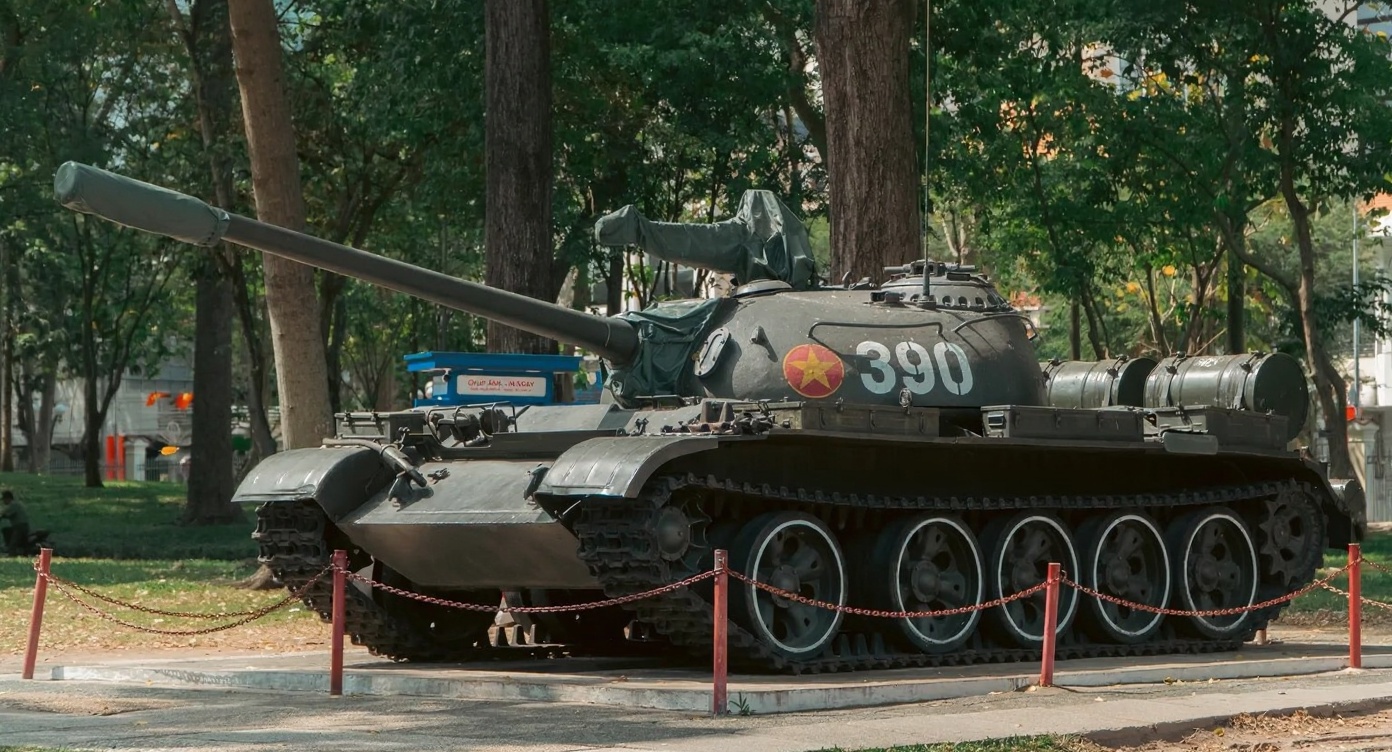
The palace served as the seat of South Vietnamese government through the end of the war. On April 30, 1975, North Vietnamese Army Tank 843 — and shortly after, Tank 390 — crashed through the iron gates of the palace compound. A soldier ran up to the rooftop and raised the NLF flag. The war was over. The image of that tank going through the gates became one of the defining photographs of the 20th century.
After 1975, the palace was briefly used by the new government before being preserved as a historical site. It was renamed “Reunification Palace” — hội trường Thống Nhất — reflecting the formal reunification of North and South Vietnam in 1976. Everything inside has been kept as it was.
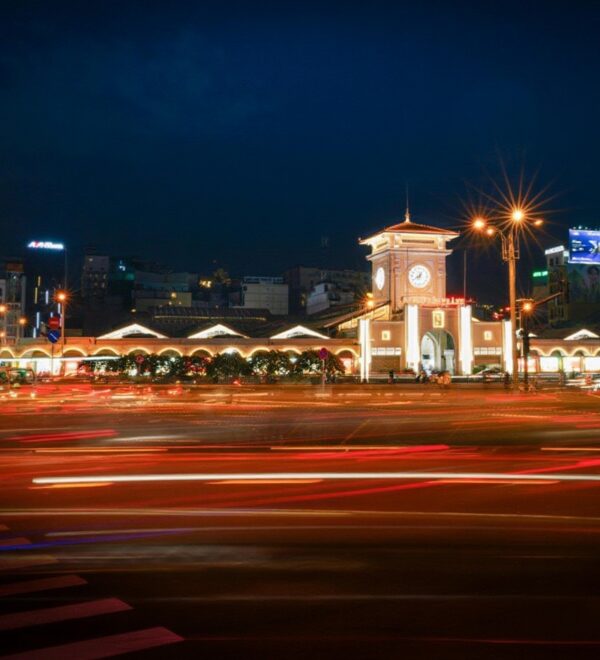
> **Quick Answer:** Reunification Palace is open daily 8:00 AM–5:00 PM (closed for lunch 11 AM–1 PM). Entrance: 40,000 VND adults / 20,000 VND children. Allow 1.5–2 hours. Located at 135 Nam Kỳ Khởi Nghĩa, District 1 — 15 minutes on foot from Ben Thanh Market.
What to See Inside the Reunification Palace
The palace has four floors open to visitors, plus a basement bunker complex. The tour is self-guided (audio guides available for rent at the entrance for 30,000 VND additional). Allow 1.5–2 hours to see everything properly.
Ground Floor — Reception and State Rooms
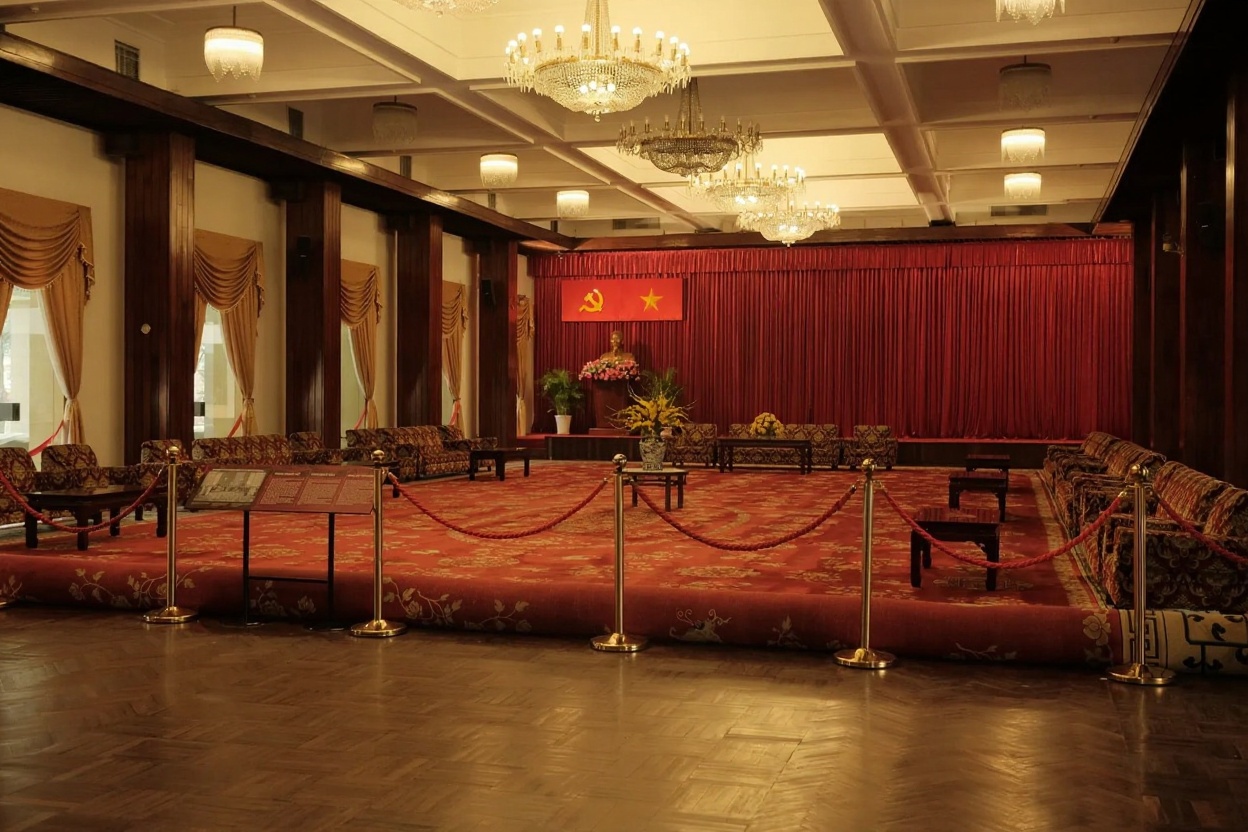
The ground floor contains the main reception hall and the formal dining room used for state banquets. The furniture is teak — heavy, dark, very 1960s official. The reception room walls are hung with lacquerwork panels depicting Vietnamese landscapes in the high-art tradition of the Ngô Đình Diệm administration. All of it is original.
First Floor — Presidential Office and Cabinet Room
The first floor is where the work of government happened. The president’s personal office has the original desk, chairs, a world globe, Vietnamese and South Vietnamese flags still standing in the corners. The cabinet meeting room has a long conference table with the president’s chair slightly elevated at one end — a detail that tells you something about how these meetings were structured.
The most arresting room on this floor is the military operations room: a large table overlaid with maps of Vietnam and the surrounding region, colored pins still in position from the last days of the war. Standing over those maps knowing how the story ended gives you a particular kind of feeling that’s hard to describe accurately.
Second Floor — Family Quarters and Cinema Room
The second floor was the private living space of the presidential family — bedrooms, a family living room, a card room. The scale here is more human than the state floors: personal photos, smaller furniture, a room that looks like someone’s house rather than a government building. There’s also a cinema room — a small screening theater used for private films — that feels anachronistically normal.
Rooftop
The rooftop contains a helipad and a dance/entertainment space that was used for official functions. The helipad is where the last American evacuees and South Vietnamese officials departed by helicopter in the final hours before the fall. Standing on it with the Saigon skyline behind you and that context in mind is one of those moments when historical weight and physical place align clearly.
Basement Bunker
The basement is the most viscerally interesting section for most visitors. The bunker complex includes the emergency communications center — rooms full of vintage radio equipment, maps, situation boards — and a series of corridors connecting them. The equipment looks operational even though it hasn’t been used in 50 years. It smells of concrete and stale air. The overall effect is of interrupted purpose: everything ready for a war that ended before any of it could be used in the final moments.
Reunification Palace vs. War Remnants Museum
Both the Reunification Palace and the War Remnants Museum are essential Saigon historical visits. They tell different parts of the same story.
Do both if you have time — they’re 10 minutes apart on foot. The Palace in the morning (cooler, before crowds), lunch in the nearby streets around Lê Lợi, War Remnants Museum in the afternoon. That’s a full Saigon history day.
For the full itinerary context, see the things to do in Ho Chi Minh City guide.
Reunification Palace for Photographers
The palace is one of the best interior photography subjects in Saigon. The 1960s–70s design aesthetic — teak paneling, geometric rugs, low ceiling lighting, vintage communications equipment — photographs exceptionally well. A few specifics:
Presidential office (first floor): Morning east light comes through the tall windows and hits the teak desk cleanly. Best 8–9 AM. Avoid flash — the room is well-lit naturally and flash flattens the texture.
Military operations room (first floor): The maps-and-pins table is the shot. Wide angle to show the full table, or tight on the colored pins clustered around Saigon and the Central Highlands. No tripods needed at ISO 800.
Basement communications center: Lower light than upstairs. Vintage radio equipment and panel boards. The green-filtered overhead lights give the space a particular color cast that’s worth keeping rather than correcting in post.
Rooftop helipad: The city skyline is visible from here — modern Saigon skyscrapers framed against the 1966 rooftop structure. Go up before 9 AM before haze builds, or late afternoon for warmer light.
Tank 390 (northeast grounds): Best light in morning. The tank is accessible — visitors can stand next to it, and the side panel showing the hull number photographs cleanly from about 3 meters.
Practical Information 2026
What Happened to the People in the Palace on April 30
The human stories of what happened inside the building on April 30 are worth knowing. President Dương Văn Minh — “Big Minh,” so called because of his physical size, not to be confused with the more famous General Minh — had been in office for exactly two days. He’d been installed in a desperate last-minute move by the South Vietnamese government, which believed his reputation for moderation might make him acceptable to the North as a negotiating partner. It didn’t matter.
After being taken to the radio station to formally surrender, Minh was held under house arrest for several years before eventually being released and allowed to emigrate to France in 1983. He died in Los Angeles in 2001. Most of the cabinet members who were in the building that morning spent years in re-education camps. Some were released within a few years; others remained imprisoned into the late 1980s.
The NLF soldiers who entered the building were members of units that had been fighting for years, some of them through the full length of the war. The officer who led the group into the palace was Colonel Bùi Tùng. In interviews given decades later, he described the moment as one of complete disbelief — that the fighting was actually over, that they were inside the palace, that it had happened so quickly at the end after so long.
Tips for Visiting
Go early or after lunch. The palace closes 11 AM–1 PM for lunch (a Vietnamese government site tradition that surprises a lot of visitors). Arrive at 8 AM for the emptiest version of the building, or at 1 PM to beat tour groups. Mid-morning 9–11 AM is the busiest period.
Bring the historical context. Without knowing the broad strokes of the American War and the fall of Saigon, the palace is an interesting building. With it, the building becomes something else. Spend 20 minutes reading about April 30, 1975, before you visit — it changes what you see.
The basement is the highlight. Most visitors spend most of their time on the upper floors and rush the basement. Do the opposite. The communications bunker is where the story of what this building actually was comes through most clearly.
Photography is allowed everywhere. No flash required by the rooms’ own lighting. The president’s office and the military operations room photograph particularly well in the morning light through the east-facing windows.
Real Talk
The Reunification Palace is one of the most undervisited significant sites in Southeast Asia. I’ve been to comparable Cold War–era preserved government buildings in Eastern Europe that draw massive tourist infrastructure. This one has a 40,000 VND entrance fee, a small parking lot, and almost no souvenir presence. Part of that is Vietnam’s approach to its own history — the war ended 50 years ago and the Vietnamese government has complex feelings about how much it should be marketed as tourist attraction. Part of it is that most Saigon itineraries default to the War Remnants Museum and skip this. Don’t make that mistake.
April 30, 1975 — What Actually Happened Here
The sequence of events on April 30, 1975 is worth knowing before you visit. By early morning that day, South Vietnamese President Dương Văn Minh had already announced unconditional surrender over the radio. The streets of Saigon were a mix of fleeing civilians, abandoned military equipment, and NVA and NLF forces moving into the city.
At 11:30 AM, Tank 843 of the 203rd Tank Brigade broke through the left gate of the presidential palace grounds. It got stuck in the gate; Tank 390 came behind it and drove through the central gate. A soldier climbed from the turret, ran to the palace steps, and carried a Viet Cong flag to the second-floor balcony. The footage of that moment, shot by French photographer Françoise Demulder, became one of the iconic images of the 20th century.
Inside the palace at that moment, President Dương Văn Minh was waiting in the first-floor reception room with his cabinet. When the NLF soldiers entered, Minh reportedly said “I have been waiting since early this morning to transfer power to you.” The NLF officer responded: “There is no question of your transferring power. Your power has crumbled. You cannot give up what you do not have.” Minh was taken to the radio station to formally announce surrender. The war — 30 years after it began with the French — was over in a conversation that lasted minutes.
Both tanks are on the palace grounds today. Tank 843, which got stuck in the left gate, is parked outside the main entrance. Tank 390, which drove through the central gate and technically made it onto the grounds first, is displayed in the northeast corner. The plaques on both tanks explain their history.
The Grounds and Surrounding Area
The palace compound covers approximately 12 hectares in the center of District 1. The grounds include the main building, a garage with original government vehicles (including a 1960s Mercedes and a military jeep), the two historic tanks, and extensive formal gardens that function as a public park on weekends — Vietnamese families picnic on the lawns under the tamarind trees.
The surrounding streets reflect the administrative center character of the area. Nam Kỳ Khởi Nghĩa Street, running along the west side of the compound, is Saigon’s diplomatic and government corridor: foreign consulates, government ministry offices, the Municipal Theatre. The Caravelle Hotel — where American journalists stayed during the war and watched combat from the rooftop bar — is four blocks east on Lam Son Square.
Notre Dame Cathedral (currently undergoing renovation as of 2026) and the Central Post Office are six minutes on foot northeast. The War Remnants Museum is 10 minutes southwest, on Vo Van Tan Street. This entire cluster of French colonial and war-era landmarks is walkable within a 20-minute radius and makes for the most historically dense single morning in Ho Chi Minh City. The Ho Chi Minh City travel guide has the multi-day itinerary for sequencing it all.
The Architecture
The building itself is worth attention independent of the history. Vietnamese architect Ngô Viết Thụ won the Prix de Rome in 1955 — the first Vietnamese to do so — and the palace design reflects a sophisticated blend of modernist principles and Vietnamese architectural symbolism. The façade’s vertical fins reduce heat gain (a practical tropical architecture decision) while also evoking the traditional Vietnamese cổng tam quan gate. The overall aesthetic is mid-century official: confident, formal, built to project authority.
The interiors use teak throughout — an expensive choice in 1966 that was also a political statement about South Vietnamese independence and prosperity during a period of active war. The lacquerwork panels on the state floors were commissioned from the Hanoi School of Fine Arts, which had been relocated south — an interesting detail about how the war disrupted cultural institutions as much as political ones.
Reunification Palace FAQ
What are the Reunification Palace opening hours?
The palace is open 8:00 AM–11:00 AM and 1:00 PM–5:00 PM daily. It closes for a two-hour lunch break from 11 AM to 1 PM — this surprises many visitors who arrive mid-morning planning to visit after lunch. Last entry is 4:30 PM. The site is open every day of the week. On Vietnamese national holidays (particularly April 30 — Reunification Day), the palace grounds host events and may have altered access to some sections.
How much does it cost to enter the Reunification Palace?
Entrance is 40,000 VND for adults and 20,000 VND for children under 15. Audio guides in English, French, and Chinese are available for an additional 30,000 VND — worth taking if you want detailed room-by-room context. Photography is included in the entrance fee; no additional charge for cameras or phones.
How long should I spend at the Reunification Palace?
Allow 1.5–2 hours to see all four floors plus the basement bunker complex properly. Rushing it in an hour means missing the basement communications center, which is the most viscerally interesting section. If you’re combining it with the War Remnants Museum in one day, do the palace in the morning (8–10 AM), have lunch nearby, then museum in the early afternoon.
Is the Reunification Palace worth visiting?
Yes — it’s one of the most significant historical sites in Vietnam and systematically underrated in travel guides. The interior has been frozen since 1975: the presidential office, military operations room, and basement bunker all look as they did when the building was in active use. For context on the American War and the fall of Saigon, the palace provides a physical, architectural experience that no museum can replicate. Entrance is 40,000 VND — the best value of any paid attraction in Ho Chi Minh City.
Can I visit the Reunification Palace and War Remnants Museum in one day?
Yes — they’re about 10 minutes apart on foot. Standard approach: Reunification Palace in the morning (8–10:30 AM), lunch in the surrounding streets, War Remnants Museum from 1:30–4 PM. Both take 1.5–2 hours each. Be aware that the War Remnants Museum contains some of the most difficult war photography in any museum anywhere — the Agent Orange and civilian casualty sections in particular. Don’t plan anything requiring sustained concentration immediately after.
How do I get to the Reunification Palace from Ben Thanh Market?
It’s a 15-minute walk — head north on Nam Kỳ Khởi Nghĩa Street from the Ben Thanh roundabout. By Grab or Be, expect to pay 40,000–70,000 VND from most District 1 hotels. The Metro Line 1 Ben Thanh station is nearby; from there it’s a 10–12 minute walk.