Last updated: May 2026
Cai Rang Floating Market — The Real One
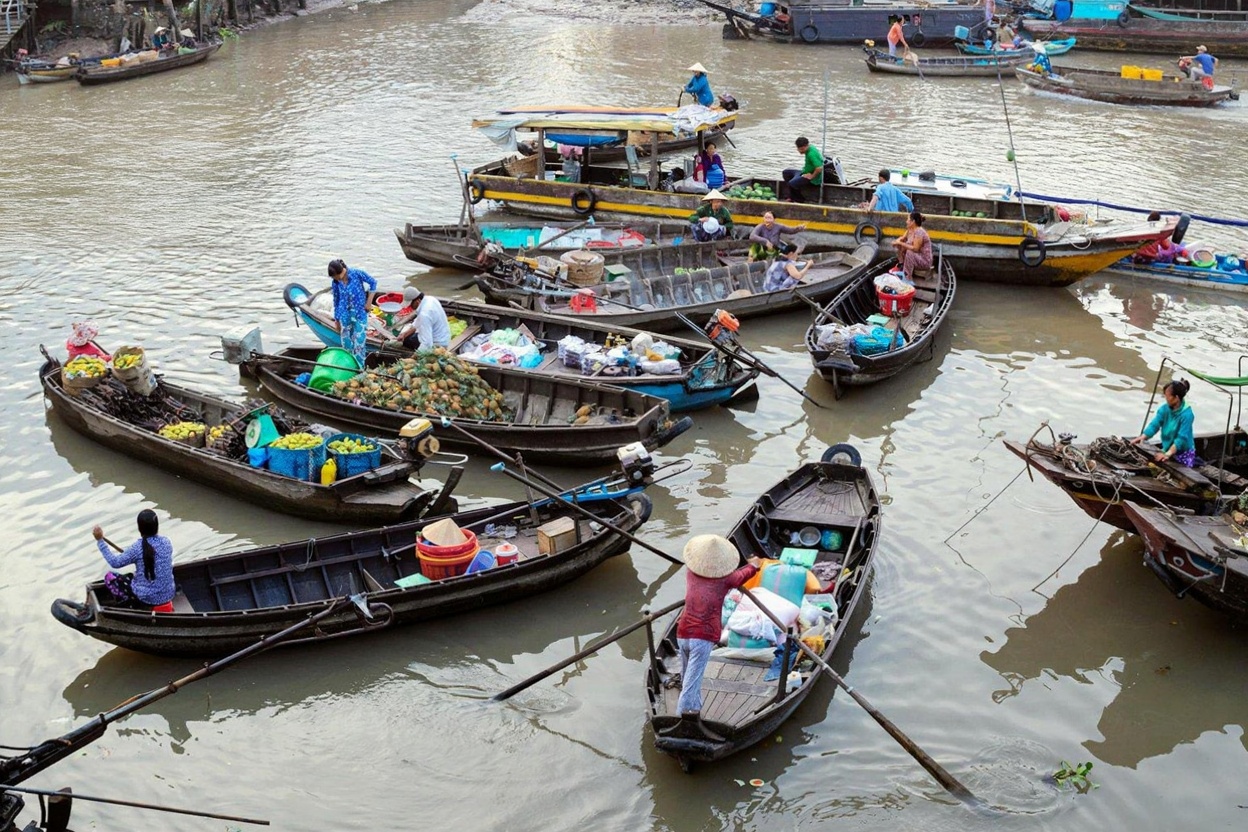
Cai Rang (Chợ nổi Cái Răng) sits on the Cai Rang River, 6km southwest of Can Tho city center. It operates as a genuine wholesale market — fruit and vegetable traders from across the Mekong Delta converge here to buy and sell bulk produce before dawn. Each boat advertises what it’s selling by hanging a sample from a long bamboo pole at the bow (called a cây bẹo) — watermelons, pineapples, dragon fruit, coconuts, bananas, cabbage. The stacks can rise two meters above the boat’s gunwale when fully loaded.
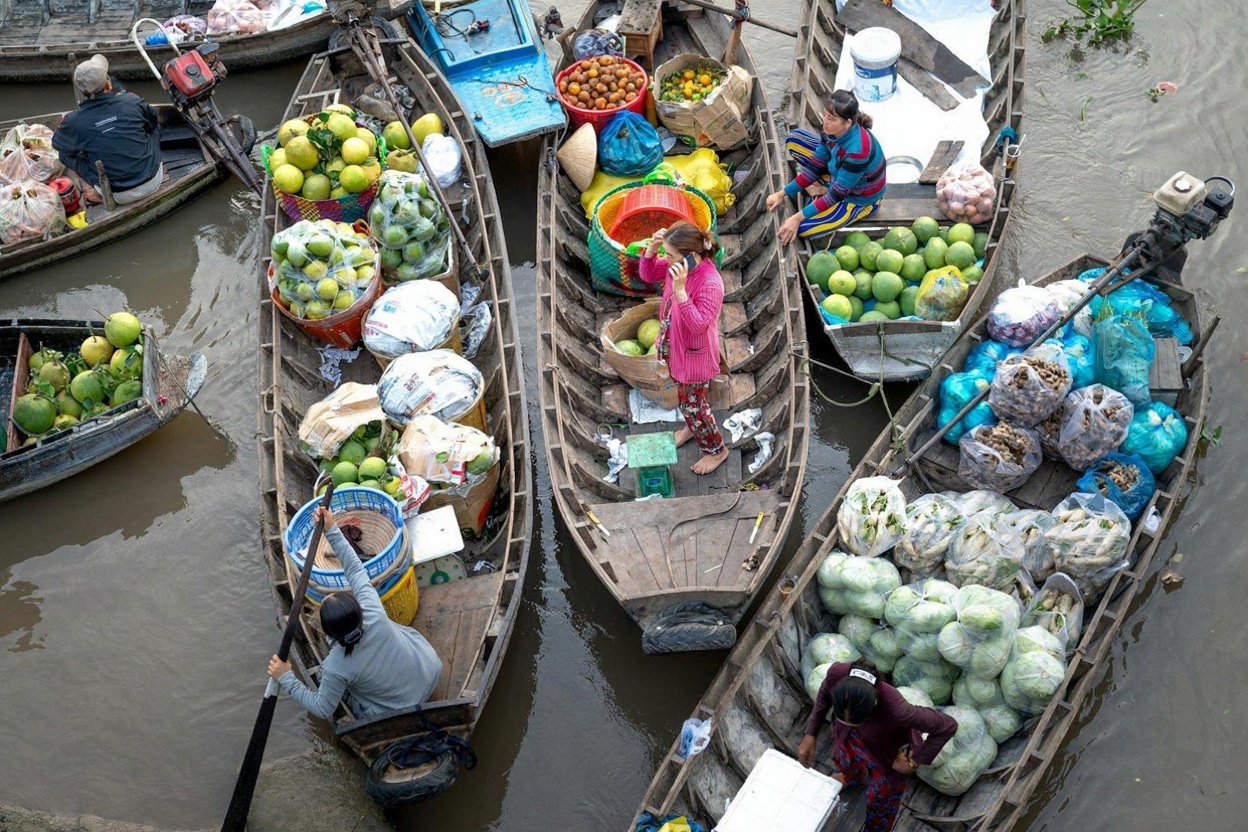
The market is most active from 5:30am to 7:30am. By 8:30am, most of the wholesale trading is done and the boats begin dispersing. Arrive after 9am and you’ll find a handful of vendors selling bottled water and pineapple slices to tourist groups — not the market. The 5am alarm is not optional.
What makes Cai Rang worth it: the scale. On a good morning you’ll see 200–400 boats simultaneously trading, arguing prices, maneuvering through narrow water channels, and cooking breakfast on small charcoal stoves at the stern. The noise is constant — diesel engines, bargaining voices, wooden hulls knocking together. You smell the produce before you see the market — ripe mango and coconut husk and river water, a combination that’s specific to this part of Vietnam.
The small food boats (thuyền bán hàng ăn) weave between the trading vessels selling coffee, bún riêu (crab noodle soup), bánh mì, and fresh fruit at market prices. Breakfast on the water: a bowl of bún riêu is 30,000–50,000 VND, coffee with condensed milk is 15,000–20,000 VND. This is the best breakfast in Can Tho.
How to Get to Cai Rang — Without the Tour Bus
The standard approach sold by Saigon day-tour operators is: bus from Saigon at 4am, arrive Can Tho at 7:30am, speedboat to Cai Rang at 8am, photograph the last few vendors, bus back to Saigon by 5pm. This is the worst way to see Cai Rang. You arrive after the market peaks, you’re on a noisy speedboat with 15 other people, and you spend most of your day on a highway.
The right approach is to stay in Can Tho the night before and hire a private longtail boat from Ninh Kieu wharf at 5:30am.
Klook has the widest selection for Vietnam and is usually the cheapest. KKday is strong on day trips and local experiences.
boat that holds 2–4 people. A 2-hour trip to Cai Rang and back covers the market properly. Total cost for a couple: 300,000–500,000 VND. No group, no schedule pressure, the driver stops where you want to stop.
Shared tour boats: Guesthouses and travel agencies in Can Tho offer shared boat tours departing Ninh Kieu at 5am–5:30am for 50,000–80,000 VND/person. These typically include the market plus a fruit orchard visit and sometimes a rice paper or rice noodle factory. The group size varies (5–15 people). The shared boats are slower than private hire but the price is significantly lower, and the local guides on these tours often have good commentary. If cost is a concern, a shared tour from a Can Tho guesthouse (not a Saigon day-tour) is fine.
What to avoid: Tours that depart from My Tho or Saigon promising “Cai Rang floating market.” These depart too late, arrive after the market peaks, and charge 400,000–800,000 VND for an inferior experience. The logistics simply don’t work — a 3.5-hour bus ride means you arrive at the tail end. Staying in Can Tho is not optional if you want to see the market properly.
Phong Dien — The Quieter Alternative
Phong Dien floating market (Chợ nổi Phong Điền) is 15km southwest of Can Tho, accessible by road (30 minutes by motorbike) or by boat (45–60 minutes from Ninh Kieu). It’s smaller than Cai Rang — 50–80 boats compared to several hundred at peak — but also significantly less visited by tourist groups.
The character at Phong Dien is more neighborhood market than wholesale trade hub: smaller transactions, more local shoppers arriving by boat from nearby canals, and vendors who look less habituated to cameras. The best window here is also early — 6am to 8am — though the market runs slightly later than Cai Rang.
Phong Dien makes the most sense as an addition to Cai Rang if you’re spending two nights in Can Tho and want a second morning on the water with a different feel. Doing both on the same morning is logistically difficult — they’re in opposite directions from Can Tho center and each requires 1.5–2 hours of boat time. If you only have one morning, Cai Rang first.
My Tho — Why You Should Skip It
My Tho is 70km from Saigon — close enough to work as a day trip, which is why it gets packaged with “Mekong Delta day tours” from Ho Chi Minh City. The floating market near My Tho exists, technically. But the vendors are there because tourists come to photograph them, not because the market serves a commercial function. The trading is performative. Prices for visitors are 3–5× the local rate. The “traditional boat ride” is on fiberglass tourist boats, not the wooden longtails used at Cai Rang.
This isn’t a judgment on My Tho as a town — the town itself is a reasonable stop if you’re doing an overland route from Saigon to Can Tho and want a lunch break. It’s a judgment on the “floating market experience” sold as part of Saigon day tours. Go to Cai Rang.
The consistent Reddit feedback on Mekong day trips from Saigon: “consider actually staying in Can Tho for a night or two” rather than checking the Mekong box on a one-day bus excursion. That’s right. The delta requires overnight time to experience properly.
What the Market Sells — Understanding What You’re Seeing
The cây bẹo pole system is worth understanding before you arrive. Each boat hangs a sample of what it’s selling from a long pole at the bow — sometimes the actual product, sometimes a branch of the plant the product grows on. Watermelons hanging from a pole means the boat carries wholesale watermelons. Dragon fruit cluster means dragon fruit. A bunch of bananas means the whole boat is loaded with bananas, often hundreds of kilos.
This system predates GPS, standardized signage, and even widespread literacy — it allowed buyers navigating the market by boat to scan hundreds of vessels quickly and steer toward what they needed. Watching it in operation at 6am, when buyer-boats are weaving purposefully through the market reading the poles, you understand why it survived into the smartphone era: it works. The cây bẹo are visible from 30 meters. Your phone screen at 6am on a river is not.
The products are mostly fruit and vegetables from the surrounding delta provinces: watermelons, dragon fruit, longan, rambutan, durian, pineapple, sweet potato, cabbage. The durian boats are identifiable from 40 meters by smell alone. The wholesale prices here are what Vietnamese restaurants and market stalls across Can Tho pay — vastly lower than what you see in tourist-area restaurants. A kilogram of rambutan at Cai Rang wholesale: 10,000–20,000 VND. At a Saigon tourist restaurant: 80,000–150,000 VND/kg. The math of the supply chain is visible on the river.
Beyond the Floating Market — What Else to Do in Can Tho
The floating market is the main reason travelers come to Can Tho, but a full day beyond the 5am market trip is easy to fill:
Ninh Kieu Riverside at dusk: The main waterfront promenade is best at 5–7pm — locals walking, food carts setting up, families on benches watching the river traffic. The Ho Chi Minh statue overlooks the wharf. Low-key and genuine city evening activity. Free.
Bình Thủy Ancient House (Nhà cổ Bình Thủy): A 19th-century Vietnamese merchant house built in French colonial style — teak furniture, ornate tiles, family altar, preserved reception rooms. 10km north of Can Tho center. Free entry or small donation. Worth 45 minutes if you’re interested in the cultural synthesis of the southern Vietnamese merchant class during the colonial period. Has appeared as a filming location for several Vietnamese period dramas.
Local food in Can Tho: The city has some of the best banh xeo (sizzling rice crepe) in the south. The version here is larger than the Saigon style, filled with bean sprouts, shrimp, pork, and eaten wrapped in rice paper with herbs and fish sauce. A full banh xeo at a local restaurant: 60,000–90,000 VND (~$2.30–3.40). The night market on Hai Ba Trung Street (near Ninh Kieu) is the most accessible option for evening food, with prices lower than the tourist restaurants on the riverfront.
Canal village boat trip: Beyond Cai Rang, the small canals (kênh) threading through the delta’s agricultural land are where most people actually live. A 2–3 hour afternoon boat trip through these channels — passing floating fish farms, riverside houses with vegetable gardens extending to the water’s edge, children swimming off wooden docks — gives a better picture of daily life in the delta than the market alone. Ask your boat operator at Ninh Kieu to take you through the smaller canals rather than the main river. Same hourly rate: 150,000–250,000 VND.
Practical Details: Getting to Can Tho
Can Tho is 170km from Saigon — 3–3.5 hours by bus or car.
By bus: FUTA Bus Lines (Phương Trang) is the most reliable option. Departs from the Mien Tay bus station in Saigon (Bình Chánh district) roughly every 30 minutes from 5am to 10pm. Journey time: 3–3.5 hours. Cost: 110,000–150,000 VND (~$4.20–5.70). Book at least a day ahead at the FUTA ticket counter or via the FUTA app. The buses are modern, air-conditioned, and genuinely punctual by Vietnamese standards.
12Go covers most Vietnam routes — sleeper buses, trains, and island ferries. Compare schedules and book in advance during peak season (Dec–Feb, Jun–Aug).
By private car/minivan: 350,000–500,000 VND one way from Saigon for a shared minivan (6–9 people). 800,000–1,200,000 VND for a private car (4 passengers). Slightly faster door-to-door than the bus. Book through your Saigon guesthouse or Grab Car.
By sleeper bus (overnight): Less useful for Can Tho given the short distance — the city is close enough that an early-morning regular bus makes more sense than an overnight sleeper. Overnight buses to Can Tho do exist and cost 200,000–300,000 VND, but the 3.5-hour journey doesn’t justify a bed.
Accommodation in Can Tho: Budget guesthouses near Ninh Kieu wharf cost 200,000–350,000 VND/night (~$7.60–13) — staying close to the wharf means a 5-minute walk to your 5:30am boat. Mid-range hotels with river views run 600,000–1,200,000 VND/night. The Ninh Kieu 2 Hotel (state-run, on the waterfront) is a reliable mid-range option at 800,000–1,200,000 VND/night with river-facing rooms worth the price. For budget: the cluster of guesthouses on Hai Ba Trung Street, 3 minutes walk from the wharf, offers the best proximity-to-cost ratio for early-morning market logistics.
For the complete guide to getting around the Mekong Delta including the route from Saigon via My Tho and Can Tho through to Phu Quoc, see our Mekong Delta from Saigon guide.
When to Visit for the Floating Market
The Mekong Delta’s dry season runs November–April, wet season May–October. The floating market operates year-round, but:
Dry season (Nov–Apr): Water levels lower, easier navigation on smaller canals, clearer skies for morning photography. The market is most active December–March when the fruit harvest peaks for export.
Wet season (May–Oct): Higher water levels mean boats navigate slightly differently, some smaller canals become inaccessible, and the famous floating markets of the upper delta (closer to Cambodia) may restrict tourist boat access during flood season (August–October). The market itself still operates — rain or shine, the wholesale traders are there. Bring a thin rain jacket.
The best month is November: post-rains so the water is high enough for interesting canal navigation, dry weather starting to establish, and the tourist peak season not yet underway. Can Tho accommodation prices drop 20–30% compared to December–February.
What I Got Wrong About the Mekong Floating Market
I did the Saigon day-tour version first. Bus at 6am, stopped at My Tho for a “floating market” photo op at 9:30am, lunch at a tourist riverside restaurant, back in Saigon by 6pm. Expensive for what it was. The My Tho “market” had maybe 12 boats. The vendors were bored. I photographed a woman holding a pineapple and she held the pose like she’d been doing it for 15 years — she had.
The second time, I stayed in Can Tho the night before, woke at 4:45am, walked to Ninh Kieu in the dark, hired a private longtail boat for 180,000 VND/hour, and was at Cai Rang by 5:40am. The scale difference was extreme. 300+ boats. The noise and movement of actual commerce. I bought a cup of coffee from a woman who’d been at her floating coffee cart since 4am. Total cost for the morning: 540,000 VND including boat, coffee, breakfast, and tips. Worth it in a completely different register.
The mistake is thinking you can do the Mekong Delta as a Saigon day trip. You can’t — not properly. You need one night in Can Tho minimum.
The secondary mistake is treating the floating market as the only thing worth doing in the delta. The morning on the market takes 2–3 hours. The rest of Can Tho — the canal boat trips through the small waterways, the fruit orchards, the afternoon market, the evening riverside — fills a full day without strain. Two nights gives you Cai Rang one morning and Phong Dien the next, with time for a canal trip and a proper afternoon in the town. That’s the right amount of time for the Mekong to make sense rather than feeling like a checkbox.
Two things worth sorting before you land: a Vietnam eSIM so you have data the moment you clear customs, and travel insurance — medical costs for uninsured foreigners in Vietnam are significant.
Airalo eSIMs activate instantly. Buy before departure — airport SIM queues in Vietnam can take 30+ minutes.
Frequently Asked Questions
What is the biggest floating market in the Mekong Delta?
Cai Rang in Can Tho is the largest operational floating market in the Mekong Delta — several hundred boats at peak, trading wholesale fruit and vegetables. It operates as a genuine commercial market rather than a tourist attraction. Phong Dien (also in Can Tho) and Cai Be (Tien Giang province) are other significant markets, but Cai Rang is the one with the scale that makes the experience worthwhile.
Is the Mekong Delta floating market worth it?
Cai Rang is worth it — with the right logistics. You must stay in Can Tho the night before, hire a private or shared boat from Ninh Kieu at 5:30am, and arrive at the market by 6am. Done this way, it’s one of the most distinctive experiences in southern Vietnam. Done as a day trip from Saigon (which means arriving after 7:30am), it’s mediocre. The experience is entirely about timing and logistics.
How much does it cost to visit the Mekong Delta floating market?
There’s no admission fee for Cai Rang — the market is on the river, publicly accessible by boat. The cost is the boat hire: 150,000–250,000 VND per hour for a private longtail boat from Ninh Kieu wharf in Can Tho, or 50,000–80,000 VND per person for a shared guided tour boat. A 2-hour private boat trip for two people: 300,000–500,000 VND total (~$11–19). Breakfast on the water adds 30,000–50,000 VND. Getting to Can Tho from Saigon is the larger cost: 110,000–150,000 VND by bus.
Can you visit the floating market as a day trip from Ho Chi Minh City?
Technically yes — but you’ll arrive after the market peaks and the experience will be poor. Can Tho is 3.5 hours from Saigon. Leaving at 5am gets you to Can Tho by 8:30am, by which point Cai Rang is winding down. The day-trip products sold from Saigon go to My Tho instead, which is closer but offers a tourist replica experience rather than the real market. The honest answer: a day trip from Saigon to see Cai Rang properly doesn’t work. Stay one night in Can Tho.
What is the best time to visit the Mekong Delta floating market?
5:30–7am is peak activity at Cai Rang. Arrive by 5:45am for the busiest trading period. By 8:30am the wholesale trading is largely finished and the market thins significantly. The best conditions for photography: November to February (clear dry-season skies, strong golden morning light at the low-sun angle). Wet season mornings are often overcast but the market still operates — bring rain gear and accept moody grey-sky photos rather than golden sunrise ones.
FAQ
What is the best Mekong Delta floating market to visit?
Cai Rang (near Can Tho) is the largest and most active — a genuine wholesale trading hub. Phong Dien (20km from Can Tho) is smaller, less tourist-heavy, and involves local retail rather than wholesale — more photogenic for interactions. Cai Be (near Vinh Long) has declined in activity. For most visitors, Cai Rang is worth seeing despite the tourist boats.
What time should you visit Cai Rang floating market?
5–7 AM is the operational core of the market — boats arrive to trade before the sun gets high. Leave Can Tho by 5 AM at the latest. The market winds down significantly by 9 AM and is essentially finished by 10 AM. Tours that depart at 7 AM will find the market thinning out.
Are Mekong Delta floating markets still worth visiting in 2026?
Yes, but with realistic expectations. The floating markets are genuine commercial operations (not staged), but they’re no longer a primary distribution system — supermarkets have taken over much of the role. What you see is a living tradition in transition rather than a thriving commercial hub. Cai Rang is still active; smaller markets have largely stopped. The boat ride through the canals around Can Tho is often more interesting than the market itself.
How do you get to the Cai Rang floating market?
From Can Tho: hire a boat from the Ninh Kieu pier (200,000–500,000 VND for 2–3 hours depending on group size). Your guesthouse can arrange this the night before. Some travelers rent a motorbike and watch from the bridge — free but less immersive. Official tours depart from the pier and include a canal boat extension.
Can you eat at the floating markets?
Yes — some boats sell ready-to-eat food (noodle soup, bánh mì, coffee). Eating on the boat from a vendor is part of the experience. The food quality is variable; more reliable to eat breakfast before leaving Can Tho and treat market food as a supplement rather than a meal.