A classic delta longtail tour — the experience depends heavily on when and where you go
Mekong Delta from Saigon: Bus, Day Trip, or Overnight?
Getting to the Mekong Delta from Saigon is easy. The FUTA/Phuong Trang bus from Mien Tay terminal to Can Tho takes 3.5 hours and costs 130,000–160,000 VND (~$5–6). The question isn’t how to get there — it’s whether a day trip is worth it. The honest answer: only if you’re using My Tho as a preview. For the real Mekong Delta experience, stay overnight in Can Tho.
Bus from Saigon Mien Tay terminal to Can Tho: 3.5h, ~130,000 VND (~$5) — easiest option
Don't do the day trip to My Tho — it's expensive for what you get and misses the real delta
Go to Can Tho minimum overnight — see Cai Rang floating market at 5am
Day trip from Saigon works only if Can Tho isn't your goal
Western route via Chau Doc → Ha Tien → Phu Quoc ferry skips returning to Saigon
Bottom line: The 3.5h bus to Can Tho is the single best-value journey in the Mekong Delta
✈ Search Flights to Vietnam
Mekong Delta from Saigon: Bus, Day Trip, or Overnight? | Vietnam Unlock
Last updated: May 2026
The Two Options: Day Trip or Overnight
Every Saigon travel agency offers a Mekong Delta day trip. They leave around 8am, go to My Tho or Ben Tre, do a boat ride, visit a coconut candy factory, and return to Saigon by 5–6pm. They cost 400,000–600,000 VND (~$15–23) per person including transport and a basic lunch.
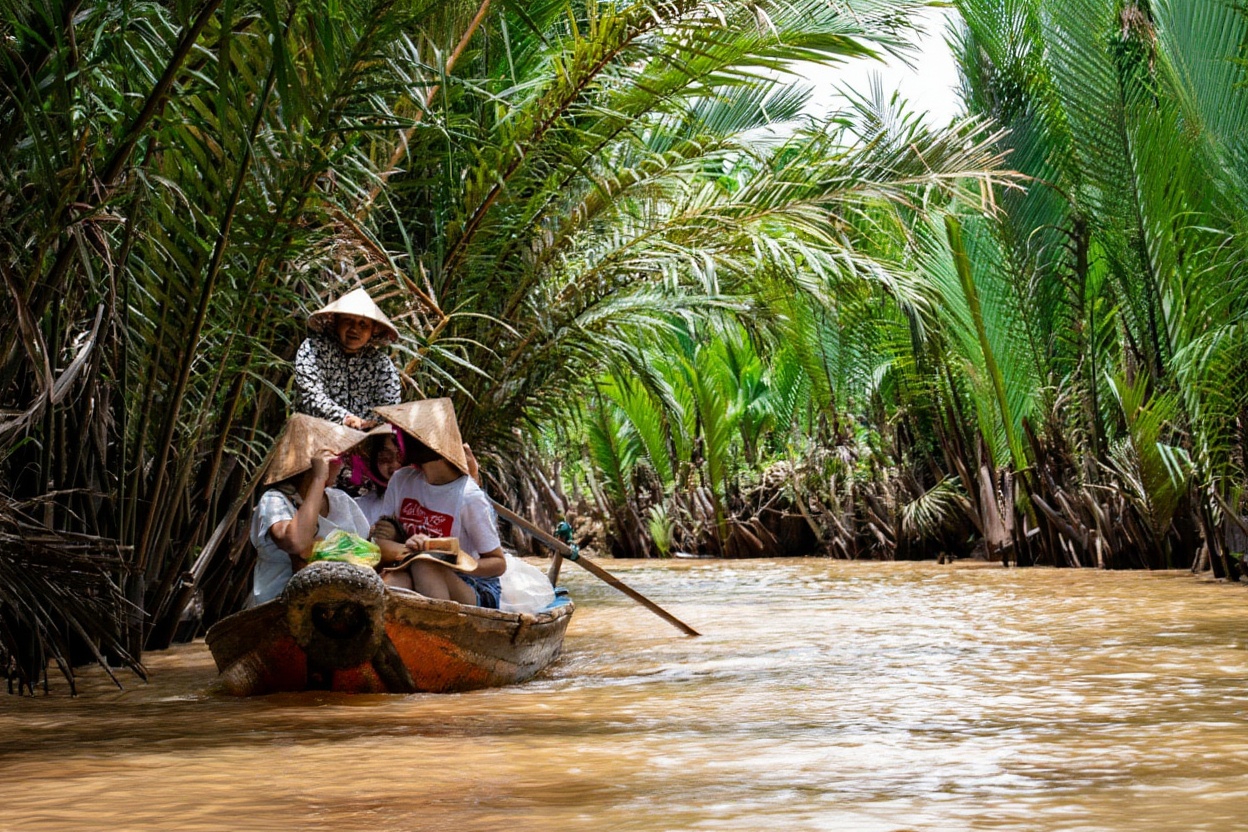
A classic delta longtail tour — the experience depends heavily on when and where you go
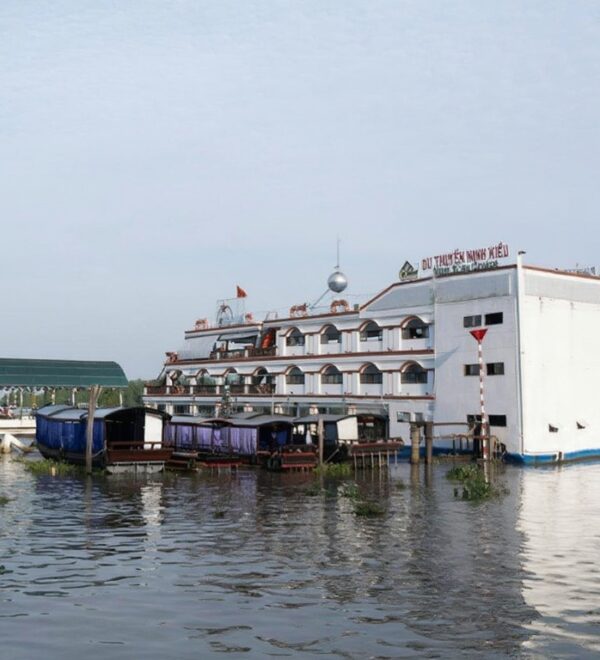
The honest assessment of the day trip: it’s fine. You’ll see a river, you’ll ride a boat, you’ll eat fresh fruit and watch coconut candy being made. You’ll be back in Saigon by dinner. What you won’t do is see the Cai Rang floating market at 5am, cycle through fruit orchards in the late afternoon quiet, or sit on a plastic stool at Ninh Kieu wharf at 9pm eating bún riêu while the river moves past in the dark.
Those things require staying overnight. And staying overnight costs roughly the same as the day trip once you subtract the tour agency markup.
⚠Real Talk
The Mekong Delta day trips from Saigon go to My Tho because it’s closest — 70km, 1.5 hours. My Tho’s floating market has been declining for years. What’s sold on most tours is a 30-minute boat circuit past a few boats with fruit, a coconut candy demo, and a honey-tasting stop. One travel blogger summarised it well: “I had visions of floating through markets while buying fresh fruit and steaming noodle bowls from old ladies on boats. But that wasn’t exactly the experience we got.” Go to Can Tho instead.
The FUTA Bus — The Right Way to Get There
The Phuong Trang / FUTA bus is Vietnam’s most reliable long-distance bus network. For the Saigon–Can Tho route specifically, it’s the best public transport option available.
Departure point: Mien Tay bus station (Bến xe Miền Tây), An Lac, Binh Tan District. About 9km from central District 1. Get there by Grab (100,000–130,000 VND, ~$3.80–4.95, 30–45 minutes in normal traffic).
Book Transport — Buses, Trains & Ferries
12Go covers most Vietnam routes — sleeper buses, trains, and island ferries. Compare schedules and book in advance during peak season (Dec–Feb, Jun–Aug).
Schedule: Buses run roughly every 30–45 minutes from 5am to midnight. No advance booking necessary for most of the year — just buy at the counter. During Tet and public holidays (April 30, September 2) book a day ahead via futabus.vn.
Journey time: 3.5–4 hours depending on traffic on the approach to Saigon. Morning departures (before 7am) are faster. Afternoon departures can hit 4+ hours in holiday traffic.
Arrival: Can Tho bus terminal is about 3km from Ninh Kieu wharf. Grab to the wharf: 40,000–60,000 VND (~$1.50–2.30).
ℹKnow Before You Go
Mien Tay bus station is the southern terminal — not Mien Dong (northern) or the city centre coach parks. Many travellers get this wrong and end up at the wrong terminal. Tell your Grab driver “Bến xe Miền Tây” clearly. If you’re booking a Grab from D1, it’s a 30-minute ride minimum — leave an hour before departure to be safe.
The Tourist Minivan Option — Skip It
Dozens of travel agencies in District 1 sell minivan services that pick up from your guesthouse door and drive to Can Tho, Ben Tre, or My Tho. They’re more expensive than the FUTA bus (200,000–350,000 VND, ~$7.60–13 vs 130,000–160,000 VND), slower due to multiple hotel pickups, and often use older vehicles.
The one advantage is door-to-door pickup. If you have a lot of luggage or can’t face navigating to Mien Tay, it’s a reasonable trade. Otherwise, the public bus is better in every other way.
Day Trip to My Tho — When It’s Worth It
The My Tho day trip isn’t worthless — it’s just limited. Here’s when it makes sense:
You have one day maximum to spend on the delta and you’re not willing to commit to an overnight. You want a preview rather than a deep dive. You’re travelling with children or people who don’t want early mornings or long bus journeys. You’re more interested in the boat experience than the floating market specifically.
If any of these describe you, book the My Tho day trip. It’s honest about what it is — a half-day boat tour near a river town — and it delivers that. The problem is when it’s marketed as “the Mekong Delta experience” rather than “a boat trip near My Tho.”
Ben Tre — The Day Trip With More Character
Ben Tre (say: ben treh) runs alongside My Tho on most D1 day trip itineraries. It’s 90km from Saigon, about 2 hours by bus — the Coconut Island tag is accurate, and the smell when you arrive is one of those delta smells that stays with you: slightly sweet, slightly fermented, river mud and coconut water baking in the afternoon heat.
The day trip format is similar to My Tho: a boat ride, coconut candy demo, rice wine tasting, honey stop. But Ben Tre has something My Tho doesn’t. It’s fractionally less visited, and the channels are narrower, more overgrown at the edges, with the afternoon light through the coconut palms landing differently. You’re still on a tour route — but the setting is better.
Book Tours & Activities — Mekong Delta
Klook has the widest selection for Vietnam and is usually the cheapest. KKday is strong on day trips and local experiences.
Ben Tre day trip: one free day, want a boat experience, not making it to Can Tho this trip. Skip it entirely if you have 2+ days — Can Tho’s canal cycling and working wholesale market is in a different league.
Overnight in Can Tho — The Recommended Route
The optimal Mekong Delta trip from Saigon for most travellers:
Day 1: Bus from Mien Tay at noon → arrive Can Tho by 3:30pm → check in to guesthouse near Ninh Kieu wharf → walk the wharf and market district → dinner at riverside stalls (bún riêu, grilled river fish, fried tofu with pineapple sauce) → book a floating market boat for the next morning.
Day 2: Wake 4:30am → boat to Cai Rang floating market (30 min on the river) → 2 hours at the market and canal detour → back by 8am → breakfast bún riêu at wharf stalls → optional: hire a bicycle and cycle the canal paths until 11am → afternoon bus back to Saigon, arrive by 6pm.
Total cost for 2 days / 1 night excluding Saigon hotel: roughly 700,000–1,200,000 VND (~$27–46) per person including bus, guesthouse, floating market boat, food, and bicycle rental. This is cheaper than most organised day trips from D1.
QUICK COMPARISON
Day Trip vs Overnight in Can Tho
Day Trip (My Tho)
Overnight (Can Tho)
Cost per person
400,000–600,000 VND (~$15–23)
700,000–1,200,000 VND (~$27–46)
Floating market quality
Declining / tourist-facing
Cai Rang — working wholesale
Independence
Group tour fixed schedule
Completely independent
Best for
Tight schedule, families
Everyone with 2+ days to spare
What the Delta Actually Feels Like
Nobody tells you this. The Mekong Delta doesn’t look like a postcard. The water is brown — a rich, sediment-heavy brown that locals call nước màu (say: nook mow), coloured water. The land is flat. No hills. No dramatic scenery. The beauty here is slower and wetter and more horizontal than anywhere else in Vietnam.
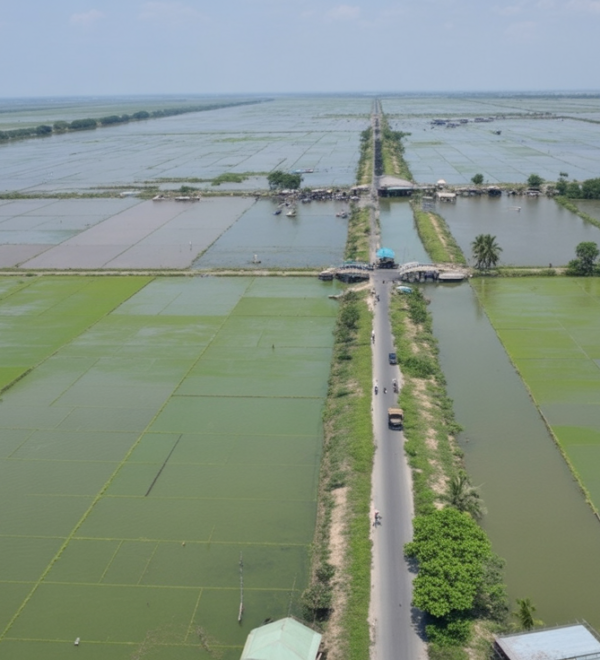
On the FUTA bus south from Saigon, the transition is gradual. The city gives way to industrial sprawl, then to rice paddies divided by irrigation channels, then to orchards where dragonfruit and mango grow at shoulder height on either side of the road. By the time you cross the My Thuan Bridge — a suspension bridge over one of the delta’s main tributaries, the brown water 30 metres below — you know you’re somewhere different.
The smell changes first. Fuel and exhaust fall away. What replaces them is river mud, fermenting fruit, and charcoal smoke from small roadside stalls. On the water in Can Tho, the morning smells differently from the afternoon: the market boats bring fish sauce and fresh herbs by 5am, and by 9am the canal paths smell of coffee and fried dough from the bánh tiêu (say: bahn tee-ew) carts.
The humidity sits differently here than in Saigon. The city has concrete to absorb and reflect heat. The delta has water. The warmth is softer but the air is heavier — an umbrella in the midday sun is not optional, it’s a survival tool. Pack light, breathable clothing regardless of season, and assume you’ll be damp by 9am.
The Western Exit Route — Saigon to Phu Quoc via the Delta
If Phu Quoc is on your itinerary, skipping the return to Saigon is worth considering. The western delta route runs Saigon → Can Tho → Chau Doc → Ha Tien → ferry to Phu Quoc. It adds 2 days to the journey but removes the need to backtrack entirely.
Chau Doc (say: chow dok) deserves at least one night. It’s 240km from Saigon — about 5 hours total from Can Tho via Phuong Trang or Tuan Thanh buses — and it’s unlike anywhere else in the delta. The main draw is the Cham Muslim community living on floating houses (nhà nổi, say: nyah noy-ee) on the Hau River. These aren’t tourist constructions — they’re houses built on pontoons where families have lived for generations, raising catfish in nets slung beneath the floors. The fish farms under Chau Doc’s floating village are among the largest in the delta; the water below the houses is always moving from the aeration systems.
Sam Mountain (Núi Sam, say: noo-ee sam) is a 230-metre limestone outcrop rising from flat rice paddies 5km outside town. You can see it from the bus before you reach Chau Doc. The pilgrimage temples on its slopes — Tay An Pagoda at the base, Ba Chua Xu shrine halfway up — are active and crowded on weekends. The view from the summit on a clear morning covers 30km of delta in every direction, flat and gleaming.
Do the floating village at dawn when the light is low over the water. Do Sam Mountain before 8am before the pilgrims arrive. Then take the morning bus to Ha Tien and catch the afternoon ferry.
↗Insider Tip
In Chau Doc, eat bún mắm (say: boon mam) — fermented fish broth noodle soup. It smells alarming and tastes extraordinary. Bowls at the morning market near the central bus station run 25,000–35,000 VND (~$0.95–1.35). Order it without overthinking the smell.
The Ha Tien to Phu Quoc ferry (Superdong or Thanh Thoi lines) takes 1 hour and costs 200,000–280,000 VND (~$7.60–10.60). Runs multiple times daily. The alternative is flying: Saigon to Phu Quoc is 45 minutes and costs 400,000–800,000 VND (~$15–30) booked ahead. If you’re time-limited, fly. If you have the days, the bus-and-ferry route is one of the best journeys in southern Vietnam.
Best Time to Make the Journey
The Mekong Delta runs on two seasons: dry (November–April) and wet (May–October). Both are viable — the experience just changes.
Dry season is the standard recommendation. River levels are manageable, canal paths are accessible by bicycle, and the floating market operates at normal capacity. The heat is intense but predictable: 34–38°C, clear sky, no shade on the boats. November through February is the most comfortable — lower humidity, occasionally cool enough at 5am on the water to want a light layer.
Wet season changes the delta’s appearance more than it affects logistics. The rivers swell and brown further. The lowland rice paddies flood and reflect the sky. The air smells more intensely of vegetation and standing water. The floating market runs shorter hours in heavy rain, and some canal cycling paths flood. But the buses run on schedule, the guesthouses stay open, and Can Tho’s covered markets stay dry. Wet season in the delta is not the travel nightmare some guides suggest — it’s just wetter.
The least comfortable window is late April to early May — the brief dead zone before the wet season arrives, when heat peaks at 38–40°C and dust from dry rice fields hangs in the air. If this is your only window, still go. The delta has no real off-season, just off-temperature.
What I Got Wrong the First Time
I did the day trip to My Tho. I got back to Saigon at 5pm feeling like I’d checked a box on a list. I hadn’t seen the Mekong Delta — I’d seen the version of the Mekong Delta that’s designed to be seen in six hours by someone who doesn’t particularly want to be there.
The second trip I took the FUTA bus alone, checked into a guesthouse 50 metres from the water, walked the Ninh Kieu night market at 8pm, got up at 4:30am, and sat on a wooden boat watching the Cai Rang floating market materialise in the mist. That trip cost less than the My Tho day trip.
Before You Go
Two things worth sorting before you land: a Vietnam eSIM so you have data the moment you clear customs, and travel insurance — medical costs for uninsured foreigners in Vietnam are significant.
Airalo eSIMs activate instantly. Buy before departure — airport SIM queues in Vietnam can take 30+ minutes.
Frequently Asked Questions
How far is the Mekong Delta from Saigon?
My Tho — the nearest delta town — is 70km from central Saigon, about 1.5 hours by bus. Can Tho — the delta’s main city and the best base — is 170km away, 3.5 hours by FUTA bus. Chau Doc, for the western delta circuit, is 240km, about 5 hours. Ha Tien, the departure point for the Phu Quoc ferry, is 340km, 6–7 hours.
✓Quick Answer
Can Tho is 170km from Saigon — 3.5 hours by FUTA bus from Mien Tay terminal for 130,000–160,000 VND (~$5–6). My Tho is 70km, 1.5 hours. The bus is the right option for both; the tourist minivans from D1 are slower and more expensive.
Is the Mekong Delta day trip from Saigon worth it?
For what it is — a boat tour near a river town — yes. For “the Mekong Delta experience” — not really. The day trips to My Tho are honest about being a boat trip and a cultural demo; they’re not honest about being a substitute for spending a night in Can Tho. If you have two days to give the delta, skip the day trip and do the overnight. If you have one afternoon, the day trip is better than nothing.
Can I get from Saigon to the Mekong Delta by motorbike?
Yes. The road from Saigon to Can Tho (National Route 1A) is well-maintained and the route is straightforward. Journey time: 3–4 hours. Having your own motorbike is the best way to explore the delta’s canal paths and smaller communities — the public bus network doesn’t reach the places worth reaching. Rent in Saigon or Can Tho; Can Tho guesthouses can usually arrange a day rental for 150,000–250,000 VND (~$5.70–9.50).
What should I pack for a Mekong Delta trip?
Light, breathable clothing — the delta is hot and humid year-round. A light rain jacket in wet season (May–October). Sun protection: hat, sunscreen, UV shirt — the boat has no shade and the river reflects sun from below. Insect repellent for evening canal walks. Cash in small denominations — most boat operators and street stalls don’t break large notes easily. Sandals that can get wet. Nothing you’d mind getting muddy.
Is the Mekong Delta suitable for travelling with kids?
Yes, with adjustments. The FUTA bus is fine for children — air-conditioned, regular stops, 3.5 hours. The floating market at 4:30am is the main variable: younger children who won’t wake for a 4am start miss the main event. The alternative is a morning boat ride at 7am — less atmospheric than the market peak, but the canal ride itself is still worthwhile. Stick to Can Tho rather than Chau Doc for easier logistics. The Ninh Kieu wharf area at night is comfortable for families — lit, active, with food options at all price points. Avoid the long multi-stop D1 day tours that run 10+ hours — they’re tiring for adults and punishing for children.
How do I book the floating market boat in Can Tho?
From any guesthouse near Ninh Kieu wharf — this is the standard. Tell the front desk you want the 4:30am floating market boat and they’ll arrange it that evening. Standard price: 150,000–200,000 VND (~$5.70–7.60) per person for a 2–3 hour trip including the market and a short canal detour. If someone quotes 400,000–500,000 VND per person, that’s the tourist rate for a private boat — you can negotiate down or find a group boat. Don’t pay more than 250,000 VND (~$9.50) per person for the standard shared boat.
How much does a Mekong Delta trip from Saigon cost in total?
Budget for 2 days / 1 night from Saigon: roughly 1,500,000–2,000,000 VND (~$57–76) per person. This includes buses both ways (260,000–320,000 VND, ~$10–12 total), one night in a guesthouse near Ninh Kieu wharf (100,000–300,000 VND, ~$3.80–11.40 depending on fan vs air-con), the floating market boat (150,000–200,000 VND, ~$5.70–7.60), food for 2 days (roughly 200,000–400,000 VND, ~$7.60–15), and optional bicycle rental (50,000–80,000 VND, ~$1.90–3). That’s cheaper than most organised day trips from D1 — and for a significantly better experience. For a full cost breakdown, see our Can Tho Mekong Delta guide.
Can I extend the Mekong Delta trip to 3 or 4 days?
Yes — and it improves with time. Day 1: Saigon → Can Tho (arrive afternoon, walk Ninh Kieu wharf). Day 2: Cai Rang floating market at 5am → canal cycling → afternoon bus to Chau Doc. Day 3: Chau Doc floating village at dawn → Sam Mountain before 8am → afternoon bus to Ha Tien or Rach Gia. Day 4: morning ferry to Phu Quoc. This is the full western delta route and it removes the need to return to Saigon at all. Total bus/ferry cost for the full route: roughly 400,000–600,000 VND (~$15–23) plus accommodation and food.
FAQ
How far is the Mekong Delta from Saigon?
My Tho (the nearest major delta town): 70km, about 1.5–2 hours by bus. Can Tho (the delta’s largest city): 170km, 3.5–4.5 hours. Ben Tre: 90km, 2–2.5 hours. Most day tours from Saigon go to My Tho and Ben Tre — Can Tho is too far for a comfortable day trip.
Can you do the Mekong Delta as a day trip from Saigon?
Technically yes, but you’ll see almost nothing real. The tourist day trips from Saigon get you to My Tho by 10 AM and have you back in Saigon by 5 PM — you spend 3–4 hours on the bus for 2 hours at the delta. An overnight in Can Tho or Ben Tre gives you the early morning floating market experience that day-trippers miss entirely.
What is the best bus from Saigon to Can Tho?
Futa/Phương Trang is the most reliable — buses every 30 minutes from Mien Tay Bus Terminal (District 6, 45 minutes from District 1 by Grab). Cost: 130,000–180,000 VND. Journey: 3.5–4.5 hours. Limousine vans (xe đò giường) are more comfortable for an extra 50,000–70,000 VND.
Is there a ferry from Saigon to the Mekong Delta?
No regular passenger ferry. The road network (including the Cao Lanh Bridge and Vam Cong Bridge completed in 2019) has made overland travel the standard. Some tour operators run speedboat tours on the Saigon River as part of organized day trips, but these don’t connect to Can Tho or the main delta.
Should I rent a motorbike or join a tour for the Mekong Delta?
Tour for the floating market (Cai Rang specifically) — boat access to the floating market is easiest to arrange through your guesthouse or a local tour operator. Motorbike for the villages, secondary canals, and anywhere you want to stop without a schedule. Many travelers do both: tour for the market morning, motorbike for the afternoon countryside.
“I moved here on a 3-month trial run. That was 5 years ago. I’ve since been to all 63 provinces, ridden every loop worth riding, and eaten things I still can’t name. This blog is what I wish existed when I landed.”