
Last updated: May 2026 — Grab fares and xe om price ranges verified
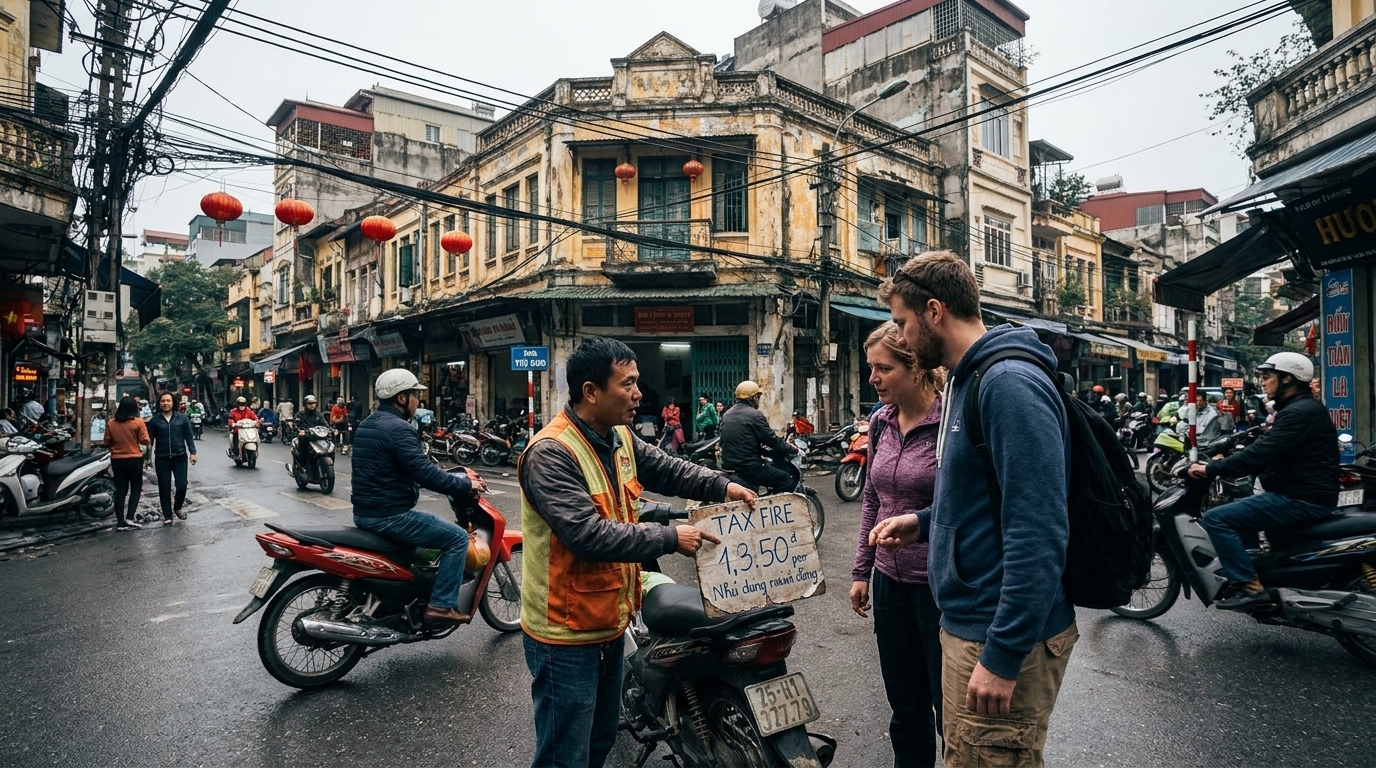
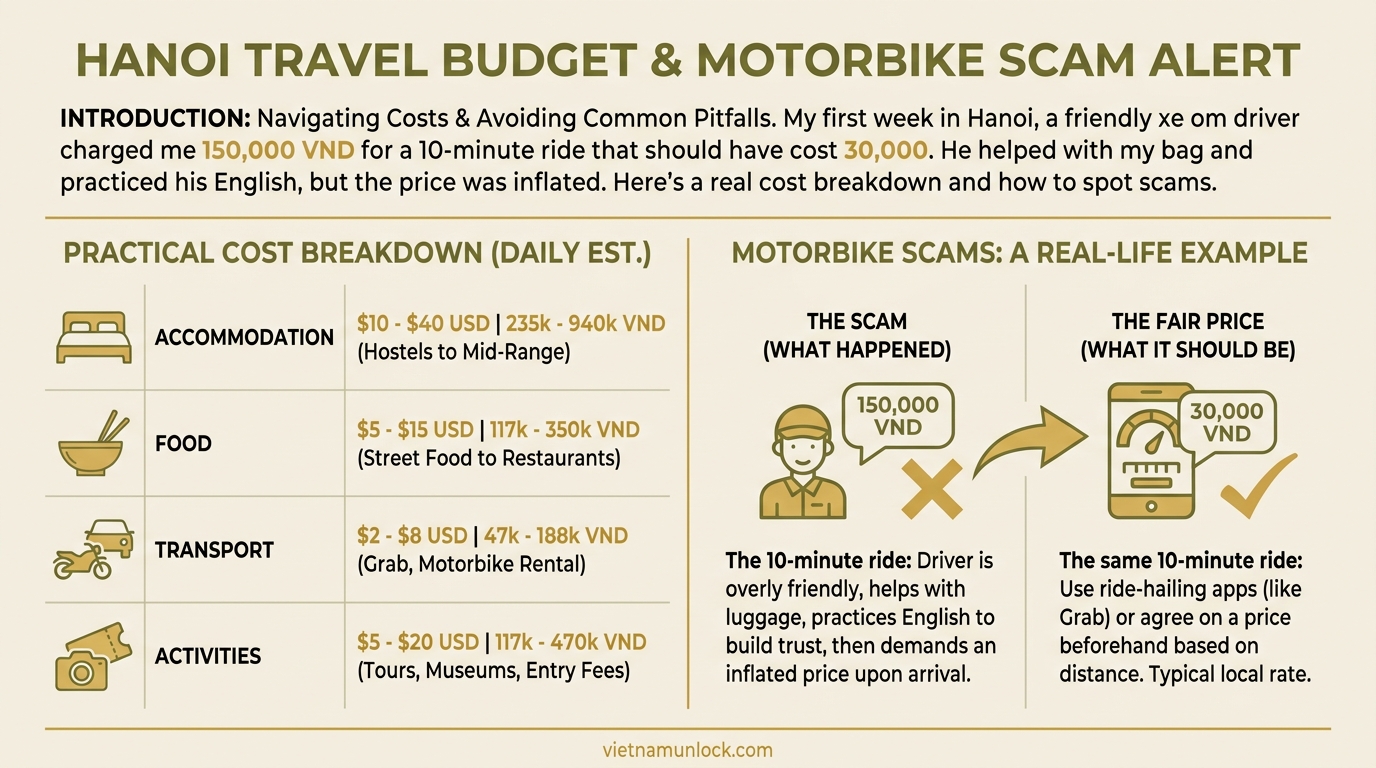
My first week in Hanoi, I paid 150,000 VND for a 10-minute xe om (say: say-ohm) ride that should have cost 30,000.
The driver was friendly. He helped me with my bag. He practiced his English the whole way. And he charged me five times the local rate while doing it.
I didn’t even know I’d been scammed until I’d been living here six months and checked a Grab estimate on that same route.
After five years of using Hanoi’s two-wheel ecosystem daily, here’s what I know.
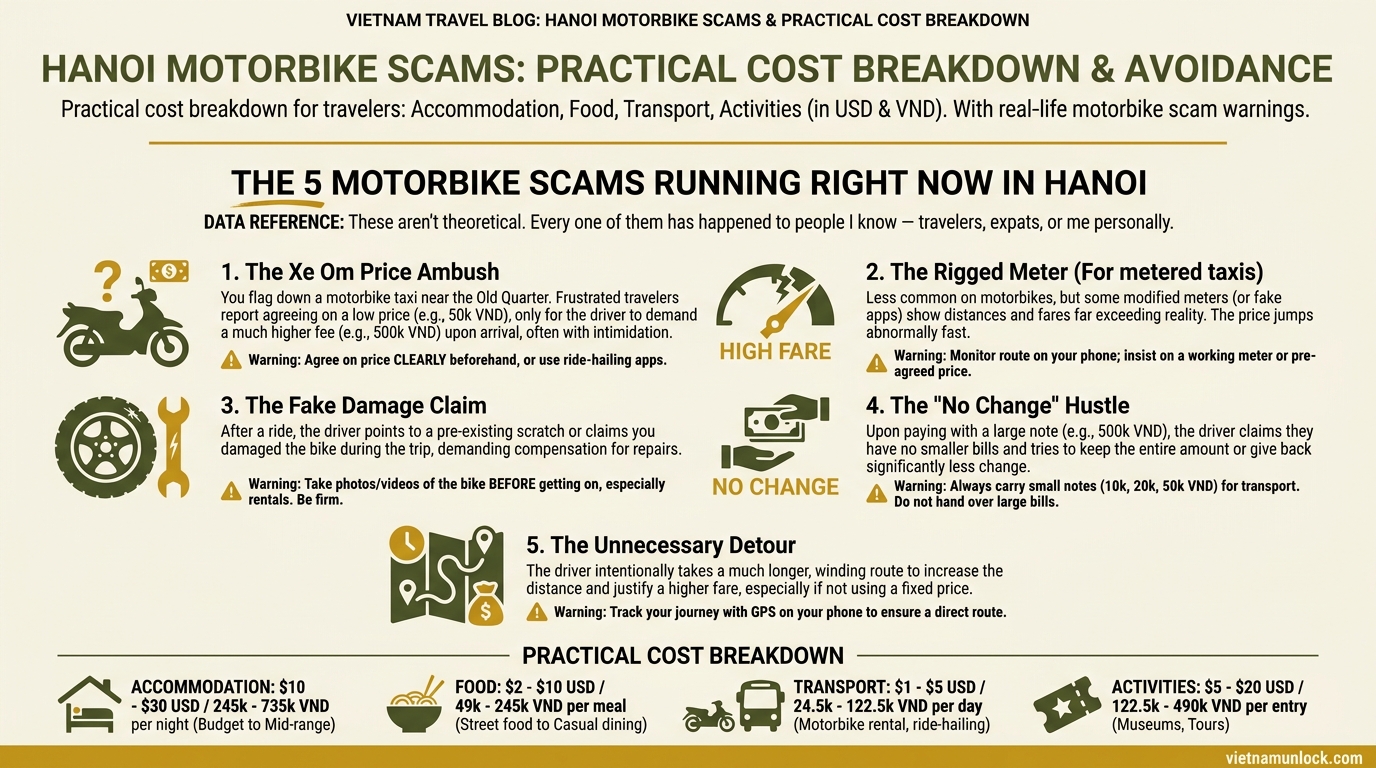
The 5 Motorbike Scams Running Right Now in Hanoi
These aren’t theoretical. Every one of them has happened to people I know — travelers, expats, or me personally.
1. The Xe Om Price Ambush
You flag down a motorbike taxi near the Old Quarter. Friendly guy. You say where you’re going. He nods and says “no problem.” You get on.
You arrive. He quotes you 150,000 VND (~$6).
A GrabBike would have been 35,000 VND (~$1.40).
This is the most common form of motorbike scam in Hanoi, and it works because there’s no meter and no app — just two people, one of whom has no idea what the fare should be.
Quick Answer
Street xe om drivers in Hanoi routinely charge tourists 2–3x the real rate. A fair fare for most Old Quarter rides is 30,000–50,000 VND (~$1.20–2). Always agree on a price before getting on, or use GrabBike where the fare is fixed before you start moving.
The fix: use Grab for any ride under 5km. If you want to use a street xe om for longer trips, name the price first — in Vietnamese if you can — and show them the Grab estimate on your phone as a reference.
2. The Fake Grab Driver
You open the Grab app. A driver accepts. You go outside. A guy on a bike waves at you.
You assume it’s your Grab driver. It’s not.
This happens most often outside hotels, hostels, and tourist areas — someone positioned near the entrance who sees you on your phone and guesses you’re waiting for a ride. They pull up, act like your driver, and you get on before you check.
Real Talk
Before getting on any motorbike you think is your Grab: check the license plate in the app against the plate on the bike. Takes three seconds. This single habit eliminates fake Grab drivers entirely.
The app shows you the driver’s name, photo, rating, and plate number. If any of those don’t match — don’t get on. Cancel and rebook.
3. The Airport Tout on a Motorbike
You exit Noi Bai Airport. Before you reach the official taxi line, someone approaches offering a motorbike to your hotel.
They’re not a scammer in the sense that they’ll rob you. They’re more like an unlicensed driver charging three times the real price, riding faster than you’d like, with no accountability if something goes wrong.
Grab from Noi Bai to the Old Quarter runs 350,000–450,000 VND (~$14–18) depending on traffic. The airport bus (Bus 86) costs 45,000 VND (~$1.80) and drops near Hoan Kiem Lake. Both are transparent, trackable, and safe.
The tout on the motorbike will quote you more and give you nothing in writing.
Skip him.
4. The “Free Tour” That Isn’t Free
A xe om driver offers to show you around Hanoi for a flat rate — sometimes free, sometimes cheap. He takes you to the Temple of Literature, a silk shop, a lacquerware gallery, a coffee place.
He’s friendly. He doesn’t pressure you to buy. But at each stop, someone on commission is expecting you to spend money.
The driver gets a kickback from every shop. The “tour” is a commission loop.
This isn’t unique to Hanoi — it runs in Hoi An, Saigon, and across Southeast Asia. The motorbike version in Hanoi targets travelers in the Old Quarter during morning hours, usually pitching the tour as a local alternative to generic tourist trips.
Not illegal. Not dangerous. Just not what it claims to be.
If you want a real xe om city ride: hire a driver, tell him exactly where you want to go, and skip any stops he suggests.
5. The Motorbike Rental Damage Claim
You rent a semi-automatic 110cc bike for a day. Return it in the same condition you got it. The owner points to a scratch on the frame and says it wasn’t there before.
It was. You just didn’t photograph it.
Rental damage scams are less common in Hanoi than in beach towns (Mui Ne, Nha Trang) — but they exist, especially with shops catering to first-timers near the Old Quarter backpacker strip.
The fix is mechanical: photograph every existing scratch, dent, and scrape before you ride away. Show the owner you’re photographing them. Email the photos to yourself with a timestamp. This one habit makes the scam nearly impossible to run.
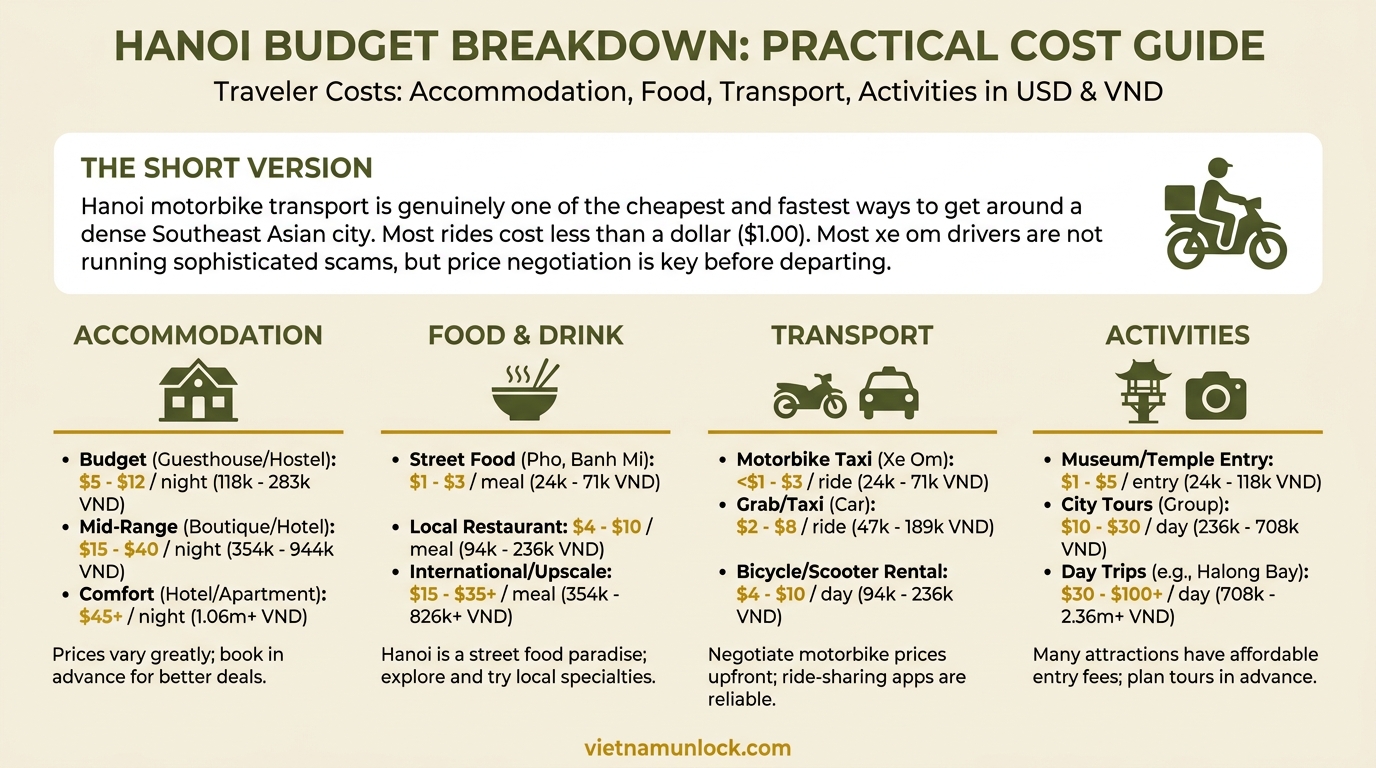
What Rides Actually Cost in Hanoi (Real 2026 Numbers)
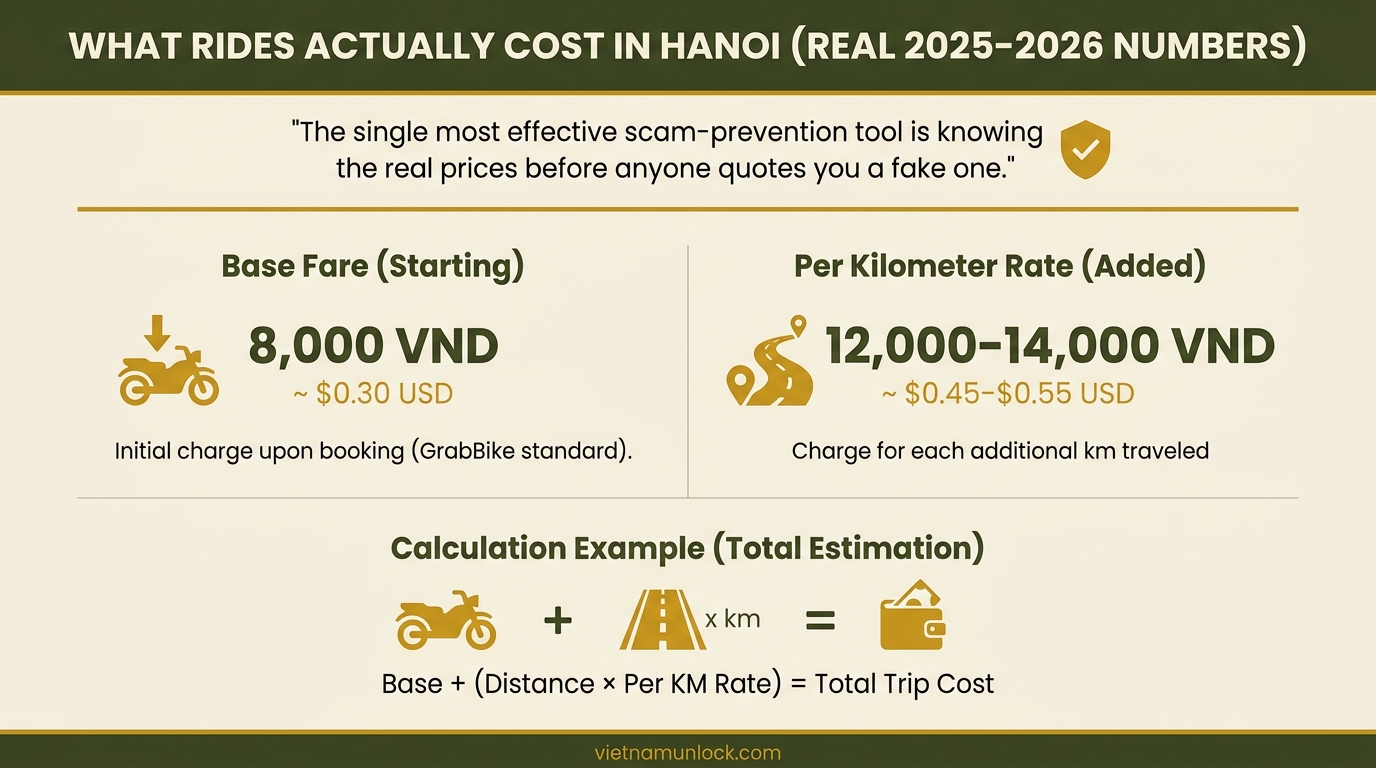
The single most effective scam-prevention tool is knowing the real prices before anyone quotes you a fake one.
GrabBike charges: 8,000 VND base + 12,000–14,000 VND per kilometer. Here’s what that means on real routes: For the broader pattern across Vietnam, the Vietnam scams guide breaks down how commission loops work in every major tourist city.
A fair street xe om fare runs roughly the same as Grab — 30,000–50,000 VND (~$1.20–2) for most inner-city hops. If someone’s quoting you 100,000+ (~$4) for a short ride, that’s not a mistake. It’s a decision they’re making about you specifically.
Insider Tip
Open Grab and check the estimated fare before you negotiate with any street driver. Show them the number. Most will match it or come close. If they refuse, walk — there’s always another xe om 20 meters away.
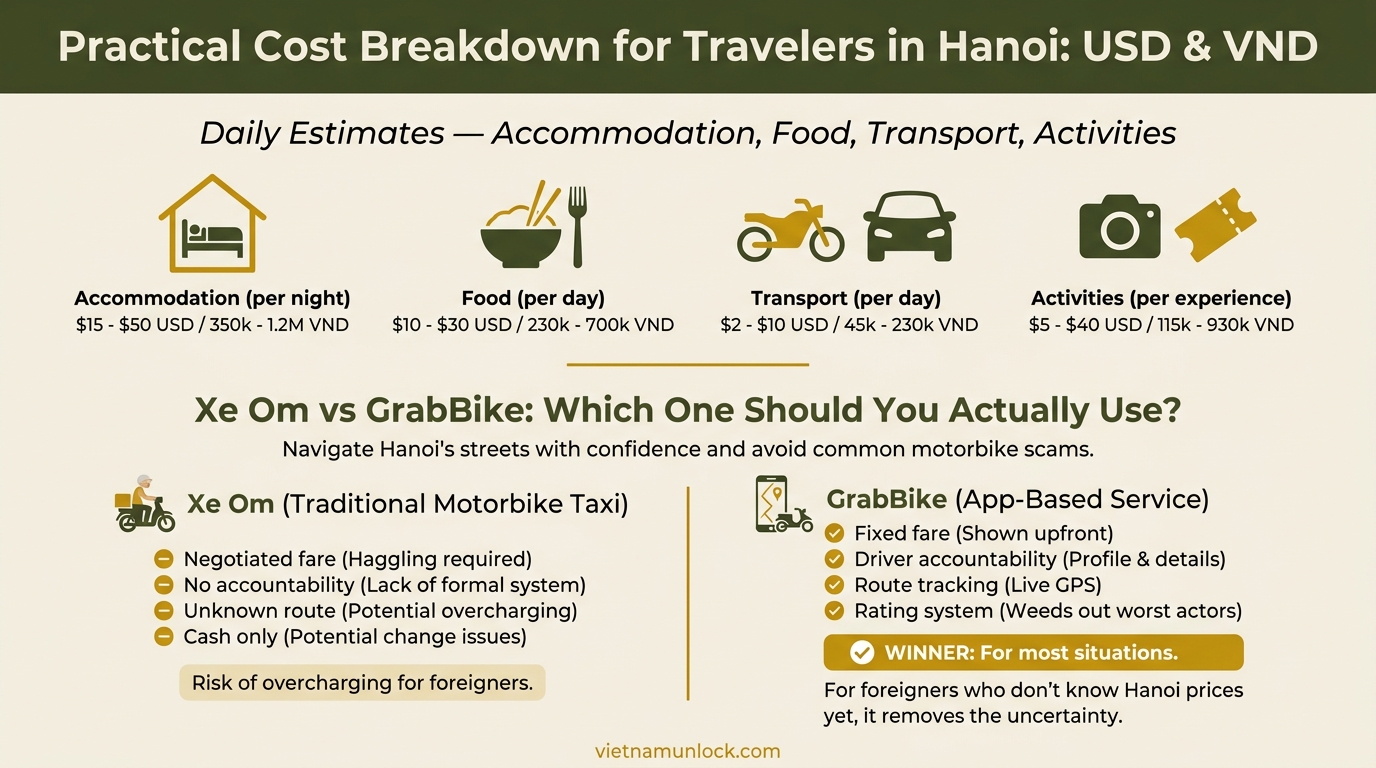
Xe Om vs GrabBike: Which One Should You Actually Use?
GrabBike wins for most situations.
Fixed fare, driver accountability, route tracking, and a rating system that weeds out the worst actors. For foreigners who don’t know Hanoi prices yet, it removes the negotiation entirely — which is exactly where most scams happen.
Street xe om has its uses.
Late at night when Grab surge pricing kicks in. Short hops the app doesn’t show competitively. Drivers who know a neighborhood’s backstreets. If you speak a little Vietnamese — or are willing to show a Grab estimate as a baseline — xe om can be faster and more flexible than the app.
The rule: if you’re not confident quoting a price, use the app. If you are — or if you need someone who knows exactly where that alley leads — negotiate.
WHO IT’S FOR
GrabBike: first-time visitors, anyone arriving at the airport, anyone who hasn’t memorized local price ranges yet. Street xe om: experienced Hanoi visitors who speak a little Vietnamese or are traveling with someone who does.
Renting a Motorbike in Hanoi: The Full Picture
Daily rental runs 150,000–200,000 VND (~$6–8) for a basic manual or semi-automatic 110cc bike. Longer rentals drop lower — a week will get you under 100,000 VND/day (~$4) at most shops.
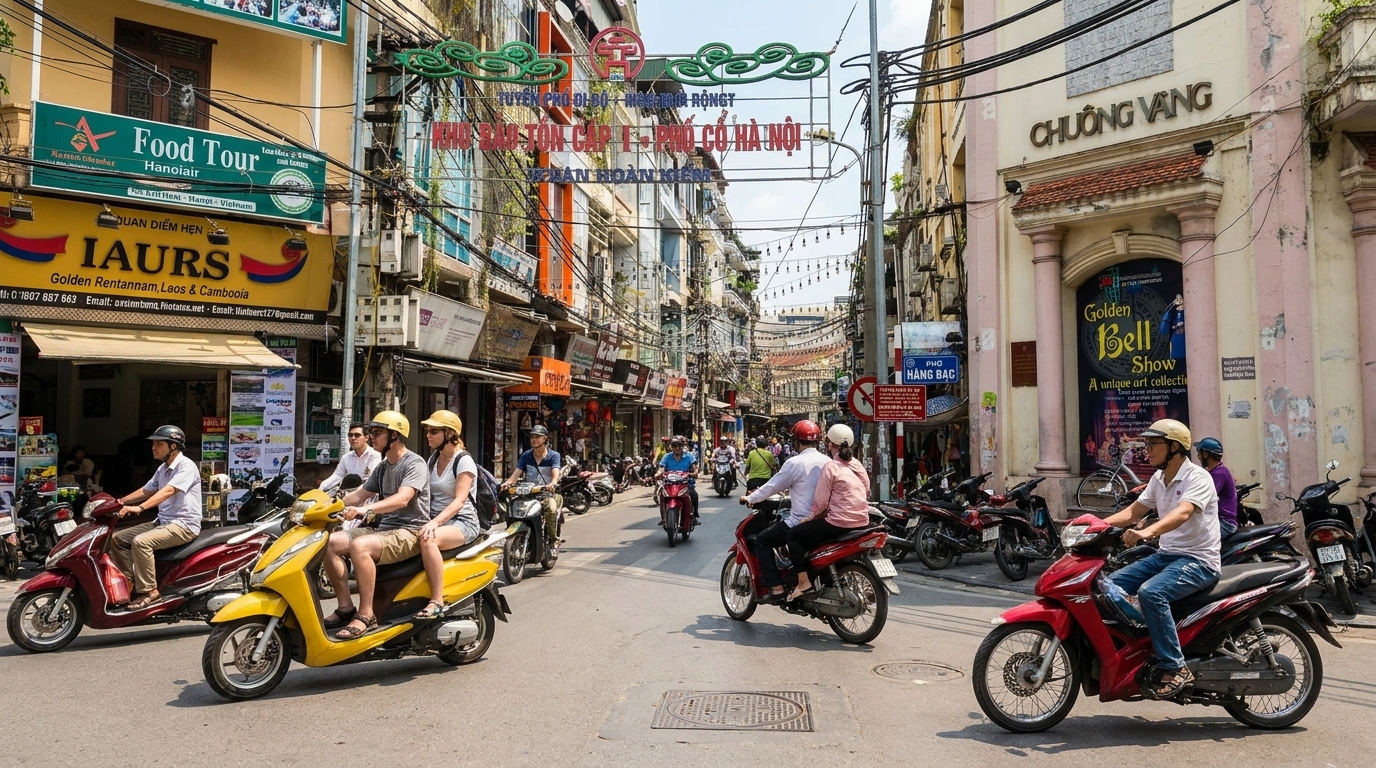
Hanoi traffic is not a good place to learn to ride. That’s the honest version.
If you’ve ridden before: fine. The city is manageable once you’ve internalized the traffic rhythm — ride with the flow, don’t brake suddenly, assume motorbikes will come from unexpected angles. The Old Quarter’s tightest streets are actually easier because everything slows down.
If you’ve never ridden: don’t start on Hanoi’s streets. Take a lesson somewhere quieter first. West Lake’s perimeter on a Sunday morning is about as low-pressure as Hanoi gets for new riders.
When renting:
- Photograph everything before you leave the shop
- Get the owner’s phone number
- Check tire pressure and brakes before riding off
- Ask if insurance is included (most cheap rentals don’t have it)
What to Do If You’re Already in a Scam
You’re at your destination. The driver quotes you a number that’s clearly too high. What now?
Don’t argue. Don’t escalate. Don’t pay the full amount and walk away silently furious.
Show them Grab on your phone. Say “app price” in English, or “giá Grab” (say: zyah grab) in Vietnamese. Quote what Grab estimates for the route. Most drivers will drop to something reasonable. Some won’t — in which case you pay roughly double the real price and add it to the cost of the lesson.
For serious scams — a driver taking your bag, refusing to let you leave — call 113 (Vietnamese police). It’s rare, but it happens, and you should know the number before you need it.
For the minor overcharges: chalk it up, know the prices now, and use Grab next time.
What Travelers Actually Say: The Consensus
Five years of reading Hanoi expat forums, Reddit threads, and solo traveler groups produces a pretty consistent picture.
Most overcharging incidents happen within the first 48 hours of arrival — before travelers have a baseline for what things cost. The scam doesn’t require malice, just information asymmetry. Once you know the real prices, xe om overcharging drops to a minor annoyance rather than a real problem.
The fake Grab driver scam generates the most heated posts. It feels more violating than a price negotiation gone wrong because you followed the rules and still got played. Plate-checking before boarding is the single most-cited piece of advice from travelers who figured this out the hard way.
Airport touts are real but low-stakes: the worst outcome is paying double for an uncomfortable ride. Using the Grab pickup zone eliminates the encounter entirely. Multiple travelers in 2025–2026 report the airport Grab zone is well-signed and easy to find. If you’re planning to rent beyond Hanoi, the Vietnam motorbike guide covers what to expect on open highways, mountain roads, and how rental quality varies by region.
Real Talk
The most common Reddit thread I see: “I wish someone had told me the real prices before I landed.” Now someone has. Screenshot the price table above before you step off the plane at Noi Bai.
Frequently Asked Questions About Hanoi Motorbike Scams
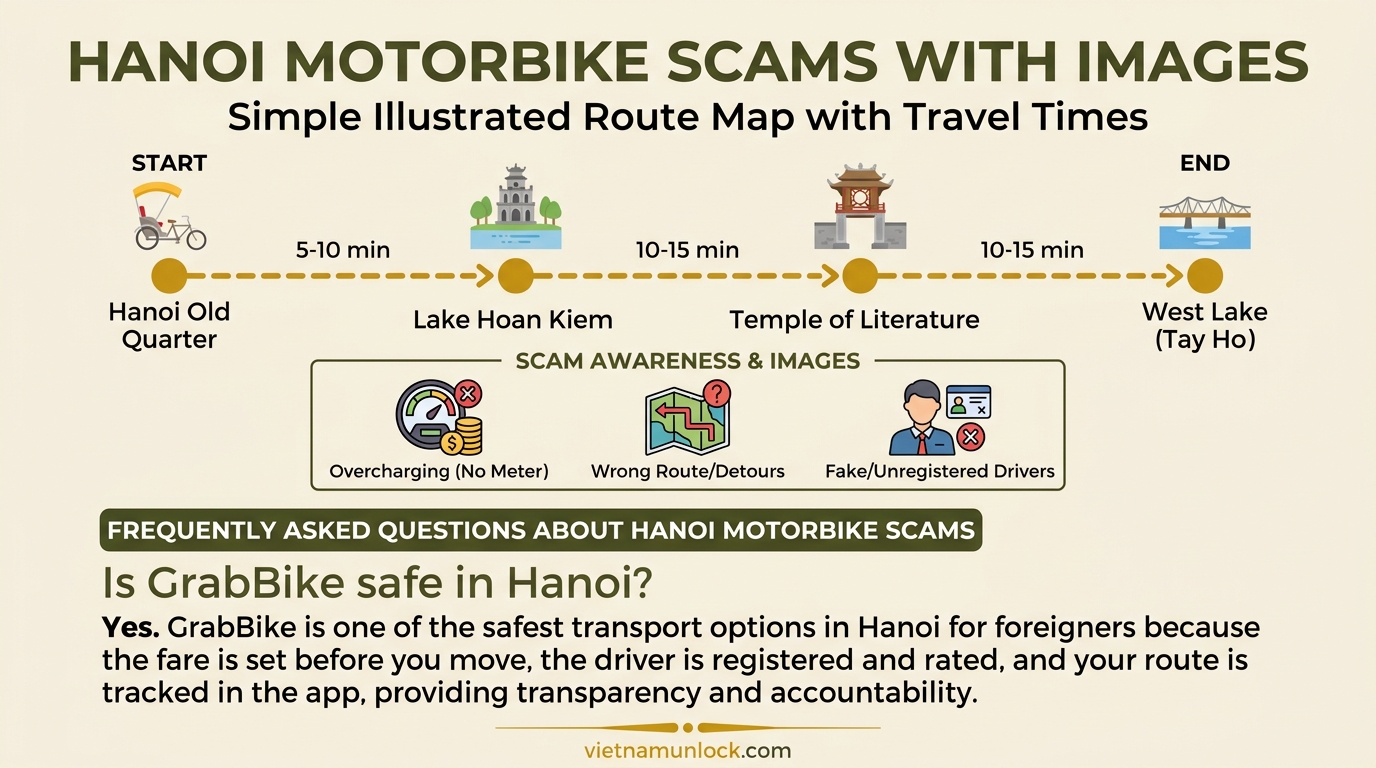
Is GrabBike safe in Hanoi?
Quick Answer
Yes — GrabBike is one of the safest transport options in Hanoi for foreigners. Fare is set before you move, driver is registered and rated, route is tracked. The one real risk (fake drivers) is eliminated by checking the plate before you board.
Klook has the widest selection for Vietnam and is usually the cheapest. KKday is strong on day trips and local experiences.
-faq-a”>Quick Answer
The vast majority are not dangerous — they’re looking to make a living, and foreigners are a higher-paying market. Overcharging is opportunistic, not threatening. Genuinely unsafe xe om situations are rare in Hanoi compared to other parts of Southeast Asia.
Should I haggle with xe om drivers?
Don’t think of it as haggling. Know the real price (check Grab), state it calmly, and see if they agree. If they do: great. If they don’t: walk. This isn’t a cultural negotiation game — it’s just knowing what something costs.
Can I rent a motorbike without a license in Hanoi?
Technically under 50cc requires no license in Vietnam. Most rentals are 110cc, which technically requires a Vietnamese license — though enforcement is inconsistent. If you’re involved in an accident without the right license, your travel insurance may not cover you. Check your policy before renting.
What’s the best way to get from Noi Bai Airport into Hanoi?
Quick Answer
Use Grab from the official pickup zone (follow signs past arrivals). Bus 86 costs 45,000 VND (~$1.80) and drops near Hoan Kiem — slower but very cheap. Avoid any driver who approaches you before you’ve exited arrivals.
What happens if a rental shop claims I damaged their bike?
Show your timestamped photos. If you have them, the claim dies immediately. If you don’t, negotiate down — they typically ask 200,000–500,000 VND (~$8–20) for “repairs” that don’t happen. This is why you photograph everything before you ride.
Two things worth sorting before you land: a Vietnam eSIM so you have data the moment you clear customs, and travel insurance — medical costs for uninsured foreigners in Vietnam are significant.
Airalo eSIMs activate instantly. Buy before departure — airport SIM queues in Vietnam can take 30+ minutes.
The Short Version
Hanoi motorbike transport is genuinely one of the cheapest and fastest ways to get around a dense Southeast Asian city. Most rides cost less than a dollar. Most xe om drivers are not running sophisticated cons — they’re just quoting more to tourists than they would to locals.
Know the prices. Use Grab as the baseline. Check plates. Photograph rentals.
That covers roughly 95% of the motorbike scam playbook in Hanoi.
The remaining 5% — the truly aggressive situations — are rare enough that I’ve seen maybe three in five years of living here. And two of them happened to friends who ignored the plate check.
Hanoi’s a loud, chaotic, wonderful city. Getting around it shouldn’t be stressful — and with the right baseline, it usually isn’t.
If you’re still working out logistics for your first days in Hanoi, the Hanoi things to do guide covers neighborhoods, timing, and what to prioritize. The Old Quarter guide gets into the specific streets where most xe om interactions happen. And if you want the full picture on how Hanoi’s transport ecosystem works — including day trips — the Hanoi travel guide has it all.
If You’re Already Being Scammed — What to Do
Sometimes the scam starts before you recognize it. You’re on the motorbike taxi, the price agreed was 50,000 VND, and now you’re at the destination and they’re asking for 500,000 VND. This happens. Here’s the actual response that works:
Stay calm. Take out your phone and open Grab — show them what a legitimate ride to the same destination would have cost. Offer to pay the agreed price plus a small premium (say, 70,000 VND instead of 50,000 VND). Take a photo of the motorbike’s license plate before you hand over money. Most xe om scammers back down at the license plate photo step — the risk of a complaint being traceable is enough to settle for the agreed price or something close to it.
Don’t pay vastly inflated prices under pressure. Don’t accept a compromise that’s still 5x the agreed amount. The agreed price plus a small tip is the correct outcome. If the situation escalates or feels unsafe, enter any nearby shop or cafe — a shopkeeper’s presence changes the dynamic immediately. For the full breakdown of what to do in various Hanoi scam scenarios, see our Vietnam scams guide.