
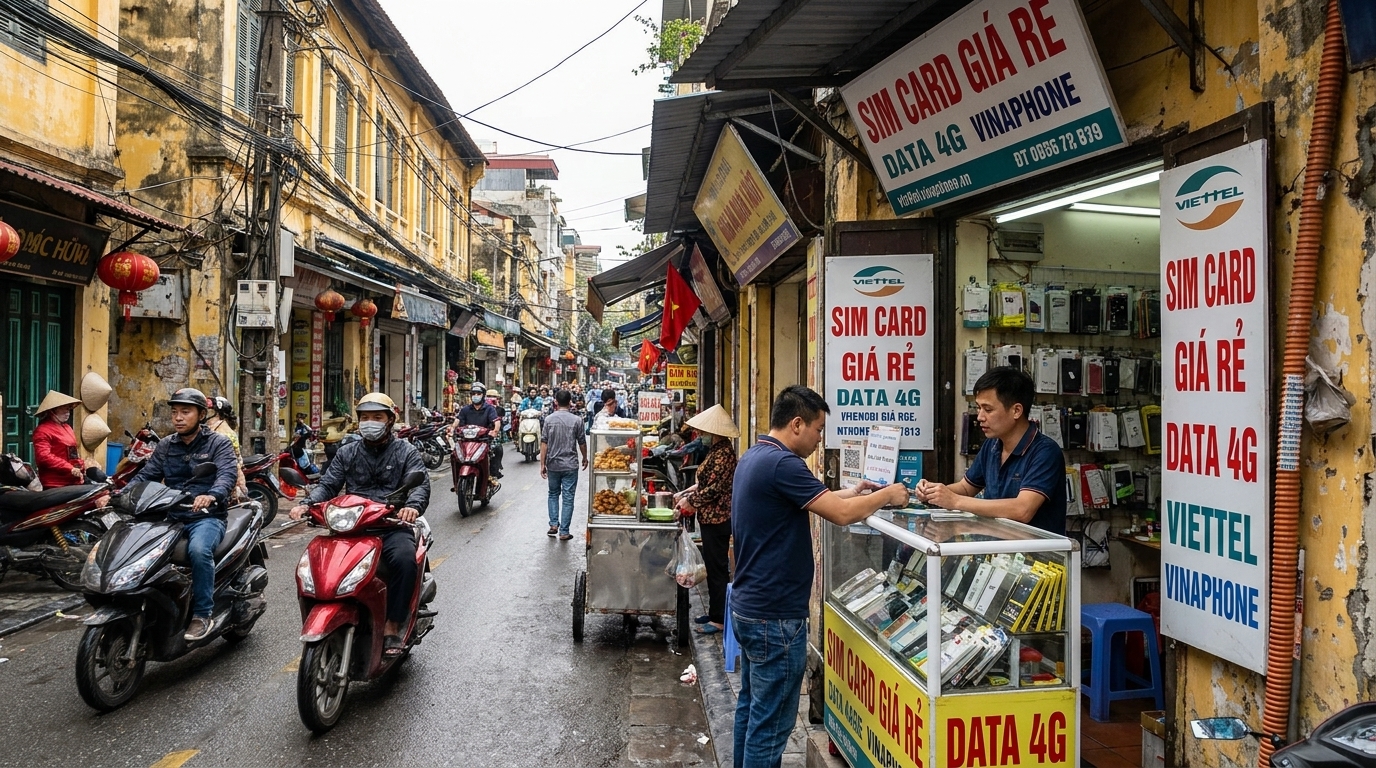
The first thing I did wrong in Vietnam was buy a SIM card at the airport.
That’s the whole article, honestly. But since you’re reading this before you land, let me give you the full version.
Finding the cheapest Hanoi SIM cards isn’t complicated — it just requires knowing which carrier, where to buy, and which tourist traps to skip.
Which Carrier Is Actually Best for Hanoi (And Vietnam)
Three carriers dominate. Here’s the honest breakdown:
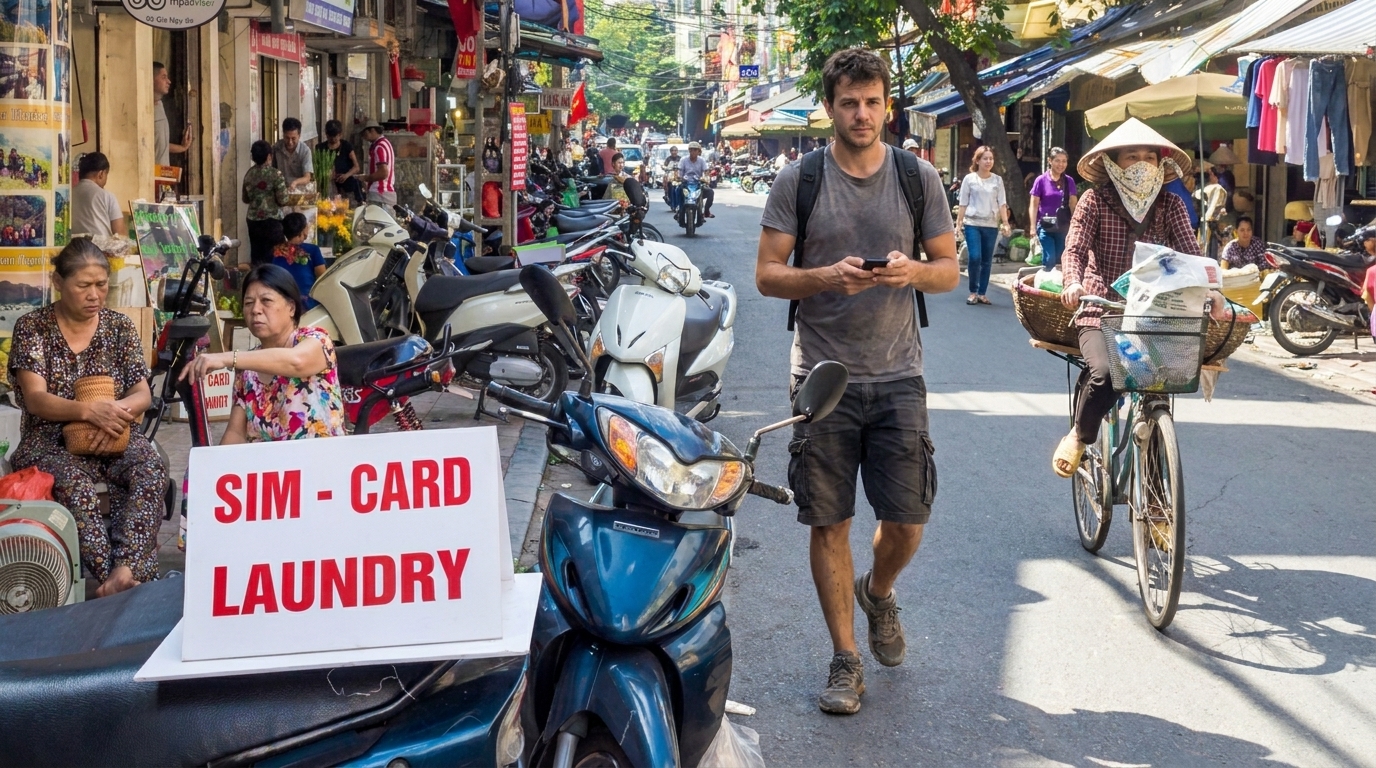
Viettel — Best Overall
Vietnam’s largest network. Best coverage across the country, not just in Hanoi — matters when you head north to Ha Giang or down to Ninh Binh. Data speeds are consistently good in the city, and the plans are the cheapest per gigabyte.
If you’re buying one SIM for your whole Vietnam trip: Viettel.
Mobifone — Best in Hanoi Specifically
Slightly faster in dense urban areas like the Old Quarter. Marginally pricier than Viettel but the difference is 10,000–20,000 VND (~$0.40–0.80). If you’re spending most of your time in Hanoi and not venturing into rural areas, Mobifone is a reasonable pick.
Vietnamobile — Skip
Cheaper on paper. Noticeably slower and patchy outside central Hanoi. Not worth the savings if you’re relying on Google Maps in traffic.
✓Quick Answer
For most travelers, Viettel is the best SIM in Vietnam — widest coverage nationwide, cheapest unlimited data plans at 60,000–90,000 VND (~$2.40–3.60) for 30 days, available at any phone shop in Hanoi including Old Quarter stores, Circle K, and airport counters. Bring your passport to register.
What a SIM Card Actually Costs in Hanoi — 2026 Prices
Here’s what you’ll actually pay at a phone shop (not the airport):

- Viettel D60: 60,000 VND (~$2.40) — 30 days, 60GB data + unlimited social media
- Viettel D90: 90,000 VND (~$3.60) — 30 days, 90GB + unlimited calls
- Mobifone C90: 90,000 VND (~$3.60) — 30 days, unlimited data (throttled after 6GB/day)
- Mobifone C120: 120,000 VND (~$4.80) — 30 days, higher daily quota
For most travelers spending 2–4 weeks in Vietnam, the Viettel D60 or D90 handles everything: maps, streaming, WhatsApp, uploading photos. You won’t run out.
⚠Real Talk
SIM counters at Noi Bai Airport charge 200,000–350,000 VND for equivalent plans. That’s 3–4x street price. Convenient if you land at 2am and need data immediately. Otherwise, wait. Any phone shop in the Old Quarter sells the same SIM at a third of the price — and there are dozens within walking distance of most hostels.
Where to Buy a SIM Card in Hanoi
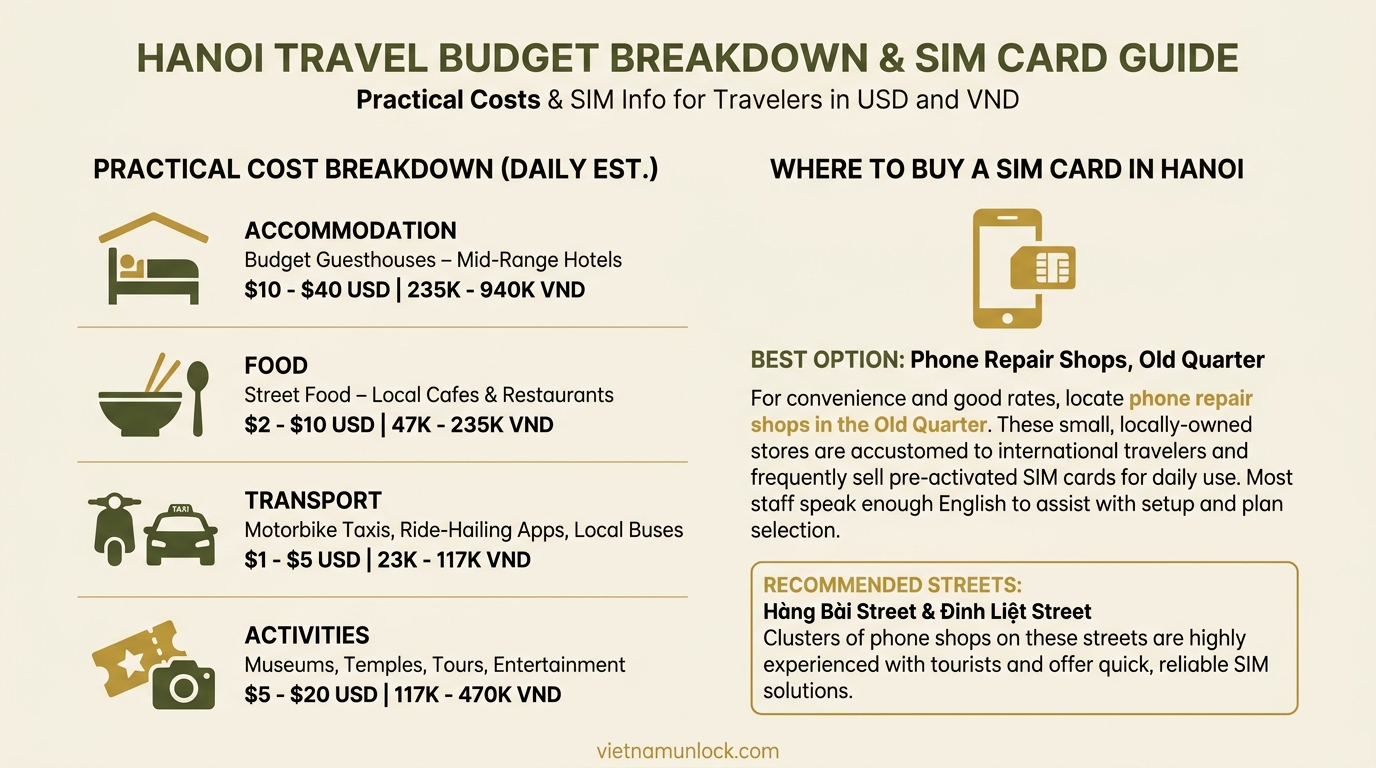
Best Option: Phone Repair Shops, Old Quarter
Hàng Bài Street and Đinh Liệt Street have clusters of phone shops that sell SIMs to tourists daily. They’re used to foreigners, they speak enough English to get through the transaction, and the prices are street price — no tourist markup.
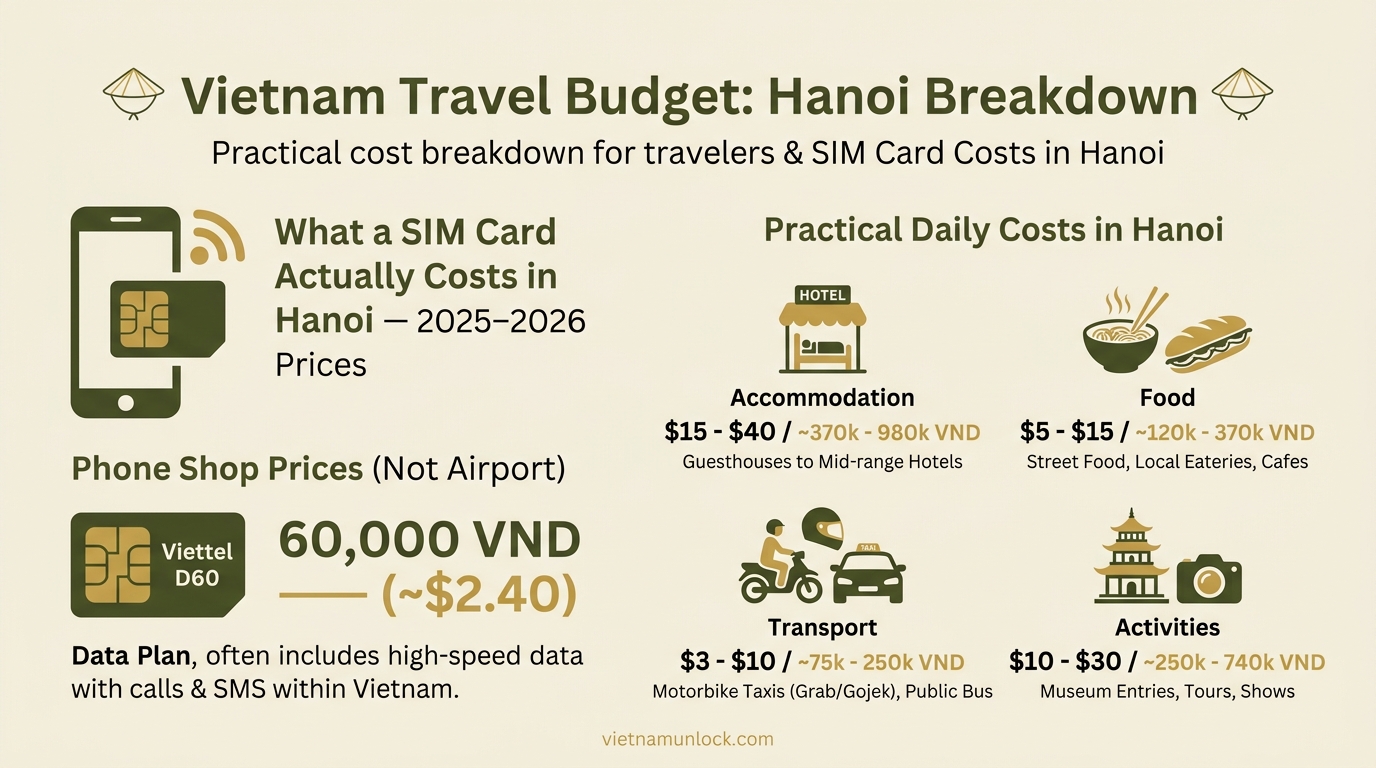
Process: walk in, say “Viettel SIM, một tháng” (Viettel SIM, one month — say: moht thang), hand over passport, pay. Done in under five minutes including registration.
Convenient: Circle K and Convenience Stores
Circle K stores (several in the Old Quarter) sell prepaid SIM starter packs. Prices are slightly above phone shop prices but still far below airport rates. Good option if you’re arriving late and need something quick.
Official Carrier Stores
Viettel and Mobifone both have official stores near Hoan Kiem Lake. Staff are more thorough with registration and can help troubleshoot if the SIM doesn’t activate properly. Useful if you have a complicated phone situation (dual SIM questions, locked phone issues).
Viettel store near Old Quarter: 45 Hàng Gai Street, Hoàn Kiếm
Mobifone: 38 Tràng Tiền Street, Hoàn Kiếm
Airport (Noi Bai) — Only If Necessary
Viettel, Mobifone, and Vietnamobile all have counters in the arrivals hall. Use only if: you land after 10pm, you’re heading somewhere remote immediately with no city time, or you genuinely can’t wait 30 minutes. Otherwise, the savings from waiting are real — 150,000–250,000 VND (~$6–10) real.
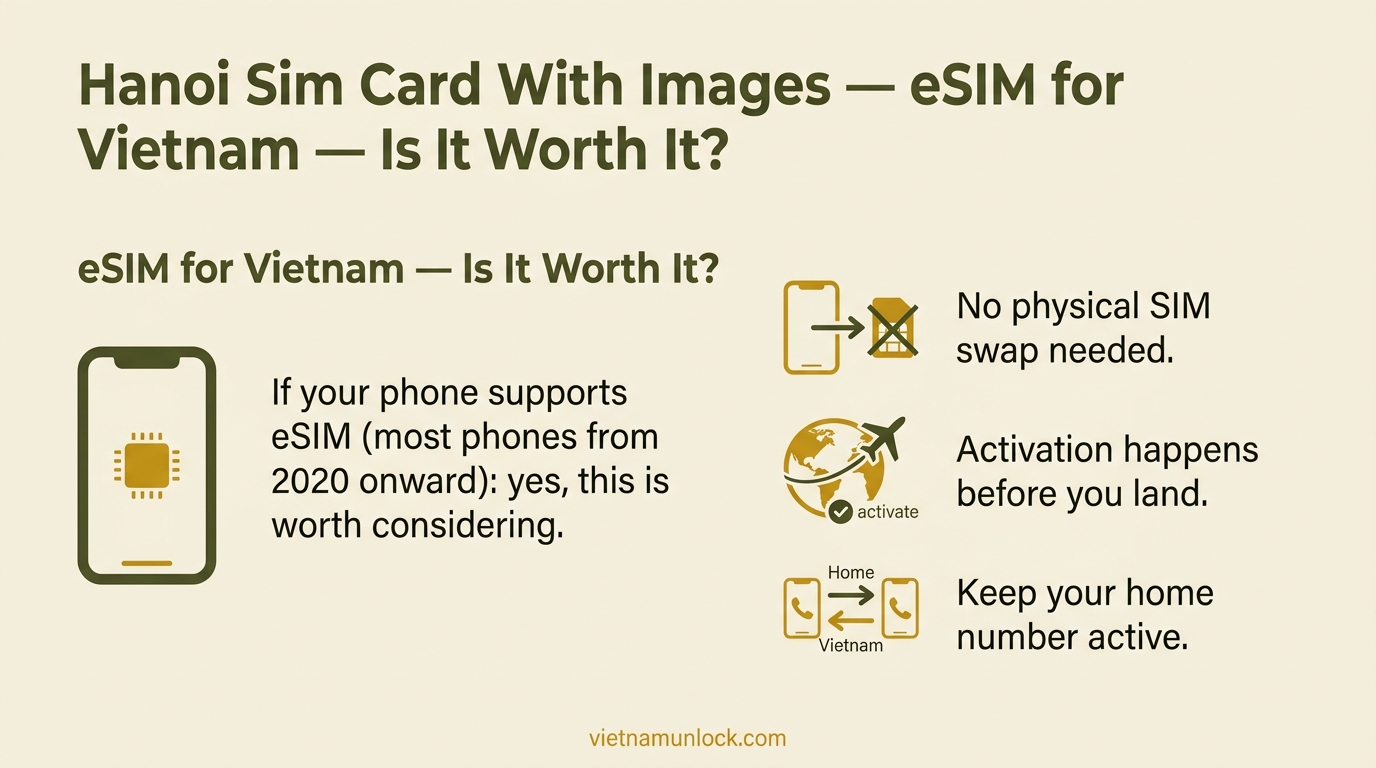
eSIM for Vietnam — Is It Worth It?
If your phone supports eSIM (most phones from 2020 onward): yes, this is worth considering.
An eSIM means no physical SIM swap, activation happens before you land, and you keep your home number active on the other SIM slot. Good for people who need to stay reachable on their regular number.
Airalo Vietnam eSIM costs roughly $6–10 USD for 15–30 days of data. That’s slightly more than a local SIM from a phone shop — the premium is for the convenience of activating before you fly.
The catch: eSIMs are data-only. No local Vietnamese number, which means you can’t receive SMS verifications from Vietnamese apps or banks. For most travelers this doesn’t matter. For long-termers who need a local number: get a physical SIM.
↗Insider Tip
Buy the eSIM the night before your flight, install it, but don’t activate it until you land. That way you have data from the moment you clear customs — no hunting for a SIM shop at 7am while jet-lagged. Set the eSIM as your data line and keep your home SIM for calls.
Does My Phone Work in Vietnam?
Vietnam uses 4G LTE on bands 3, 7, and 28 (Viettel), and 1, 3, 28 (Mobifone). Most modern phones — iPhone 11+, Samsung Galaxy S10+, Google Pixel 3+ — support these bands.
Two things to check before you buy:
- Is your phone unlocked? Carrier-locked phones (from AT&T, Verizon, etc.) may not accept a foreign SIM. Check with your carrier before you leave — most unlock for free after 12 months.
- Is it nano-SIM or eSIM? All Vietnamese SIM cards are nano-SIM. If your phone only takes micro or standard SIM: you need an eSIM or an adapter.
iPhone users in the US: iPhones sold in the US since iPhone 14 are eSIM-only with no physical SIM tray. You need an eSIM for Vietnam — Airalo is your best option.
Registering the SIM — What to Expect
Since 2023, Vietnam requires SIM cards to be registered with a passport. The shop takes a photo of your passport and inputs your details into the carrier’s system. Takes two minutes. Mandatory — no registration, no working SIM after a few days.

What you need: just your passport. That’s it.
If a shop offers to sell you a SIM without registering it, walk out. Those unregistered SIMs get deactivated within days.
How Much Data Do You Actually Need?
Honest answer: less than you think, if you download maps offline.
Before leaving your accommodation each morning, download the offline map for the area you’re visiting in Google Maps or Maps.me. That eliminates the biggest data drain — navigation — and lets you use a cheaper data plan without stress. Particularly useful when exploring the Hanoi Old Quarter where you’ll be navigating constantly.
For active travel (streaming, Instagram, video calls): the 60–90GB plans are plenty for a month. For light use (WhatsApp, maps, occasional browsing): the 30GB plans work fine.
What Travelers Actually Say: The Consensus
The consistent advice across Reddit threads and TripAdvisor from 2025–2026: buy Viettel at a phone shop, not the airport. This comes up in almost every Vietnam trip-planning thread.
On airport SIMs: multiple travelers report paying 250,000–350,000 VND for plans that expired in 7–10 days. “I felt so ripped off once I walked around the corner and saw the same SIM for 70,000 VND” is the common story. The airport SIM isn’t a scam exactly — it’s a convenience surcharge. But the surcharge is 200–300%.
On eSIMs: the traveler consensus shifted noticeably in 2024–2025. More travelers arrive with eSIMs already activated. “Zero friction from the moment I cleared customs” is the repeated benefit. Those who had issues usually had locked phones or older models without eSIM support.
On Grab without a local SIM: yes, Grab works with roaming data. But roaming plans from US carriers (except Google Fi) run slowly enough that Grab requests sometimes fail to connect. A local SIM eliminates that frustration — especially important when you need Grab to escape a motorbike taxi scam situation fast.
Frequently Asked Questions About Vietnam SIM Cards
What’s the difference between a SIM card and an eSIM?
A physical SIM is a small card you insert into your phone’s SIM tray. An eSIM is a digital version — activated via QR code, no physical card. Same data, different delivery. eSIM is more convenient (no swapping, activate before landing) but requires a compatible phone and a slightly higher price via Airalo vs buying locally.
Can I use my home country’s roaming plan instead?
You can. US carriers (T-Mobile, Google Fi) include free international data. T-Mobile’s free international data runs at 2G speeds — frustrating for maps in Hanoi traffic. Google Fi gives full LTE speed internationally and is genuinely usable. Still more expensive than a local SIM for longer trips, but acceptable for a 3–5 day visit where simplicity matters more than cost.
The Bottom Line on Hanoi SIM Cards
Vietnam has some of the cheapest mobile data in the world. A 30-day unlimited SIM costs less than a coffee back home.
Buy Viettel at a phone shop near your hostel. Bring your passport. Skip the airport counter unless you really can’t wait. If your phone is eSIM-compatible, Airalo is a clean alternative you can set up before landing.
The only way to overpay for a SIM in Hanoi is to not read anything before you land — and you’ve already fixed that.
Planning the rest of your Hanoi trip? The Hanoi things to do guide has neighborhoods, activities, and transport covered. And watch out for the motorbike scams that catch most first-timers on day one.
Frequently Asked Questions
Which SIM card is best for foreigners in Hanoi?
Viettel has the best nationwide coverage, including in remote areas like Ha Giang and rural Ninh Binh. For most tourists: buy Viettel at Noi Bai Airport arrivals before customs — 100,000–150,000 VND (~$3.80–5.70) for 30 days with 5–10GB data. Takes 5 minutes, requires your passport.
Can I use an eSIM instead of a physical SIM in Vietnam?
Yes, for compatible phones (iPhone XS+, most modern Androids). Airalo sells Vietnam eSIMs from $4.50 USD for 1GB or $7 for 5GB. Activate before you land. Downside: eSIMs don’t come with a local number, which matters for verifying apps like Grab. For pure data, eSIM is convenient; for a local number, get a physical SIM.
SIM Card Troubleshooting — Common Problems and Fixes
Things that go wrong, and what to do:
SIM not activating after purchase. Takes up to 30 minutes for registration to clear the carrier’s system. If it hasn’t activated after an hour, go back to the shop with your passport — they can check the registration status directly. Most shops are used to this and will fix it quickly.
No signal in specific areas. Viettel covers most of Vietnam, but basement floors, certain concrete buildings, and some rural valleys have no signal regardless of carrier. Ha Giang Loop’s most remote sections (beyond Đồng Văn) have patchy coverage even with Viettel — download your maps offline before entering the loop. For the Ha Giang province generally, Viettel is still the best carrier but expect signal gaps.
Data running out mid-trip. Top up at any Circle K, FamilyMart, or phone shop — tell them your carrier and they’ll sell you a data recharge voucher (thẻ data) or top up your account directly. Alternatively, text the carrier’s shortcode: for Viettel, text “DATA” to 191 to check your balance. Most 30-day plans auto-expire even if data remains — buy the next plan fresh rather than trying to extend.
Phone won’t read the SIM. Check that the SIM is seated correctly in the tray — nano-SIMs can shift. If the phone still doesn’t read it, the phone may be carrier-locked (see above) or incompatible with Vietnam’s frequency bands. In that case, eSIM is your only option. Airalo works reliably and can be purchased and installed on the spot at the airport.
Apps requiring Vietnamese phone number verification. Some Vietnamese apps (local banking, certain delivery apps) require SMS verification to a Vietnamese number. If you’re using an eSIM (data-only), you won’t have a Vietnamese number. Grab, Booking.com, and most international apps work fine with eSIM. Purely local apps are the exception.
Using Your Vietnam SIM for Calls and Data
Most travelers use their Vietnam SIM exclusively for data — WhatsApp, Line, and Messenger handle all voice calls over the internet. This is the correct approach. International calls from a Vietnamese SIM are expensive (10,000–15,000 VND per minute); calls within Vietnam via a local number are cheap (1,000–2,000 VND per minute) but rarely necessary given app-based calling.
If you need to make a local Vietnamese call (booking a restaurant with no online presence, calling a guesthouse directly, arranging a motorbike repair), the per-minute local rate from a Viettel SIM is low enough that it doesn’t matter. A 5-minute local call costs 5,000–10,000 VND (~$0.20–0.40).
For inbound calls: if you’re staying in Vietnam for longer than 2 weeks and people need to reach you on a Vietnamese number, the local SIM handles this. Share the Vietnamese number on your SIM packaging with relevant contacts. Incoming calls cost nothing.
Vietnam SIM Cards FAQ
Do I need a SIM card in Vietnam or can I use roaming?
Roaming works but is expensive — most international plans charge $5–15/day for data abroad, and speeds are often throttled. A Vietnamese SIM at 60,000–90,000 VND (~$2.40–3.60) for 30 days of unlimited data is dramatically cheaper. The only reason to use roaming is if your stay is under 2 days or you can’t unlock your phone before departure.
Can I buy a Vietnam SIM card before I arrive?
Yes — eSIM providers like Airalo sell Vietnam eSIMs you can purchase and install before your flight. This is the best option for travelers who want data the moment they clear customs without hunting for a SIM shop. Physical SIM cards (Viettel, Mobifone) can only be purchased in Vietnam and require in-person registration with your passport.
How long does a Vietnam SIM card last?
Most tourist plans are 15 or 30 days. The plan duration is fixed from activation — a 30-day Viettel plan bought on January 1 expires February 1 regardless of how much data you used. If you’re staying longer than 30 days, buy a new plan (top-up) at any convenience store or phone shop. The SIM itself doesn’t expire; only the data plan does.
Which SIM card is best for traveling Vietnam north to south?
Viettel — it has the widest rural coverage, which matters when you’re in Ha Giang, Phong Nha, or the Mekong Delta. Mobifone is fine in cities but occasionally drops out in remote areas where Viettel still has signal. For full-country travel, Viettel is consistently the recommendation from long-term travelers and expats.
One More Thing: WiFi vs SIM in Vietnam
Some travelers ask whether a pocket WiFi device is better than a SIM card. For Vietnam, it’s not. Pocket WiFi rental costs 150,000–200,000 VND per day — that’s more per week than a 30-day unlimited SIM. The only advantage is sharing data between multiple devices without each person buying a SIM. For a solo traveler or a couple, individual SIMs are cheaper and simpler. For a family of 4 who all need data, a pocket WiFi can make financial sense if rental prices drop — check current rental rates at Noi Bai Airport.
Hotel and hostel WiFi in Vietnam is generally adequate for browsing but often throttled for video streaming and unreliable in older buildings. Don’t plan to rely exclusively on accommodation WiFi if you need consistent connectivity — a local SIM is the backup that makes everything else work. Our Vietnam WiFi guide covers what to expect from connectivity across different regions.