
Last updated: May 2026 — Train prices and Hai Van Pass car transfer rates verified.

That’s a waste. The road between Da Nang and Hue crosses the Hai Van Pass — a mountain ridge that drops straight into the South China Sea — and if you pick the right transport, those two hours become one of the best parts of your Vietnam trip.
Here’s every option, with honest trade-offs. Pick based on your budget, timeline, and how much you care about the view.
The Hai Van Pass: Why the Route Matters
The Hai Van Pass (Đèo Hải Vân — say: day hi van) sits at 496 meters above sea level. At the summit, you’re standing on a mountain ridge with the East Sea (South China Sea) directly below on both sides. On a clear day the view extends from Da Nang Bay in the south to Lang Co lagoon in the north — an arc of turquoise water, white sand, and jungle that doesn’t look real.
There are two ways to experience this stretch: the mountain road (QL1A, old highway), which goes over the pass, or the Hai Van Tunnel (opened 2005), which goes under it in six minutes flat.
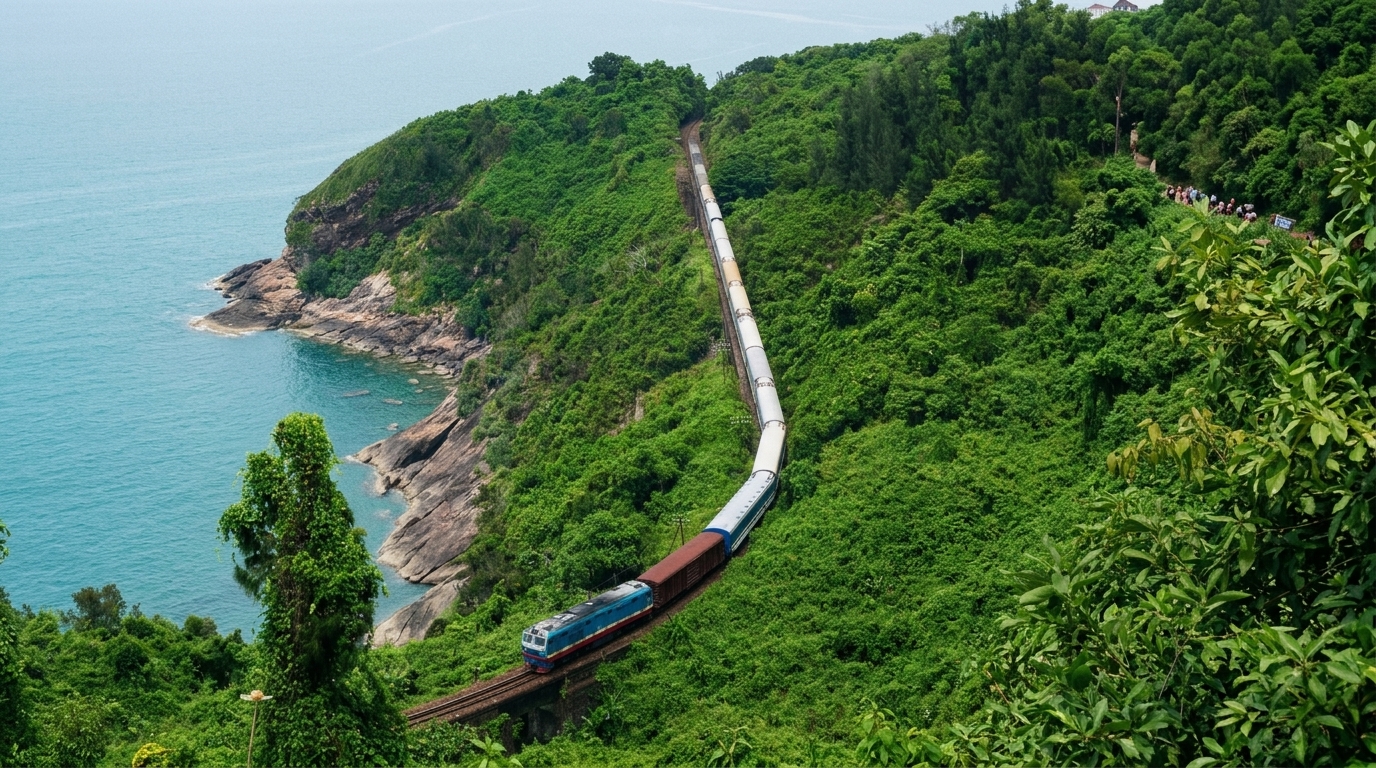
The train takes the old coastal track, hugging the cliff face on the east side of the pass. The train crosses it on a track that was literally blasted out of the mountainside in the early 20th century — in several sections, the sea is directly below the window.
The direct bus and most private transfers use the tunnel. You’ll be in an air-conditioned vehicle staring at a concrete wall for six minutes. Then you’re on the other side.
That is the essential trade-off for every transport option below.
✓Quick Answer
The fastest way from Da Nang to Hue is the train (70 minutes, 90,000–200,000 VND). The most scenic is motorbike or private car over the Hai Van Pass road (2.5–3 hours). Direct buses use the tunnel and take 3–4 hours including stops. Distance: 100 km.
Option 1: Train — The Best Overall Choice
The Reunification Express (tàu thống nhất — say: tao toong nyut) runs the Da Nang–Hue route multiple times daily. The journey takes 70–100 minutes depending on which train you catch. For context: the bus takes 3–4 hours and covers the same distance through a tunnel.

The train crosses the Hai Van Pass on the original coastal track. The section between km 800 and km 840 — roughly 15 minutes of the journey — runs on a narrow track blasted into the face of a cliff above the sea. The window view on the east side (sit on the right facing Hue, or left if you’re going Da Nang) looks directly down at the water. No tunnel, no concrete. Just ocean and sky.
Trains to book:
- SE1, SE3, SE5, SE7 (express) — 70–80 minutes, fewer stops
- TN1, TN3 (local) — 90–100 minutes, more stops, slightly cheaper
- Book at dsvn.vn (official) or 12Go.asia (English interface, small booking fee)
Prices (2026):
Seat (hard seat): 90,000–110,000 VND (~$3.60–$4.40)
Soft seat: 130,000–160,000 VND (~$5.20–$6.40)
Soft berth (6-berth): 200,000–280,000 VND (~$8–$11.20) — overkill for a 70-minute ride but some people do it
Which seat to book: Soft seat is worth the premium. The difference between hard seat and soft seat on Vietnamese trains is significant — padded vs. wooden bench. For a 70-minute coastal crossing, pay the extra 40,000 VND.
Da Nang Station is at 16.0674° N, 108.2065° E on Hải Phòng street — 3 km from the beach, 15 minutes by Grab from the tourist center. Hue Station is at 16.4601° N, 107.5958° E, right in the city center, walkable to most guesthouses.
★Jake’s Pick
Soft seat on the SE3 or SE5. Book the east-facing window seat (right side of the train heading toward Hue). Bring a snack. Give yourself 20 minutes at Da Nang Station before departure — it’s chaotic in the best way.
Option 2: Private Car Over Hai Van Pass — The Most Dramatic
A private car or minivan that takes the old mountain road (not the tunnel) over Hai Van Pass is the most visually rewarding way to do this journey. You get the summit views, you can stop for photos, and you’re in a comfortable vehicle. The downside: it costs 4–6x more than the train.
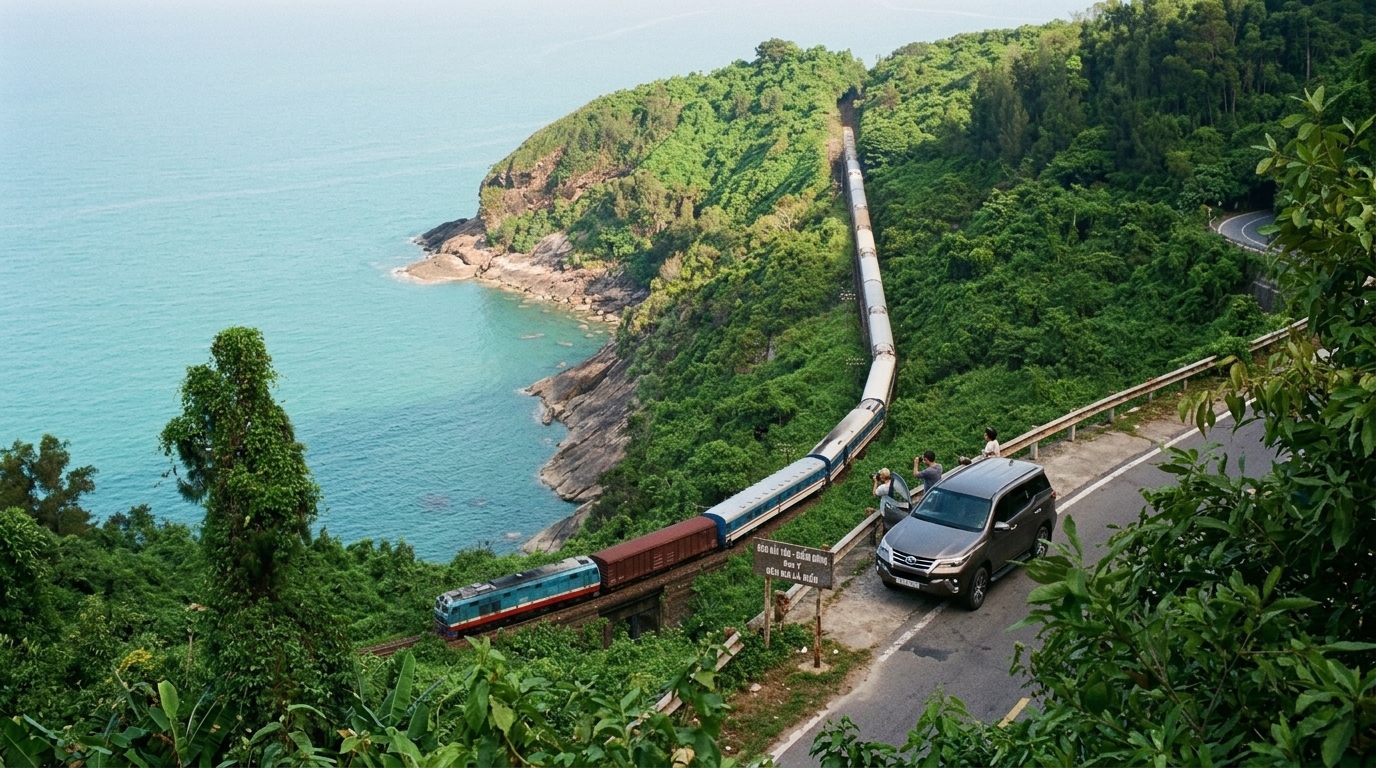
What to book: Look for “Hai Van Pass scenic transfer” specifically — most car services default to the tunnel unless you ask. Make it explicit in writing. Popular booking platforms: GetYourGuide, Klook, or book directly with a guesthouse in either city.
Prices (2026):
Shared car/minivan: 250,000–400,000 VND per person (~$10–$16)
Private car (4-seat): 800,000–1,200,000 VND total (~$32–$48)
Private minivan (7-9 seat): 1,000,000–1,500,000 VND total (~$40–$60)
Journey time: 2.5–3.5 hours with a 20-minute stop at the pass summit.
The summit (Đỉnh Đèo Hải Vân — 16.1948° N, 108.1337° E) has French-era and American War-era military ruins, a small café selling bad coffee at inflated prices, and a view that justifies every cent of the transport premium. Spend at least 20 minutes here. Don’t rush it.
ℹKnow Before You Go
Private car services frequently advertise “Hai Van Pass route” and then use the tunnel to save time and fuel. Confirm the route before you leave, get it in writing if possible, and check with your driver at the start. If they head toward the tunnel, say “qua đèo Hải Vân” (say: kwah day hi van) — over Hai Van Pass.
Option 3: Motorbike — Best If You Have Time
Renting a motorbike in Da Nang and riding to Hue over the Hai Van Pass is the version of this journey that will actually stay with you. The road is well-paved, clearly marked, and the gradient on the Da Nang side is steady and manageable. At the summit you’re at eye level with clouds.
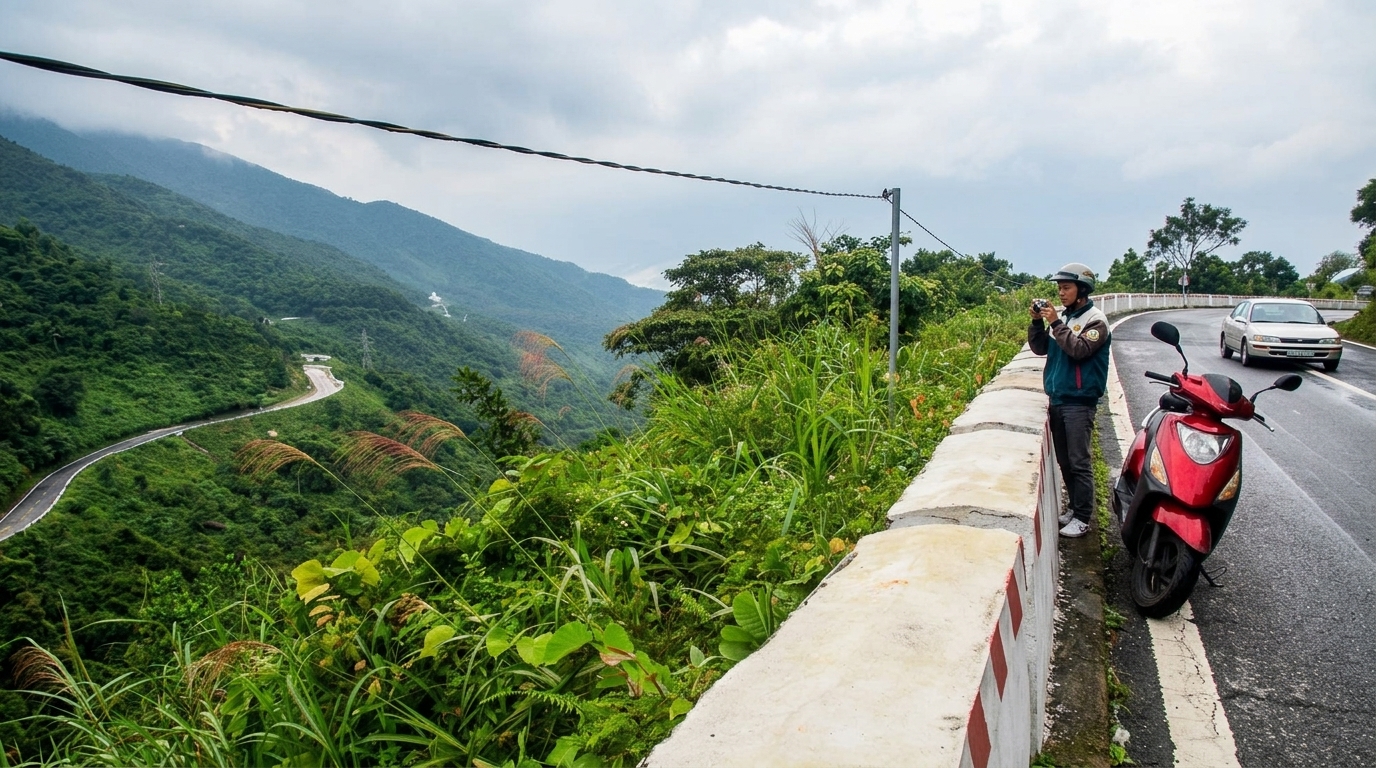
The descent into Lang Co lagoon on the Hue side is one of the best 20 minutes of riding in Vietnam. The road hairpins down the mountain with the lagoon visible the whole way — turquoise water, white sand strip, mountains behind.
Klook has the widest selection for Vietnam and is usually the cheapest. KKday is strong on day trips and local experiences.
0,000 VND/day (~$6–$10) for a manual semi-automatic. Most rental shops are around Bạch Đằng street near the Han River. One-way rentals (drop off in Hue) are possible but cost more — expect to pay 300,000–450,000 VND (~$12–$18) total for the arrangement.
Ride time: 2.5–3 hours including the pass stop. Add 30 minutes if you stop at Lang Co beach on the Hue side (worth it).
Honest warning: The Hai Van Pass gets thick fog and sudden rain — the mountain creates its own weather. If it’s overcast in Da Nang, the pass might be completely fogged in. Check before you go. Riding in fog at 400 meters with no guardrail is not the experience you want.
→Who It’s For
Confident riders who have ridden in Vietnam before and have at least 3 days in the region. Not for first-time Vietnam riders — the mountain traffic includes buses and trucks that own the center of the road. Not ideal if you’re on a tight schedule or if it’s been raining.
Option 4: Bus — Cheapest, But Not the Best
Multiple open-tour bus companies run Da Nang–Hue daily. The trip takes 3–4 hours because buses use the Hai Van Tunnel (6 minutes of concrete) and make multiple stops in both cities picking up passengers.

Prices (2026):
Open-tour bus: 120,000–200,000 VND (~$4.80–$8)
Sleeper bus (evening departures): 150,000–250,000 VND (~$6–$10)
Main operators: The Sinh Tourist, Phuong Trang (FUTA), Queen Café Bus. Book at your guesthouse, directly at their offices, or via Vexere (vexere.com — Vietnamese bus booking platform with English interface).
The bus is fine. It gets you there. You’ll miss the pass completely, you’ll make three unscheduled stops at tourist shops, and you’ll sit next to someone’s market goods for part of the journey. But it costs half the train fare and leaves frequently.
The Hai Van Pass Stop: What to Expect
If you’re going by private car or motorbike and stopping at the summit: it’s a real mountain pass with genuine infrastructure remnants from two wars, strong wind even on clear days, and a view that justifies the entire detour.
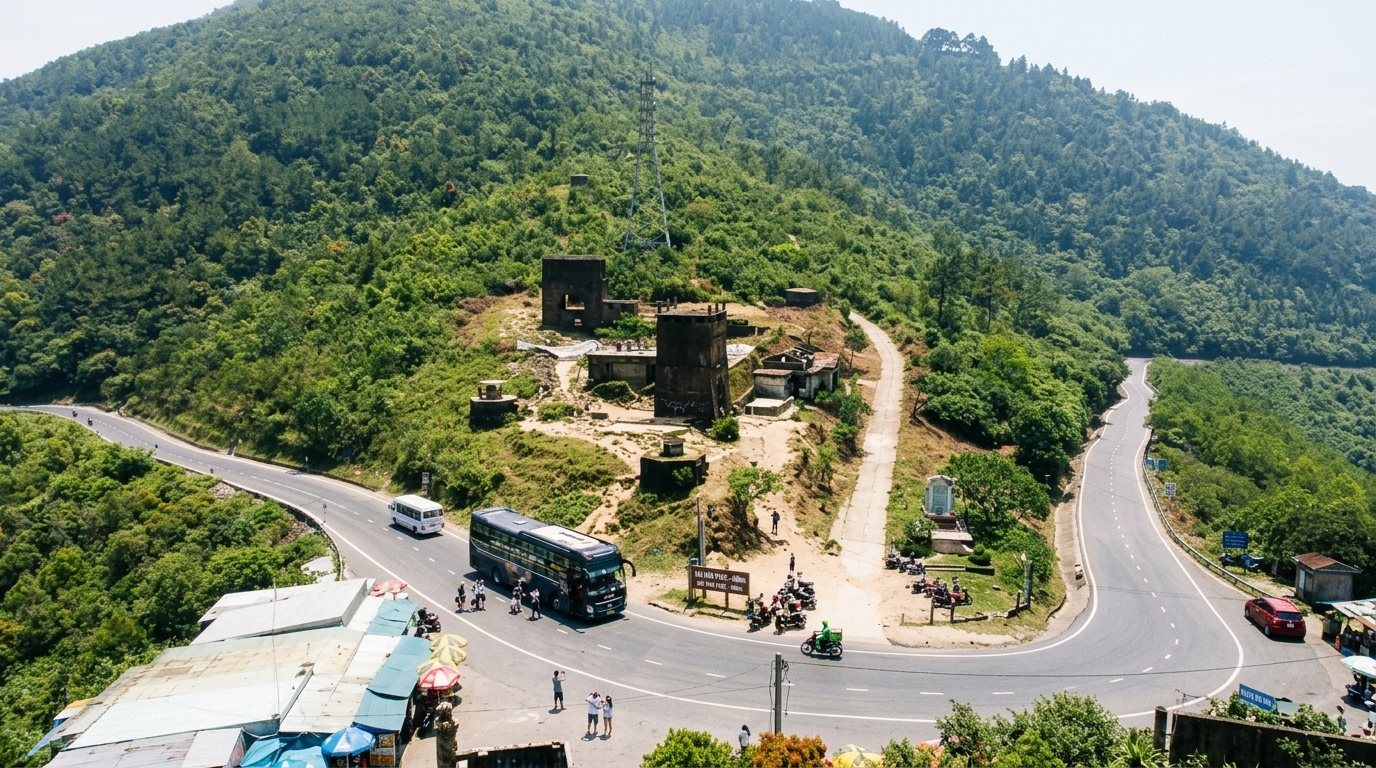
The summit sits at the border of Da Nang city and Thua Thien-Hue province — there’s a gate marking the old provincial boundary. The bunkers and gun emplacements were used by the French, then the Americans, then the North Vietnamese Army. They’re not preserved or labeled, just there, slowly being reclaimed by vegetation.
Practical notes at the summit:
• Wind is strong year-round — bring a layer even in summer
• The view is north: Lang Co lagoon, the Truong Son mountain range, the coast curving toward Hue
• South: Da Nang Bay, Son Tra Peninsula, Monkey Mountain
• Coffee/drinks available at 30,000–50,000 VND (~$1.20–$2) — basic but functional
• No entrance fee
• Best light: morning or late afternoon — midday sun flattens the view
Practical Notes: Getting From City Center to Station/Departure Point
In Da Nang:
Da Nang Train Station → city center: 15 min by Grab (40,000–70,000 VND / ~$1.60–$2.80) or xe ôm (say: say-ohm). The station is on Hải Phòng street — easy to find, clearly signposted.
Bus terminals: Da Nang has two main terminals. Inter-city buses from multiple companies leave from areas near Phan Châu Trinh street. Book through Vexere or your guesthouse for pickup options.

In Hue:
Hue Train Station is 1 km from the city center — walkable with light bags, 10 minutes by Grab (30,000–50,000 VND / ~$1.20–$2).
Guesthouses cluster north of the Perfume River within 500m of the station. If you’re staying south of the river (near the Imperial City), add another 15-minute Grab.
Lang Co: Worth a Stop?
Lang Co is a narrow strip of land between the mountains and the sea — a lagoon on one side, beach on the other — about 30 km north of Da Nang. If you’re going by private car or motorbike, it’s a natural stop on the route.
The beach at Lang Co (Bãi biển Lăng Cô — 16.2332° N, 108.0740° E) is long, quiet by Vietnamese standards, and has minimal development. Water is clear. Infrastructure is basic — a few seafood restaurants, no resort beach chairs. The lagoon side has fresh seafood at market prices.
Worth stopping if: you’re on a motorbike, you have a full day, the weather is clear, and you like quiet beaches with no tourist infrastructure.
Skip if: you’re on a schedule, it’s raining, or you want facilities.
Lang Co has a train station (tiny — only local trains stop). The express trains pass through without stopping.
Da Nang to Hue FAQ
Should I go over or under the Hai Van Pass?
Over, if you have the option. The tunnel is faster but you’ll see nothing. The mountain road and the coastal train track both cross the pass in spectacular fashion — the 15–20 minutes you spend above the clouds (or at the summit) is one of the more memorable things you can do between these two cities. The bus forces you through the tunnel by default. The train, motorbike, and scenic private car transfer all take the pass.
Is it safe to ride a motorbike over Hai Van Pass?
For experienced Vietnam riders: yes, in good weather. The road is sealed, the gradient is steady, and the traffic is manageable. For first-time Vietnam riders: no. The Vietnamese traffic culture on mountain roads — where trucks own the center line — is genuinely dangerous if you don’t know how to read it. Fog is also a real hazard on the pass; don’t ride in mist or rain.
What’s the cheapest way from Da Nang to Hue?
Hard seat on a local train: 90,000 VND (~$3.60). Bus is similar at 120,000 VND (~$4.80) but takes twice as long. The train hard seat is better value even if it’s slightly less comfortable.
Can I take a day trip from Da Nang to Hue?
Yes, but it’s barely worth it. Hue needs at least a full day to do justice — the Imperial City alone warrants 3–4 hours, and the royal tombs are another half day. A day trip means arriving at 9am and leaving by 4pm. Workable, not ideal. If you can stay overnight, do it. Before you leave, check our Da Nang things to do guide if you haven’t finished exploring the city yet.