Last updated: May 2026
The Red Dunes — What They’re Actually Like
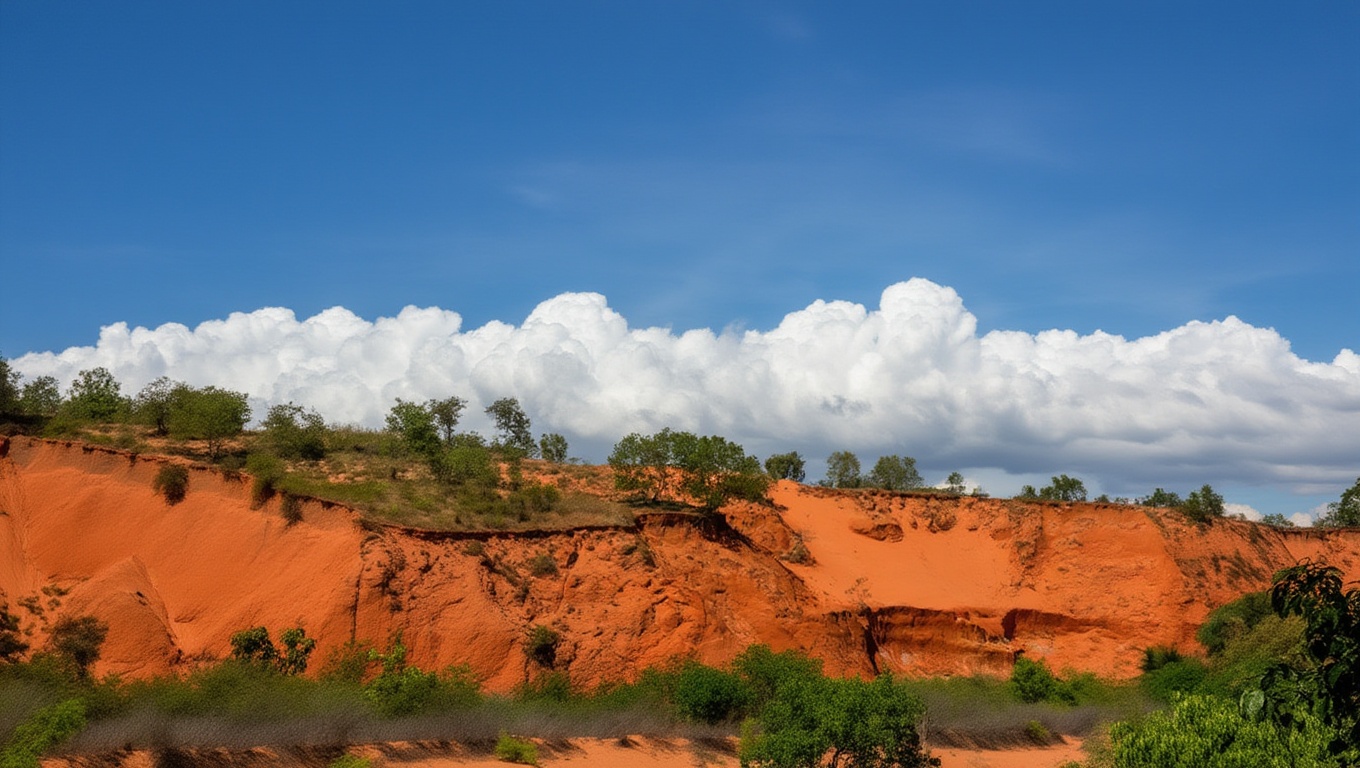
The Red Dunes sit 3km northeast of central Mui Ne on the same road as the fishing village. They’re a 30-meter-high bluff of rust-colored sand rising directly from the flat coastal scrub — not the Sahara, not vast, but genuinely dramatic at the right hour.
At 5:15am, before the ATV rental operators unlock their machines, the Red Dunes are quiet in a way that surprises you. The sand carries warmth from the previous day’s sun even in the pre-dawn cool. The color shifts as light builds — from grey-brown to rust to deep orange to the red that gives them the name. That transition takes about 45 minutes and it’s free to watch.
By 7am the ATVs are running. By 9am there are vendors selling drinks at the bottom, children renting sand-sled boards, and a steady stream of motorbike tourists cresting the ridge. By 11am it’s hot, crowded, and the sand is churned up. The dunes haven’t gone anywhere but the experience has.
⚠Real Talk
The ATV operators at the Red Dunes are aggressive at dawn — they’ll rev engines near you regardless of whether you’ve rented one. This is the business model. If you’re going for the silence and color, arrive at 5am and be on the high ridge before they set up. If you’re going for the ATV experience, there’s genuinely nothing wrong with that — it’s 30 minutes of fast sand-driving on terrain that’s built for it. Just don’t expect a meditative sunrise if you show up at 8am.
The White Dunes and Bau Trang — The Better Experience
The White Dunes (Đồi Cát Trắng) are 35km from Mui Ne center — a 45-minute to 1-hour motorbike ride northeast along the coast road. The dunes here are white-grey silica sand rather than iron-rich red, and they’re significantly larger: higher, steeper, and more photogenic in the flat morning light.
The main attraction at the White Dunes isn’t the sand itself — it’s Bau Trang, the freshwater lake that sits at their base. In wet season (May–October) and early dry season mornings, the lake is full enough to create a mirror reflection of the white dunes and sky above. It’s one of the more unexpected landscapes in southern Vietnam: white sand rising on one side, still water below, no resort infrastructure visible from the ridge.
By mid-morning in dry season (November–April), the lake level drops and the reflection disappears. By noon it’s just hot sand and a shrunken water body. The window for the lake reflection is 5:30–8am in dry season and 5:30–10am in wet season.
The motorbike ride to Bau Trang is part of the experience. The coast road northeast of Mui Ne passes salt flats, small fishing villages, and eventually the sand desert landscape that surrounds the White Dunes. It’s flat, fast, and completely unlike the resort-strip character of central Mui Ne.
Red Dunes vs White Dunes — Which to Choose
Sand Sledding — Worth It or Skip?
Sand sleds are available for hire at both dune systems — flat plastic boards you sit or lie on and ride down the dune face. Cost: 30,000–50,000 VND (~$1.15–1.90) per board, typically rented by local kids at the dune base.
Honest assessment: it’s decent fun at the Red Dunes where the slope angle is right. The White Dunes’ steeper faces are actually better for speed but the sand there is finer and drier — a harder surface that means faster descent and rougher landings. Not for everyone. The main value is that it forces you to actually engage with the dunes rather than just photograph them from the ridge.
The kids renting the boards will sometimes “help” you down the slope — which involves pushing without being asked and then requesting payment. Not a scam exactly, more of an established hustle. Nod politely, say không cảm ơn (no thank you — say: kong kahm uhn) if you don’t want the push.
The Fairy Stream — Add This to the Dunes Day
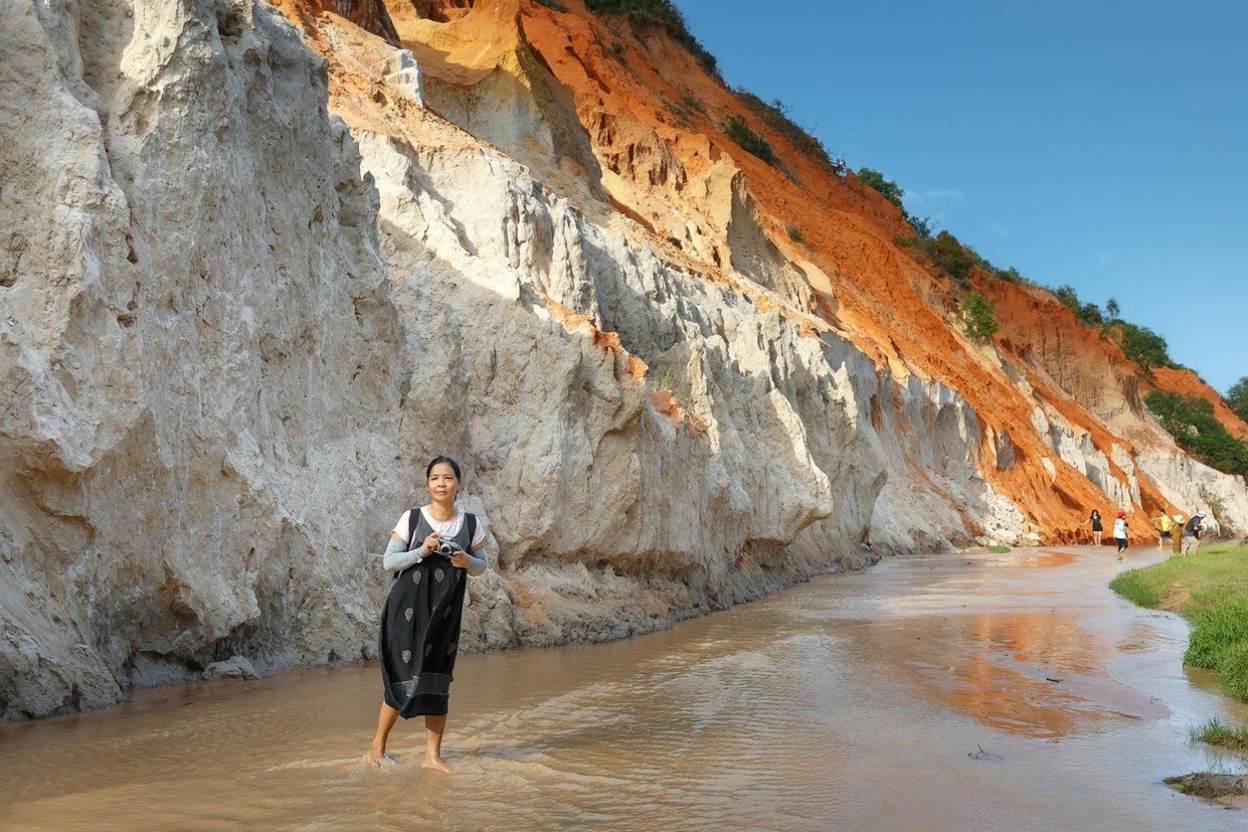
The Fairy Stream (Suối Tiên) is 1km from the Red Dunes: a shallow stream that flows through a canyon of layered white and red sandstone, with water coconut palms leaning overhead and the stream bed running cool and ankle-deep between colored walls.
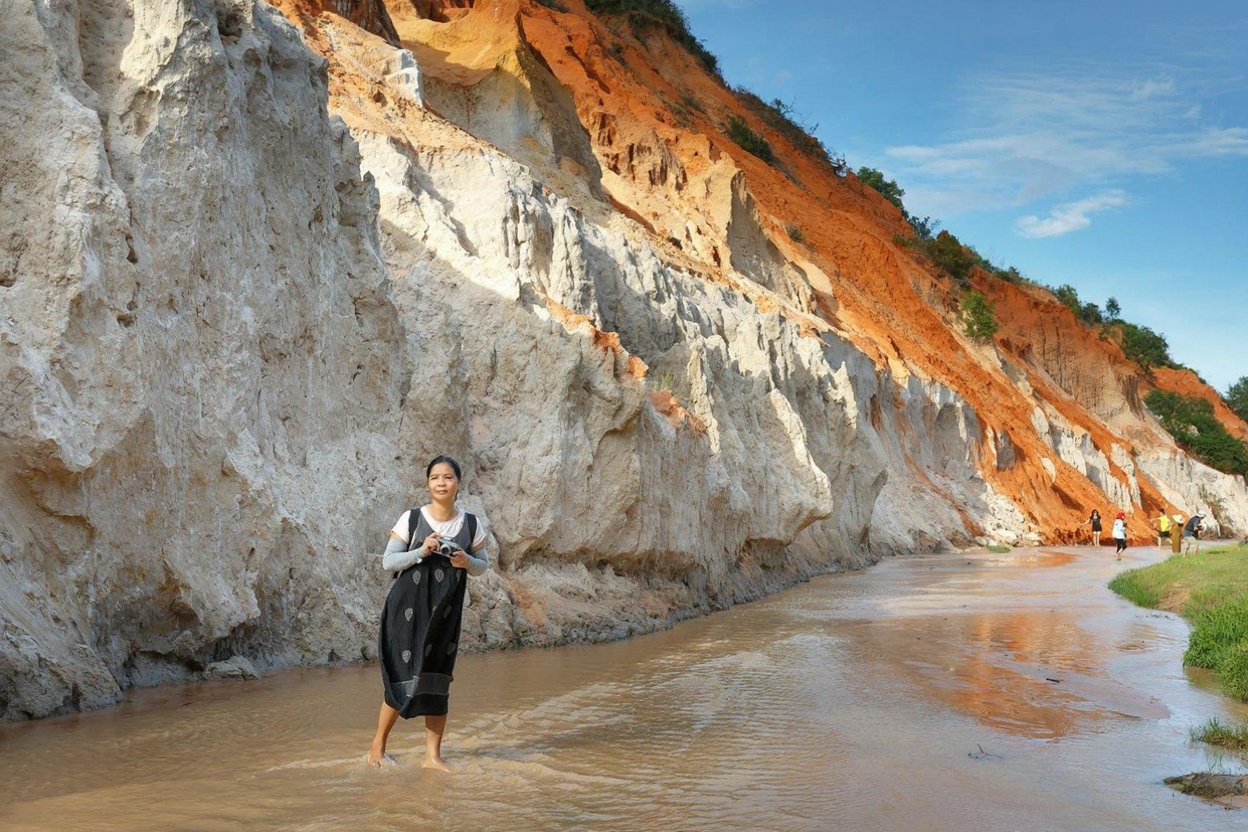
The walk takes 30–45 minutes each way. Remove your shoes at the entrance (or don’t — the water is ankle-deep and the sand floor is clean). The walls get more dramatic further upstream: red and white banded stone, occasional overhanging sections, local birds you won’t see anywhere on the beach strip. The stream temperature is noticeably cooler than the air even in April — a relief after a full morning on the dunes.
No entrance fee. No tour needed. Go in the late afternoon (4–5pm) when the light hits the canyon walls at an angle and the colors intensify. Avoid noon when the sun is directly overhead and all the shadow that makes the canyon interesting disappears.
Combine the Red Dunes at dawn with the Fairy Stream at 4pm — those two things are the actual non-negotiable Mui Ne itinerary. Everything else is optional.
Getting to the Dunes Without a Tour
The Red Dunes are 3km from central Mui Ne on Nguyen Dinh Chieu street. Motorbike from any rental shop in town: 120,000–180,000 VND/day (~$4.55–6.85). The ride is 10 minutes with no navigation required — follow the main road northeast until you see the orange sand on your left. No map needed.
The White Dunes require more commitment: 35km each way, 45–60 minutes on a motorbike on the coastal highway. The road is good and flat — easy ride for anyone comfortable on a Vietnamese semi-automatic. Alternatively, every guesthouse in Mui Ne offers a White Dunes tour: half-day for 150,000–250,000 VND per person (~$5.70–9.50) including transport, guide, and the optional boat ride on Bau Trang lake.
Klook has the widest selection for Vietnam and is usually the cheapest. KKday is strong on day trips and local experiences.
or the dawn lake, no group pace, and cheaper if you’ve already rented the bike. The tour version is fine for travelers who don’t ride or want to go as a group.
The Full Mui Ne Dunes Day — A Practical Itinerary
If you’re staying two nights in Mui Ne and want to see both dune systems without rushing, here’s the sequence that works:
Day 1 Morning — White Dunes (Bau Trang): Wake at 4:30am, on your motorbike by 5am. Arrive White Dunes 5:45–6am. Walk to the ridge above Bau Trang. Spend 30–40 minutes on the ridge as the light builds. The reflection disappears quickly in dry season — by 8am the lake surface is often too bright and the sand too washed out. Ride back along the coast to Mui Ne, arriving by 8:30am. Eat breakfast. Planning the trip from Ho Chi Minh City? See our guide on getting to Mui Ne from Saigon for bus and transport options.
Day 1 Afternoon — Fairy Stream: Go at 4pm when the low sun hits the canyon walls. Walk upstream 1km through the ankle-deep water. This takes 45 minutes each way at a slow pace. Back at the main road by 5:30pm.
Day 2 Dawn — Red Dunes: Wake at 5am. Ride 10 minutes to the Red Dunes. Climb the north ridge and watch the sun rise over the South China Sea. Be on the ridge before 5:30am for the warm sand and silence. Watch the color shift from rust to orange to red. Leave by 7am before the ATVs get going. Cost: nothing. Memory: kept.
This sequence means you see both dune systems at their best time of day, use both full mornings, and don’t need a tour for either. Total motorbike cost for the two days: 240,000–360,000 VND (~$9.10–13.65) rental. Total entry fees: essentially zero.
The Wind and the Kitesurfers — Context for When to Visit
The wind is the overlooked factor in any Mui Ne dunes visit. From October to February, the northeastern monsoon sends consistent 20–30 knot winds across the coast. This is why Mui Ne became one of Southeast Asia’s premier kitesurfing destinations — the wind is reliable and strong. It’s also why the sand dunes behave differently in these months: the Red Dunes’ surface ripples constantly, the sand blows in your face on exposed ridges, and the fine particles get into everything.
For dune photography and the reflective surface of Bau Trang lake, the calm shoulder months — October, March, and April — are better. Less wind means less sand movement, clearer air, and a flatter lake surface for the reflection shot.
For kitesurfing on the beach and dramatic sand-in-motion photography at the dunes, December–February is prime. Arrive at the Red Dunes at dawn in January when the wind is already building at 6am and the sand streams off the dune crests like smoke — it’s a completely different visual from the still-air morning.
The Fishing Village at Dawn — Combine It With the Red Dunes
The Mui Ne fishing village is 2km past the Red Dunes on the same road — a 15-minute total ride from central Mui Ne. The two work together as a single dawn itinerary: arrive at the Red Dunes at 5:15am, spend 45 minutes on the sand as the sun comes up, then ride another 2km to the fishing village to arrive just as the basket boat fleet returns from the night’s fishing.
The fishing village at 6:30–7am: hundreds of round basket boats (thuyền thúng) pulled up on a short stretch of grey gravel beach, their turquoise hulls and tangerine buoys stacked at the waterline. The smell is honest and direct — brine, fish, diesel, damp wicker. Women sorting catch by type on plastic tarps. The market at the village edge operating at full speed by 7am.
This combination — dunes at dawn then fishing village at 7am — is the best two-hour sequence in Mui Ne. Neither requires a tour. Both require a motorbike and an early alarm. Both are free.
Getting to the Dunes — Practical Details
Every guesthouse in Mui Ne rents semi-automatic motorbikes — Honda Wave or similar — for 120,000–180,000 VND per day (~$4.55–6.85). No Vietnamese driver’s licence is technically required for under-50cc engines but the police rarely stop tourists on the beach road. If you’re riding to the White Dunes (35km on the national highway), a proper licence is sensible. For the Red Dunes 3km away, local traffic only.
If you don’t ride: every guesthouse offers a dawn dunes tour as a standard package — driver + Red Dunes + fishing village, about 100,000–150,000 VND per person (~$3.80–5.70). The White Dunes tour is 150,000–250,000 VND (~$5.70–9.50) per person and typically includes Bau Trang lake plus a stop at the Red Dunes. Both tours leave at 5am and return by 8:30am.
12Go covers most Vietnam routes — sleeper buses, trains, and island ferries. Compare schedules and book in advance during peak season (Dec–Feb, Jun–Aug).
Sunscreen is non-negotiable at the dunes from 8am onwards — the reflected sand heat amplifies UV significantly, and the lack of shade on any exposed ridge means you’ll burn in under 20 minutes without protection. Bring water; there are vendors at the dune base but nothing on the ridge itself, and the walk up takes 10–15 minutes in loose sand. A broad-brimmed hat is more useful than a cap — the sand reflects UV upward as much as the sun sends it down, so your face gets it from both directions by mid-morning.
What I Got Wrong About the Dunes
The first time I went to the Red Dunes I arrived at 9am on a rental motorbike, thinking “I’ll get the morning light.” I was three hours too late. The ATV circuits were running, the sand was churned up, and the color that looks so dramatic in photographs was washed out in direct overhead sun. I watched a dozen ATVs loop the same track for 45 minutes and left without the shot I wanted.
The second visit: 5am, walked up the north ridge while it was still dark, sat on the high point as the sky went grey then pink then orange over the South China Sea. The sand — and this specific detail surprised me — was still warm from the previous day despite the pre-dawn temperature. That residual heat in the sand at 5am, before any engine starts, is the thing I didn’t expect and remembered longest.
Two things worth sorting before you land: a Vietnam eSIM so you have data the moment you clear customs, and travel insurance — medical costs for uninsured foreigners in Vietnam are significant.
Airalo eSIMs activate instantly. Buy before departure — airport SIM queues in Vietnam can take 30+ minutes.
Frequently Asked Questions
Are the Mui Ne sand dunes worth visiting?
Yes — specifically at dawn. The Red Dunes at 5:30am are genuinely impressive: rust-orange sand, silence before the ATV crowd, and a coastal sunrise view that’s worth the early alarm. The White Dunes at dawn with the reflection lake are even better but require a 35km motorbike ride. Both are free or nearly free to access. Neither is worth visiting in the middle of the day.
How early should I go to the Mui Ne sand dunes?
For the Red Dunes: 5–5:30am to beat the ATV operators who typically start at 6:30–7am. For the White Dunes/Bau Trang: 5:30–6am to catch the reflection lake before it dries in dry season. A 4:30am alarm is not excessive — it’s the same logic as getting to the Cai Rang floating market in the Mekong Delta. The experience is entirely different before and after the crowd arrives.
Are there entrance fees at the Mui Ne sand dunes?
The Red Dunes have no formal entrance fee — you ride up, park your motorbike, and walk to the sand. Vendors at the base will try to sell drinks, and sand sled kids will approach you immediately, but nothing is mandatory. The White Dunes/Bau Trang have a small admission fee of approximately 15,000–20,000 VND (~$0.60–0.75) collected at a booth near the car park. Both sites have motorbike parking attended by local kids who expect 5,000–10,000 VND (~$0.20–0.40) as a tip. This is standard — leave it.
What should I wear to the Mui Ne sand dunes?
Closed-toe shoes or sandals you don’t mind getting sandy — not flip-flops. The sand between the car park and the dune crest is 200–300 meters and gets very hot in the sun; bare feet are painful by 8am. A hat is essential — the dunes offer zero shade once you’re on the ridge. Long sleeves are useful at dawn not for sun protection but for the slight cool that persists on the ridge before 7am, and for keeping sand off your arms when the wind picks up. Leave expensive camera gear in sealed bags — fine sand gets into everything.
What is the best month to visit Mui Ne sand dunes?
October, March, and April are the best months: dry enough for good road conditions, calm enough wind for undisturbed sand surfaces and a still reflection at Bau Trang, and cool enough in the early morning that the dune walk is comfortable. December–February is peak season (more tourists, Christmas/New Year crowds) but also prime wind season — if you’re combining dunes with kitesurfing or want dynamic sand movement photography, this is the time. May–September (wet season) brings rain that makes the dunes darker and more dramatic in color, and Bau Trang lake is fullest — but the roads can be muddy and the morning light is often overcast.
What is the difference between Mui Ne Red Dunes and White Dunes?
The Red Dunes (Đồi Cát Đỏ) are iron-rich red sand, 3km from central Mui Ne, smaller and more accessible — a good 20-minute visit at dawn. The White Dunes (Đồi Cát Trắng/Bau Trang) are white silica sand, 35km from town, larger and more dramatic, with a freshwater lake at the base that creates reflection photography in wet season and early dry season mornings. Both are worth seeing; the White Dunes require more planning but reward it.
Can I do the Mui Ne dunes without a tour?
Yes, easily. The Red Dunes are a 10-minute motorbike ride from central Mui Ne — rent a semi-auto for 120,000–180,000 VND/day and ride northeast on Nguyen Dinh Chieu until you see the orange sand. No guide, no map, no tour needed. The White Dunes require a 45-minute motorbike ride on the coastal highway — straightforward for experienced riders, but most guesthouses also offer shared minibus tours to Bau Trang for 150,000–250,000 VND per person if you’d rather not ride.
Is the sand sledding at Mui Ne worth it?
For one run — yes. The local kids rent boards for 30,000–50,000 VND (~$1.15–1.90) and the Red Dunes slope is legitimately good for it. After two or three runs the novelty wears off and you’ll be hot and sand-covered. Do one run early before the sun is up properly, then walk the ridge. That’s the right way to do it.
FAQ
What is the difference between the red and white sand dunes in Mui Ne?
Red Dunes (Đồi Cát Hồng, 7km from town): accessible, lively, plastic sleds for rent, fairy stream nearby, open sunrise to sunset — this is the main tourist site. White Dunes (Bàu Trắng, 56km northeast of Mui Ne): larger, more remote, far fewer tourists, dramatic sweeping landscape. Red is more convenient; White is better if you have a motorbike and want fewer people.
What time should you visit Mui Ne sand dunes?
Sunrise is the peak time for photography — the low-angle light creates strong shadows in the dune patterns and temperatures are bearable. By 8–9 AM the Red Dunes are crowded with tour groups and jeep convoys. Sunset is second-best for light and cooler than midday. Avoid 10 AM–4 PM when temperatures exceed 35°C and the experience is unpleasant.
Are the Mui Ne sand dunes worth visiting?
Red Dunes — modest in scale compared to the Sahara or similar, but they photograph well and the fairy stream nearby is genuinely pretty. Worth 2 hours maximum. White Dunes — more spectacular and worth the 1-hour motorbike ride from Mui Ne town. Together they justify a day if you’re in Mui Ne; they wouldn’t justify a trip from Saigon alone.
Do they rent sandboards at the Mui Ne dunes?
Yes at the Red Dunes — plastic sleds (not sandboards) available for 30,000–50,000 VND. Actual sandboarding technique doesn’t translate from snow boarding; most people slide on their feet or sit on the sleds. It’s more for fun than sport. The White Dunes have fewer vendors — bring water and expect to hike.
How do I get to the Mui Ne sand dunes?
Red Dunes: 7km from the main resort strip — xe om (20,000–30,000 VND one way), rented motorbike (best option), or as part of a sunrise tour that picks you up at 4:30–5 AM. White Dunes: need a motorbike or hire a driver — 56km each way, budget 2.5 hours for the round trip plus time on the dunes.