Last updated: May 2026 — Market hours and accommodation prices verified
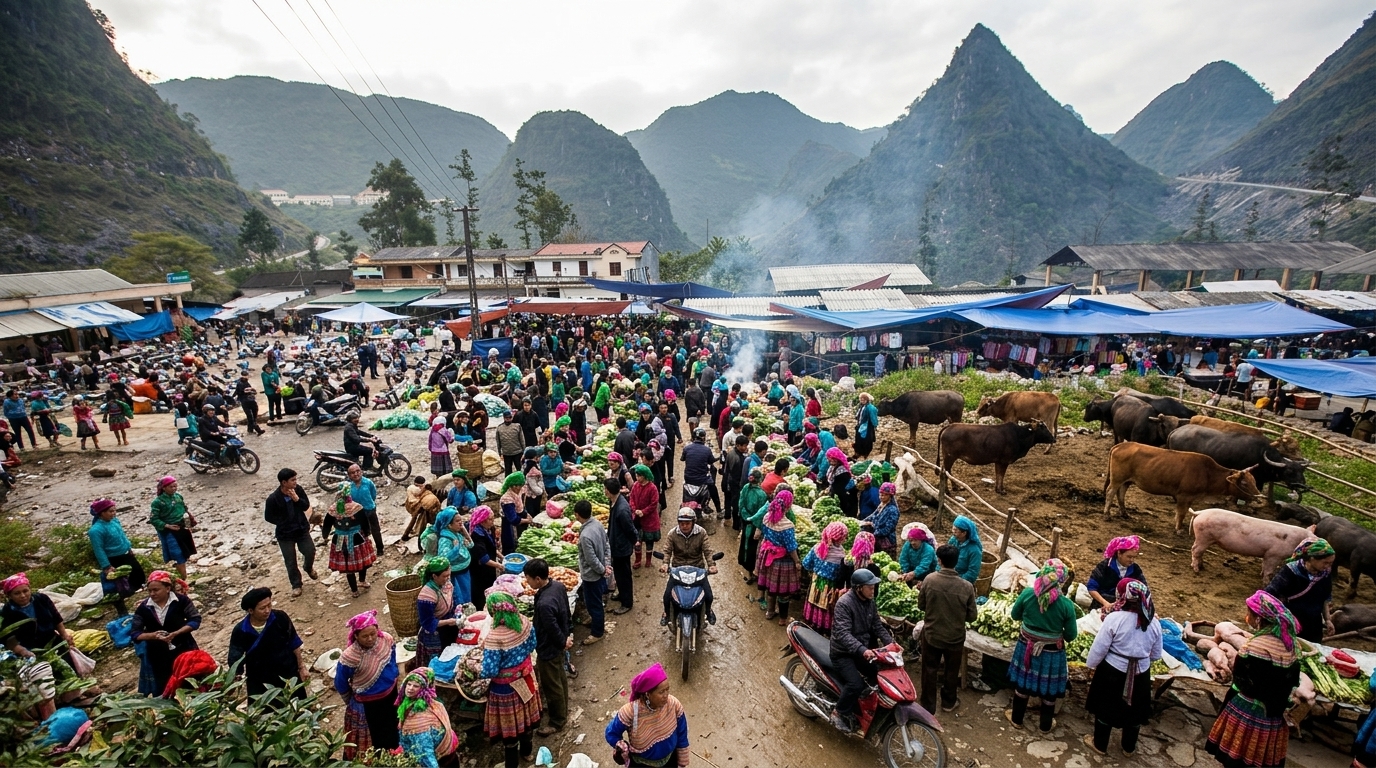
I got there at 6:45am on my second Ha Giang trip, before the tour groups from Dong Van hostels, and for about an hour I was surrounded by H’mong, Dao, Lo Lo, Giay, Nung, and Tay people doing what they’d been doing at this site for generations: buying, selling, arguing, drinking corn wine out of communal cups at 7am, and mostly ignoring the fact that I existed. A grandmother in full traditional Lo Lo dress with silver jewelry was negotiating hard over a pile of dried chilies. Two H’mong men had a living pig in a bag. The thắng cố cauldrons — enormous iron pots of horse meat stew — were already bubbling over wood fires at the center of the food section.
That first hour is the real Meo Vac market. What happens after the buses arrive is still good, but different. This is how to be there for the first hour.
The Market — What’s Actually There
Meo Vac market (23.1547° N, 105.4271° E) runs every Sunday at the market square in Meo Vac town. It’s not a craft market. It’s a functioning weekly trading market for the ethnic communities of the surrounding mountains — produce, livestock, textiles, tools, medicine, food.
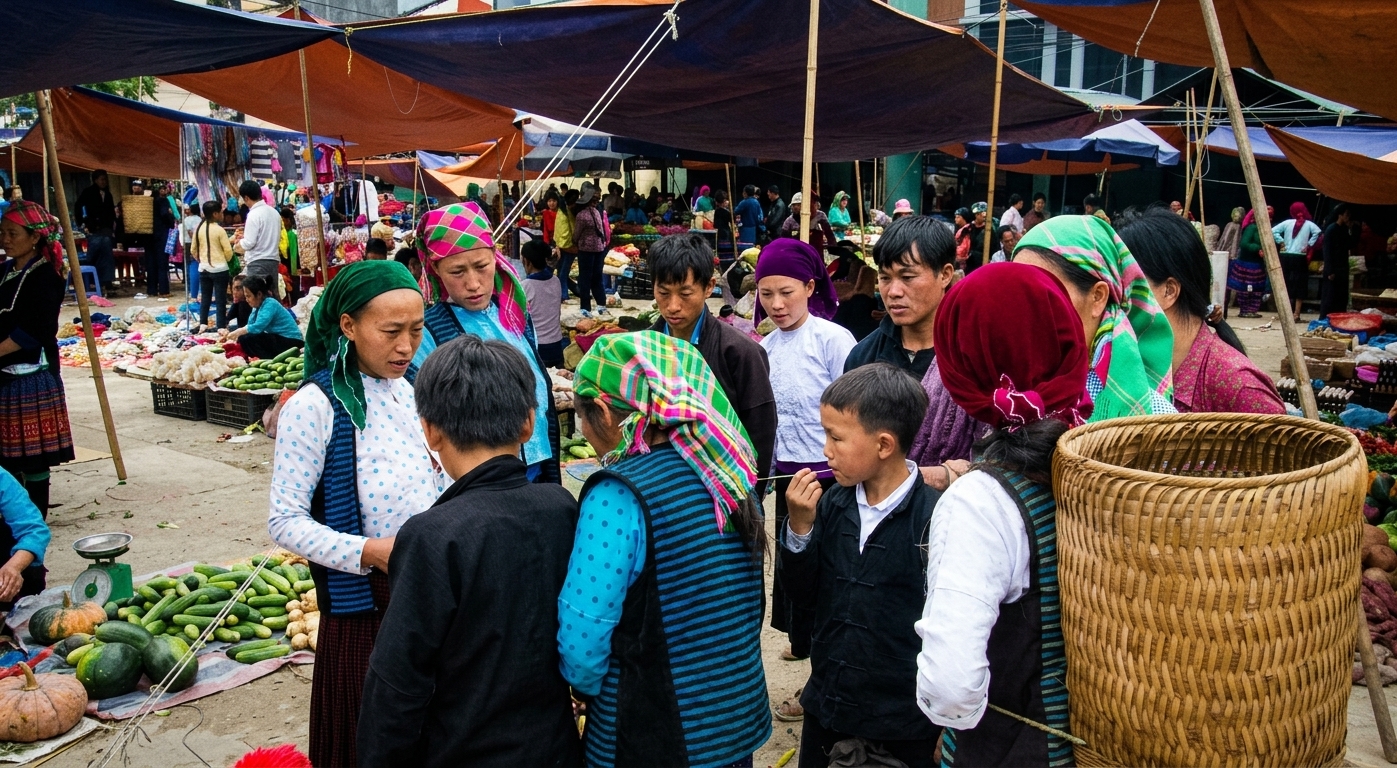
The Food Section
The most viscerally interesting part. At the center: thắng cố (say: tang co) — a traditional H’mong dish of horse meat, organs, and sometimes goat, slow-cooked in enormous iron cauldrons over wood fires with lemongrass, ginger, and star anise. The smell is intense. A bowl costs 50,000–100,000 VND (~$2–4) depending on portion and which stall. You eat it with a side of mèn mén (steamed corn cake) and rượu ngô (say: roo-oh ngoh — corn wine) if you’re doing it properly.
Corn wine is served in a shared cup that circulates around the table. There’s etiquette: when someone passes you the cup, you drink. If you don’t want to participate, decline politely before sitting down — don’t accept and then refuse mid-round. The wine is strong (35–45% alcohol), warm, and tastes of fermented corn. At 8am, this is either a memorable cultural experience or a terrible decision, depending on your constitution.
Also in the food section: xôi ngũ sắc (five-color sticky rice, each color from a different plant dye), bánh tam giác mạch (buckwheat flour cakes, only in season Oct–Nov), and grilled corn with a chili-lime salt that costs 15,000–20,000 VND (~$0.60–0.80) and is worth more than that.
The Livestock Section
Behind the main market building. Live pigs in bags, chickens in crates, occasionally cattle traded on the perimeter. This is a working market for farming communities — the prices being negotiated here will determine whether someone can afford seed stock for the next season. Photograph with discretion or not at all; this is the section where cameras feel most invasive.
The Textile and Craft Section
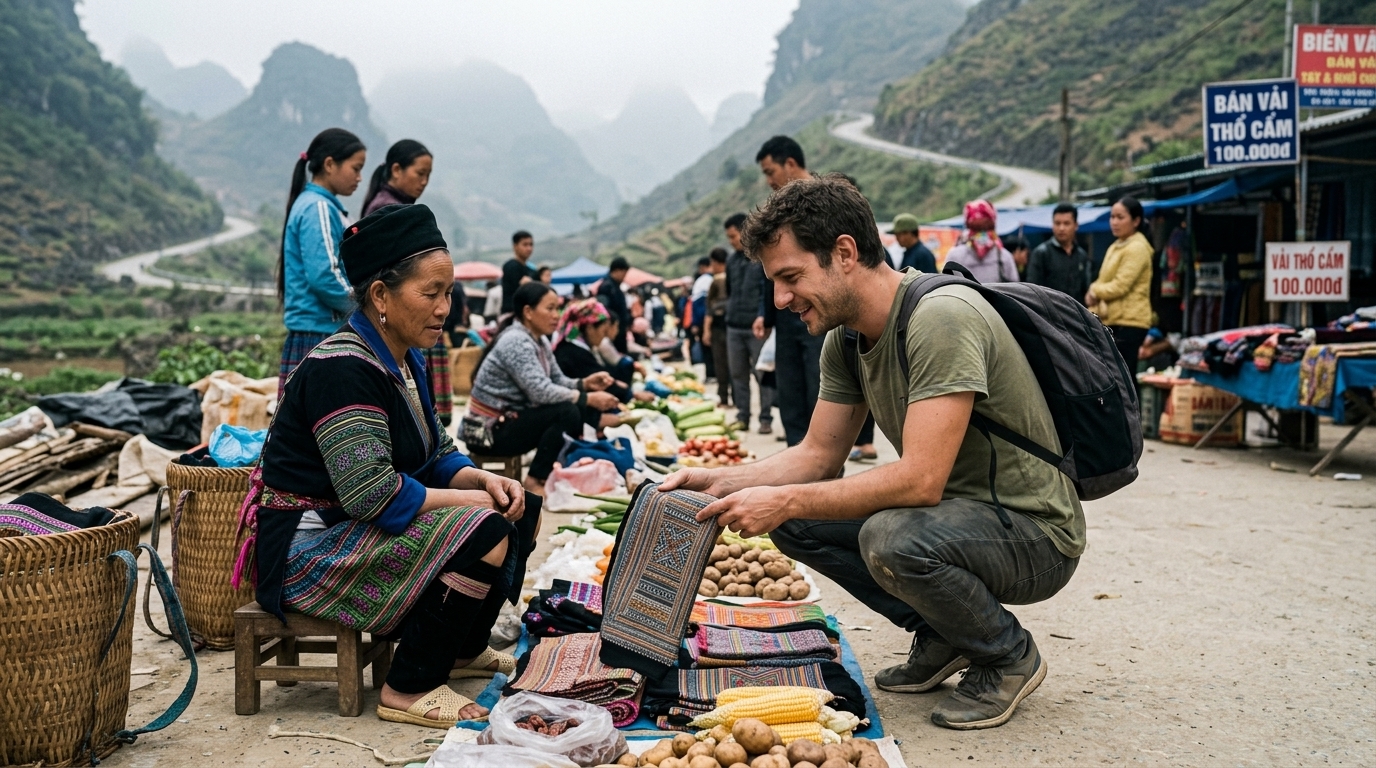
H’mong batik fabric, hand-embroidered clothing, silver jewelry (some handmade, some manufactured). The handmade pieces are identifiable by irregularity and weight — machine-made silver is uniform and light; handworked silver has tool marks and varying thickness. If you’re buying fabric, the women who made it are usually sitting nearby; buying directly from them rather than from the stall middlemen means the money reaches the right person.
Timing — When to Arrive and Why It Matters
The market officially runs Sunday only, starting around 6am. The real answer on timing:
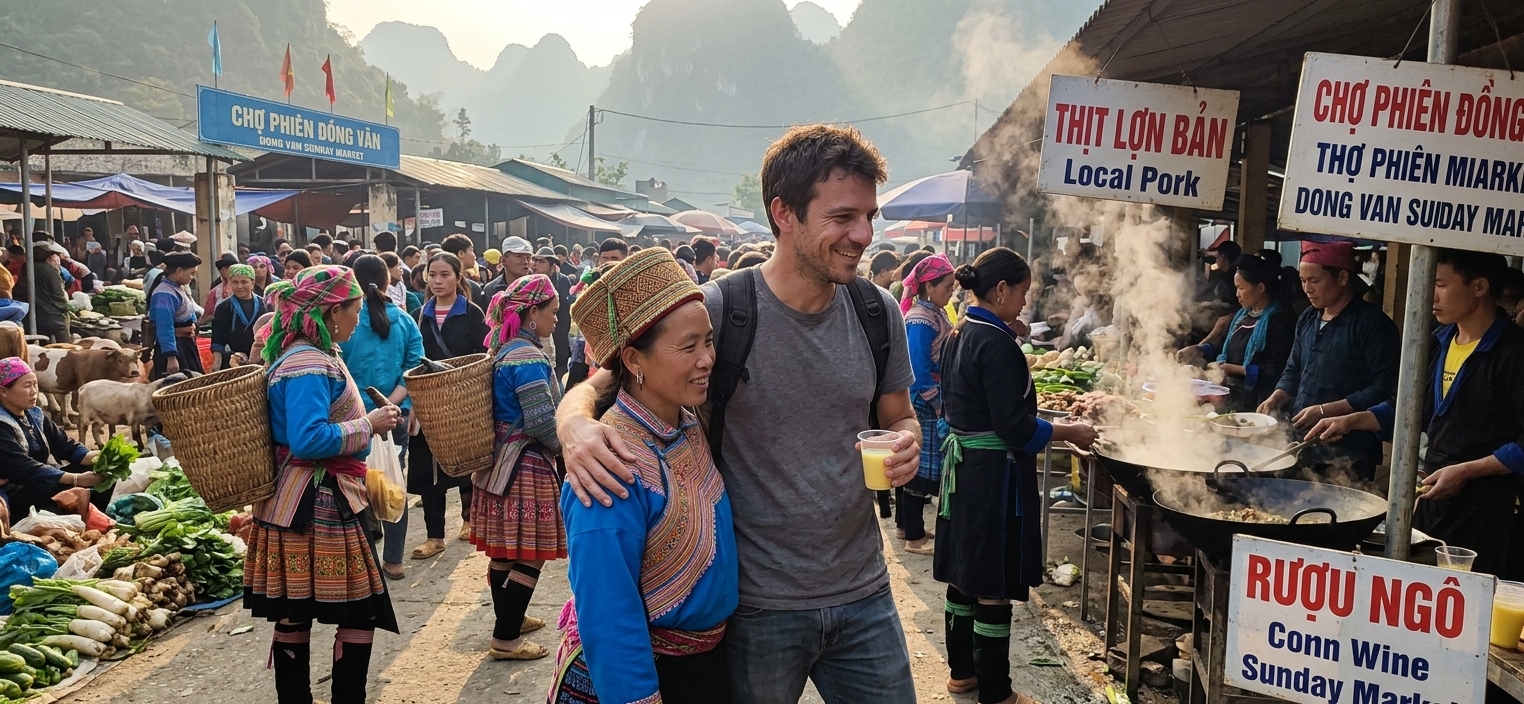
- 6:00–7:30am: Early traders from distant villages, livestock trading, food stalls starting fires. Very few tourists. The light is soft and the pace is unhurried. This is the best window.
- 7:30–10:00am: Peak market activity. All ethnic groups present, food section fully operational, good energy. Tour groups from Dong Van hostels start arriving around 8:30–9am.
- 10:00am–noon: Tourist density increases significantly. Vendors who sell to tourists become more aggressive. The market is still worth seeing, just different in character.
- After noon: Locals pack up and leave. What remains is predominantly tourist-facing stalls.
If you’re staying in Dong Van (24km north), leave by 6:30am to arrive before 7:30. If you’re doing the loop from Ha Giang city on a tight schedule, the Sunday timing of Meo Vac market should anchor your entire itinerary — plan around it, not the other way around. For full loop planning including timing, routes, and budget, see our Ha Giang Loop guide.
Insider Tip
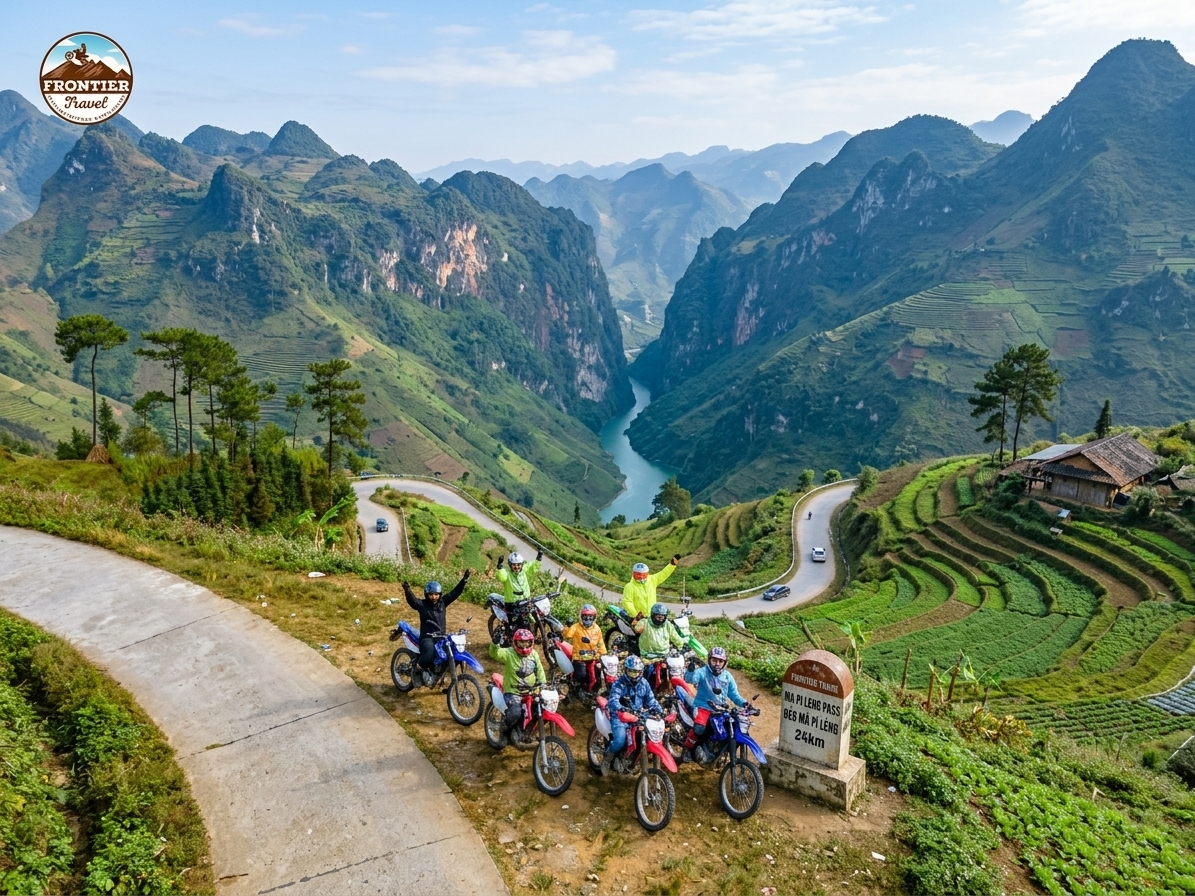
The road from Dong Van to Meo Vac via Ma Pi Leng pass is 24km but takes 45–60 minutes by motorbike. Do the math for your departure time and add buffer for the views — you will stop at Ma Pi Leng. Leave Dong Van by 6:00am on Sundays to arrive comfortably before the crowds.
Getting to Meo Vac
Meo Vac is 24km from Dong Van via the pass road (Ma Pi Leng) — about 45 minutes by motorbike, longer by jeep. It’s 150km from Ha Giang city, about 4–5 hours.
The town of Meo Vac itself is small — one main street, a few guesthouses, the market square, and a handful of restaurants. There’s no ATM that reliably works for international cards as of 2026; withdraw cash in Ha Giang city or Dong Van before coming. The market runs on cash only.
12Go covers most Vietnam routes — sleeper buses, trains, and island ferries. Compare schedules and book in advance during peak season (Dec–Feb, Jun–Aug).
Fuel: fill up in Dong Van before the Ma Pi Leng pass. Meo Vac has a petrol station in town but supply can be inconsistent on busy Sundays.
Where to Stay in Meo Vac
Most loop itineraries overnight in Meo Vac on Saturday night to catch the Sunday morning market — this is the right call. The options are limited but the best ones are legitimately good:
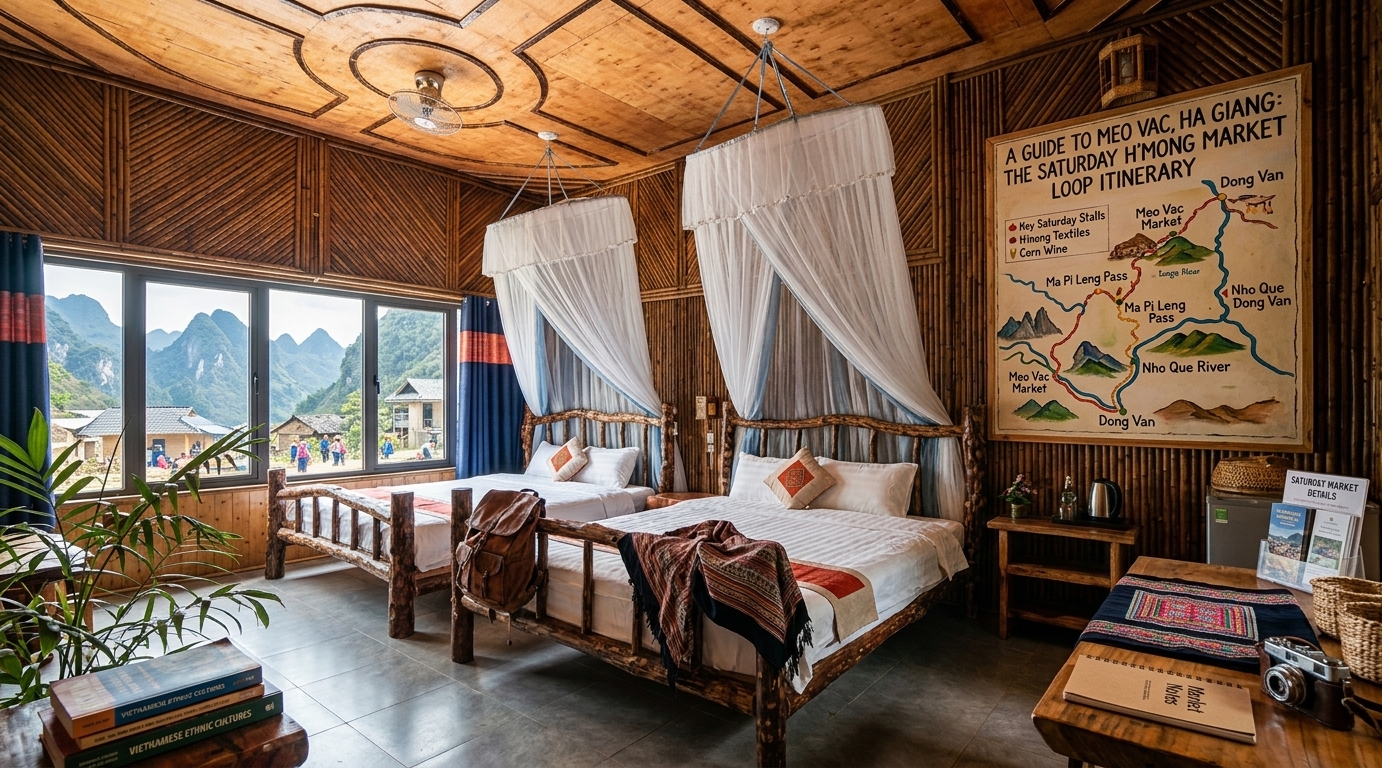
O’Chau Meo Vac Homestay — Best Overall
The most consistently well-reviewed accommodation in Meo Vac. Rooms with balconies facing the mountains, 400,000–600,000 VND/night (~$15–23). Family-run, clean, breakfast available. Books out every Saturday — reserve at least 3–4 days ahead in peak season (October–November).
comfortable beds. Worth it if you’re spending two nights in Meo Vac or want somewhere genuinely relaxing to decompress after Ma Pi Leng.
Saturday nights in Meo Vac are the hardest booking on the entire Ha Giang Loop during October–November. If you’re going during buckwheat flower season, book a week out minimum.
Beyond the Market — What Else Is in Meo Vac
The market is the main event but Meo Vac district has more if you have time:
Meo Vac Canyon Viewpoint
23.1580° N, 105.4220° E — A viewpoint on the edge of the valley where Meo Vac sits, looking back toward the karst peaks. Less dramatic than Ma Pi Leng but quieter, and the town below is visible. Best at golden hour the evening before market day.
Lunch at Nhà hàng Thanh Phương
17 Đường Hạnh Phúc, adjacent to the market area. Thắng cố served outside of market hours, plus standard Vietnamese dishes. Rượu ngô by the bottle. Not fancy — plastic chairs, street tables — but the food is solid and the corn wine is the real thing, not tourist grade.
The Road to Du Gia
If you’re returning to Ha Giang on the south route through Du Gia rather than backtracking through Dong Van, the road follows the Nho Que River upstream through a valley that sees almost no tour traffic. The road is rougher than the main loop but the scenery is worth it if you have time and a capable bike.
What to Know Before You Go
Camera Etiquette
This is the thing I wish someone had told me clearly: Meo Vac market is a real trading market, not a cultural show. The people there are doing business, not posing. Ask before photographing individuals, especially women and elders. “Chụp ảnh được không?” (say: choop anh dook kong — May I take a photo?) usually gets a nod or a wave-off; respect either. The food and goods sections are generally fine to photograph without asking; close-ups of people require permission.
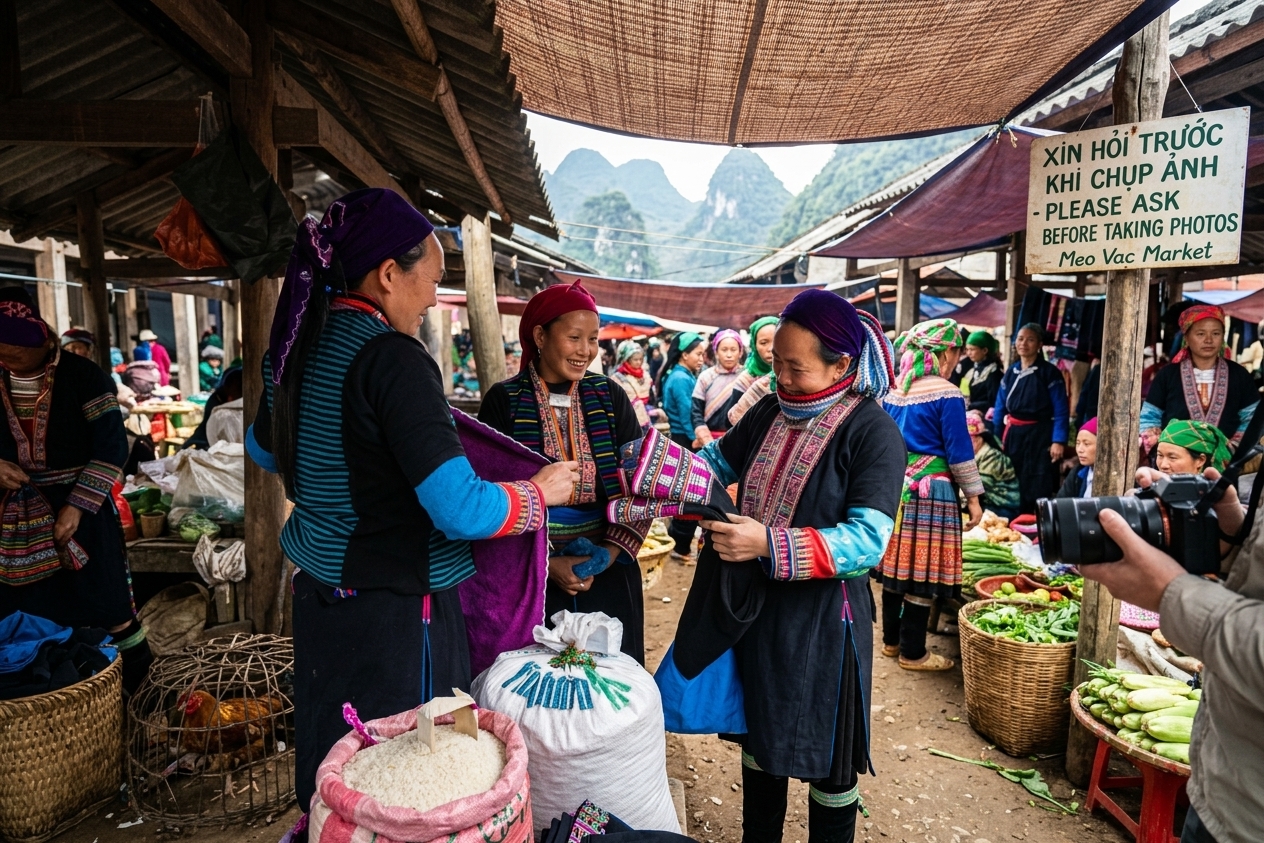
The H’mong community has had mixed experiences with cameras and tourism. Some women have found their images used commercially without permission or compensation. Paying a small amount to photograph someone in traditional dress — 20,000–50,000 VND (~$0.75–1.90) — is common and accepted. Photographing without asking and then arguing about it when called out is the wrong move.
What Not to Buy
Wildlife products — dried animals, animal parts — occasionally appear at rural markets. Don’t buy them. “Medicinal” products that appear to contain protected species are both illegal to export and directly connected to wildlife trafficking in the region.
Language
Very little English is spoken at the market, even among vendors who deal with tourists. Vietnamese gets you further than English; a few basic H’mong phrases (“ua tsaug” — thank you) get you a long way. Google Translate camera mode works reasonably on written Vietnamese if you need to read prices or signs.
What Travelers Actually Say: The Consensus
The people who come back most impressed are the ones who arrived before 7:30am. Every report from travelers who got there early (6:30–7:30am) describes a market that still belongs to the locals. Every report from people who arrived after 9am describes a market that was still good but clearly tourist-oriented by then.
The thắng cố is a genuine dividing line. About half of travelers who try it love it immediately; the other half find the organ content or smell off-putting. If you’re in the second group, the grilled corn and xôi are a fine alternative and you’ll still have had the market experience. Don’t feel obligated to eat horse organs to prove cultural authenticity.
The Saturday night accommodation crunch in October–November is consistently cited as the biggest practical problem. Travelers who didn’t book ahead report sleeping in overflow rooms, inflatable mattresses, or backtracking to Dong Van. One week of lead time solves this completely.
Real Talk
Meo Vac’s tourist market reputation has grown fast since 2022. The market is still real — the trading, the livestock, the H’mong women in traditional dress doing actual business — but the dynamic has shifted. Go early, respect the space, and you’ll see something genuine. Arrive after 10am expecting an Instagram moment and you’ll get exactly that.
Two things worth sorting before you land: a Vietnam eSIM so you have data the moment you clear customs, and travel insurance — medical costs for uninsured foreigners in Vietnam are significant.
Airalo eSIMs activate instantly. Buy before departure — airport SIM queues in Vietnam can take 30+ minutes.
FAQ
Is Meo Vac market open every day?
Quick Answer
The full market is Sunday only. A smaller daily market operates near the same location on other days — produce, basic goods — but the ethnic minority gathering, livestock trading, and thắng cố cauldrons are Sunday only.
Can I reach Meo Vac without doing the full Ha Giang Loop?
Yes but it’s a lot of road for one market. The fastest route from Ha Giang is about 4–5 hours each way. Most people who come specifically for the market do it as part of the 3–4 day loop, overnighting in Meo Vac Saturday night. A dedicated Meo Vac day trip from Ha Giang city is possible but leaves you with 8–10 hours of riding for a few hours of market.
Is thắng cố really horse meat?
Quick Answer
Yes — the dish traditionally contains horse meat and organs, slow-cooked in a large iron pot. Some stalls use goat or pork as a substitute. Look for the stalls with the massive cauldrons at the market center for the traditional version. The flavor is closer to rich beef than anything gamey.
What ethnic groups attend Meo Vac market?
Primarily H’mong (Black H’mong and Flower H’mong), Red Dao, Lo Lo, Giay, Nung, and Tay communities from the surrounding mountains. Each group’s traditional dress is distinct — if you spend time looking, you can identify them. The Lo Lo women’s dress is the most elaborate, with intricate embroidery and large silver ornaments; the Black H’mong wear deep indigo batik.
Is it safe to drink the corn wine at the market?
The rượu ngô served at market stalls is home-distilled — not regulated, not consistent in alcohol content, and sometimes made with questionable water sources. Most experienced travelers drink it in small amounts with food rather than treating it as a drinking session. The shared cup etiquette is real: you accept the cup, take a sip, pass it on. You don’t have to drain it. If you have genuine concerns about communal cups, it’s acceptable to decline politely before sitting at the communal table.
What time does the Sunday market end?
Quick Answer
The local trading mostly wraps up by 11am–noon. By 1pm, the market square is largely empty. The tourist-facing stalls sometimes linger until 2–3pm on busy Sundays. Arrive after 10am and you’re getting the tourist version, not the real one.