Last updated: June 2026 — dates and logistics verified June 2026.
I’ve been to the lantern festival seven or eight times. The first time in 2021, I didn’t know it was happening — I just rounded a corner and the Ancient Town looked like a completely different place. Silk lanterns everywhere, the river covered in floating candles, no motorbike noise, the old French colonial architecture visible for the first time without traffic and overhead wires dominating the frame. It was the version of Hoi An that the photographs promise and the daytime town rarely delivers.
The second time I went specifically for it, on a February full moon with a friend visiting from the US. We got there at 5 PM, found a spot on the riverbank, bought two floating lanterns (15,000 VND each after negotiating down from 40,000), and waited. The experience was still good — but noticeably more crowded, more performative, more obviously designed for people like us. Both versions are real. The first-time-by-accident version is better. You can manufacture the timing; you can’t manufacture the surprise.
The most important thing to know: this isn’t a once-a-year event you have to plan your whole trip around. It happens every month. Check the full moon date for when you’re traveling to Hoi An, book your accommodation to include that night, and treat it as the anchor of a 3–4 day Hoi An stay rather than a standalone destination.
When Is the Hoi An Lantern Festival?
The festival falls on the 14th day of each lunar month — the full moon. Because the Vietnamese lunar calendar doesn’t align with the Gregorian calendar, the date shifts every month. In 2026, full moon nights in Hoi An fall approximately on:
> **Quick Answer:** The Hoi An Lantern Festival is the 14th lunar day (full moon) every month — not a single annual event. In 2026, upcoming dates include July 9, August 8, September 6. Book your Hoi An accommodation to include one of these nights. The festival runs approximately 5 PM–10 PM in the Ancient Town.
What Happens at the Hoi An Lantern Festival
The Ancient Town transforms from around 5 PM on full moon night. The sequence:
5:00–6:00 PM — Setup. Vendors along Nguyen Hoang Street and the riverside set out lanterns, incense, and floating candle boats for sale. The electric lights in the Ancient Town begin switching off. Residents light red and yellow candles on the windowsills of their shophouses.
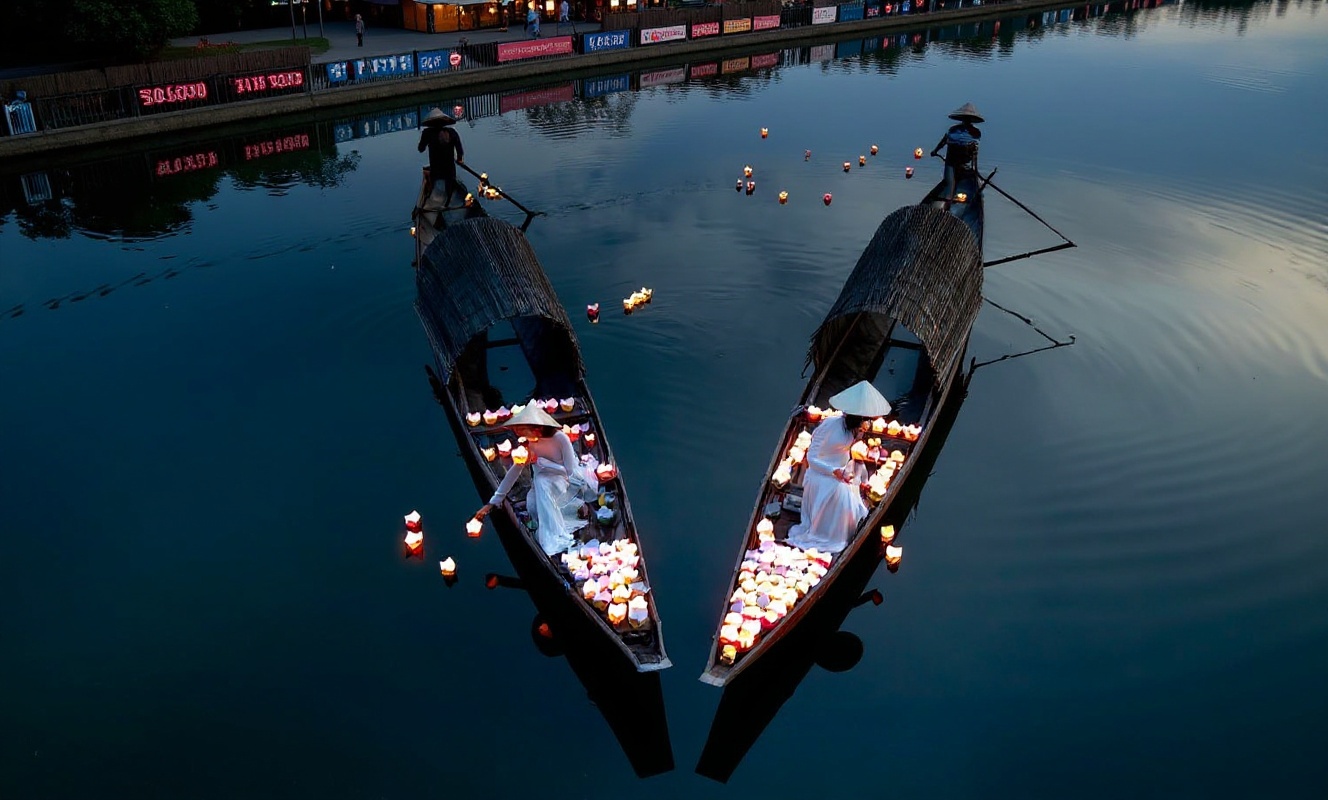
6:00–8:00 PM — Peak atmosphere. No motorbikes, no cars. The streets — which during the day are crowded with vehicles despite Ancient Town restrictions — become fully pedestrian. The light source is exclusively lanterns and candles. The Thu Bon riverbank fills with people releasing floating lanterns (đèn hoa đăng) onto the water. These are small lotus-shaped paper boats with a candle inside — 10,000–20,000 VND each, sold by vendors along the bank. You release them at the water’s edge and they drift downstream, joining hundreds of others.
8:00–10:00 PM — Live music and later crowd. Traditional Vietnamese music performances happen on Nguyen Hoang Street and in the Japanese Covered Bridge area. The crowd thins slightly as some visitors leave; the atmosphere softens from peak bustle to something more intimate.
The History of the Hoi An Lantern Festival
The tradition of celebrating the full moon in Hoi An predates the modern festival by centuries. During the town’s peak as a major Southeast Asian trading port (16th–18th centuries), Japanese and Chinese merchant communities resident in Hoi An observed their own lunar calendar traditions — including full moon celebrations involving lanterns and offerings to ancestors.
The modern Hoi An Full Moon Festival (officially called Đêm Rằm Phố Cổ — “Full Moon Night of the Ancient Town”) was formalized in the late 1990s after the Ancient Town was designated a UNESCO World Heritage Site in 1999. The restrictions on cars and electric lights were introduced as part of a broader effort to preserve the historical character of the town and reduce the impact of motorized traffic on its narrow streets and old buildings. The cultural program — traditional music, lantern-making demonstrations, cooking shows — was added incrementally over the 2000s.
The floating lantern tradition (đèn hoa đăng) is specifically a Vietnamese custom for praying for good fortune and remembering ancestors. The lanterns are released to carry wishes downstream; in the context of the Thu Bon River, they drift south toward the sea. The visual effect of hundreds of lit lanterns on a dark river is what made the festival internationally famous, particularly after photographs spread through early social media in the late 2000s.
The festival’s commercial success has changed it. In 1999, it was a local tradition with modest tourism interest. By 2019, it was on every Vietnam travel list and drew several thousand visitors per full moon night in peak season. The cultural program remains genuine; the economic activity around it — vendors, tour groups, restaurant promotions — is considerable. Both things are true simultaneously.
What to Eat During the Lantern Festival
The full moon night brings out food vendors beyond the usual Ancient Town restaurant presence. Along Nguyen Hoang Street and the nearby alleys, street food setups that don’t operate on ordinary nights appear for festival evening.
What to look for:
Cao lầu: Hoi An’s signature dish — thick rice noodles, char siu pork, local greens, crispy rice crackers, in a small amount of sauce rather than broth. The noodles are made with water from a specific local well; genuine cao lầu is only available in Hoi An. 60,000–80,000 VND at street stalls, 90,000–130,000 VND at restaurants. On festival night, several restaurants set up outdoor seating on the street — look for the plastic-stool setups on Tran Phu Street.
White rose dumplings (Bánh vạc): Hoi An specialty — delicate translucent rice flour dumplings stuffed with seasoned shrimp, topped with crispy shallots and a dipping sauce. Available at stalls near the Central Market and from vendors who work specifically on full moon nights. 40,000–60,000 VND for a plate.
Bánh mì Phượng: The most famous bánh mì shop in Hoi An (and arguably in Vietnam) is on Le Loi Street, open until late. On festival nights, the queue is longer than usual — go before 5 PM or after 9 PM. 35,000–50,000 VND.
Chè Hội An: Vietnamese sweet soups and desserts, sold from wheeled carts that appear specifically on festival nights near the river. Try chè trôi nước (glutinous rice balls in ginger syrup) or chè thưng (mixed fruit and bean sweet soup). 20,000–30,000 VND per serving.
Most Ancient Town restaurants run special menus on full moon nights with inflated prices. The better strategy is street food during the festival atmosphere (5–8 PM), then dinner at a non-Ancient Town restaurant after 8:30 PM when the crowds thin and the regular places on Tran Phu and Bach Dang return to normal pricing.
The Real Talk on the Hoi An Lantern Festival
Real Talk
The festival is genuinely beautiful and it’s also genuinely crowded. During high season (November to March), the Ancient Town on full moon night is dense — hundreds of tour groups, organized visits from Da Nang hotels, and travelers who’ve specifically planned their Vietnam trip around this date. If you expected a romantic, intimate experience, a Saturday full moon in February will not provide it. The better full moon visits: weekday nights in shoulder season (April–June, September–October), when the crowd is maybe 40% of peak. The festival still happens; the difference is you can actually walk through the Old Quarter without stopping every 30 seconds.
Where to Watch From — Best Spots in the Ancient Town
Thu Bon Riverbank (Nguyen Hoang Street): The main floating lantern release point and the most photographed location. Peak crowds 6:30–8:00 PM. Go early to claim a good riverside spot; the vendors are set up by 5 PM and the best positions fill quickly.
Japanese Covered Bridge (Cầu Nhật Bản): The Ancient Town’s most iconic structure. During the festival, the bridge is lit by lanterns and surrounded by performers. Crowds are dense here; cross the bridge early and find a position before the peak. The view back toward the Thu Bon River from the bridge’s western end is the best photograph in Hoi An.
Tan Ky Ancient House area (Nguyen Thai Hoc Street): Less crowded than the riverfront, better for simply walking through the atmosphere rather than watching a specific thing. The shophouses along this street lean their lanterns out over the street and the cumulative effect of 200m of lit buildings is striking.
Bach Dang Street (south side of river): If you want to photograph the lanterns floating past from above, cross the An Hoi footbridge to the south side of the Thu Bon. The view back toward the north bank — lit shophouses, lantern strings, floating lights on the river — is cleaner and less crowded than anywhere on the north bank itself.
Practical Tips for the Lantern Festival
Book accommodation inside the Ancient Town. Hotels and homestays within the Ancient Town boundaries let you walk out into the festival without navigating transport. The difference between watching the lanterns and then walking back to your guesthouse 50 meters away vs. finding a xe om at 9 PM while everyone else is doing the same thing is significant. See our where to stay in Hoi An guide for the best positions inside the Old Quarter.
Arrive before 6 PM. The electric lights go off and the crowd peaks simultaneously around 6:30 PM. If you’re coming from Da Nang or An Bang Beach, factor in that every taxi and xe om heading toward the Ancient Town is going the same direction at the same time. Be inside the perimeter by 5:30 PM.
Pay 10,000–20,000 VND for a floating lantern, not 50,000 VND. The vendors on the riverbank will start at 50,000 VND for a single floating lantern. The correct price is 10,000–20,000 VND. Walk along the bank until you find the right price; it’s available.
The Ancient Town entrance ticket applies. Hoi An’s Ancient Town requires a ticket (120,000 VND) for entrance to the main sights (Japanese Covered Bridge, ancient houses, museums). The ticket is sold at booths at the main entrances. During the lantern festival, the streets themselves are free to walk; the ticket is checked if you enter specific historic buildings.
Best months for photography: October–November for dramatic clouds and lower haze; January–February for the most elaborate festival setup (coincides with pre-Tet preparation). June–August for warm evenings with minimal rain risk from the north coast rainy season (Hoi An’s typhoon risk is October–November).
Lantern Festival Photography — What Actually Works
The Hoi An lantern festival photographs well, but requires some adjustments from daytime travel photography.
Phone cameras: Modern phone cameras (iPhone 15+, Samsung S24+) handle the low light reasonably well in Portrait or Night mode. The key limitation is motion blur on floating lanterns — they move, and shutter speeds slow down in low light. Burst mode and selecting the sharpest frame works better than single shots.
The floating lantern shot: Get low — crouch at the water’s edge or find a step that puts you at river level. The reflection doubles the visual impact. Shoot wide enough to include 5–10 lanterns in the frame rather than trying to isolate one. Long exposure (2–4 seconds on a tripod or braced against a wall) captures the light trails as lanterns move. Handheld long exposures at the riverside are unpredictable but sometimes produce the most interesting results.
The street lantern shot: Look for the illuminated shophouse facades on Tran Phu and Nguyen Thai Hoc Streets — the architecture with hanging lanterns photographs better than the riverside crowds. Shoot with the crowd as texture in the background rather than trying to eliminate it. The crowd IS the atmosphere; fighting it compositionally produces sterile results.
Best 10 minutes of the night for photography: 6:10–6:20 PM, just after the electric lights go off and before full darkness — the sky still has blue-hour color and the lanterns are lit. This window is about 10 minutes in February, longer in summer. Miss it and you’re shooting in full dark, which is harder to make look interesting without proper equipment.
Combining the Lantern Festival with Your Hoi An Trip
The full moon night works best as the centerpiece of a 3–4 night Hoi An stay rather than a standalone visit. The Ancient Town is interesting enough during daytime to fill 2 days; An Bang Beach is 4km away and worth a morning or afternoon; the My Son Sanctuary (UNESCO Cham ruins, 40km southwest) is a solid half-day. See the things to do in Hoi An guide for the full itinerary framework, and the Hoi An day trips guide for the My Son and nearby options.
If you’re building your Vietnam itinerary around the lantern festival, the logistics are simple: check the full moon calendar, book Hoi An for 3–4 nights spanning that date, and treat the full moon night as the fixed anchor of your central Vietnam stop.
The Day After the Lantern Festival
One thing most guides don’t mention: the morning after the full moon is one of the best times to be in Hoi An. The tour groups that came specifically for the festival night have left. The Ancient Town is quiet — quieter than almost any other morning. The light is good (full moon nights are often clear-sky, and the morning after tends to hold). The shophouses smell of incense from the previous night’s candles. The river has a few stray paper lantern husks drifting downstream.
If you’re staying in the Ancient Town, go out at 6:30 AM the morning after the festival. Walk down to the riverside before the vendors set up. Get breakfast at one of the pho or banh mi stalls that open early on Tran Phu. The Hoi An that most travelers spend 3 days trying to find — calm, historically textured, not overwhelmed by tourism — is most accessible in this specific window.
For everything else worth doing in Hoi An beyond the lantern festival, the Hoi An things to do guide has the full breakdown — Ancient Town sights, An Bang Beach, day trips, and the best cao lầu in town.
One last thing: the lantern festival occasionally gets cancelled or scaled down during severe weather. October and November are Hoi An’s rainy season — typhoons and flooding affect the central coast in those months, and the full moon nights of October and November carry real weather risk. The festival still happens unless conditions are extreme, but factor in that An October or November visit has a non-trivial chance of rain on the festival night. The river looks genuinely impressive in the rain with lanterns reflected in it; the practical experience (wet, crowded, limited visibility) is less comfortable than a dry night. If your trip timing is flexible, February–April or June–September full moons have the most reliable weather.
Hoi An Lantern Festival FAQ
When is the Hoi An Lantern Festival?
The Hoi An Full Moon Lantern Festival (Đêm Rằm Phố Cổ) takes place on the 14th day of every lunar month — 12 times per year, not once annually. Upcoming 2026 dates: July 9, August 8, September 6, October 6, November 5, December 4. The event begins around 5 PM and runs until approximately 10 PM, when electric lights return to the Ancient Town.
Is the Hoi An Lantern Festival worth it?
Yes — it’s one of the genuinely beautiful things to see in Vietnam, and the fact that it happens monthly means almost everyone visiting Hoi An for 3+ nights can time it. The caveat: during peak tourist season (November–February), the Ancient Town on full moon night is very crowded. Shoulder season full moons (April–June, September–October) give you a similar atmosphere with fewer tour groups. Worth planning around regardless of when you go.
How much do floating lanterns cost in Hoi An?
10,000–20,000 VND per lantern from riverbank vendors. Starting price is often 30,000–50,000 VND — negotiate or walk to the next vendor. The lanterns are small paper lotus boats with a tea-light candle inside. You light the candle, walk to the water’s edge, and release. The candles burn for 15–30 minutes.
Do I need tickets for the Hoi An Lantern Festival?
The festival itself is free to attend — the streets of the Ancient Town are open to everyone during full moon night. The Ancient Town entrance ticket (120,000 VND) is required if you want to enter the historic buildings (Japanese Covered Bridge, ancient houses, museums). You don’t need a ticket to walk the streets, watch the floating lanterns, or participate in the general atmosphere.
What is the best time to arrive for the Hoi An Lantern Festival?
Arrive in the Ancient Town by 5:00–5:30 PM — before the electric lights go off and before the main crowd arrives. Claim your riverside spot early if you want to release a floating lantern. The peak atmosphere is 6:30–8:00 PM. After 8:30 PM the crowd thins and the remaining experience is more peaceful. If you’re coming from Da Nang or An Bang Beach, account for all taxis heading the same direction simultaneously — leave earlier than you think you need to.