Last updated: May 2026
Hoi An is one of the best-positioned bases in Vietnam for day trips. The Ancient Town is compact enough that you don’t need a base day to recover — you step out the door, jump on a bike or into a Grab, and within an hour you’re somewhere completely different. Hindu temple ruins in the jungle. A coconut forest where you spin in a circular basket on still brown water. A vegetable village where the cooking class instructor has been growing the same herbs for twenty years.
The problem is that every tour agency in Hoi An sells everything. Ba Na Hills sits next to My Son on the same flyer. They are not equivalent experiences. Here’s how to sort them.
My Son Sanctuary — The One You Don’t Skip
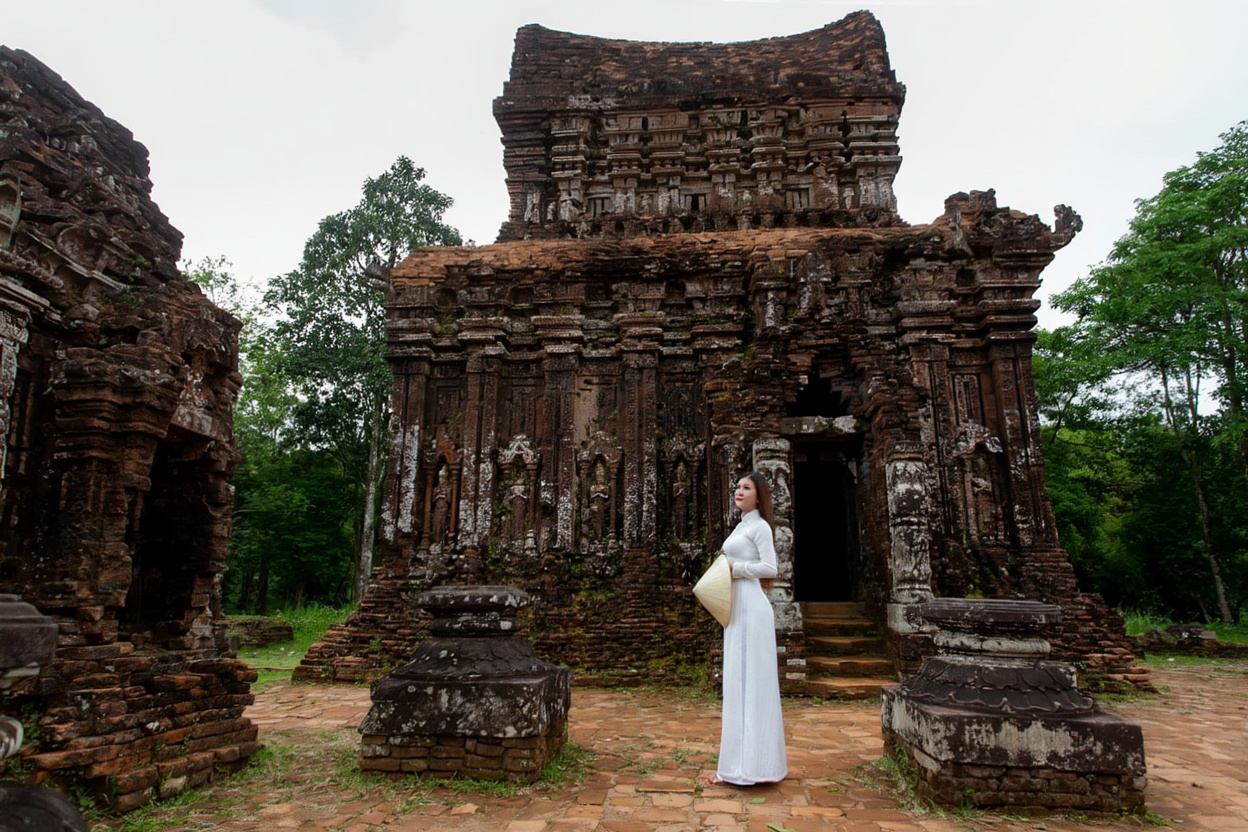
My Son (pronounced: mee son) is a group of partially ruined Cham Hindu temples built between the 4th and 14th centuries, 40 km west of Hoi An in a jungle valley ringed by hills. It’s a UNESCO World Heritage Site — one of the most significant archaeological sites in Southeast Asia — and it consistently gets treated as an afterthought by travellers who spend more time booking a Golden Bridge photo than they do here. For everything else the town offers beyond day trips, our Hoi An travel guide covers the Ancient Town in full. Before planning day trips, check our Hoi An things to do guide to nail down your base itinerary first. Hoi An sits at the heart of the central coast — see our central Vietnam guide for how it connects to Da Nang, Hue, and Phong Nha.
What My Son actually is: you approach through a narrow jungle valley, the road narrowing between rice paddies before a final stretch of shade trees. The air is cooler than the coast — ten degrees of temperature difference at 7am is noticeable after Hoi An’s muggy alleys. And smells of wet earth and moss. The brick temple towers are a deep terracotta red against the green — the kind of colour that photographs can’t quite get right. What remains after extensive damage during the Vietnam War (unexploded ordnance was still being found in the surrounding area into the 2000s) is fragments: some towers intact to their full height, others reduced to a platform and a few courses of brick. That fragmentation is part of the experience. You’re not at Angkor Wat — this is smaller, quieter, and in some ways more affecting for it. The scale of Angkor can be overwhelming; My Son is intimate enough to actually look at individual carvings and doorway lintels without being pushed along by the crowd.
Getting there: Organised tour (250,000–350,000 VND / ~$9.50–13.30 per person) departs from Hoi An at 8am or 9am, includes transport and guide, returns by early afternoon. Or charter a car one-way for 600,000–800,000 VND (~$22.80–30.40) and time it yourself.
Entrance fee: 150,000 VND (~$5.70) per person for the site. Guides available separately at the entrance — worth it for context on the temple groups.
Go early. The first tour buses arrive at 9:30–10am. If you can get there by 7:30–8am on a self-arranged car trip, you’ll have the ruins nearly to yourself for an hour. By midday in the dry season (Feb–May), the heat in the open valley is significant — this is a sweating-through-your-shirt kind of site at noon.
ℹKnow Before You Go
My Son lost significant sections during US bombing in 1969, and the bomb craters are still visible in the surrounding fields. Some sites within the complex are closed due to ongoing restoration. The Cham cultural performance held at the site is optional and adds 20–30 minutes — worthwhile for context on the civilisation behind the temples, not just the architecture.
Cam Thanh Coconut Forest — Best Half-Day Near Town
Cam Thanh village and the Bay Mau coconut forest sit 8 km south of the Ancient Town, reachable by bicycle in 30 minutes or Grab in 15. The draw is the thung chai (basket boat, say: toong jai) — circular woven bamboo vessels about 1.5 metres across that fishermen use in the shallow water canals threading through the mangrove forest.
The boatmen row you through the coconut palm canopy and, at some point, start spinning the basket boat in tight circles as a demonstration. Tourists shriek. Photos are taken. It’s unambiguously a tourist product — but it’s a good one. The water is still and brown-green. The palms form a canopy overhead. The whole thing takes 45–60 minutes on the water.
Organised tour vs. independent: Organised tours from Hoi An bundle the basket boat with a cooking demo or village walk for 250,000–400,000 VND (~$9.50–15.20) per person. Going independently: bicycle to the village, negotiate directly with local families at the dock for 100,000–150,000 VND (~$3.80–5.70) per person. The independent rate is meaningfully lower and the experience is identical.
One thing the tour agencies don’t advertise: the basket boat ride is short. If you’re expecting a full-day activity, you’ll be back in town by early afternoon at the latest. Pair it with An Bang Beach in the same half-day — the two are 3 km apart.
→Who It’s For
Anyone who wants a genuinely Vietnamese-looking half day with minimal effort. The photos are excellent. The experience is light on cultural depth but high on visual appeal. Not for people who feel uncomfortable doing tourist-facing activities — it is, without apology, a tourist experience.
Tra Que Vegetable Village — Cooking Class Capital
Tra Que (say: tra kweh) is a small farming village 2 km north of the Ancient Town on a peninsula between the Đế Võng River and a lagoon. It grows the herbs that supply half the restaurants in Hoi An — rau muống (morning glory), húng quế (Thai basil), ngò gai (sawtooth coriander) — and has built a cottage industry around cooking classes that use fresh ingredients picked the same morning.
The format at most Tra Que operations: bicycle or walk from town (or be collected), tour the vegetable garden while the guide explains what’s growing and why, pick ingredients, walk to the kitchen, cook 3–4 dishes, eat what you made. Half a morning, start to finish. The TripAdvisor review that keeps showing up in the research captures it: “We just got back from our cooking class tour at Tra Que village and we gotta say that it was fantastic — we really loved the morning time spending at the market to prepare ingredients for cooking.”
Price: Cooking classes at Tra Que-based operators run 350,000–550,000 VND (~$13.30–20.90) per person including the garden tour, ingredients, and the meal. You can also just bicycle through the village independently without booking a class — the 20-minute ride through market garden plots is pleasant in the early morning when the dew is still on the greens.
★Jake’s Pick
Tra Que is one of the few day trip options from Hoi An that genuinely connects to the place rather than being built around it. The village has been here for 500 years. The cooking class is the tourist layer, but the herb gardens and the people running them are real. Worth half a morning over a second trip to the Ancient Town.
Marble Mountains — Worth the Half-Day
The Marble Mountains (Ngũ Hành Sơn) are five limestone and marble hills rising from the coastal plain 30 km north of Hoi An on the Da Nang outskirts. Each hill is named after a classical Vietnamese element — water, fire, wood, metal, earth. The most-visited is Thủy Sơn (Water Mountain), which contains a network of cave temples, viewpoints over Da Nang and the coast, and a large cave pagoda called Huyền Không that filters green-grey light through a hole in the ceiling onto altar offerings below.
The practical reality: Grab from Hoi An runs 270,000–350,000 VND (~$10.25–13.30) one-way. Entrance: 40,000 VND (~$1.50) plus 15,000 VND (~$0.60) for the elevator if you don’t want to climb. Give it 2–3 hours. Marble carving workshops line the road at the base of the mountain — some are genuinely skilled craftsmen; the products near the entrance are heavily tourist-priced.
The Marble Mountains work best as a combination with My Son (stop here on the way back from My Son via a self-arranged car), or as a standalone if you’re doing a Da Nang transit day. Don’t dedicate a special trip from Hoi An for just this — unless caves and Buddhist cave temples are your specific interest, in which case Huyền Không alone justifies it. One practical note: the marble carving shops at the base of Thủy Sơn are the source of most of the marble souvenirs sold in Hoi An, and the pricing here is better than in the Old Town. If you’re buying marble pieces, this is the place to do it — the showrooms at the entrance to the mountain have reasonable quality and you can watch the carving.
Ba Na Hills — Honest Assessment
Ba Na Hills is a French colonial hill station-turned-resort complex 40 km northwest of Hoi An, famous primarily for the Golden Bridge: two stone-coloured hands holding a golden suspension bridge above the fog. It’s one of the most photographed structures in Vietnam and the reason most people visit. It’s also 90% of the reason you should calibrate your expectations before going.
Ba Na Hills is a theme park. It has a Moulin Rouge replica, a wax museum, a beer garden modelled on a French village, and an indoor amusement park. The cable car ride to the top through cloud is spectacular — the scenery from up there is dramatic and the engineering is impressive. The Golden Bridge, up close, is striking in person rather than just in photos.
A Reddit user who visited in March 2024 summed it up accurately: “Ba Na hills is touristy AF and probably somewhat commercialised, but I enjoyed it nonetheless.” That’s the honest framing. Go for the cable car, the fog, the views, and the bridge. On a clear morning, the valley and mountain range below the cable car are worth the trip in themselves — clouds often sit mid-mountain, so you ride through fog for a stretch before emerging above it. Don’t expect a cultural site.
Getting there: All-inclusive day tour from Hoi An runs 850,000–1,100,000 VND (~$32.25–41.75) per person including transport, cable car, and entry. Self-arranged: Grab to the base for 500,000–700,000 VND (~$18.98–26.57) one-way, then cable car and entry separately at the gate. The all-inclusive tour is genuinely easier here.
Go on a weekday. Ba Na Hills on weekends, especially Vietnamese public holidays, is significantly more crowded — queues for the cable car can run 60–90 minutes. Weekday visits are measurably better.
⚠Real Talk
I spent three hours at Ba Na Hills expecting something like a hillside temple complex with mountain walks. I got a Vietnamese Disneyland with a genuinely excellent cable car. The Golden Bridge is impressive. The French village replica is bewildering. If you go in knowing what it is, you’ll have a good time. If you go expecting the kind of experience you’d have at My Son, you’ll be disappointed and slightly baffled.
Cham Islands — Only If You Want Snorkeling
The Cham Islands (Cù Lao Chàm) are a cluster of eight small islands 18 km offshore, reachable by speed boat from Cửa Đại (45 minutes) or wooden boat (90 minutes). They form a UNESCO Marine World Biosphere Reserve — the main reason to go is the coral snorkeling, which is genuinely good when conditions allow (visibility is best March–August; September–January, swell and reduced visibility make the trip less worthwhile).
Day trip tour: 450,000–650,000 VND (~$17.10–24.70) per person, includes speedboat transport, two snorkeling spots, equipment rental, and lunch on the island at a basic seafood restaurant. The islands themselves have one small fishing village — Bãi Làng — with a handful of good seafood restaurants and a small museum covering the islands’ history as a trading post. The rest is forested hills and undeveloped coastline. It’s a full day out — boat there, snorkel, eat, boat back — and genuinely restorative if you’ve spent several days walking Hoi An’s busy streets.
Who it’s for: people who want to put on a mask and float over coral rather than walk around ruins. Not a particularly cultural experience, and the snorkeling isn’t at Komodo or Koh Tao level — but the water is clear, the coral is healthy enough, and a day on the water in the South China Sea is its own reward. Skip during the September to January swell season — the boat ride is rough and visibility drops significantly.
Practical Notes: Getting Around on Day Trips
Bicycle: Free or 50,000–80,000 VND (~$1.90–3.05) rental per day. Practical for Tra Que (2 km), Cam Thanh (8 km), and An Bang Beach (4 km). Not practical for My Son, Marble Mountains, or Ba Na Hills.
Grab: The default for anything over 10 km. App works throughout Hoi An and the surrounding area. Da Nang Grab picks up and drops off at Marble Mountains without issue.
Klook has the widest selection for Vietnam and is usually the cheapest. KKday is strong on day trips and local experiences.
tions. Ba Na Hills has steep mountain roads; not recommended on a rental unless you’re confident.
Organised tours: For My Son and Ba Na Hills specifically, joining an organised tour is the path of least resistance — logistics handled, guide included, no navigation stress. The Hoi An tour agency network is efficient and competitive; prices don’t vary much between agencies, so book with whoever is closest to your guesthouse. One legitimate reason to shop around: guide quality for My Son varies significantly. A good guide turns the site from an interesting ruin into a story about the Cham civilisation, their trade routes, and why a Hindu kingdom existed on the Vietnamese coast for nearly a thousand years. Ask your guesthouse to recommend a specific guide rather than just booking the cheapest package.
What to bring for day trips: Water (buy in Hoi An, not at day trip sites where prices double), cash in VND (most day trip sites and village operators don’t accept cards), sunscreen (My Son and Marble Mountains have significant exposed sections), and appropriate footwear for temple sites — sandals are fine but good-grip shoes help on slippery stone steps at the Marble Mountains.
Two things worth sorting before you land: a Vietnam eSIM so you have data the moment you clear customs, and travel insurance — medical costs for uninsured foreigners in Vietnam are significant.
Airalo eSIMs activate instantly. Buy before departure — airport SIM queues in Vietnam can take 30+ minutes.
Frequently Asked Questions
What is the best day trip from Hoi An?
My Son Sanctuary is the strongest day trip — it’s a UNESCO World Heritage Site, genuinely moving, and completely different from the Ancient Town experience. Go on an early morning tour or self-arrange to arrive before 9am when it’s quietest. The 40 km drive through Vietnamese countryside is part of the experience. If you only have half a day, Cam Thanh Coconut Forest (basket boat, 8 km south) is the best standalone half-day option near town.
Is Ba Na Hills worth it from Hoi An?
Worth it if you go knowing what it is: a cable car ride to a mountain resort with a French village theme park, a wax museum, and the Golden Bridge. The cable car is genuinely impressive and the scenery is spectacular. Not worth it if you expect cultural depth — it’s entertainment, not heritage. Go on a weekday to avoid weekend queues for the cable car.
How do I get to My Son from Hoi An?
Organised tour is the easiest option — departs 8–9am from Hoi An’s tourist quarter, includes transport, guide, and entrance, returns by 1–2pm. Price: 250,000–350,000 VND (~$9.50–13.30) per person. Self-arranged: charter a car for 600,000–800,000 VND (~$22.80–30.40) one-way and go early to beat the tour buses. Grab does not go this far; most motorbike riders won’t take the route. Stick with an organised car or tour.
Can you do a cooking class near Hoi An?
Yes — Tra Que Vegetable Village, 2 km north of the Ancient Town, is the best base for cooking classes. The half-morning format includes a garden tour, ingredient picking, cooking 3–4 dishes, and eating what you made. Price: 350,000–550,000 VND (~$13.30–20.90) per person. Book through your guesthouse or directly with operators in Tra Que village. Morning departure (8–8:30am) is standard — the produce is freshest and the temperature is bearable.
How many days do you need in Hoi An for day trips?
Three to four days gives you the Ancient Town (including an early morning visit and a lantern evening) plus 2–3 day trips. A realistic 3-day structure: Day 1 — Old Town morning + Cam Thanh afternoon; Day 2 — My Son full day; Day 3 — Tra Que morning + An Bang Beach afternoon. For Ba Na Hills and Marble Mountains, add a fourth day or replace one of the above depending on your interests.