Last updated: May 2026
Five hills. One worth your time. The other four are either closed, inaccessible, or just hills.
That’s not a complaint — Thủy Sơn alone earns the trip. It’s a 156-metre marble hill threaded with cave temples, viewpoints over the coast, and a pagoda complex that’s been active since the 17th century. The caves in particular are the kind of place that earns the phrase “you have to see it in person” — photographs can capture the scale but not the quality of light, or the smell of incense smoke drifting through a hole in the cave ceiling thirty metres above your head.
The Five Hills — Which One You’re Actually Visiting
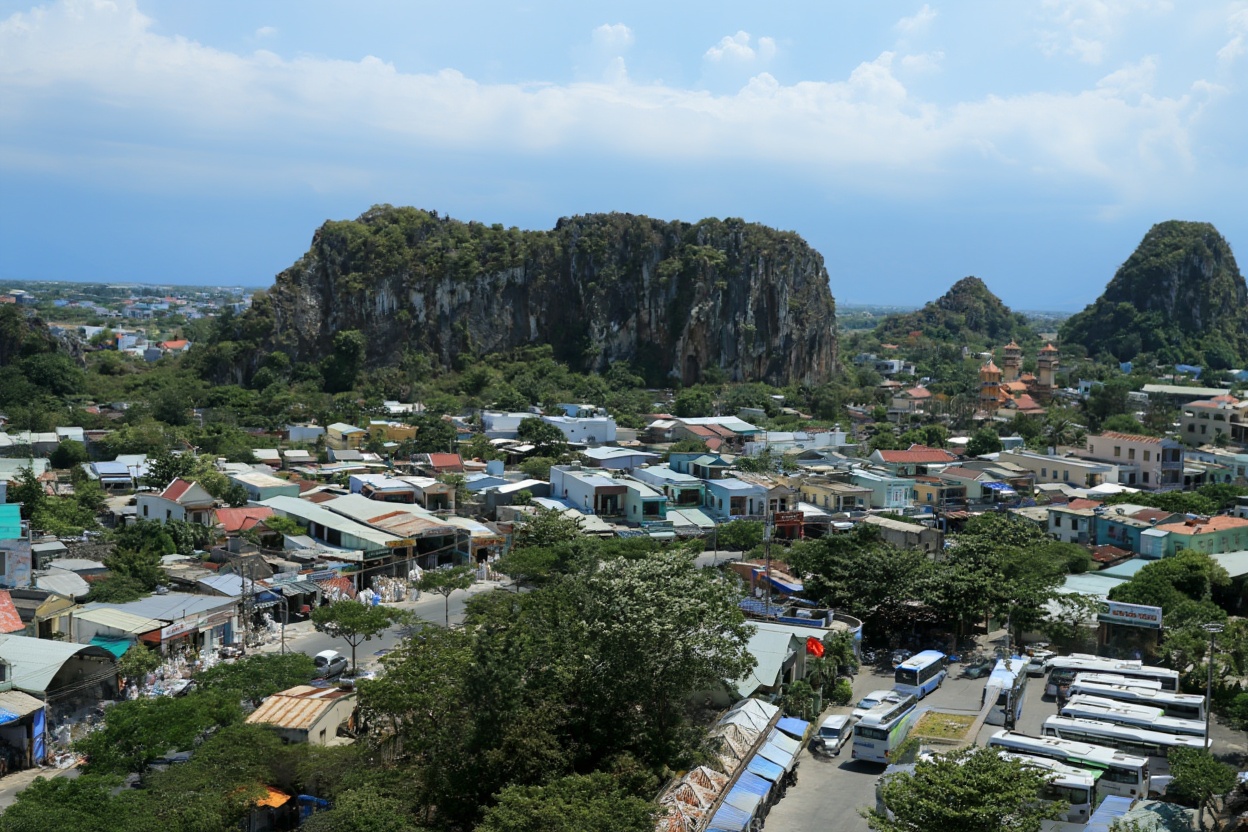
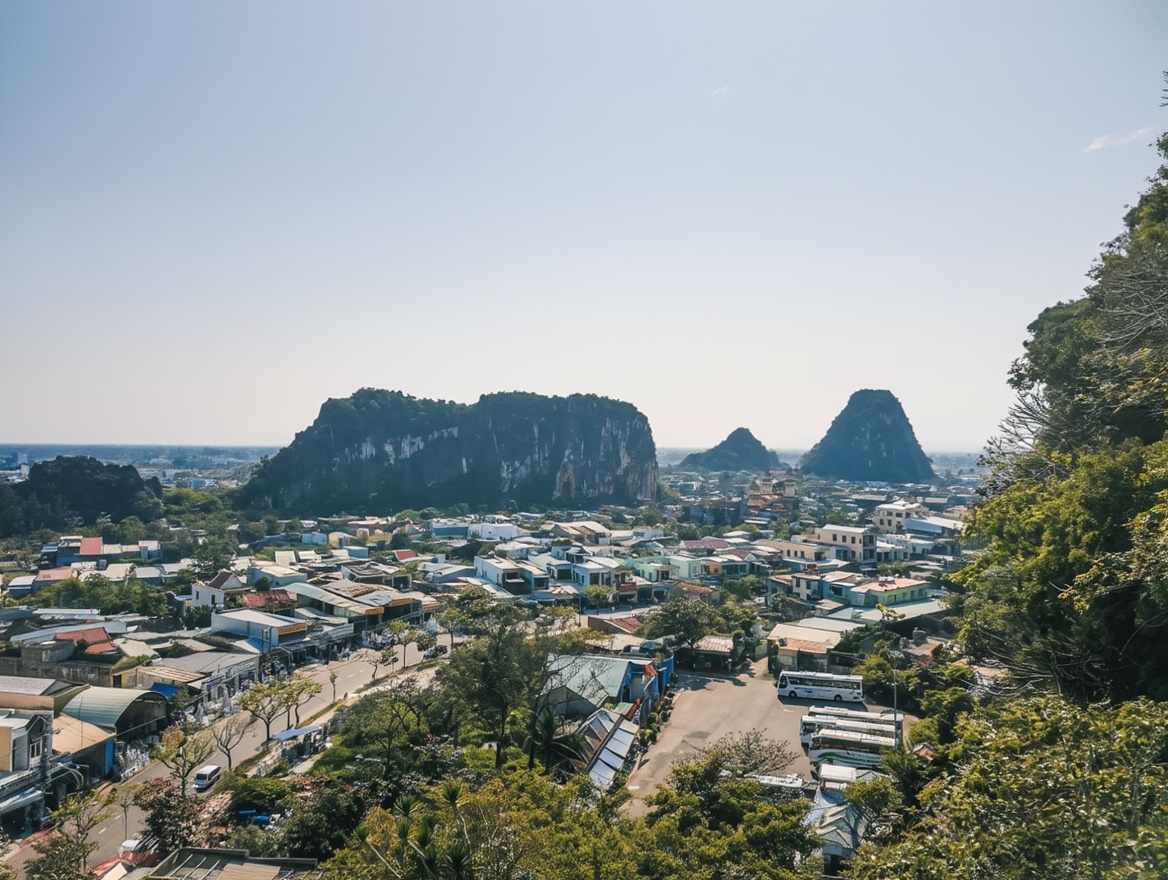
The five hills are named after classical Vietnamese elements: Thủy (Water), Mộc (Wood), Hỏa (Fire), Kim (Metal), and Thổ (Earth). Every guidebook lists all five. In practice, only Thủy Sơn has developed pathways, cave temples, and visitor infrastructure. The rest are either private, undeveloped, or home to stone carving workshops rather than sites.
When someone says “the Marble Mountains” as a tourist destination, they mean Thủy Sơn. Buy your ticket, take the elevator or the stairs up the front face, and everything worthwhile is on this one hill.
Thủy Sơn itself is divided into three main levels: the lower pagoda area (Tam Thai Pagoda, founded 1630), the cave circuit (Huyền Không and Âm Phủ), and the upper summit with panoramic views toward the coast and inland toward the Trường Sơn mountains. A single visit covers all three if you’re moving at a reasonable pace. Most people do the caves and call it done; the summit adds 20 minutes and a different quality of view — the coast from the top on a clear morning, Non Nước Beach stretching south, is genuinely worth the extra climb.
Huyền Không Cave — The One That Gets You
Huyền Không is the largest cave on Thủy Sơn — a vaulted natural chamber about 30 metres high, with three openings in the ceiling that let in columns of light. Buddhist altars line the walls. On a clear morning, those light shafts hit the incense smoke in a way that makes the cave look like something from a film set. It’s not staged. The openings have been there for centuries.
The cave is reached by a pathway from the main pagoda level — about a 10-minute walk from the elevator exit, through a gate and down a set of steps. It’s well-signposted. The altar inside is active — monks conduct ceremonies here, and visitors leave offerings. Don’t photograph the monks without permission. Do photograph the light.
One TripAdvisor reviewer described it: “Especially the mystical stalactite cave has inspired us. The light falling through the openings makes the cave almost magical.” That’s accurate and not overwritten.
ℹKnow Before You Go
Huyền Không Cave is most atmospheric between 8–10am when the sun angle hits the ceiling openings directly. By noon the light has moved and the shafts largely disappear. This is the single strongest argument for arriving early.
Âm Phủ Cave — The Cave of Hell
Âm Phủ (say: um foo) means “the underworld” or “hell” in Vietnamese — and the cave earns the name in the literal sense. It’s a steep descent through a narrow entrance into a series of chambers, with painted Buddhist scenes of judgement and punishment lining the walls. The iconography is explicit: figures being cooked, sawn apart, fed to serpents. Not subtle. Very Vietnamese Buddhist.
The practical reality: it’s tight. The entrance passage requires ducking and angling your shoulders. The steps down are steep and the rock is smoothed by decades of foot traffic — wet from humidity, or from rain, it becomes genuinely slippery. One reviewer described it as “one of the more challenging climbs” among the caves. That’s a reasonable description. Wear shoes with grip.
The cave is worth it. The combination of the cramped descent, the painted hell scenes, and the smell of incense from a small altar at the bottom is specific to this place in a way that the wider pagoda complex isn’t. It’s strange and memorable.
→Who It’s For
Âm Phủ Cave is not suitable for people with mobility issues, claustrophobia, or anyone carrying a child on their front. The steps are steep, the passage narrow, and there’s no other way through. One TripAdvisor reviewer noted attempting it with a 9-month-old in a carrier — “in hindsight probably not the most safe activity.” Skip it if the description gives you pause; the rest of the mountain is excellent without it.
The Elevator Question
There is an elevator. It costs 15,000 VND (~$0.60) each way and it goes up the front face of Thủy Sơn to a platform about one-third of the way up the hill. From there, you still climb.
This matters because the elevator creates a false impression that you can avoid significant stair climbing. You cannot. The caves, the pagodas at the top, and the viewpoints all require additional ascent — some of it steep, over rough stone, without handrails. The elevator saves roughly 150 stairs at the base. The site has several hundred more above that.
Use the elevator going up if you want to save your knees for the rest of the mountain. Walk down the front stairs on the way out — the view from the staircase over Non Nước Beach and the coast is better than anything you see from the elevator.
Practical Notes Before You Go
Entrance fee: 40,000 VND (~$1.50) per person. Buy at the ticket booth at the base — no need to book in advance. Multiple Reddit users confirm: “Just go there and buy the ticket directly. It takes like 10 seconds.” Ignore any third-party booking for this specific site.
Timing: 7am opening is the right call. A Da Nang travel guide puts it plainly: “Take your tour of Marble Mountains in the morning at 7am, when the air is cool for climbing and you can have the paths and pagodas all to yourself.” By 10am the tour buses arrive. By noon in the April–August dry season, the climb is genuinely uncomfortable — open marble faces absorb and radiate heat, and the “sweaty midday climb” description from TripAdvisor reviews is not an exaggeration.
Shoes: This is not negotiable. [RECURRING across 4+ sources] The marble steps are polished smooth and become very slippery when wet — from rain, humidity, or just heavy foot traffic. Sandals work in dry conditions on the main paths. Anything involving caves, especially Âm Phủ, requires closed-toe shoes with grip. Umbrellas are useful in both rain (obvious) and midday sun (less obvious — they help with stability on steep descents, a TripAdvisor reviewer noted).
Dress code: Shoulders and knees covered for entering the pagodas and cave temples. Loose cotton trousers and a t-shirt with a scarf or sarong in your bag covers everything. Vendors at the base sell light cotton trousers for 50,000–80,000 VND (~$1.90–3.05) if you arrive in shorts — functional and not badly priced, but you’ll be carrying them for the rest of your trip.
Photography: No restrictions on most of the site. The caves and pagodas are fine to photograph. Don’t photograph monks or devotees at prayer without permission — a nod and gesture to your camera is the standard ask. The light in Huyền Không Cave between 8–10am is worth switching your phone to manual exposure settings if you know how; auto-exposure tends to blow out the shafts. Even if it doesn’t, the cave earns a few minutes with the phone down.
Time needed: 2 hours covers the main cave circuit at a reasonable pace. 3 hours gives you the summit viewpoints, the pagoda complex, a break at the rest stop (cold drinks, shade, halfway up on the main path), and time to browse the Non Nước stone carving village at the base on the way out.
Getting There
From Da Nang city centre: 10 km south on the coastal road. Grab runs 80,000–120,000 VND (~$3–4.55) and takes 15 minutes outside rush hour. GrabBike is faster through city traffic and cheaper — 50,000–70,000 VND (~$1.90–2.65). Motorbike rental from Da Nang is straightforward; the route along Võ Nguyên Giáp street follows the coast the entire way. If you are planning a full day in the city, see the full things to do in Da Nang guide for how to combine the Marble Mountains with other spots.
From Hoi An: 30 km north. Grab one-way costs 200,000–270,000 VND (~$7.60–10.25). The Marble Mountains sit directly on the Da Nang–Hoi An route, which makes them a natural stop when transferring between the two cities — combine with a half-day in Da Nang or drop your bags at your Hoi An accommodation and come back the same afternoon. If you’re planning a dedicated day trip from Hoi An, the Marble Mountains pair naturally with My Son Sanctuary on a self-arranged car.
12Go covers most Vietnam routes — sleeper buses, trains, and island ferries. Compare schedules and book in advance during peak season (Dec–Feb, Jun–Aug).
Parking: The site has a car park at the base. Motorbikes park free or for a small fee (5,000–10,000 VND / ~$0.20–0.40) directly at the entrance.
Tam Thai Pagoda — Worth the Stop
Tam Thai Pagoda sits on the lower level of Thủy Sơn, reachable in about five minutes from the elevator exit. It’s one of the oldest continuously operating pagodas in central Vietnam — the current structure dates from an 1825 reconstruction under Emperor Minh Mạng, though the site itself is older. The pagoda is active: monks live here, ceremonies are held, the incense smoke is permanent rather than staged for visitors.
Most visitors walk through without slowing down, which is the wrong call. The courtyard has a large stone turtle base that once held an imperial stele — the original was damaged, the replacement sits slightly off-axis, which is the kind of small awkwardness that tells you something about the site’s history if you look for it. Early morning (7–8am) is genuinely serene here: the monks at morning prayer, the incense settling in still air, no tour groups yet.
Non Nước Stone Carving Village
The base of the Marble Mountains — the whole surrounding neighbourhood — is Non Nước, Vietnam’s most concentrated marble carving district. The workshops here supply marble souvenirs sold across the country. Statues of the Buddha in every scale, bowls, vases, chess sets, decorative panels. The carving skill is genuine; some workshops produce pieces that take weeks to complete.
The practical point: if you’re buying marble or stone souvenirs anywhere on your Vietnam trip — Hoi An Old Town, Da Nang market, Hanoi — the prices and selection are better here at the source. The showrooms directly at the mountain entrance are tourist-facing with tourist pricing. Walk one block further into the village for workshop prices.
One caveat: the entrance road to the Marble Mountains is lined with vendor stalls and carving showrooms aggressively soliciting visitors. “Be prepared to be approached” is the consistent note in traveller reviews. This is not a hostile situation — it’s a sales environment — but arriving mentally prepared means you can walk through confidently rather than feeling ambushed. A direct “no thank you” and continued walking is the standard response.
What to Skip
The organised tours sold from Da Nang hotels bundle the Marble Mountains with Lady Buddha (Linh Ứng Pagoda, on the Son Tra peninsula) and sometimes Âm Phủ Cave as a named stop. The Lady Buddha statue is large and the pagoda is fine — but it’s a 40-minute detour each way from the Marble Mountains to Son Tra. If you’re choosing one or the other for a half-day, the Marble Mountains are the stronger site.
The “Marble Mountains, Lady Buddha, and Dragon Bridge” combo tour is the default Da Nang tourist day. If all three are on your list, the tour format makes logistical sense. If you’re specifically here for the Marble Mountains, going independently gives you more time and less waiting.
The other skip: the photobooth and souvenir photography at the mountain entrance. A handful of vendors offer traditional costume photos near the ticket booth. The photos are not bad — the costumes are genuine Cham-style dress — but the pricing is negotiated and the pressure is real. Worth knowing it’s there so it’s not a surprise.
Combining With Other Da Nang Sights
The Marble Mountains work cleanly as one half of a Da Nang half-day. Logical combinations:
Marble Mountains + My Khe Beach: Arrive at the mountains at 7am, finish by 9:30–10am, Grab north 10 minutes to My Khe. The beach is at its best in the morning before the wind picks up in the afternoon. Done by 1pm with both covered.
Marble Mountains + Da Nang transit: If you’re moving from Hoi An to Da Nang (or vice versa), the mountain sits directly on the route. Stop for 2.5 hours, continue to your accommodation. No backtracking required.
Marble Mountains as a Hoi An day trip: The 30 km from Hoi An is manageable as a standalone half-day, but factor in the transport cost: Grab one-way from Hoi An runs 200,000–270,000 VND (~$7.60–10.25), so the return trip costs more than the entrance fee. Worth it if the Marble Mountains specifically appeal — if you’re more generally curious about Da Nang, save it for when you’re based there. Our Hoi An day trips guide covers how to combine this with other stops efficiently.
Jake’s Confession
First visit: arrived at 12:30pm in late March, thinking I’d save the morning for the beach. The marble steps were radiating heat through my shoe soles within the first five minutes. By the time I reached Huyền Không Cave, I was the kind of sweaty that makes you not want to look at any more stairs. The cave was impressive anyway — the light shafts were still there even at midday, reduced to two rather than three as the sun angle had moved — but I spent most of my time in there for the shade rather than the altars. I half-heartedly attempted Âm Phủ Cave, got one-third down the entrance passage, decided the narrow descent in midday heat was not for me that day, and turned around. Saw a monk at Tam Thai Pagoda who looked at my sweat-soaked shirt with the specific expression of someone who has watched tourists make this mistake five times before breakfast.
Second visit: arrived at 7:10am. Walked the entire mountain in two and a half hours. Had Huyền Không to myself for twenty minutes, watched the light columns move across the altar as the sun shifted, completed Âm Phủ without issue, made it to the summit viewpoint in time to watch the fishing boats coming in off Non Nước Beach. Completely different site. The exact same entrance fee, the exact same caves — unrecognisable experience.
Arrive early. It’s the single highest-leverage thing you can do here.
Two things worth sorting before you land: a Vietnam eSIM so you have data the moment you clear customs, and travel insurance — medical costs for uninsured foreigners in Vietnam are significant.
Airalo eSIMs activate instantly. Buy before departure — airport SIM queues in Vietnam can take 30+ minutes.
Frequently Asked Questions
How much does Marble Mountain cost in Da Nang?
Entrance to Thủy Sơn (the main hill) costs 40,000 VND (~$1.50) per person. The elevator is an additional 15,000 VND (~$0.60) each way. Buy tickets at the gate — no advance booking needed or useful. Total cost including elevator both ways: 70,000 VND (~$2.65). One of the best-value sites in central Vietnam.
How long do you need at Marble Mountain?
2 hours covers the main caves (Huyền Không and Âm Phủ) and the pagoda complex at a reasonable pace. 3 hours adds the summit viewpoints, a rest stop break, and time to browse the Non Nước stone carving village at the base. Most organised tours allocate 2 hours on site. If you’re self-arranging, 2.5 hours is a comfortable allow.
What is the best time to visit Marble Mountain?
7–9am. The mountain opens at 7am and the first tour buses typically arrive around 9:30–10am — you have roughly two hours of near-solitude. The morning temperature is also significantly cooler than midday, which matters on a marble hill that absorbs and radiates heat. The light shafts in Huyền Không Cave are most dramatic in the morning sun angle. Avoid noon to 2pm from April through August.
Is Marble Mountain worth it from Hoi An?
Yes — and it’s most efficiently done as a transit stop rather than a dedicated day trip. The Marble Mountains sit directly on the Da Nang–Hoi An road (30 km from Hoi An, 10 km from Da Nang). If you’re transferring between the two cities, build in a 2.5-hour stop. If you’re doing a dedicated trip from Hoi An, pair it with a morning visit to Da Nang’s My Khe Beach or the Dragon Bridge area to make the journey worthwhile.
Do you need to book Marble Mountain tickets in advance?
No. Multiple sources confirm tickets are available at the gate with no wait. “Just go there and buy the ticket directly. It takes like 10 seconds.” — Reddit r/DaNang. Skip any third-party booking for this specific site — there’s no benefit and you pay the same or more.