Updated: May 2026
Most travelers ride without a Vietnamese license and most are fine — but the rules matter in an accident — our Vietnam driving license guide covers what you actually need and what international permits cover.
What Kind of Bike Do You Actually Need
The Vietnam motorbike question most travelers get wrong is overthinking the machine. Unless you’re specifically doing Ha Giang or the northern mountain loops, you don’t need anything particularly capable.
Automatic scooters (50–125cc): The Honda Air Blade, Yamaha Grande, and Honda Vision dominate Vietnamese roads. Automatic transmission — twist and go. No clutch, no gears. Easy to learn in 20 minutes if you’ve never ridden. Adequate for city riding, coastal routes, and flat terrain. Maximum speed ~80–90 km/h. Fuel economy is excellent. Rental: 100,000–200,000 VND/day ($4–8).
Semi-automatic scooters (110–150cc): The Honda Wave and Win series. Manual gearshift without a clutch (foot lever). More power than automatics, better on hills and light off-road terrain. The Win (an older Chinese-made Honda clone) is the classic “budget traveler” bike — cheap, repairable everywhere, slow, and not particularly comfortable for tall riders. Rental: 100,000–180,000 VND/day.
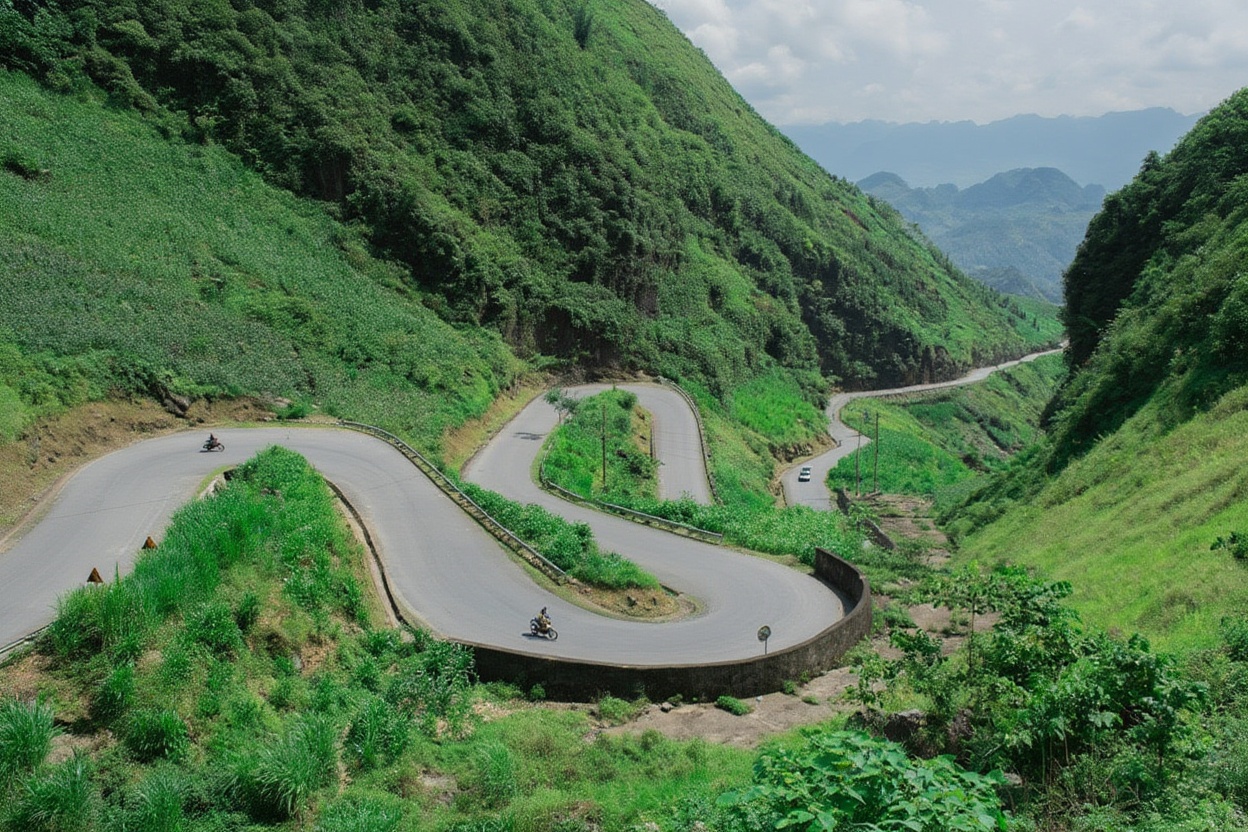
Manual gearbox bikes (150–250cc): Honda CB150R, Honda XR150, Royal Enfield Himalayan. Proper clutch, proper gears. Required for serious mountain roads — Ha Giang’s switchbacks at altitude, the Ho Chi Minh Trail in the west. If you can’t ride a manual motorcycle before arriving in Vietnam, don’t try to learn on Vietnamese roads. Rental: 200,000–400,000 VND/day for quality bikes.
The XR150 rule: For the Ha Giang Loop specifically, rent an XR150 or equivalent trail/dual-sport bike. Automatic scooters make it around the loop, but the switchbacks and unpaved sections around Meo Vac become genuinely dangerous in wet conditions on a scooter. The loop deserves a proper bike.
Renting vs. Buying: The Numbers
For trips under three weeks, renting is almost always the better choice. For a month-long north-to-south (or reverse) journey, buying and selling is often cheaper and gives you more flexibility.
| Option | Cost | Best For | Risk |
|---|---|---|---|
| Daily rental (auto scooter) | 100,000–200,000 VND/day ($4–8) | Day trips, city use, short routes | Damage deposit claims |
| Daily rental (quality manual) | 200,000–400,000 VND/day ($8–16) | Ha Giang Loop, mountain routes | Damage deposit claims |
| Buy a used Win/Wave | $250–400 USD | Full north-south journey, 3–6 weeks | Breakdowns, resale value |
| Buy a quality used bike | $400–800 USD | Same as above, more reliable | Breakdowns, resale |
| Sell at end of trip | Recover $150–350 USD | After a long trip | Finding a buyer in time |
Where to buy: The Facebook group “Vietnam Motorbike Buying and Selling” is the main marketplace for traveler-to-traveler sales. Expat forums and hostel bulletin boards in Hanoi and HCMC also work. The “Hanoi Backpackers” hostel on the Ta Hien drinking street is informally known as a place where long-haul riders sell before flying home.
Where to sell: Same places, reversed. Give yourself at least a week before your departure date to find a buyer — weekend sales are most active. Selling at the last minute typically means taking a significant loss.
The Legal Reality: Licenses and Insurance
Most travelers ride motorbikes in Vietnam without a legally valid license. This is true and worth stating plainly so you can make an informed decision.
Vietnam technically requires either a Vietnamese motorcycle license or an International Driver’s Permit (IDP) with a motorcycle endorsement. The important detail: IDPs issued by the AAA and most other international licensing bodies only cover car driving in Vietnam, not motorcycles. A motorcycle-specific IDP (requiring a motorcycle license in your home country) is technically required for legal riding.
In practice: police stops targeting tourists specifically for license checks are rare outside of periodic crackdowns (usually around major holidays). When they do occur, fines for riding without a license run 150,000–400,000 VND ($6–16). This is annoying but not catastrophic.
The more significant legal issue is insurance. Without a valid license, your travel insurance is unlikely to cover motorcycle accidents. Read your policy carefully. Some policies explicitly exclude motorcycles over 125cc. Some exclude all motorized two-wheel vehicles. Some require a valid license in the country of riding. If you crash without valid insurance coverage, medical costs for serious injuries in Vietnam can reach $10,000–50,000+ USD — amounts that would need to come directly from you.
If motorbike riding is a significant part of your Vietnam plan, get a motorcycle-specific IDP before you leave your home country and buy travel insurance that explicitly covers motorcycle use. The admin takes a few hours. The financial protection is real.
Safety: The Actual Statistics
Vietnam has one of the highest road fatality rates per capita in Southeast Asia. Motorbikes account for the majority of those fatalities. Tourists are represented in the accident statistics at higher rates than local riders — partly because of inexperience, partly because tourists are more likely to attempt mountain roads and long-distance routes.
The most dangerous conditions in order:
- Mountain roads in rain: Ha Giang, Sapa, and the Central Highlands have roads that become genuinely dangerous when wet. Clay soil roads lose all traction. Waterfalls cross the road surface after heavy rain. Pull over and wait it out — this is not negotiable
- Night riding: Poorly lit rural roads, animals crossing, potholes invisible until you’re in them. Don’t ride long-distance at night unless you know the road well
- Urban traffic: The pattern is counterintuitive for Western riders — traffic flows by filling every gap rather than following explicit right-of-way rules. The key insight is that everyone moves slowly and predictably. Speed is the risk amplifier in cities, not complexity
- Overconfidence on day 2–3: The period when riders have gotten comfortable but haven’t encountered their first difficult situation. This is statistically the highest-risk window
Helmet law: Vietnam has a mandatory helmet law and police enforce it. The helmets available at rental shops and roadside sellers are low-quality half-helmets — adequate for fines, inadequate for serious impact protection. Buy or bring a proper DOT/ECE-rated full-face helmet if you’re doing extended riding. The quality difference matters at the speeds where accidents happen.
Renting: The Right Way
The single most important rule for renting a motorbike in Vietnam: film a 60-second walkaround video of the entire bike before you take it. Every panel, every side, close-ups of any existing scratches or damage. This is the complete defense against the damage deposit scam — the most common complaint about motorbike rentals across Vietnam.

Where to rent: Google Maps, search “motorbike rental [city]” and read recent reviews. Shops with 4.5+ stars and recent English reviews are the baseline. In Hanoi, the Hoan Kiem area and Tay Ho (West Lake) have multiple reputable rental shops. In HCMC, District 1 has the highest density. Hostel recommendations are unreliable — hostels earn commission from specific shops.
The rental contract: Read it. Key things to confirm before signing: daily rate, fuel policy (usually full-to-full), damage claim process, what counts as “damage,” whether there’s a fixed deposit amount, and whether they hold your passport (they shouldn’t — offer cash deposit instead).
Deposit: Reputable shops take a cash deposit of 500,000–2,000,000 VND ($20–80) rather than a passport. A shop that insists on holding your passport is either running the damage scam or setting up for it. Walk away.
Fuel: Vietnam runs on A95 gasoline (octane 95). Petrol stations are everywhere on main routes. In very rural areas (deep Ha Giang, remote Ho Chi Minh Trail sections), fuel availability can be sparse — fill up whenever you see a station rather than waiting until you’re running low.
Understanding Vietnamese Traffic: The Actual System
Foreign riders consistently describe Vietnamese city traffic as “chaotic.” This is wrong in a useful way. Vietnamese traffic is not chaotic — it has a coherent internal logic, just not the explicit right-of-way structure most Westerners learned to drive in.
The core principle: traffic flows by negotiation, not by rule. At an intersection without lights, you enter slowly and the other vehicles accommodate you — or you wait until there’s a gap. Nobody has strict right of way. Everyone moves at speeds that allow for adjustment. The result is constant low-speed merging that looks chaotic from the outside but produces very few high-speed collisions in city centers.
What trips up foreign riders is applying their home country rules to this system. Stopping at a roundabout waiting for right of way means stopping indefinitely — nobody is giving it to you. Expecting drivers to yield at a merge means getting stuck. The correct approach is to join the flow slowly and let the system absorb you. Move at the pace of surrounding traffic. Don’t stop unexpectedly. Signal your intentions with your movement rather than expecting others to read your brake lights.
The genuinely dangerous part of Vietnamese traffic is not city centers — it’s the two-lane national highways where trucks and buses travel at speed and passing culture is aggressive. Highway 1 between major cities has sections where bus drivers overtake on blind corners. The safest approach: ride the secondary roads (Highway 14, the coastal roads) rather than Highway 1 wherever possible, and treat any oversize vehicle behind you as a signal to pull to the shoulder and let it pass.
Routes Worth Riding
Ha Giang Loop (3–4 days from Ha Giang town): The best motorbike route in Vietnam and one of the best in Southeast Asia. The road curls through limestone karst mountains to the Chinese border and back through the Dong Van Karst Plateau UNESCO Geopark. Ma Pi Leng Pass drops 1,000 meters into the Nho Que River gorge — one of the most dramatic road views in Asia. Do this on a proper bike (XR150 or equivalent), not a scooter, and give it enough days to not rush the corners. The standard route clockwise: Ha Giang → Quan Ba → Yen Minh → Dong Van → Meo Vac → Du Gia → Ha Giang.
Hue to Hoi An via Hai Van Pass (1 day): The coastal mountain pass — 496 meters at the summit — with ocean views on both sides and the ruins of a French-era border checkpoint at the top. Any bike handles this route. Jeremy Clarkson called it one of the greatest roads in the world on Top Gear; that assessment holds. Start before 8am to beat the tour buses that congest the pass by mid-morning. The full route takes 3–4 hours with stops.
Ho Chi Minh Trail (west side, 4–7 days): The wartime supply route through the Central Highlands from Hanoi (or Hue) to HCMC. Passes through Phong Nha’s cave country, the Khe Sanh Combat Base area (historical stop), and the coffee plantations around Da Lat. Far less traffic than coastal Highway 1. More demanding riding — sections are dirt or broken asphalt. Requires a manual bike and mechanical confidence, or at minimum a clear plan for what to do when something breaks.
Da Lat and Central Highlands (2–3 days loop): Cool mountain air (Da Lat sits at 1,500 meters elevation), pine forests, waterfalls, flower farms, and the best coffee growing region in Vietnam. Accessible on any bike from HCMC — 270km, about 6 hours on good roads. The Phan Rang coastal descent from Da Lat to the coast is particularly dramatic.
Coastal route: HCMC to Mui Ne (1 day): The most accessible long-distance motorbike day trip from Saigon. 200km along coastal Highway 1 and then the coastal road to Mui Ne’s sand dunes. Flat, well-surfaced, straightforward on any automatic scooter.
Breakdowns and Repairs: Vietnam’s Secret Advantage
Vietnam has the best motorbike repair infrastructure of any country in Southeast Asia. Every town, every village, almost every rural crossroads has a xe máy (motorbike) repair shop — identifiable by the scooters parked outside, a man with tools, and the sound of an impact wrench. The network is extraordinary.
Common repairs and approximate costs:
- Flat tire (puncture repair): 20,000–50,000 VND ($0.80–2)
- Tube replacement: 80,000–150,000 VND ($3–6)
- Chain adjustment or replacement: 50,000–200,000 VND ($2–8)
- Brake pad replacement: 50,000–120,000 VND ($2–5)
- Carburetor cleaning: 100,000–200,000 VND ($4–8)
- Battery replacement: 100,000–250,000 VND ($4–10)
Communication at roadside repair shops is usually possible without Vietnamese. Point at the problem, make the noise it’s making, gesture at the relevant part. Vietnamese mechanics are used to clueless foreigners showing up with broken bikes and handle the whole transaction through demonstration. Most repairs take under 30 minutes. Pay what they ask — the prices are fair and negotiating at a roadside mechanic is unnecessary and slightly embarrassing.
The Win/Honda Wave’s advantage for long-distance budget trips is that it uses parts available at every roadside mechanic in the country. Newer, more modern bikes may require parts that aren’t stocked in rural areas — a significant problem if you break down between towns in Ha Giang. Old, simple mechanics break predictably and are fixed with tools that exist everywhere.
What I Got Wrong
First week riding in Hanoi. I’d ridden motorcycles before — a 250cc around Austin, some dirt bike experience. I assumed the traffic would be the hard part to adjust to and the riding itself would be fine.
The traffic was actually the easy part. Everyone moved predictably and slowly. What I wasn’t ready for was rain on the second day. I’d taken a scooter on a day trip to the Ba Vi mountains outside Hanoi. On the way back, the road surface went from dry to streaming water in about ten minutes. The clay soil on the shoulder had no grip. I went into a slow turn too fast, front wheel washed, went down at about 25 km/h. Road rash on my left forearm, bent handlebar, cracked plastic on the rental bike.
The damage to the bike cost me 500,000 VND. The road rash healed in two weeks. The actual lesson: Vietnam mountain roads in rain are not a function of skill level. They’re a function of road surface, and some surfaces lose almost all traction when wet. Since then I pull over and wait under a bus shelter or roadside shop whenever serious rain starts on a mountain road. The delay is always worth it.
Two things worth sorting before you land: a Vietnam eSIM so you have data the moment you clear customs, and travel insurance — medical costs for uninsured foreigners in Vietnam are significant.
Airalo eSIMs activate instantly. Buy before departure — airport SIM queues in Vietnam can take 30+ minutes.
Frequently Asked Questions
Do I need a license to ride a motorbike in Vietnam?
Legally, yes — a motorcycle-endorsed International Driver’s Permit or Vietnamese license is required. In practice, most tourists ride without one and face occasional fines of 150,000–400,000 VND if stopped. The more important issue is insurance: without a valid license, most travel insurance policies won’t cover motorcycle accidents. Get proper IDP and confirm your policy covers motorbikes before riding.
Is Vietnam safe for motorbike travel?
Safer than its reputation when approached intelligently, more dangerous than travelers assume when approached casually. Key safety rules: don’t ride mountain roads in rain, don’t ride long-distance at night, wear a real helmet (not the cheap half-helmets from rental shops), and give yourself 3–4 days to adapt to Vietnamese traffic before attempting difficult terrain.
How much does it cost to rent a motorbike in Vietnam?
Automatic scooters: 100,000–200,000 VND/day ($4–8). Manual bikes: 200,000–400,000 VND/day ($8–16). Weekly and monthly rates available — typically 20–30% discount on daily rate. Deposit: 500,000–2,000,000 VND cash (never leave your passport). Budget separately for fuel: ~50,000–80,000 VND per tank on a scooter.
What is the best motorbike route in Vietnam?
Ha Giang Loop for mountain scenery, full stop. Hue to Hoi An via Hai Van Pass for the best single-day coastal route. The Ho Chi Minh Trail through the Central Highlands for the most historically layered long-distance ride. Which is “best” depends on how much time you have and how experienced you are — Ha Giang needs 3–4 days and a proper manual bike.
Can I buy a motorbike in Vietnam and sell it at the end of my trip?
Yes, and it’s a popular strategy for trips of 3 weeks or more. Budget $250–500 USD to buy a used Honda Win or Wave; expect to recover $150–350 USD when selling. The Facebook group “Vietnam Motorbike Buying and Selling” is the main marketplace. Give yourself at least a week before departure to find a buyer — last-minute selling means significant losses.
What gear do I need to bring for motorbike travel in Vietnam?
Non-negotiables: a full-face helmet (buy before arriving or in a major city — roadside helmet quality is poor), gloves, and a rain jacket. Highly recommended: over-the-ankle boots or at minimum closed shoes (sandals are fine for city riding, dangerous on gravel or if you need to put a foot down on rough terrain), and a dry bag or waterproof backpack cover for your gear. For mountain routes: light riding gloves rated for impact, not just sun protection. For the full north-to-south trip: a luggage strap and bungee net for securing bags to the rack, and a tire patch kit for self-service on remote roads.
Is Hanoi or HCMC better to start a motorbike trip?
Hanoi for north-first riders heading to Ha Giang, the northwest, and down the coast. HCMC for south-first riders going to the Mekong, Da Lat, and up the coast. The rental market is well-developed in both cities. Hanoi’s Old Quarter area and Tay Ho have concentrated rental shops. HCMC’s District 1 has the highest density. Both cities have active buy-sell communities for travelers doing long-haul trips.
Vietnam by motorbike is one of the best travel decisions you can make in Southeast Asia — when you do it right. The right bike, the right route, a documented pickup, a proper helmet, and the discipline to stop when the weather turns. Everything else is just the open road.
The Hanoi motorbike scams guide covers the rental damage claim scam in more detail — essential reading before you rent anywhere in the capital. For the full Ha Giang experience, the Ha Giang Loop guide has operator recommendations, permit requirements, and a day-by-day route breakdown. For a broader overview of getting around the country, our Vietnam transport guide covers buses, trains, and everything beyond two wheels.
FAQ
Do I need a license to ride a motorbike in Vietnam?
Legally yes — you need a Vietnamese license or an IDP (International Driving Permit) endorsed for motorcycles. Under 50cc scooters technically don’t require a license (this is why some rental shops specifically offer 49cc bikes). In practice, many tourists ride without a license; the practical consequence is that travel insurance typically won’t cover accidents on unlicensed motorbikes.
What size motorbike should a beginner rent in Vietnam?
Start with a 110–125cc automatic scooter — reliable, easy to ride, and adequate for most Vietnam terrain including mountain roads. Honda Air Blade and Yamaha Nouvo/Sirius are common, well-supported rental bikes. Avoid semi-automatics and manuals until you’re comfortable with Vietnamese traffic. The 250cc+ adventure bikes on Ha Giang are for experienced riders only.
How much does motorbike rental cost per day in Vietnam?
Basic automatic scooter: 120,000–200,000 VND/day ($5–8). Semi-automatic Honda Wave: 100,000–150,000 VND/day. Manual 125cc: 150,000–250,000 VND/day. Ha Giang-ready manual bikes (XR125, Honda CRF): 250,000–400,000 VND/day. Long-term rates (weekly/monthly) are 20–30% cheaper.
Can you buy a motorbike in Vietnam and sell it at the end of your trip?
Yes — the ‘Saigon to Hanoi sell’ or reverse is a classic backpacker move. Buy a decent used Honda Win or XR125 in Saigon for $300–600 USD, ride north, and sell in Hanoi for $200–500. Budget for at least $50–100 in repairs en route. Check Facebook groups ‘Motorbike Vietnam’ and buy from other travelers rather than shops for better deals.
What should I know about riding motorbikes in Vietnamese cities?
Traffic flow is different from Western countries — treat it as a river, not a series of rules. Merge gradually, don’t make sudden moves, and go with the flow. Roundabouts are free-form. Motorbikes generally have right of way over pedestrians. Drive defensively and watch for vehicles cutting across your path. Never ride after drinking.