Last updated: May 2026 — Du Gia boat prices, morning timing advice, and Du Già CN Homestay availability verified.
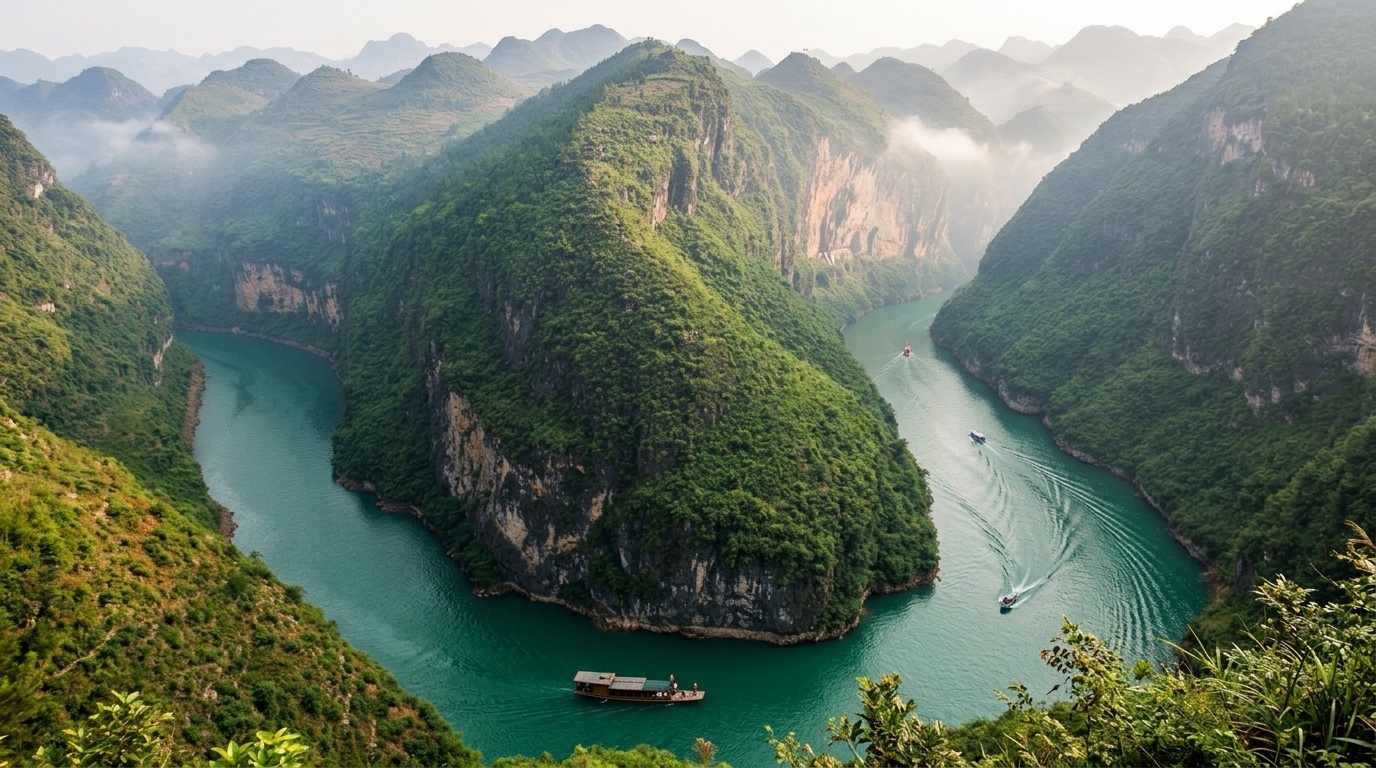
I did not do the boat trip. I arrived in Du Gia at 3pm and the light was already wrong, the boats were tying up, and I told myself I’d come back.
Second loop, I planned the whole thing around being at the Du Gia dock by 7am. That version of the Nho Que River was something else entirely.
What the Nho Que River Actually Is
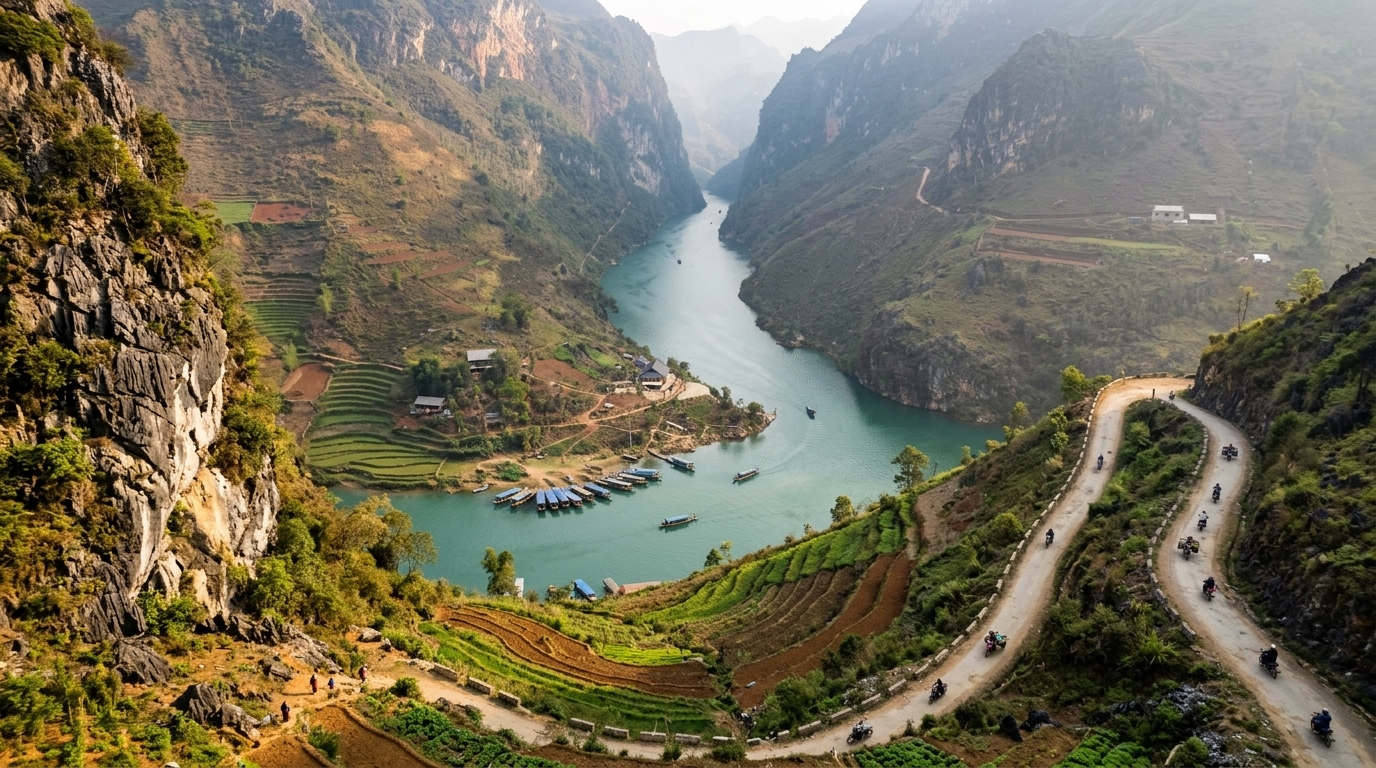
The Sông Nho Quế (Nho Que River) runs along the Hẻm Tu Sản — Tu San Canyon — a gorge cut through the Dong Van Karst Plateau that’s consistently called one of the deepest canyons in Southeast Asia. The river runs roughly 60km before crossing into China, but the section between Meo Vac and Du Gia is what travelers come for.
| Nho Que River | Ma Pi Leng | |
|---|---|---|
| Location | Runs along the Hẻm Tu Sản, cut through Dong Van Karst Plateau | Pass on the Dong Van to Meo Vac road stretch |
| Viewing Perspective | Experienced from a wooden boat departing from Du Gia village | Seen from viewpoints: Ma Pi Leng Pass and Nho Que gorge overlook |
| Key Feature | Real turquoise water (or jade/electric) from calcium carbonate | High altitude views, including looking down at the river |
| Transportation | Requires a boat to see it from the water | Seen while driving the road or stopping at viewpoints |
| Relationship | The gorge where the river is viewed from Ma Pi Leng Pass | A pass that provides a perspective on the river and gorge |
| Best for | Travelers seeking a closer, unique view of the turquoise water. | Travelers who want panoramic views and are driving the standard route. |
The turquoise color is real, not a filter. It comes from the mineral content of the water as it moves through the limestone — calcium carbonate suspension that scatters light in a way that makes the river look like someone poured glacier melt into the gorge. On cloudy days it shifts to jade. On bright mornings in dry season it goes electric.
You see it from two angles on the Ha Giang Loop. The first is from the road — specifically the Ma Pi Leng Pass viewpoint and the Nho Que gorge overlook, both on the Dong Van to Meo Vac stretch. The second is from the river itself, on a wooden boat departing from Du Gia village on the return leg. These are different experiences and one doesn’t replace the other.
Nho Que River from the Road: Ma Pi Leng Pass
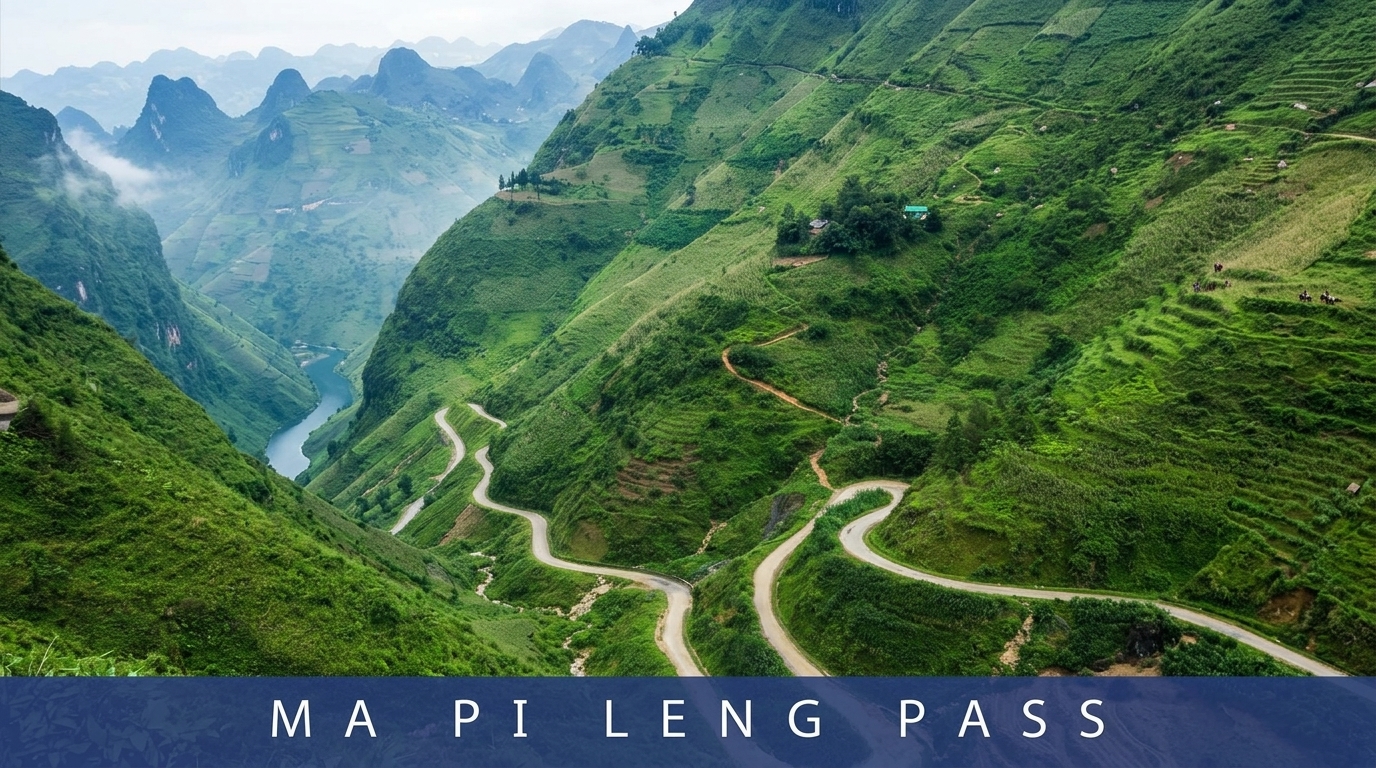
The road viewpoint comes at you on Day 2 of the classic clockwise loop — the Ma Pi Leng Pass from Dong Van to Meo Vac. The main summit viewpoint sits at roughly 23.2267° N, 105.3923° E. The Nho Que gorge overlook is 200 meters further south at 23.2204° N, 105.3947° E, down a short walk from the road.
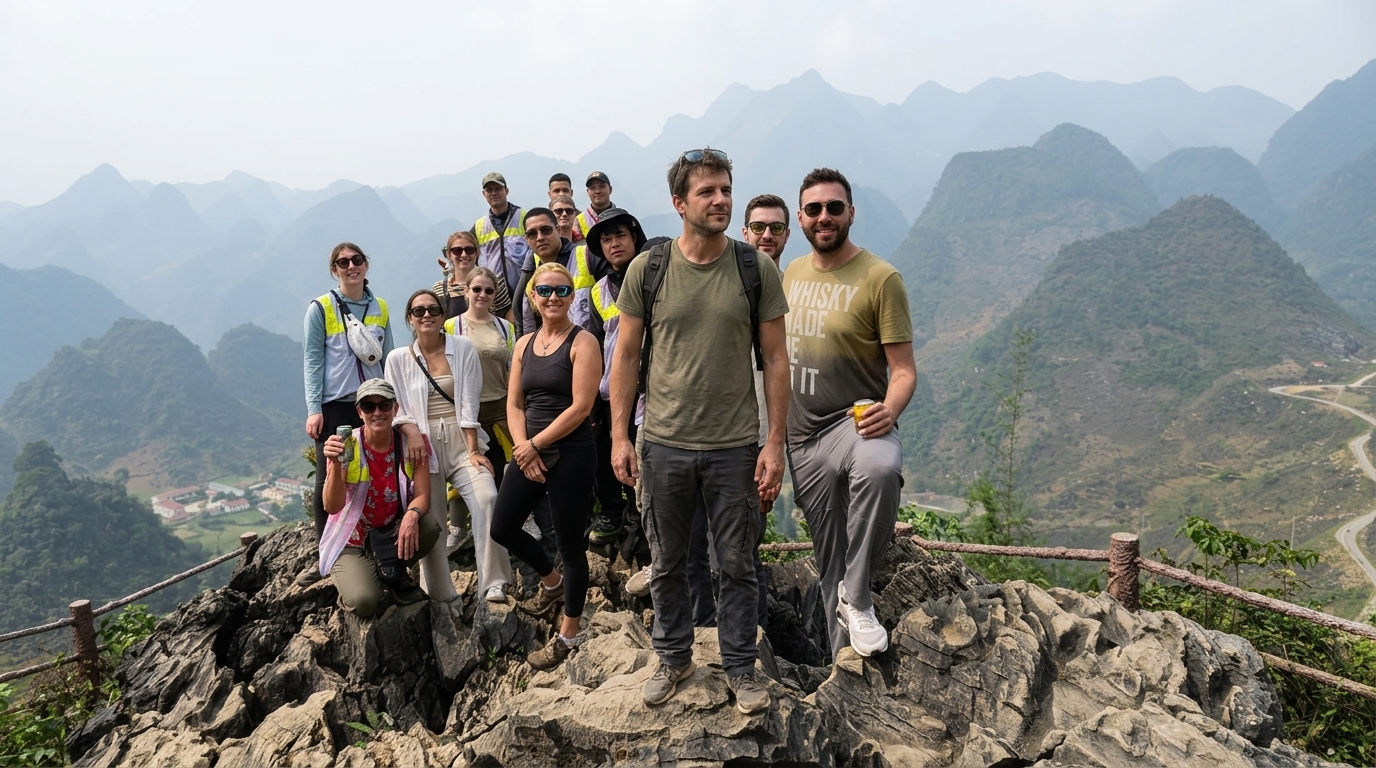
Pull well off the road before stopping. The pass is narrow, the drop is real, and you don’t want to be that person straddling a motorbike at the edge of a two-hundred-meter cliff while a truck rounds the corner.
The view from above is genuinely affecting — the river looks impossibly thin, the walls of the gorge rise straight up, and on a clear morning you get the full color contrast: grey rock, green vegetation at the rim, turquoise thread at the bottom. It’s one of the best viewpoints in northern Vietnam and it doesn’t require any planning beyond riding the route.
What the road view can’t give you is scale or silence. You’re looking down at something abstract. The boat trip puts you inside it.
The Nho Que River Boat Trip from Du Gia
Du Gia village sits at 22.9863° N, 105.3421° E on the interior return road — the section from Meo Vac back toward Ha Giang City that most loop riders take on Day 3 or 4. The boat dock is straightforward to find: there’s one obvious loading point on the river at the village edge, with a cluster of wooden boats and a ticket kiosk.
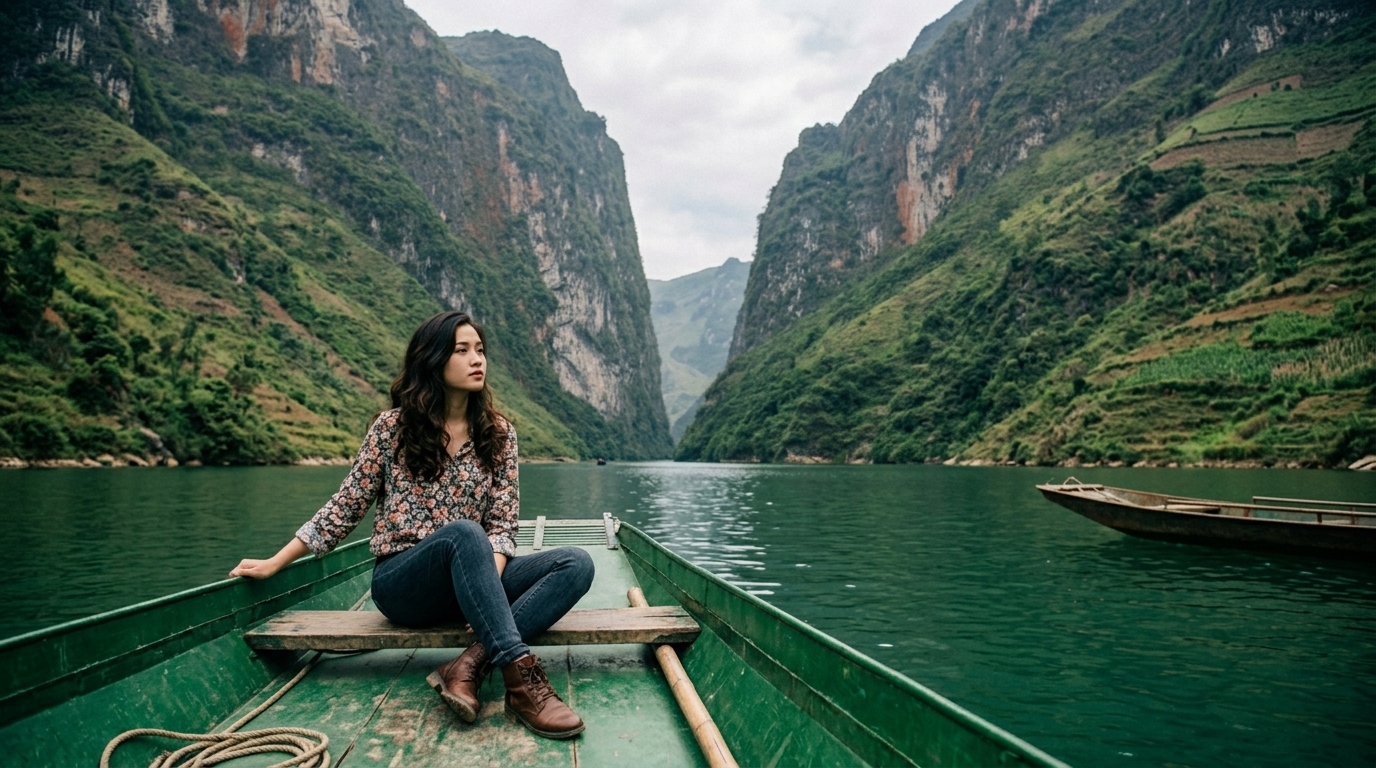
What the Boat Trip Looks Like
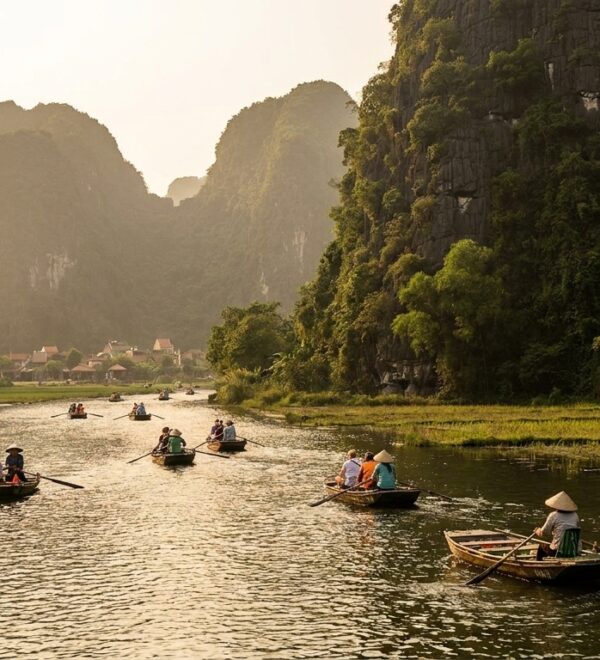
The boats are long and wooden, motorized, low in the water. You share with 4–6 passengers — strangers from other groups if you’re a couple or solo rider, which is fine. The trip goes 4km into the canyon from the Du Gia launch point and returns the same way. Total time: 45 minutes to an hour, depending on how long you pause at the turnaround point.
Inside the canyon it’s immediately different from the view above. The walls close in — 150 to 200 meters of limestone on both sides, vegetation hanging from ledges, the river the only sound except the engine. The turquoise color is more saturated from the surface than from above, and the walls reflect it back at you.
The mouth of Tu San cave, where the canyon narrows most, is the coldest point. The air changes — suddenly ten degrees cooler, clammy, the kind of cold that drips from the rock ceiling and lands on your neck. Drips on your helmet if you’re wearing one in the boat, which honestly you should be.
Most riders describe it as unexpectedly peaceful given where it sits on a 350km motorbike route. “Gentle sway” is the standard descriptor. Choppy if there’s wind, which there usually isn’t in the gorge.
Price and Booking
Cost is 80,000–120,000 VND (~$3–5) per boat (not per person), shared between your group. If you’re riding with others from the same hostel, coordinate the night before in Meo Vac — a full boat of 6 people splits to around 15,000–20,000 VND (~$0.57–0.76) each, which is absurd value.
Solo riders pay 80,000–120,000 VND (~$3–5) total if they can get onto a boat with other passengers going at the same time. Just wait at the dock — boats generally don’t leave until they have enough people to make it worthwhile. Peak season (October–November, January–March), you’ll find other passengers quickly. Shoulder months, you might wait 20–30 minutes.
No advance booking required or possible — it’s cash on the day, at the dock.
Quick Answer
The Nho Que River boat trip departs from Du Gia village (22.9863° N, 105.3421° E). Cost: 80,000–120,000 VND (~$3–5) per boat shared between 4–6 people. Trip duration: 45–60 minutes return. Best time: 6:30–8:30am for morning light. No advance booking — cash at the dock.
When to Go: Morning Is Not Optional
This is the detail that changes the experience.
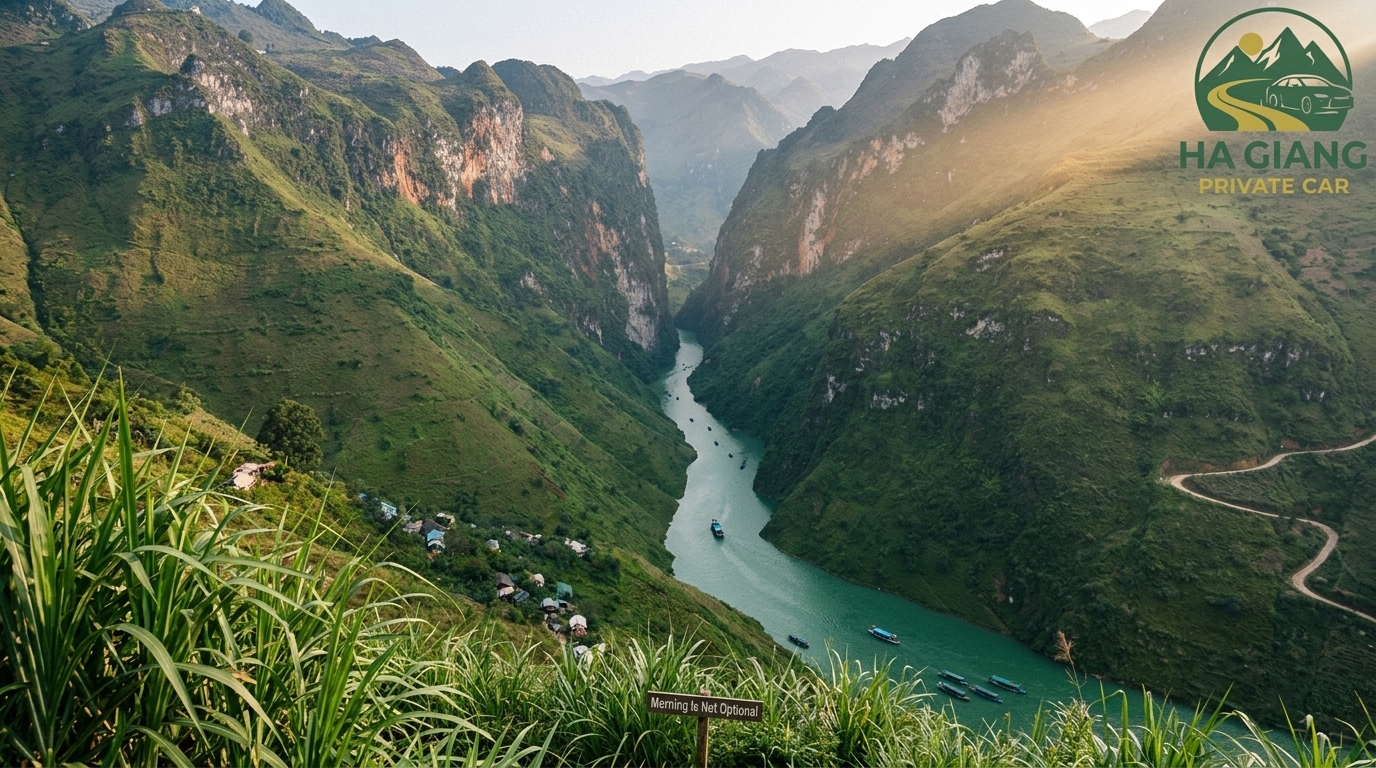
The canyon runs roughly north-south. Direct sunlight reaches the river for a limited window in the morning — somewhere between 6:30 and 9:00am depending on season, weather, and how clear the sky is. Outside that window, the walls block the sun, the turquoise color mutes to grey-green, and the photos look like photos of a grey-green river.
Inside the window, the light hits the water at an angle that makes the mineral color glow. The walls stay cool. The boats are fewer. The canyon is quiet except for bird calls echoing off the limestone.
After 9am, the boats get busy and the light goes flat. This isn’t crowd-avoidance advice — it’s physics.
Getting there by 7am means either:
- Overnight in Du Gia — which several homestays accommodate (Du Già CN Homestay at làng Lạc A is the most recommended, 250,000–400,000 VND (~$9–15)/night). Genuinely the best approach. You get the morning, you get the boat, you’re still back on the road to Ha Giang City by 10am.
- Very early departure from Meo Vac — Du Gia is about 70km from Meo Vac on the interior road. Leaving by 4:30–5am would get you there in time, but that’s a mountain road in the dark. Don’t do this.
Plan the overnight. It also adds the option of doing the Nho Que boat trip AND riding out at a sane hour.
Du Gia Overnight: The Case for Slowing Down
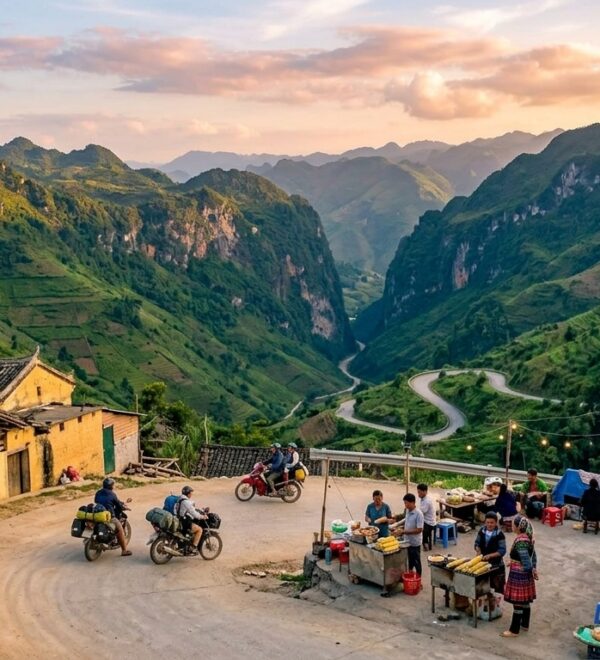
Du Gia is a small village — one main road, a handful of homestays, a few food stalls that open for the morning rush of loop riders. It’s not Dong Van with its restored old quarter atmosphere, but it has a different quality: genuinely quiet, genuinely local, with views of the river gorge from certain points that most riders miss by passing through without stopping.
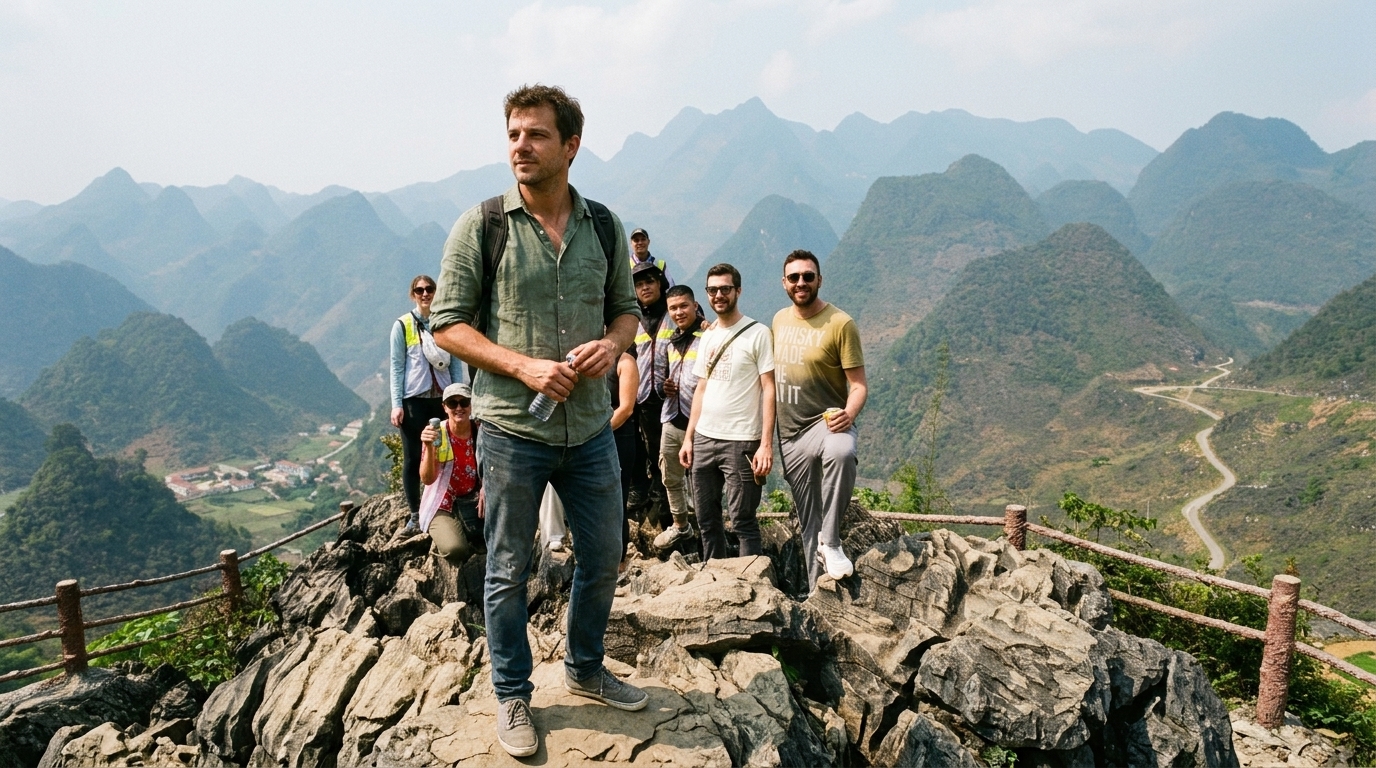
The dawn at Du Gia is the damp stone and charcoal smoke smell of Vietnam before the motorbike engines start — cook fires going in the kitchens, mist sitting low over the water, temperature around 16–18°C even in April. By 6am it’s light enough to see the cliff walls. By 6:30 you’re on the boat.
After the boat trip, Du Gia to Ha Giang City is about 45km on flat, good road — roughly 90 minutes. You can be back at Ha Giang City in time for lunch and the overnight bus back to Hanoi.
Where to Stay in Du Gia
- Du Già CN Homestay (làng Lạc A) — 250,000–400,000 VND (~$9–15)/night. Wooden construction, ethnic minority decor, views toward the water. Has a reputation for the best breakfast in the village, which at this price and in this location is exactly what you want. Bookable on Booking.com but most riders just show up — there’s room except peak season.
- Local guesthouses along the main road — 200,000–300,000 VND (~$8–11). Basic rooms, shared bathrooms. Functional. The river isn’t visible from the rooms but you’re paying for the location, not the view.
Neither option is on a booking platform consistently — carry cash, confirm the room price before putting down your bag, and don’t expect WiFi to be reliable after 9pm.
Nho Que River vs Ma Pi Leng: Do You Need Both?
If you’re riding the clockwise loop, you pass Ma Pi Leng on Day 2 and reach Du Gia on Day 3 or 4. Both are naturally on the route — there’s no detour required.
The road viewpoint takes 20–30 minutes and requires nothing except stopping. Do it.
The boat trip requires overnight planning to hit the morning window. If that’s not possible — if you’re doing a three-day loop and running behind — skip the boat and keep the road viewpoint. It’s still one of the best things on the Ha Giang Loop.
If you have four days and can build in the Du Gia overnight, the boat trip adds something the road view doesn’t give you: being inside the thing instead of looking at it from above. Different experience, not a bigger one. Worth it if the logistics allow.
Real Talk: The boat trip gets overhyped in some itinerary posts as a must-do that can’t be missed. It’s excellent. It’s also 45 minutes of sitting in a boat, and if you arrive at the dock at 11am with flat light and a boatload of selfie sticks, it’s significantly less excellent. The setting is doing all the work — timing is what makes it the experience it’s supposed to be.
Getting to Nho Que River: Full Route Logic
On the Ha Giang Loop (Recommended)
The Nho Que River is not a side trip — it’s built into the loop route. Clockwise riders see it twice: from the road at Ma Pi Leng on Day 2, and again from the river at Du Gia on the return leg.
Day 3 of a four-day clockwise loop: Meo Vac → Du Gia (70km, ~2.5–3 hours on interior mountain road) → overnight → boat trip at 7am Day 4 → Ha Giang City (45km, ~1.5 hours) → Hanoi bus.
12Go covers most Vietnam routes — sleeper buses, trains, and island ferries. Compare schedules and book in advance during peak season (Dec–Feb, Jun–Aug).
This is the natural rhythm. Don’t force it into a three-day loop unless you’re an experienced rider who knows how long the road actually takes.
As a Day Trip from Ha Giang City
Technically possible. Du Gia is about 80–90km from Ha Giang City via the interior road. You’d leave Ha Giang City by 5am to be at the dock by 7am. This is a long day on mountain roads and you miss the rest of the loop scenery. Not recommended unless you’ve already done the loop and are going back specifically for this.
The Interior Road (Du Gia to Ha Giang City)
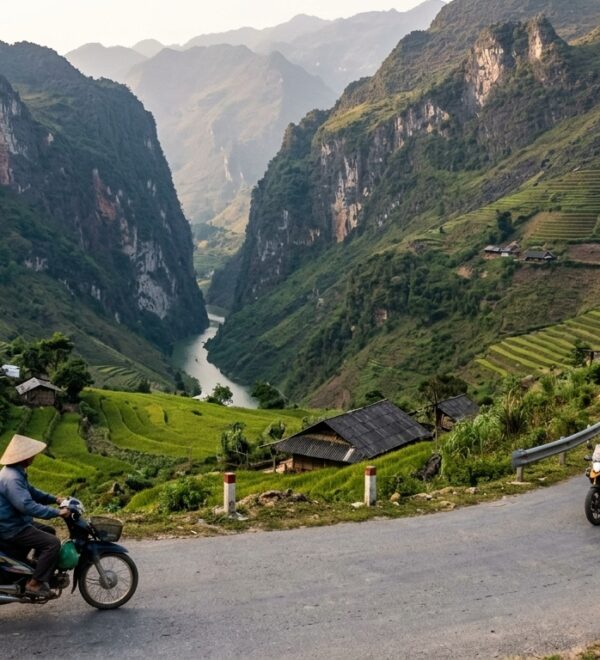
The return road from Meo Vac through Du Gia to Ha Giang City gets less attention than the main loop but has its own character — quieter traffic, deeper valley views, fewer international riders. Signal is mostly dead on this stretch. Download the offline map section before you leave Meo Vac.
What Travelers Actually Say: The Consensus
Traveler reviews of the Nho Que boat trip split neatly by one variable: what time they arrived. People who got to Du Gia by 7am describe the turquoise color as “unreal,” “unlike anything I’d seen in Vietnam,” “the best two hours of the whole Ha Giang trip.” People who arrived at 10am or later describe murky green water, full boats, and a flat canyon. It’s the same river, different conditions. The timing advice in this article is not hyperbole — it’s the difference between two completely different experiences.
The other consistent note: riders who planned the Du Gia overnight specifically to hit the morning window said it was the best logistical decision they made on the loop. The alternative — riding through Du Gia as a stop on the way back to Ha Giang City without overnight — works, but only if you’re leaving Meo Vac early enough to reach Du Gia by 7am. Most riders don’t. Plan the overnight and remove the uncertainty.
↗Insider Tip
Several travelers mention that the boat operators at Du Gia will quote a higher price if you arrive alone or with one other person. The standard rate is for a shared boat of 4–6. If you arrive at the dock and there’s nobody else waiting, either wait 20 minutes for others to show up (they usually do by 7:30am) or negotiate explicitly for the shared rate. Don’t just accept the first number quoted for a solo charter.
Two things worth sorting before you land: a Vietnam eSIM so you have data the moment you clear customs, and travel insurance — medical costs for uninsured foreigners in Vietnam are significant.
Airalo eSIMs activate instantly. Buy before departure — airport SIM queues in Vietnam can take 30+ minutes.
FAQ
Where does the Nho Que River boat trip depart from?
Du Gia village, on the interior return road of the Ha Giang Loop. GPS: 22.9863° N, 105.3421° E. There is one boat dock at the village edge — it’s obvious when you arrive. No advance booking; cash on the day.
How much does the Nho Que River boat trip cost?
80,000–120,000 VND (~$3–5) per boat, not per person. The boat holds 4–6 passengers. If you’re solo or a couple, you’ll share with other travelers who arrive at the same time. Solo cost in practice: 80,000–120,000 VND (~$3–5) total if you wait for others, or more if you charter alone.
How long is the Nho Que River boat trip?
45–60 minutes return. The boat goes 4km into the Tu San Canyon from the Du Gia launch point, stops briefly at the turnaround point, and returns. There’s no landing — you stay in the boat the whole time.
Is the Nho Que River boat trip worth it?
Yes, with conditions: do it in the morning (6:30–9am) for the light, and plan the Du Gia overnight so that’s actually achievable. Arriving at 11am with flat light and full boats is a different — and substantially lesser — version of the same trip.
Can I see the Nho Que River without a boat?
Yes. The Ma Pi Leng Pass viewpoints on the Dong Van to Meo Vac road give you the above view of the gorge — dramatic, free, no planning required. The boat trip gets you inside the gorge. Both are worth doing if logistics allow; the road view alone is not a compromise.
What’s the best time of year for Nho Que River?
October–November for the clearest water and best color (dry season, post-harvest rice fields on the approach). January–March also excellent. Avoid June–August — heavy rain makes the river muddy, the gorge road can close, and the boat dock may suspend operations. The color the river is famous for disappears entirely in the wet season.