Last updated: May 2026
Long Beach (Bai Truong) — The Main Strip
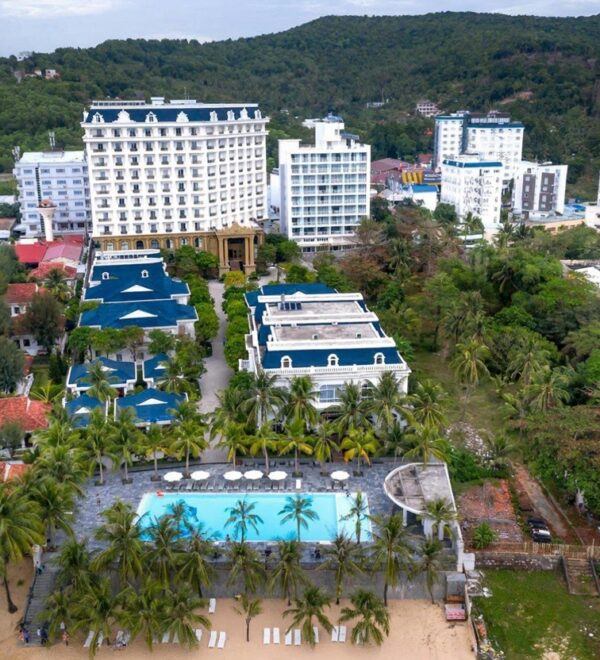
Long Beach is 20km of west-coast shoreline that runs from the airport area south to An Thoi pier. This is where most of Phu Quoc’s resort development sits — budget guesthouses, midrange hotels, and major resort chains lined up along the coastal road.
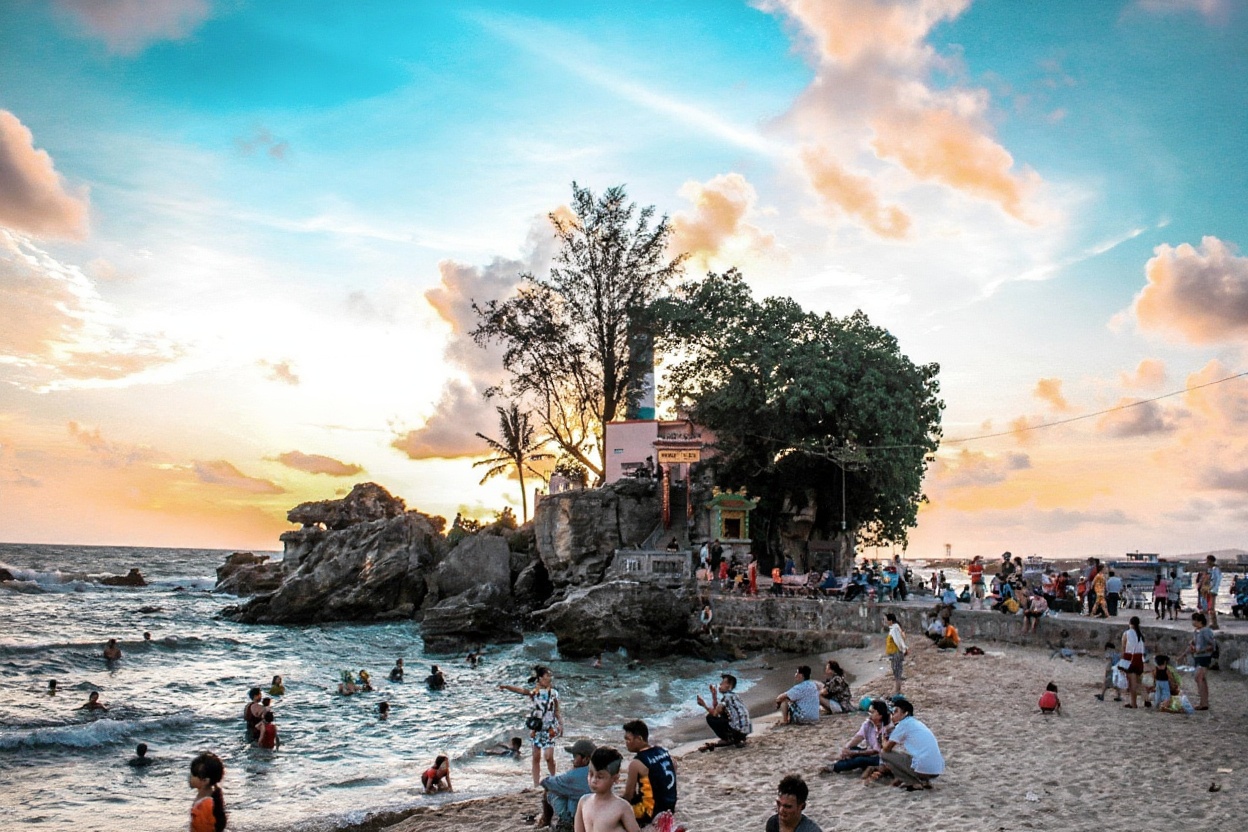
The beach itself is fine. The water is calm in dry season (November–April), the sand is pale and clean in the mornings before the day gets hot, and the sunset from Long Beach is legitimately good — the sun drops directly over the Gulf of Thailand and the sky goes orange-red on clear evenings from November to February.
The honest version: Long Beach is convenient and mediocre. It’s the default choice because it’s where the hotels are, not because it’s the island’s best swimming or best sand. If you’re staying here and looking for the postcard version of Phu Quoc beaches, you need to ride south.
⚠Real Talk
Multiple Reddit users summed up Phu Quoc’s overdevelopment problem well: “They paved paradise and put up a Vingroup mall.” Long Beach is the example. What was once a working fishing village coast is now a solid wall of resort infrastructure from the airport to the pier. Beautiful at sunset. Less beautiful when you realize the “beach” you’re on is a strip between two resort fence lines.
Sao Beach (Bai Sao) — The Instagram Version
Sao Beach is on the southeast coast, 25km from town — 45 minutes by motorbike on the inland road through pepper plantations and fishing villages. It’s the beach that appears in every “Phu Quoc beaches” search result: white sand that squeaks underfoot, water that transitions from light turquoise to deep blue, and relative shade from the trees that line the upper beach.
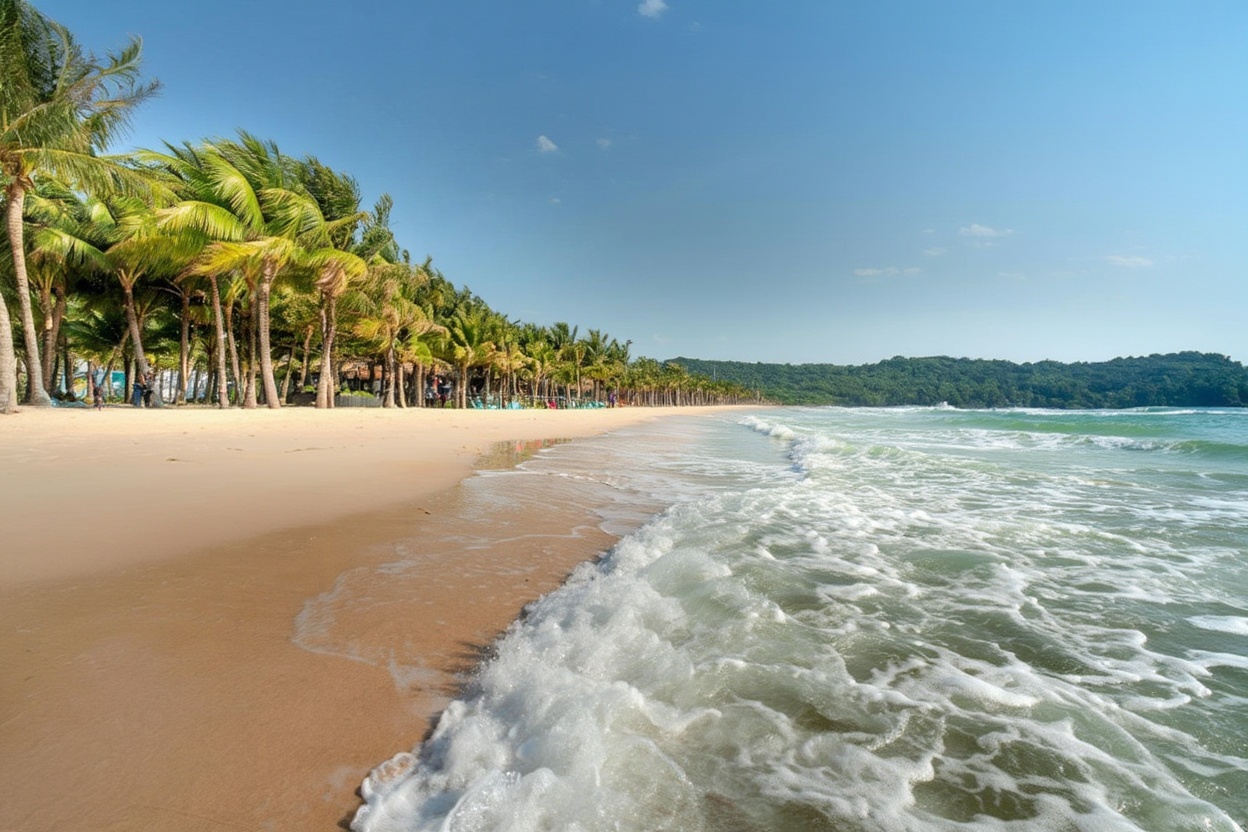
Sao Beach is genuinely good. The sand is the softest on the accessible part of the island. The water is clear in dry season — visibility to 3–4 meters, coral fragments on the seafloor, the occasional small fish visible without snorkelling gear. There are beach chairs for rent (100,000–150,000 VND per day from the restaurants behind the beach, ~$3.80–5.70) and a handful of seafood restaurants at the back.
The catch: it fills up in peak season (December–February). By 10am on a Saturday in January, Sao Beach is busy — domestic Vietnamese tourists, tour group vans, and the resort shuttle crowd all arriving simultaneously. Get there by 8am and you’ll have the best part of the morning to yourself. Get there at noon and you’ll be sharing the beach with several hundred people.
From November to April: crystal clear and worth every motorbike minute. May to September: rougher surf, some seaweed, and the occasional jellyfish warning.
Khem Beach (Bai Khem) — The Island’s Best Sand
Khem Beach is 28km south of town on the island’s southern tip, bordered on one end by the JW Marriott resort. The Marriott owns the best section of the beach, but you don’t need to be a guest to access it — you can rent beach chairs from a small operator in the middle section of the beach for around 150,000–200,000 VND per day (~$5.70–7.60).
The sand at Khem is the finest on the island. It’s the kind of sand that doesn’t stick to wet skin — dry powder even at the waterline. The water is marginally clearer than Sao Beach, the resort infrastructure means the beach is cleaner (raked daily), and the road to reach it passes through some of the island’s better-preserved southern forest.
Reddit user jlu1976 described it: “At the south of the island is Bai Kem (or Khem depending on the map). It’s the beach where the JW Marriott is located. You can rent a couple beach chairs from the resort in the middle of the beach. The water is sheltered.” That’s accurate. The bay faces southwest, and the peninsula on the right side of the bay blocks the wave energy even in moderate wind — making it swimmable on days when Long Beach has too much chop.
Getting there without a motorbike is awkward — a taxi will cost 300,000–450,000 VND (~$11–17) return from town. With a motorbike it’s a 50-minute ride through interesting terrain. Worth doing as a combined Sao + Khem day on your second or third day on the island.
Ong Lang Beach — The Quiet Alternative
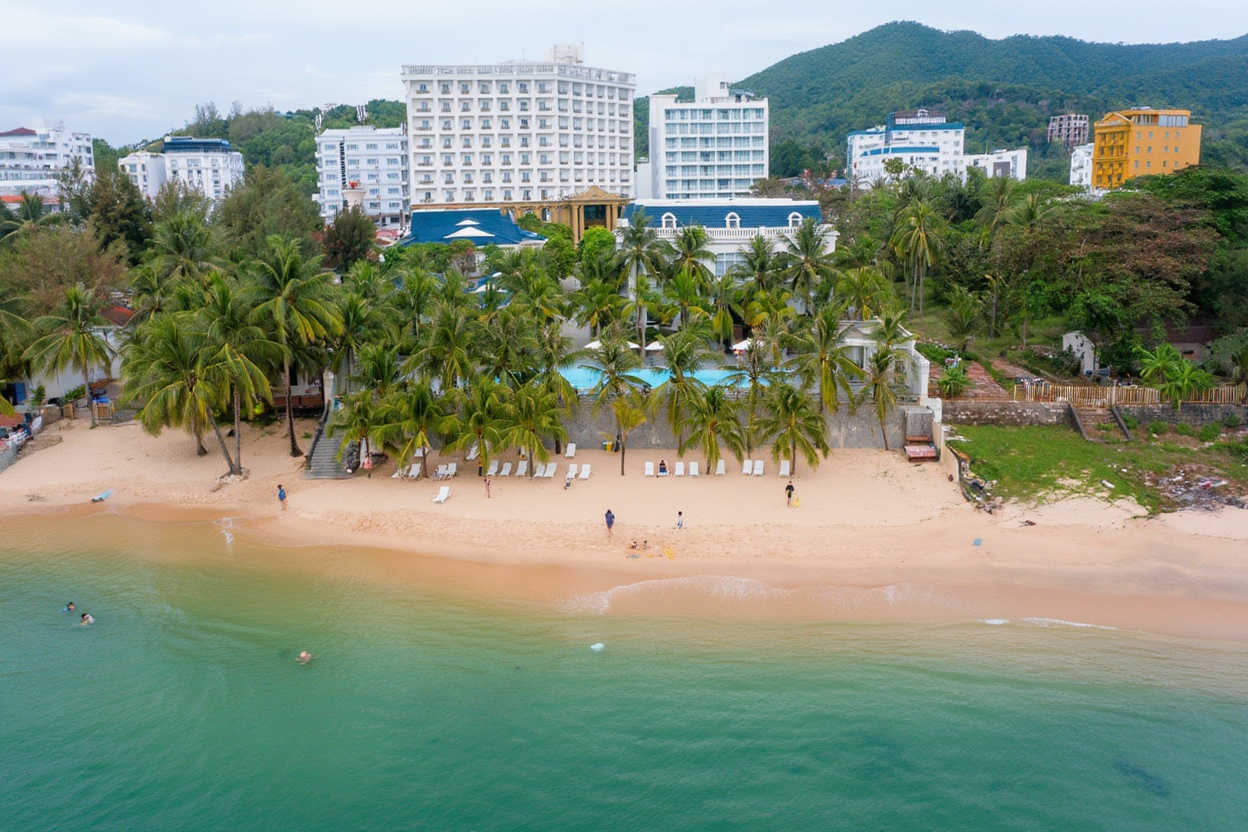
Ong Lang Beach is north of Phu Quoc town on the west coast — 14km, about 25 minutes by motorbike. It’s less developed than Long Beach but still has a cluster of mid-range resorts and guesthouses operating directly on the sand. The beach is shorter and rockier at the north end but the south section near the main road is clean and swimmable.
Ong Lang is the budget traveler’s beach — lower accommodation prices, fewer megaresorts, more Vietnamese families and independent travelers than the package-tour crowd. If you’re spending a week on the island and want to move away from Long Beach for a couple of nights without going all the way south, Ong Lang has enough to justify the ride.
Ganh Dau and the Northern Beaches
Ganh Dau is at the northern tip of the island — 30km from town, a 50-minute motorbike ride through the National Park. The beach is basic: brown sand, minimal facilities, the occasional fishing boat. What it offers is a view directly across the narrow strait to Cambodia — the Cambodian coastline is visible on clear days, close enough that you can make out individual trees.
The road to Ganh Dau through the National Park is good and passing through the National Park’s interior gives you the best sense of what Phu Quoc’s forest looks like before the resort development moved inland. Rare birds, fruit bats, and the occasional monitor lizard on the road. Worth doing as a half-day ride if you have time on the island.
The northeast coast beaches (Cua Can, Ham Ninh) are murky and not suitable for swimming — the water is brown year-round due to river outflow, and there’s very little sand. Ham Ninh village is worth a quick stop for the seafood restaurants on stilts over the water, but not for the beach.
The Jellyfish Question
Box jellyfish have been reported at Phu Quoc beaches intermittently, particularly in the wet season (May–September) and transitional months. This is not a constant threat — most trips will see zero jellyfish — but it’s worth knowing about.
The west coast beaches (Long Beach, Ong Lang) see jellyfish less frequently than the south and east coasts. Sao Beach occasionally has jellyfish warnings in May and October. Khem Beach is generally clear due to the sheltered bay. If you see warning signs or locals pointing at the water, treat it seriously — the local fishing community pays attention to jellyfish presence.
Practical: wear a rash guard for snorkelling regardless of season. If you get stung, the standard first aid is vinegar (acetic acid) on the sting — not freshwater, not urinating on it. Every resort beachside bar will have vinegar.
Snorkelling and Diving Off Phu Quoc
The best snorkelling around Phu Quoc is not from the main beaches — it’s from the offshore islands in the An Thoi archipelago (15 southern islands reachable by boat from An Thoi pier). These islands have coral reefs in significantly better condition than anything close to the main beach strip. Day trips run 350,000–600,000 VND per person (~$13–23) including snorkelling gear, boat, and usually a floating lunch.
Diving: 3–4 dive sites around the island with visibility up to 15m in dry season. The best diving season is November–May. Two-tank dive trips from the main operators: 1,200,000–2,000,000 VND (~$45–76). Phu Quoc Dive Centre and Rainbow Divers are the established operators. The reefs are not world-class — if you’re a serious diver, this is still worth doing but don’t compare it to Thailand’s Similan Islands.
What to Do When the Beach Isn’t an Option
Wet season (May–September): rough seas close most beaches for swimming at some point most days. The fallback activities: the fish sauce (nước mắm) factory tour in Duong Dong town (the barrels of fermenting anchovy paste smell like the island used to smell everywhere before the resorts arrived), the pepper plantation in the north (Khu Du Lich Suoi Tranh area), and the Night Market in Duong Dong town for seafood that’s cooked right in front of you from 5pm until midnight.
For the wider picture on what to do beyond beaches, see our Phu Quoc things to do guide.
Klook has the widest selection for Vietnam and is usually the cheapest. KKday is strong on day trips and local experiences.
gap between Phu Quoc beach photography and Phu Quoc beach reality is significant and worth being honest about before you book.
The photographs of Sao Beach show white sand, turquoise water, and perhaps three people visible in the entire frame. This is achievable — at 7am on a weekday in November. By 10am on a Saturday in January, the same beach has sunbeds end-to-end, the restaurant music is audible from the waterline, and the boat tours are anchoring offshore and putting groups in the water around you.
Khem Beach photographs look exclusive and pristine because the JW Marriott limits public access somewhat — the beach is naturally less crowded than Sao. But the resort architecture is highly visible from the water and the service-to-strangers ratio is, predictably, low outside the resort’s own operation.
None of this makes the beaches bad. It makes them what they are: resort beaches in a fully developed tourist destination, which are different from the empty tropical beach that lives in most people’s imagination of Vietnam.
The island’s less crowded beaches — Ganh Dau, the beaches accessible only by boat on the small southern islands — require effort. That effort (an extra motorbike ride, a boat trip, an earlier alarm) is exactly the filter that keeps them manageable. It’s the same principle as every good beach anywhere: the closer to the road, the more crowded.
Beach Infrastructure — What to Expect
Most Phu Quoc beaches have attendants renting sunbeds for 50,000–150,000 VND per day (~$1.90–5.70) depending on location. At Sao Beach the restaurants behind the beach provide free chairs if you buy something (a drink, lunch) — this is the standard arrangement. At Long Beach the resort-adjacent sections require you to be a guest or pay; the public access sections have independent operators setting up plastic chairs.
Toilets and showers: available at Sao and Khem beaches for free or a small fee (10,000–20,000 VND, ~$0.40–0.75). Long Beach relies on your resort facilities. Bring your own towel — beach towels are not standard equipment at most budget accommodation.
Food: Sao Beach has five or six seafood restaurants at the back of the beach, most with nearly identical menus. Grilled squid, steamed clams with lemongrass, crab in tamarind — prices are higher than town (a plate of clams: 150,000–200,000 VND vs 80,000–120,000 VND in Duong Dong market). You’re paying for the location. Not a scam, just the math of being on the best beach.
The Best Time of Day for Each Beach
Long Beach: Sunrise is the best time — the west-facing beach catches the glow on the water at 6–7am before the sun is fully up, the sky goes pale yellow, and the boats visible offshore are lit from behind. By 11am the sun is beating directly down with no shade on the beach itself (the resorts cut down most of the original shoreline trees when they built). Sunset is the reason most people are here — 5:30–6:30pm from November to March, the sun drops exactly over the Gulf horizon.
Sao Beach: 7–10am for swimming — the water is at its clearest and the crowds are minimal. Skip the noon–2pm window (too hot, too crowded). Return for the late afternoon 4–5:30pm period when the light is soft and the day-tripper tour groups have mostly left.
Khem Beach: Any time in dry season, but morning (8–11am) before it gets hot. The sheltered bay means flat water all day — good for families with young children any time of day. The afternoon light hits the beach differently than Sao — more direct, more reflective off the white sand.
What I Got Wrong About Phu Quoc Beaches
I made the mistake of spending most of my first trip on Long Beach because that’s where my guesthouse was. It’s fine — adequate for a morning swim, perfectly positioned for the sunset — but “fine” and “adequate” aren’t the words I came to an island to use.
The second visit: motorbike south to Sao Beach at 7:30am, arrived while the restaurant staff were still setting up, had the water almost to myself for 90 minutes. The sand was cleaner than I expected after all the Reddit complaints about the island. The water at that hour was genuinely turquoise — not the muddy blue of Long Beach after boat traffic starts. I understood why the photographs look the way they do.
The key: most Phu Quoc visitors stay on Long Beach and never ride to the south. The south coast beaches are not secrets, but they require 45 minutes each way that most package tourists don’t bother with. That small barrier is the entire difference between a crowded beach and a good one.
Two things worth sorting before you land: a Vietnam eSIM so you have data the moment you clear customs, and travel insurance — medical costs for uninsured foreigners in Vietnam are significant.
Airalo eSIMs activate instantly. Buy before departure — airport SIM queues in Vietnam can take 30+ minutes.
Frequently Asked Questions
What is the best beach in Phu Quoc?
Khem Beach for water quality and sand softness — it’s the most objectively excellent beach on the island. Sao Beach for the classic tropical beach aesthetic — the turquoise-and-white combination that appears in every Phu Quoc photo is real and worth seeing. Long Beach for convenience if you’re staying in the main resort area and just want to swim in the morning. The northeast coast is not worth visiting for swimming.
Is Phu Quoc beach water clear?
In dry season (November–April): yes, particularly at Sao Beach and Khem Beach — turquoise to clear blue, visibility 3–4 meters. Long Beach is slightly murkier due to boat traffic and resort runoff. After heavy rain any beach can turn murky for 24–48 hours. In wet season (May–September): choppier, less clear, some jellyfish risk on south-coast beaches.
What months should I avoid Phu Quoc beaches?
May to September is wet season — heavy rain, rough seas, and reduced beach swimming options. The west coast beaches (Long Beach, Ong Lang) are less affected than the south coast during the monsoon, but jellyfish risk increases across all beaches from May to October. The island itself stays open and operational year-round — restaurants, activities, and accommodation all function normally — but if the beach is your primary reason for visiting, November to April is the correct window. December to February is peak season with the best weather but also the most tourists and highest prices.
Is Phu Quoc safe for solo female travelers?
Yes — Phu Quoc is one of the safer island destinations in Southeast Asia for solo female travelers. The resort infrastructure means there are always people around, taxis and Grab operate 24 hours, and the beach areas are well-lit in peak season. The main precautions are the same as anywhere in Vietnam: keep an eye on your belongings at the beach, avoid deserted roads late at night, and use Grab rather than unmetered taxis for late rides back from the Night Market. The biggest practical risk is motorbike accidents on roads that are less well-maintained in the south of the island — wear a helmet (they are always provided with rentals) and reduce speed on gravel sections.
Is Phu Quoc still worth visiting despite overdevelopment?
Yes — for the beaches specifically. The resort overdevelopment is real and the Reddit community’s complaints are valid: “rubbish everywhere, fake and empty buildings” (martinnov92, r/VietNam) and “very overpriced, overcrowded and poor service” (Training-Pollution66, r/VietNam) are not wrong descriptions of certain parts of the island. But Sao Beach and Khem Beach are genuinely good by any regional standard. The island as a cultural destination is diminished; as a beach destination it still earns the visit, particularly for families and people who haven’t been to Thailand or the Philippines yet. Manage expectations — you’re going for the water, not the island experience.
Are Phu Quoc beaches good for families with young children?
Khem Beach is the best family option — the sheltered bay means minimal wave action, the water is shallow for 30–40 meters from the shoreline, and the sand is the finest on the island (no rough shells or pebbles underfoot). Long Beach is acceptable for small children in the mornings before the beach gets hot. Avoid Sao Beach for toddlers in peak season — it’s busy and the sun chairs make monitoring a small child more difficult. Most resort beaches on Long Beach have shallow entry points and lifeguards on duty in peak season.
How do I get from Phu Quoc town to Sao Beach?
Motorbike: 45 minutes on the inland road through pepper plantations. Rental 150,000–200,000 VND/day (~$5.70–7.60). Taxi: 300,000–400,000 VND one-way (~$11–15). Grab operates on Phu Quoc — use the app for the most accurate pricing. No public bus service to Sao Beach.
FAQ
What is the best beach in Phu Quoc?
Sao Beach (Bai Sao) on the southeast coast: white sand, clear water, relatively uncrowded on weekdays. Ong Lang Beach on the west coast: calmer water, shaded by casuarina trees, good for swimming year-round, surrounded by mid-range resorts rather than mega-resort infrastructure. Long Beach (Tran Hung Dao Street strip) is the main tourist area — better facilities but more crowded and less pristine.
Which Phu Quoc beaches are best for swimming?
The west coast beaches (Long Beach, Ong Lang) have calmer water protected from the open ocean. The east coast (Sao Beach) is more exposed but still swimmable except during heavy monsoon. The north coast near Ganh Dau has the clearest water but requires a motorbike to reach. Avoid swimming at beaches near the ferry terminals and Duong Dong town center.
Are Phu Quoc beaches crowded?
Long Beach and the resort strip near Duong Dong are crowded year-round, especially Dec–March. Sao Beach gets tour buses by 10 AM from October to March. For quieter beaches: Ong Lang (north of Long Beach), Cua Can Beach (near the north ferry terminal), and Ganh Dau (very north tip). Go early — most beaches are quiet before 9 AM.
Are the beaches in Phu Quoc clean?
Mixed — northern and east coast beaches are generally cleaner. Long Beach and beaches near the main tourist areas have litter issues, partly from ocean plastic and partly from tourism pressure. Sao Beach is kept cleaner because it has a resort presence managing the immediate sand area. Overall Phu Quoc beaches are cleaner than mainland coastal Vietnam.
How do you get to the beaches in Phu Quoc?
Rent a motorbike (120,000–180,000 VND/day) — this is the best way to access the full island. Grab works on the island but surge pricing applies to remote beaches. Resorts on Long Beach are within walking distance of the main street. For Sao Beach, it’s 25km from Duong Dong — motorbike is easiest. Taxis exist but are expensive relative to motorbike.