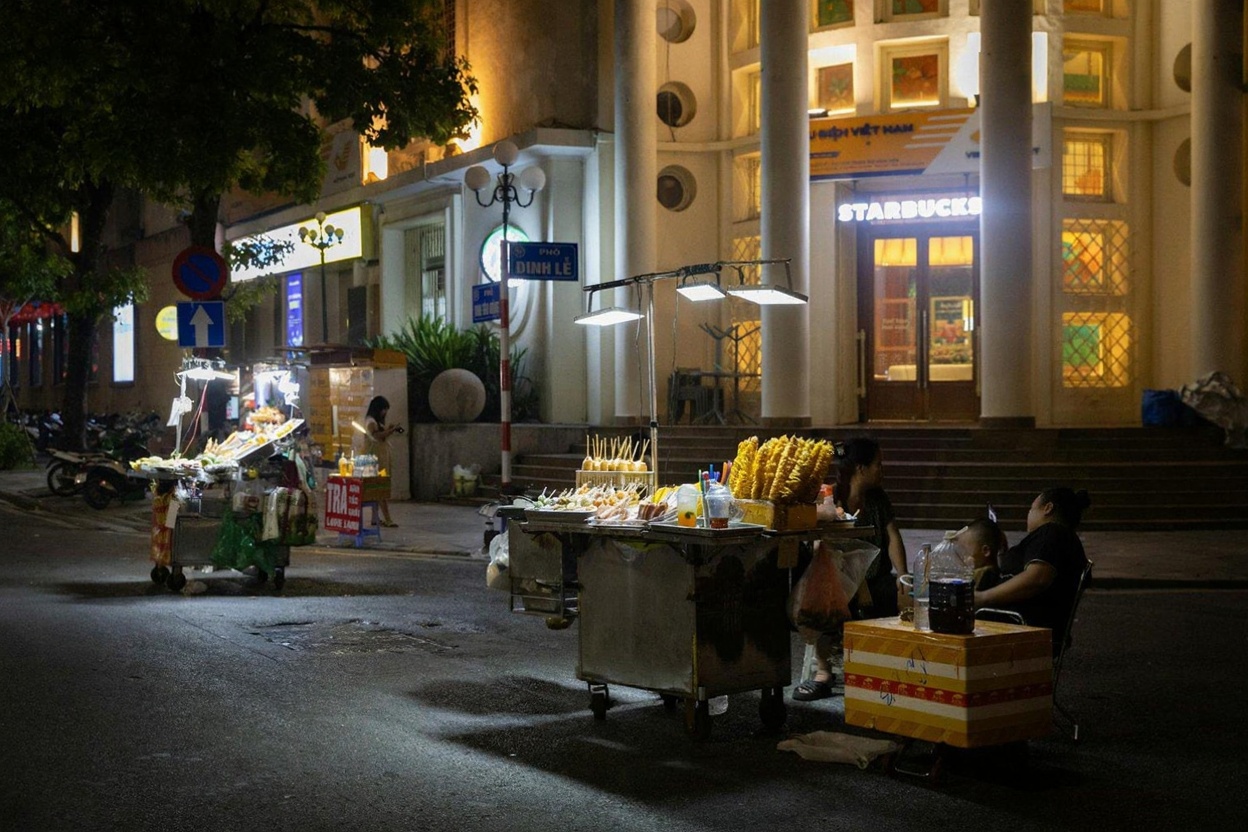
Every first-timer in Hanoi ends up at the night market. There’s a section of the Old Quarter that gets closed to traffic on Friday and Saturday and Sunday evenings, and suddenly the streets fill with stalls selling clothes, souvenirs, mini LEGO sets, phone cases, silk scarves, and enough fake brand-name merch to stock a swap meet. Vendors call out. The smell of grilled corn and bánh tráng nướng drifts down the alley. Backpackers bargain aggressively over 50,000 VND items.
It’s a decent market. It’s not a great market. And the best thing about it isn’t the shopping — it’s the fact that it dumps you into the most interesting neighborhood in Hanoi at exactly the right time of night.
Here’s how to do it right.
Hanoi Night Market — Quick Facts
| When | Friday, Saturday, Sunday — 6pm to 11pm |
| Location | Hàng Đào → Hàng Ngang → Đồng Xuân, Hoàn Kiếm District |
| Entry fee | Free |
| Payment | Cash only at almost all stalls |
| Peak hours | 7pm–10pm |
| Best for | Souvenirs, cheap clothes, street food, atmosphere |
| Bargaining | Yes — but not at all stalls, and prices are already tourist-marked up |
| Nearby | Hoàn Kiếm Lake, Ta Hien Street (Beer Street), Bia Hoi Corner |
| Combine with | Dinner at a market food stall + drinks on Ta Hien after |
What the Night Market Actually Is
> **Quick Answer:** A weekend pedestrian market in the Old Quarter, running Friday–Sunday from 6–11pm. About 1km of stalls selling souvenirs, clothing, and street food along Hàng Đào and Đồng Xuân. Free to enter, cash only, prices are tourist-level. Best used as a combination of light shopping and gateway into the neighborhood’s nightlife.
The Hanoi Night Market is not a traditional market. It’s not where Hanoians shop. It’s a weekly tourist event that happens to be well-organized and reasonably atmospheric — the Old Quarter streets are closed to motorbikes, stalls are set up in rows down the center of the road, and foot traffic flows along the sides.
What you’ll find: reproduction lacquerware, silk scarves of variable quality, T-shirts that say “Vietnam” in fifty variations, conical hats, sandals, knock-off North Face and Supreme clothing, local tea, embroidered linen, dried mango and spiced cashews, and — a particular favorite of budget travelers — small LEGO-compatible brick sets that cost 100,000–200,000 VND and will occupy your next two evenings. One Filipino traveler posted in r/VietNam about spending 150,000 VND (~$6) on one: “The seller said I’d finish it in 8 hours… took me way longer, but totally worth it.”
What you won’t find: bargain prices if you’re used to Dong Xuan during the day, authentic handcraft directly from the maker, or anything you couldn’t also find on the surrounding streets. The night market is the convenience layer — same goods as the permanent shops, lower overhead per stall, and the atmosphere of a block party thrown on a commercial street.
Getting There
> **Quick Answer:** The market runs along Hàng Đào from Hồ Hoàn Kiếm (Sword Lake) north to Đồng Xuân Market. Start at the lake end — it’s the most scenic entry point. From most Old Quarter accommodations, you’re walking distance. Grab from Hoan Kiem area: 40,000–60,000 VND.
The market occupies a single main corridor: Hàng Đào → Hàng Ngang → Hàng Đường → Đồng Xuân, which is roughly 1.2km of pedestrianized street. The natural entry is from Hồ Hoàn Kiếm — the lake is lit at night, the weekend crowd around it is huge, and walking north from the lake’s northern tip drops you straight into the market’s southern end.
12Go covers most Vietnam routes — sleeper buses, trains, and island ferries. Compare schedules and book in advance during peak season (Dec–Feb, Jun–Aug).
The roads immediately surrounding the market — Đinh Tiên Hoàng, Lê Thái Tổ, the lanes off Hàng Bạc — fill with honking motorbikes looking for detours, so give yourself extra time if you’re coming by Grab. Drop-off works best on Đinh Tiên Hoàng on the lake’s east side, then walk across to the market entrance.
If you’re staying in the Old Quarter, you’re probably already within a five-minute walk. The market’s entire catchment area is navigable on foot from the Hoan Kiem lakeside.
What to Actually Buy (and What to Skip)
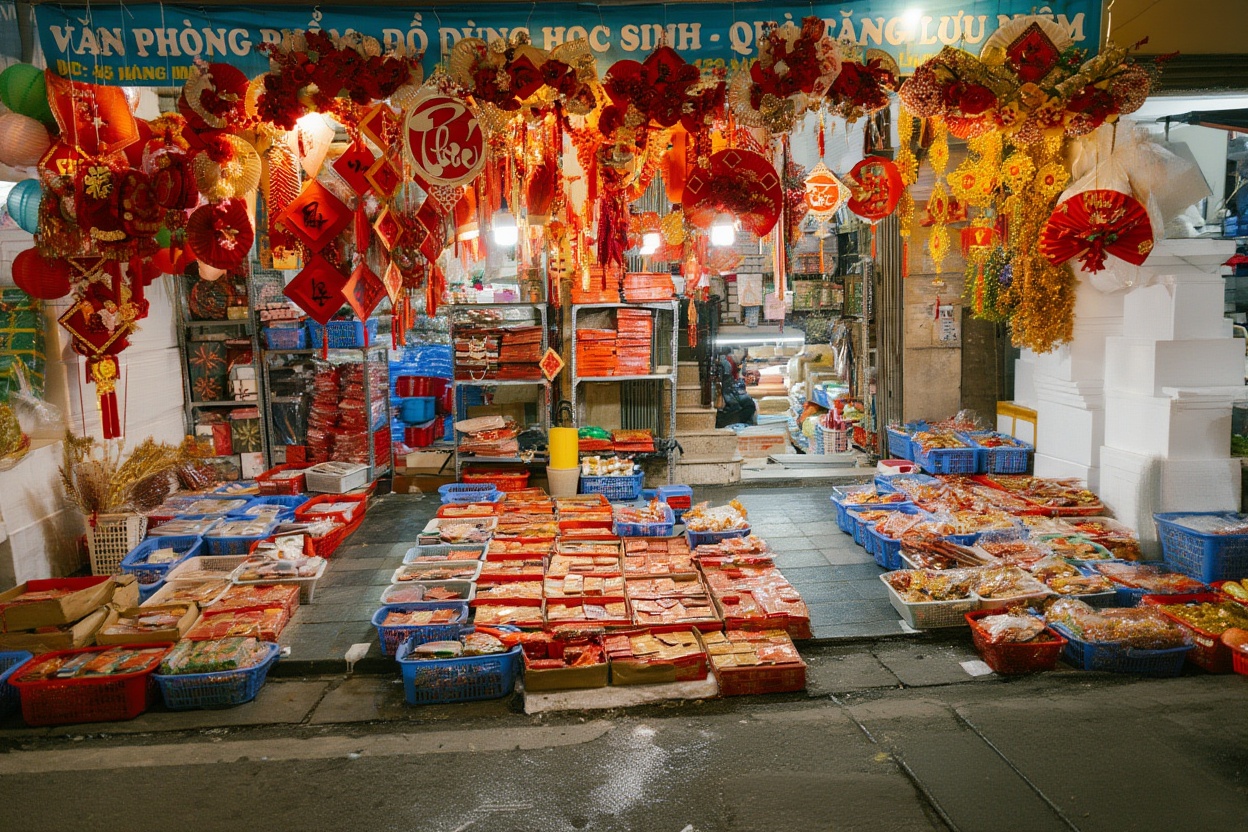
I’ll be direct: most of what’s sold at the night market you can get cheaper at Đồng Xuân Market during the day, or from the permanent shops on Hàng Gai and Hàng Trống. The night market runs on convenience and atmosphere, not price advantage.
That said, some things are worth picking up:
Dried fruit and snacks: The dried mango, jackfruit, and mixed nut stalls near Đồng Xuân end are genuinely good. Prices: 80,000–150,000 VND per 500g bag. Taste before buying — some stalls are much better than others, and vendors generally let you sample.
Simple linen and cotton clothing: The loose linen pants, plain T-shirts, and cotton dresses are reasonably priced (80,000–200,000 VND) and hold up. Check the stitching. The “branded” versions of the same items — North Face, Patagonia, anything with a logo — are fakes and not worth the money.
Lacquerware trinkets: Small bowls, chopstick sets, keychains — fine as gifts, priced 30,000–150,000 VND. The higher-end lacquerware (the pieces that are actually hand-painted by artisans) is not at the night market. It’s in the specialty shops on Hàng Khai.
Knock-off brand clothing: Not worth it. The quality is inconsistent, the sizing runs Vietnamese (not Western), and you’ll find yourself carrying a hoodie for three weeks that starts peeling by week two.
Silk: Buying silk at the night market is fine for scarves at 80,000–150,000 VND, but don’t buy anything you plan to use seriously. The Hàng Gai silk shops have better quality at not-much-higher prices, and the shops will actually be accountable if something’s wrong.
Bargaining: How It Works Here
This is the part most guides get wrong: not all night market vendors bargain, and going in hard at every stall will waste your time and annoy people.
The rule of thumb: stalls with no price tags → expect bargaining. Stalls with price tags → the price is the price, though you can sometimes get a small discount on multiple items. Stalls selling food → fixed price, no bargaining.
On bargaining stalls, the first price quoted to a foreign face typically runs 50–100% above where the vendor will comfortably land. Opening at half the asking price is normal. Walking away is the most effective negotiating tactic — if the vendor calls you back, you have room to move. If they don’t, the price was real.
One TripAdvisor reviewer put it plainly: “You must bargain a lot and not hope for anything authentic.” That’s accurate and not a complaint — it’s just what the night market is. The vendor knows it’s a tourist market. You know it’s a tourist market. The transaction works fine as long as both parties understand the game.
Critically: don’t bargain so hard that you’re negotiating over 10,000 VND (about $0.40). The vendors are running small businesses on low margins. If you got to a price that feels fair, it is fair.
When to Go (and What Peak Hours Feel Like)
> **Quick Answer:** Arrive at 6:30–7pm to see the market before it hits full density. By 8pm on Saturday it is genuinely, chest-to-back crowded. If crowds bother you, Sunday evening is slightly lighter than Saturday.
The market technically opens at 6pm, but the setup isn’t complete until 6:30 and the real energy doesn’t arrive until 7. Between 7 and 10pm on Friday and Saturday, Hàng Đào is thick with people. Not uncomfortably — the street is wide enough for flow — but the side passages between stalls and the narrow alleys off the main corridor genuinely congest.
TripAdvisor reviewers describe it: “A district of the old town is corralled off to all but foot traffic, which makes the area around the night market a chaos of pedestrians, cars and motorcycles.” And: “There are crowds, especially as the two side passages are not very wide.” These aren’t complaints so much as accurate descriptions of what any large pedestrian market feels like at peak hours.
By 10:30pm the stalls start packing up. If you want to see the market and then continue into the neighborhood’s nightlife, arrival at 6:30–7pm gives you time to walk the full corridor, eat something, buy what you’re buying, and be done by 9 — when the bars around Ta Hien are hitting their stride.
The Food at the Night Market
The food stalls are better than the shopping stalls. Specifically:
Bánh tráng nướng (grilled rice paper with egg, spring onion, and dried shrimp): 20,000–30,000 VND. One of those things that makes more sense at 8pm in a crowded street than anywhere else.
Grilled corn (ngô nướng): 20,000–30,000 VND, brushed with butter and chili salt. The smoke from the charcoal hits you half a block away.
Chè (sweet dessert soups): Several stalls near Đồng Xuân sell chè ba màu (three-color dessert) and chè đậu xanh (mung bean). 20,000–40,000 VND per cup, served in plastic cups with ice.
Bún bò Huế and phở: There are proper sit-down food stalls at the Đồng Xuân end of the market. These are not tourist traps — they’re serving the people working the stalls. Bowls run 40,000–70,000 VND.
If you want a proper dinner, the streets adjacent to the market corridor (especially the lanes off Hàng Bạc and Hàng Ngang) have the kind of plastic-stool spots that don’t mark up for market traffic. Our Hanoi street food guide covers the specific spots worth finding.
What to Do After the Market
This is the real value proposition of the night market: it’s a built-in warm-up for the best part of the evening.
Ta Hien Street (Beer Street): Two blocks east of the market corridor, Ta Hien is where Hanoi’s nightlife concentrates. A narrow street with bars running the full length on both sides, plastic tables in the road, cheap Bia Hà Nội and Tiger, and a mix of locals, expats, and travelers. Bottles: 20,000–35,000 VND. A TripAdvisor reviewer recommended it directly: “Cap off your evening at one of the adjacent bars, preferably one with a balcony overlooking the hustle and bustle below.”
Klook has the widest selection for Vietnam and is usually the cheapest. KKday is strong on day trips and local experiences.
): The famous bia hoi intersection — freshly brewed draft beer at 7,000–15,000 VND per glass, plastic stools on the sidewalk, maximum chaos. This is technically part of the Old Quarter nightlife system but runs independently of the market. At 9pm on a Saturday, it’s standing room only. Lương Văn Can and the surrounding blocks have more of the same.
Hồ Hoàn Kiếm night walk: After the market, walking the full circumference of Sword Lake at night is one of those free Hanoi experiences that lands harder than most paid activities. The Turtle Tower is lit. The Thê Húc Bridge is red. The weekend nights around the lake are full of Hanoians running, stretching, playing badminton, and taking photos — the city being a city, not performing for tourists. Takes 25–30 minutes at a slow pace.
The Night Market vs Đồng Xuân During the Day
This is the comparison worth making if you’re actually shopping rather than atmosphere-absorbing.
Đồng Xuân Market — the permanent covered market at the northern end of the night market corridor — is open daily from around 6am to 6pm. It sells almost everything the night market sells, plus wholesale goods, fresh produce, raw fabric, and the kind of practical merchandise that locals actually buy. Prices are lower. The atmosphere is more functional and less theatrical.
The night market adds: pedestrian streets, evening food stalls, ambient energy, and the convenience of everything being in one strip. It subtracts: the interesting wholesale and fresh sections of Đồng Xuân, daytime light for evaluating fabric and colors, and the price advantage of buying without tourist markup.
If you’re buying meaningful quantities — fabric, multiple items of clothing, gifts for people back home — go to Đồng Xuân during the day and bargain there. If you want an evening walk with some shopping on the side, the night market is the right call. Our Hanoi markets guide covers Đồng Xuân, Hàng Da, and the other non-tourist market options in detail.
The Old Quarter on Weekends: More Than Just the Market
The market is the anchor, but the bigger story is what happens to the whole Old Quarter on weekend evenings. Beyond the market corridor, the streets around Hồ Hoàn Kiếm also partially pedestrianize on Friday, Saturday, and Sunday nights — which means a section of central Hanoi becomes, effectively, a car-free zone where the city comes out to play.
The vibe around the lake is different from the market: locals circle the water on foot, kids on bikes weave through the promenaders, families stake out benches and share bags of chips and bubble tea. Street performers set up near the Thê Húc Bridge. On a warm Saturday, the scene from the southern tip of the lake — the market lights to the north, the Turtle Tower lit in the center, the street food vendors on the east bank — is the closest thing Hanoi has to a city square moment.
The practical upside: even if the market shopping doesn’t interest you, the weekend pedestrian zone justifies the trip. You can walk from Hoan Kiem around to the Ngọc Sơn Temple side, north through the market to Đồng Xuân, then back through the lanes of Hàng Bạc and Hàng Mắm to complete a loose circuit of the best-lit, most walkable part of the Old Quarter. Takes about 90 minutes at a slow pace. Free. The best orientation to Hanoi’s historic center you’ll find. For everything else about the city, our Hanoi travel guide has the full picture.
Is the Night Market Worth It?
> **Quick Answer:** Yes, once. It’s a good introduction to the Old Quarter at night — the energy is real even if the shopping is tourist-grade. Come for the atmosphere and the food, not for deals you can’t find anywhere else.
My honest take after five years in Hanoi: I’ve stopped browsing the night market, but I still end up walking through it regularly because it’s in the middle of the neighborhood I’m going to anyway.
The first time, it’s genuinely fun. The stalls glow, the crowds are lively, the grilled corn smells good, and everything is cheap enough that buying a silk scarf you don’t need feels like a reasonable decision. After that, the novelty wears off and you either go because you’re meeting someone there or because it’s the most convenient route from Hoàn Kiếm to Beer Street.
For first-time visitors, the night market is worth an hour of your evening. Don’t dedicate a whole night to it — use it as the first act of a bigger Old Quarter evening that ends on Ta Hien or at a rooftop bar somewhere around Hàng Bông. See our full Hanoi things to do guide for the complete evening routing.
Practical Info
Hanoi Night Market — At a Glance
| Item | Details |
|---|---|
| Days | Friday, Saturday, Sunday only |
| Hours | 6pm–11pm (peak: 7–10pm) |
| Entry | Free |
| Payment | Cash (VND). Most stalls don’t take card. |
| ATM nearby | Multiple on Đinh Tiên Hoàng lakeside — note ~3% fee per transaction |
| What to buy | Snacks, simple linen clothes, souvenir trinkets |
| What to skip | Fake branded gear, high-end silk, anything priced without room to bargain |
| Bargaining | On unpriced items only. Start at 50% of asking price. |
| Best food stalls | Bánh tráng nướng, grilled corn, chè — all 20,000–40,000 VND |
| After the market | Ta Hien Street (Beer Street), Bia Hoi Corner, Hoan Kiem lake walk |
Two things worth sorting before you land: a Vietnam eSIM so you have data the moment you clear customs, and travel insurance — medical costs for uninsured foreigners in Vietnam are significant.
Airalo eSIMs activate instantly. Buy before departure — airport SIM queues in Vietnam can take 30+ minutes.
FAQ
What days is the Hanoi Night Market open?
Friday, Saturday, and Sunday evenings only — 6pm to 11pm. It does not operate Monday through Thursday. If you’re in Hanoi on a weekday, the permanent Đồng Xuân Market is open daily until about 6pm and sells similar goods.
Is the Hanoi Night Market free?
Yes — free to enter and walk through. You only spend money if you buy something. Cash only at almost all stalls.
Where exactly is the Hanoi Night Market?
It runs along Hàng Đào → Hàng Ngang → Hàng Đường → Đồng Xuân, in the Hoàn Kiếm district of the Old Quarter. The southern entry is near the northern tip of Hồ Hoàn Kiếm (Sword Lake). You can walk the full length in about 20 minutes without stopping.
Can you bargain at the Hanoi Night Market?
At most stalls, yes — especially those without price tags. Starting at about half the initial quote is normal. Stalls with fixed price tags are usually serious about those prices, though you can sometimes negotiate a small discount on multiple items. Food stalls have fixed prices.
Is the Hanoi Night Market safe?
Generally yes. Standard precautions apply: keep your phone in a front pocket or bag in dense crowd sections, don’t flash large amounts of cash. Pickpocketing can happen in any crowded market environment. The market itself has no reputation for scams beyond normal tourist-price markups. Solo travelers and couples both navigate it without issue — the crowd density actually makes it feel safer than quieter streets.
What’s better — the Hanoi Night Market or Đồng Xuân Market?
Different purposes. Đồng Xuân during the day has lower prices, more selection, and a more local atmosphere — better for actual shopping. The night market has atmosphere and evening food — better as an activity. If you’re in Hanoi for more than two nights, do both.
Hanoi Night Market — Cheat Sheet
| ✅ Fri/Sat/Sun 6–11pm only | ✅ Start at the Hoan Kiem end (southern entry) |
| ✅ Bring cash (VND) | ✅ Bargain on unpriced items — start at 50% |
| ✅ Best food: bánh tráng nướng, corn, chè | ✅ End the night on Ta Hien Street |
| ❌ Don’t buy fake branded gear | ❌ Don’t bargain over 10,000 VND differences |
| ❌ Not open weekdays | ❌ For serious shopping, go to Đồng Xuân during the day |