Last updated: May 2026 — Permit requirements, motorbike rental prices, and loop regulations verified.
The road drops so fast your stomach doesn’t follow.
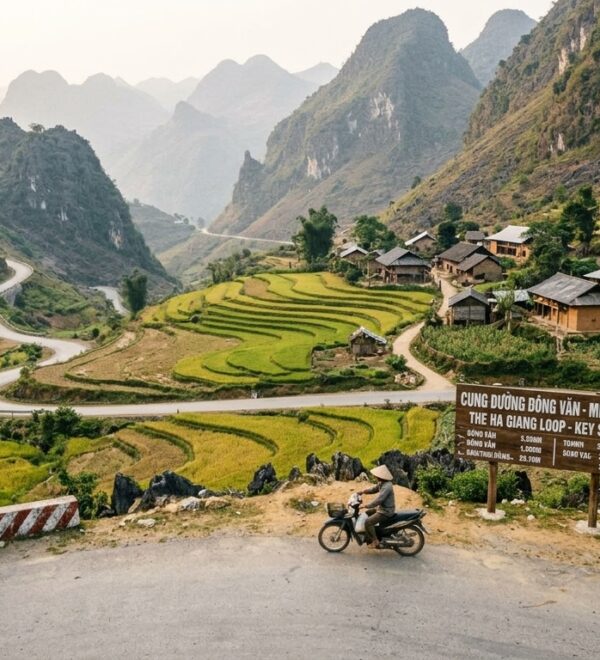
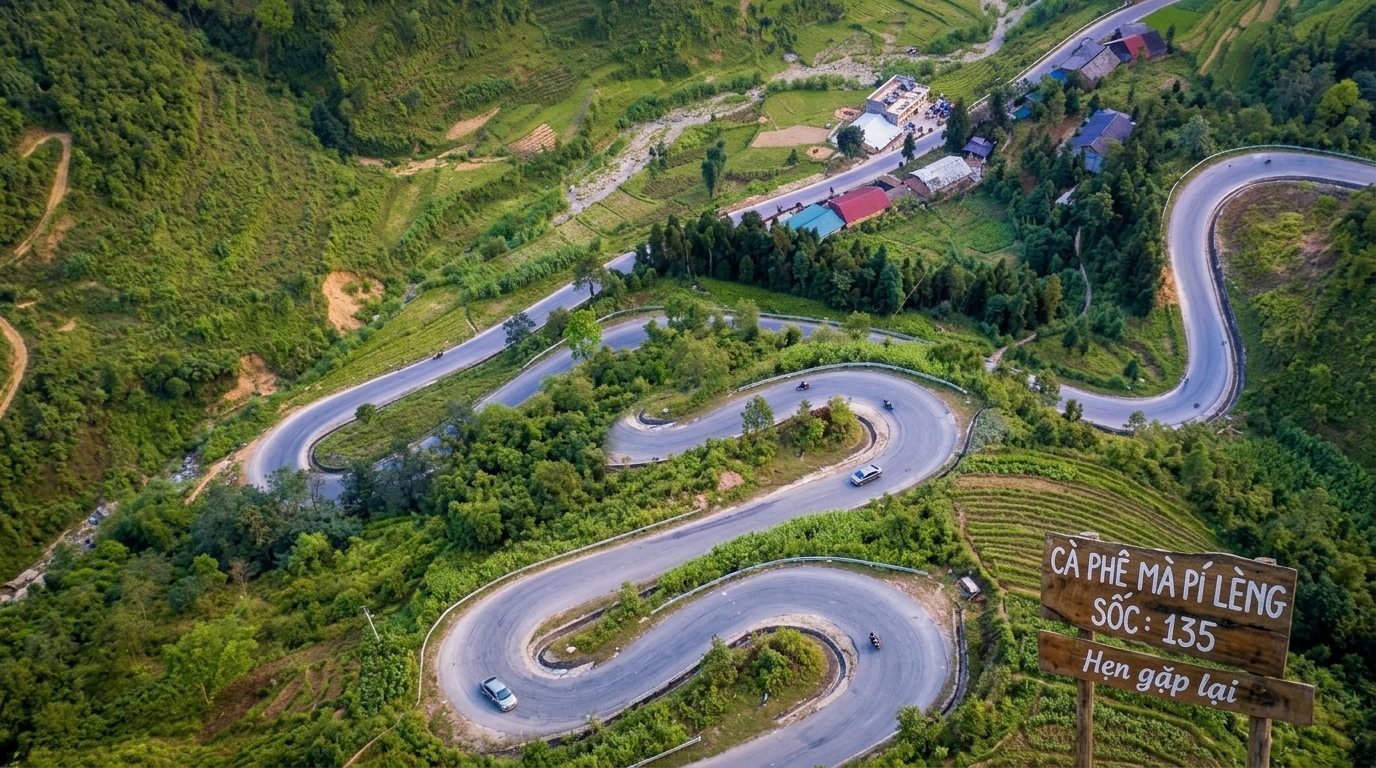
One minute you’re looking at a valley that appears to be from another planet — limestone karst teeth punching through cloud, terraced fields in shades of green you couldn’t name — and the next you’re leaning hard into a switchback with nothing but air on your left and rock wall on your right. Your hands tighten. Your brain catches up. This is Ma Pi Leng.
I’ve done the Ha Giang Loop four times. The first time I had no idea what I was doing. The second time a police officer pulled me over and I handed him my driver’s license and watched his expression make it very clear that what I’d handed him was entirely the wrong document. The third and fourth times I got it right. Not sure about handling the roads yourself? Our Ha Giang jeep tour breakdown covers what’s actually included, honest driver quality notes, and whether the extra cost is worth it.
This guide is everything I’ve learned — including the mistakes. If you’re planning to ride Ha Giang, read this before you book anything.
Is the Ha Giang Loop Worth the Hype?
Short answer: yes, with one condition.
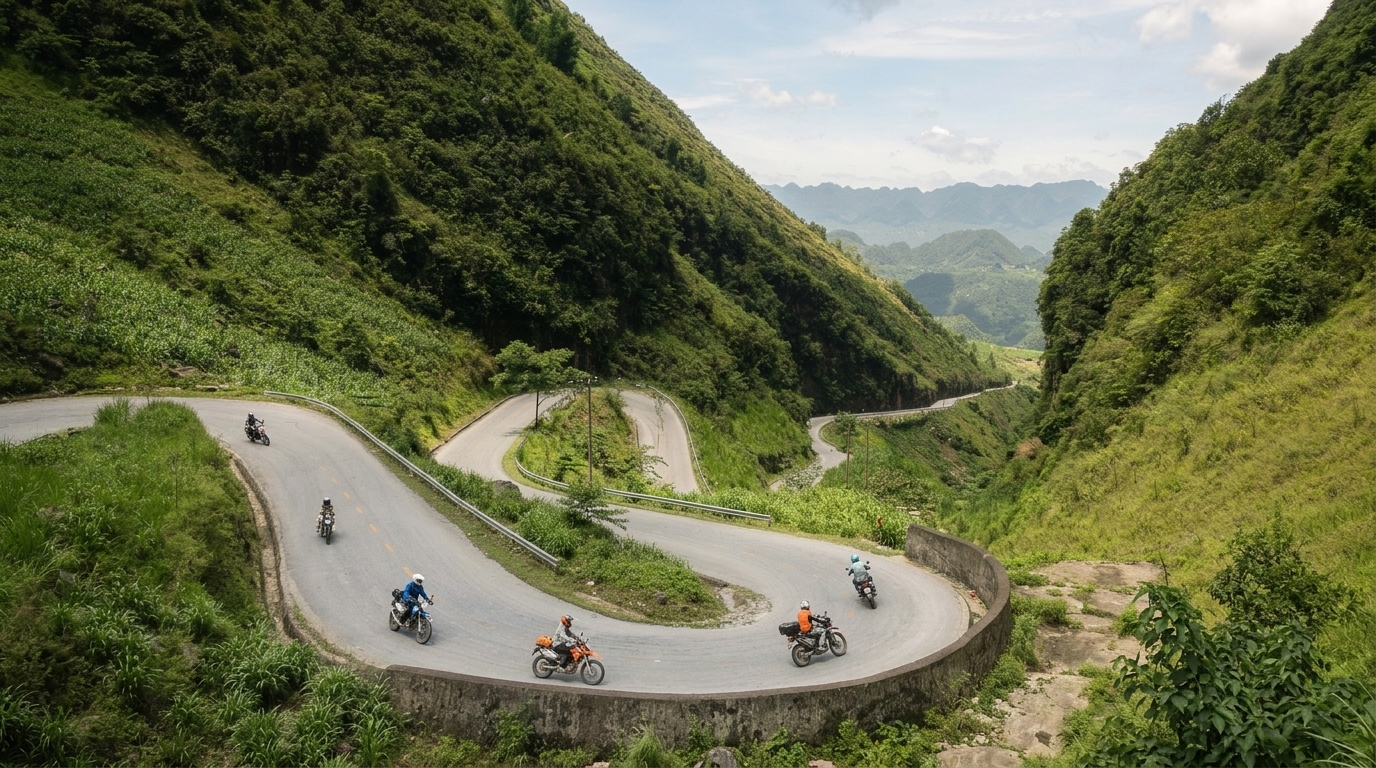
Ha Giang is genuinely unlike anything else in Southeast Asia. The scale of the Dong Van Karst Plateau — a UNESCO Global Geopark — doesn’t translate in photos. You have to be on the road, winding through canyon walls that dwarf you, to understand why people come here and immediately plan to come back.
The condition: you have to go prepared. The loop rewards people who’ve done the homework. It punishes people who wing it — with crashes, fines, or a scam that ruins the whole trip.
⚠Real Talk
Ha Giang has changed significantly since 2019. The Dong Van Sunday market is now ringed with tourist restaurants and souvenir shops. Pho Bao village feels staged for cameras. The road to Lung Cu Flag Tower got paved, which cut travel time by 30% and the sense of adventure by about the same. It’s still extraordinary. Just go in with updated expectations.
The best version of the Ha Giang Loop is still available to you. It just requires getting off the main track at a few key points — which I’ll tell you exactly where.
The Ha Giang Permit — Get This Right Before You Leave the City
Here’s where most guides bury the important thing. The permit is not optional.
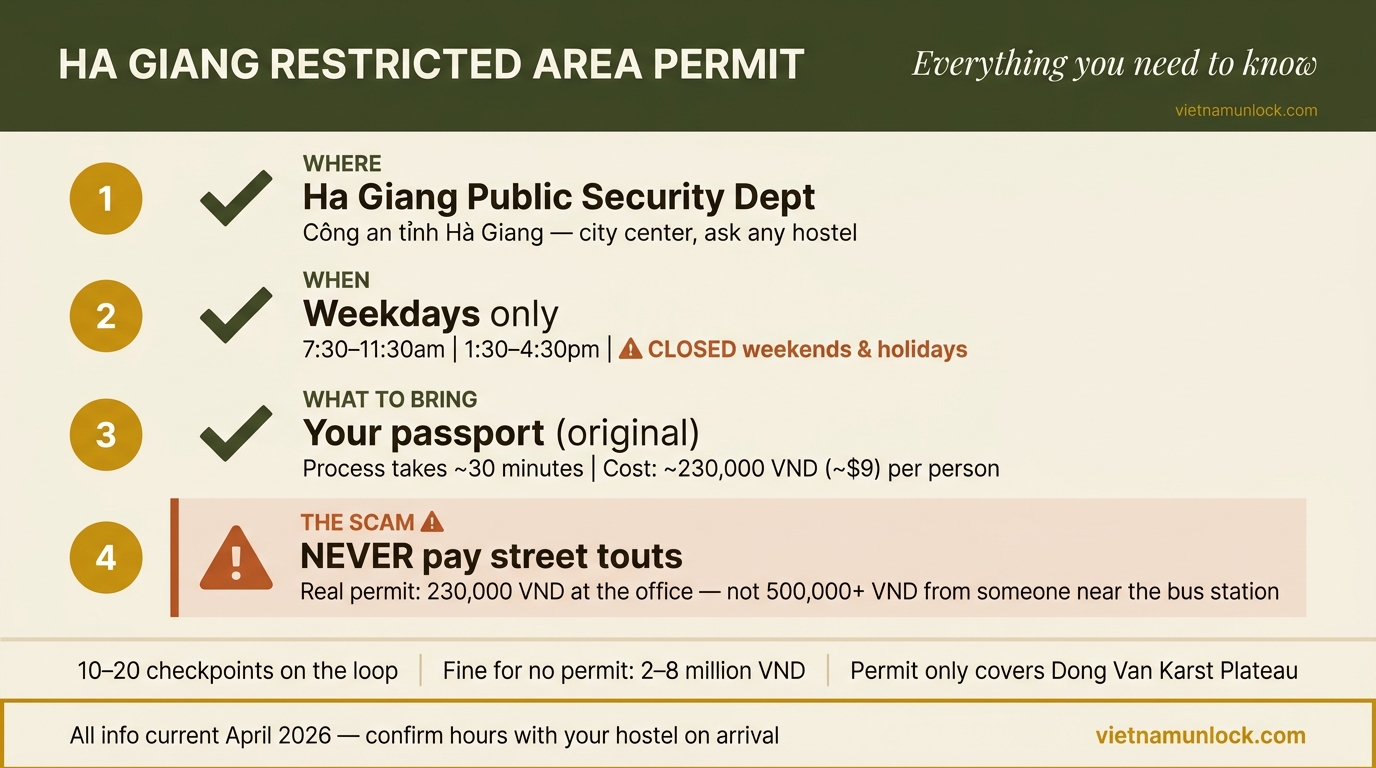
Foreign visitors need a restricted area permit to enter Dong Van Karst Plateau — the core of the loop. The permit costs approximately 230,000 VND (~$9) per person and must be obtained at the Ha Giang police office before you leave the city. Bring your passport. The process takes about 30 minutes, sometimes less.
ℹKnow Before You Go
The permit office is at the Ha Giang Public Security Department (Công an tỉnh Hà Giang), typically open 7:30–11:30am and 1:30–4:30pm weekdays. Go first thing in the morning on the day you arrive. Don’t arrive on a weekend expecting to sort this out — it’s closed.
Your hostel or motorbike rental shop can usually tell you exactly where to go. They send people there every day.
Now, the scam to avoid: people near the bus station or on the street offering to “help” you get your permit for 500,000 VND or more. They’ll produce a piece of paper. It will look real. It will not be real. The police checkpoints will tell you exactly how real it is — there are 10 to 20 of them across the full loop.
Get the permit yourself. It’s a 30-minute admin task.
Getting from Hanoi to Ha Giang
There’s one serious option: overnight sleeper bus. The journey is 6–7 hours.
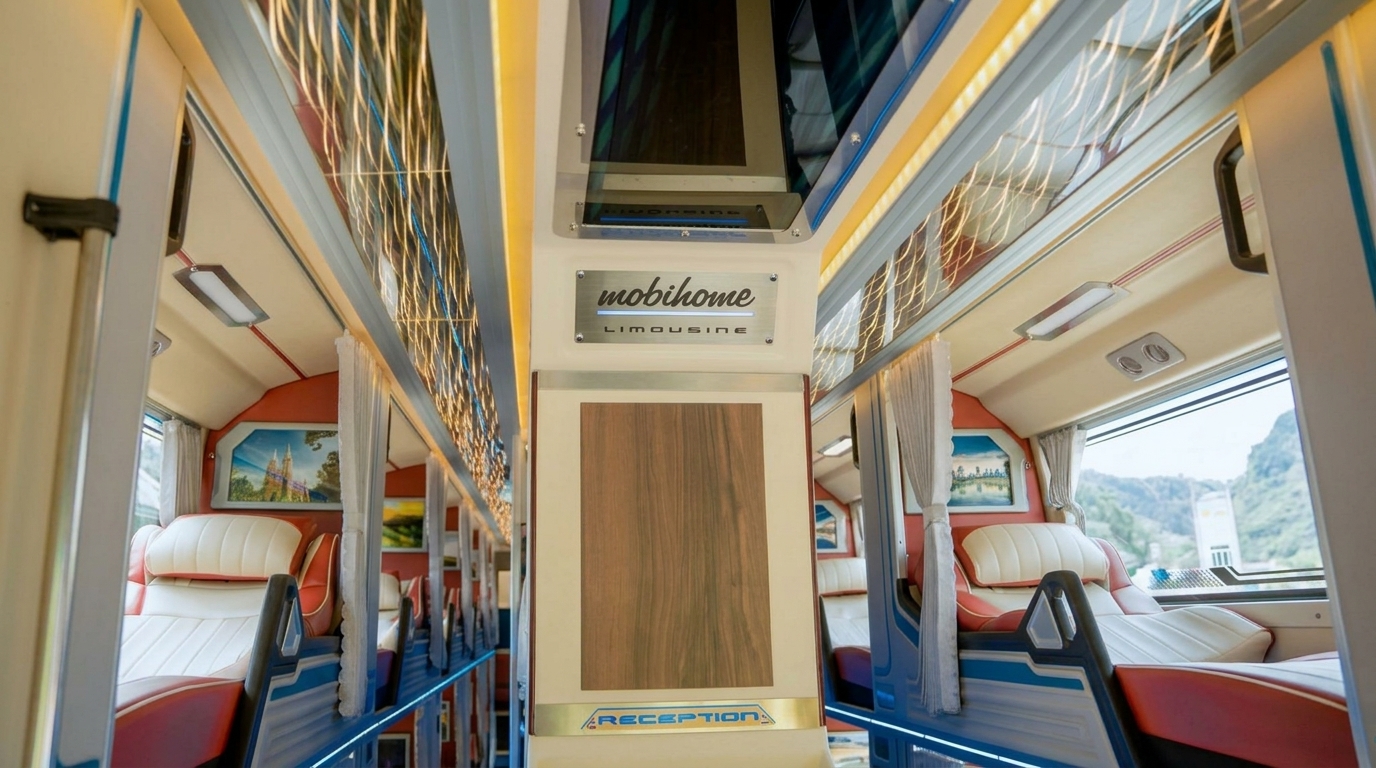
Reputable operators in 2026: Bằng Phấn, Quang Tuyến, Mạnh Quân. If you’re coming from Hanoi’s Old Quarter, Good Morning Cat Ba runs directly from the backpacker area. Fares run 300,000–550,000 VND ($12–22) for standard berths, up to 600,000 VND for VIP double cabins.
12Go covers most Vietnam routes — sleeper buses, trains, and island ferries. Compare schedules and book in advance during peak season (Dec–Feb, Jun–Aug).
The overnight buses depart around 20:30–22:30 and arrive in Ha Giang at 4:00–5:00am. Book on Vexere or RedBus and request a lower berth (tầng 1) if the road motion bothers you — the mountain roads on the Ha Giang side of the journey can be rough, and upper berths amplify every curve.
Arriving at 4am means you wait for daylight before doing anything. Ha Giang City has 24-hour conveniences, and most hostels will let you drop your bag even if your room isn’t ready.
✓Quick Answer
The overnight bus from Hanoi to Ha Giang costs 300,000–550,000 VND ($12–22), takes 6–7 hours, and departs from Mỹ Đình bus station or Old Quarter pickup points. Book on Vexere in advance.
Motorbike vs Easy Rider — The Honest Breakdown
This is the most important decision you’ll make for this trip, and most guides fudge it.
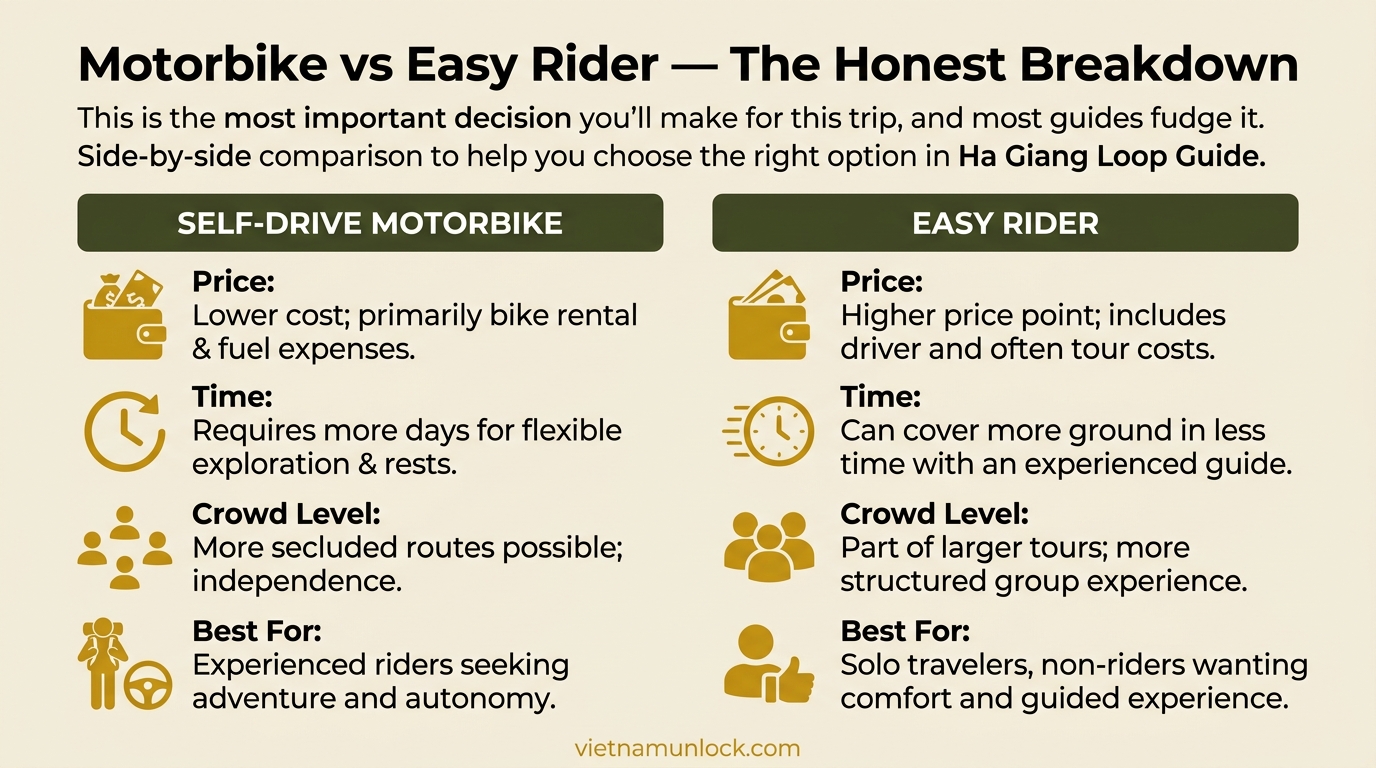
Self-Drive Motorbike
You want to ride yourself if: you have actual riding experience (not “I rode a scooter around Hoi An once”), you have a valid IDP (International Driving Permit under the Vienna Convention 1968 — this matters, not just any IDP), and you’re comfortable with mountain roads that have no guardrails on one side and a 200-meter drop on the other.
Rental costs: semi-automatic 110–125cc bikes (Honda Blade, Yamaha PG-1) run 180,000–250,000 VND per day. Manual 150cc+ bikes (Honda XR 150, Honda Winner X) run 350,000–650,000 VND per day. Trusted rental shops in Ha Giang City: QT Motorbikes, Loop Trails, Hồng Hào. Deposit is typically 1.5–3 million VND in cash — they prefer cash over holding your passport.
Before you take the bike: film a 360-degree video of the entire bike, including under the frame and the odometer reading. This is not paranoia. The motorbike damage scam is the most common rip-off on this loop — rental shops have been known to “discover” new damage on return that wasn’t there when you left. The video is your only defense.
→Who It’s For
Self-drive is for confident riders with an IDP, genuine off-road or mountain experience, and a tolerance for risk. If you’ve never ridden a manual or haven’t ridden in over a year — take the easy rider option. Ego-driven crashes on Ma Pi Leng are a regular occurrence and the nearest hospital is far.
Easy Rider (Guided Motorbike Tour)
You hire a local guide who drives the motorbike; you sit on the back and look at things. This is actually excellent for first-timers and for people who just want to be present on the loop without managing a vehicle through mountain passes.
3-day/2-night tours run 3,800,000–4,500,000 VND ($152–180). 4-day/3-night tours run 4,800,000–6,000,000 VND ($192–240). Reputable operators: Bong Hostel, Loop Trails Tours, Jasmine Ha Giang. Tip your guide 150,000–200,000 VND per day — they’re doing the hard work.
•Know Before You Go — 2026 Regulation Change
A British tourist died on the Ha Giang Loop in 2026, triggering a government crackdown that changed how easy rider tours legally operate. As of April 2026, tour guides must be licensed (có thẻ hướng dẫn viên) and accompany the group for the entire journey. Rental shops can no longer sell tours directly — that practice is now explicitly illegal. Book only through registered tour operators (Bong Hostel, Loop Trails, Jasmine Ha Giang), not through whoever hands you a motorbike key. Groups caught without a licensed guide, signed contract, and insurance are stopped on the road and turned back. This is no longer theoretical — police identified 40+ violations in April 2026 alone. Riding solo changes the calculus on almost every decision — our Ha Giang solo guide gets into the specifics: safety, finding riding partners at hostels, and what the road actually feels like when it’s just you.
Easy rider guides double as translators and cultural connectors. Some of the best moments I’ve seen on the loop came from groups with local guides — stopping at a roadside fire in Yen Minh, being invited into a house in Nam Dam village for corn wine that tastes like it was distilled inside a rock.
The Ha Giang Loop Route — Day by Day
The classic clockwise direction: Ha Giang City → Quan Ba → Yen Minh → Dong Van → Meo Vac → back via Yen Minh. For a deeper breakdown of bike types and what to look for, our Ha Giang motorbike guide covers rental specs, road conditions, and maintenance checks.
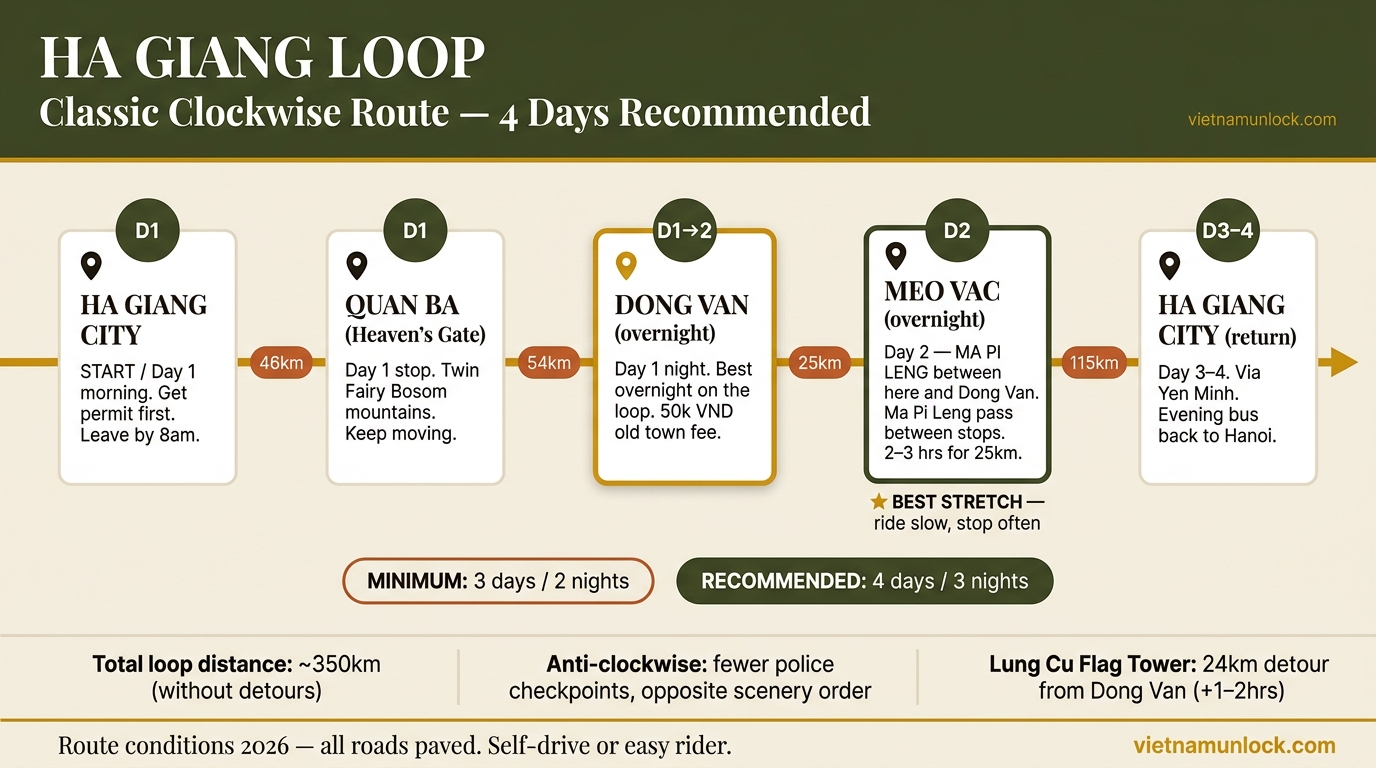
Minimum time: 3 days/2 nights. Recommended: 4 days/3 nights. Comfortable: 5 days/4 nights if you want to get off the main route. If you’re working out the day-by-day logistics, our 3-day Ha Giang Loop itinerary maps out exactly which sections to tackle each day and where to sleep.
Day 1 — Ha Giang City to Dong Van (120km)
This is the long day. You’re covering the full northern reach of the plateau. Leave Ha Giang City early — by 8am if possible — because you want daylight for the full stretch.
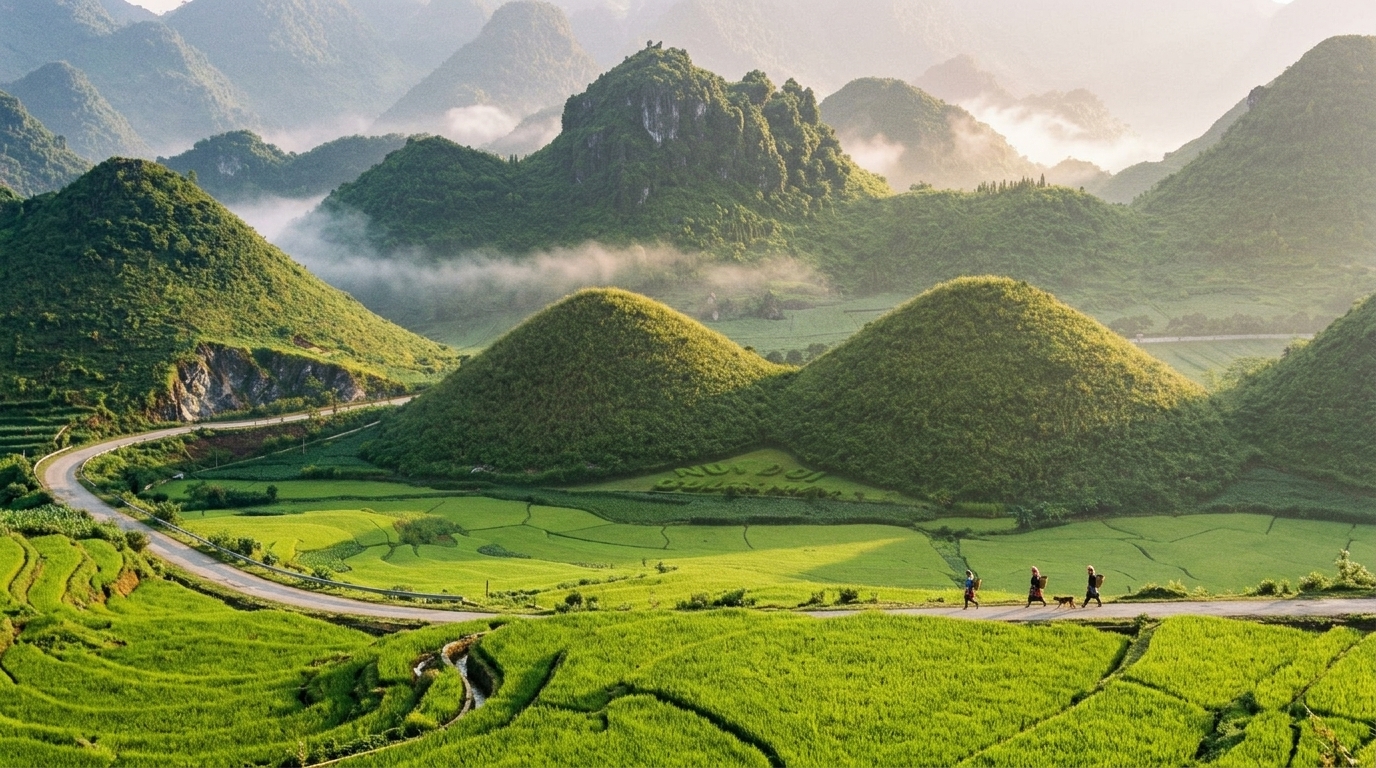
The Heaven’s Gate pass (Cổng Trời) at Quan Ba is about 46km from Ha Giang City. Twin mountains called the Fairy Bosom (Núi Đôi) rise from a valley floor so green it looks fake. There’s a viewpoint with tour buses and trinket sellers — take 10 minutes, then keep moving.
Yen Minh, around 100km in, is a quiet town with a French-era church and basic guesthouses. Some riders stop here for night one to break up the drive. I’ve done it both ways — stopping in Dong Van (another 50km) gives you the more atmospheric overnight.
Dong Van Old Town at night, with its preserved Qing-dynasty architecture and gas lamps, is the best overnight on the loop. The ancient town entry fee is 50,000 VND, but your accommodation is usually inside or adjacent. Dong Van Citadel Sunday market fills the square with H’mong, Tay, and Dao vendors — if your timing allows it, this is worth restructuring your itinerary around.
↗Insider Tip
The viewpoint most riders stop at near Heaven’s Gate has a secondary trail on the left side that bypasses the trinket market and reaches the actual summit ridge. It takes 10 extra minutes on foot and the photos are completely different — no signs, no souvenir umbrellas in frame.
Day 2 — Dong Van to Meo Vac (25km, the best stretch)
Twenty-five kilometers. On a map that sounds like nothing. On the road it takes 2–3 hours because you will stop constantly.
 ma pi leng pass road nho que river canyon ha giang vietnam — vietnam unlock” width=”1200″ height=”675″ />
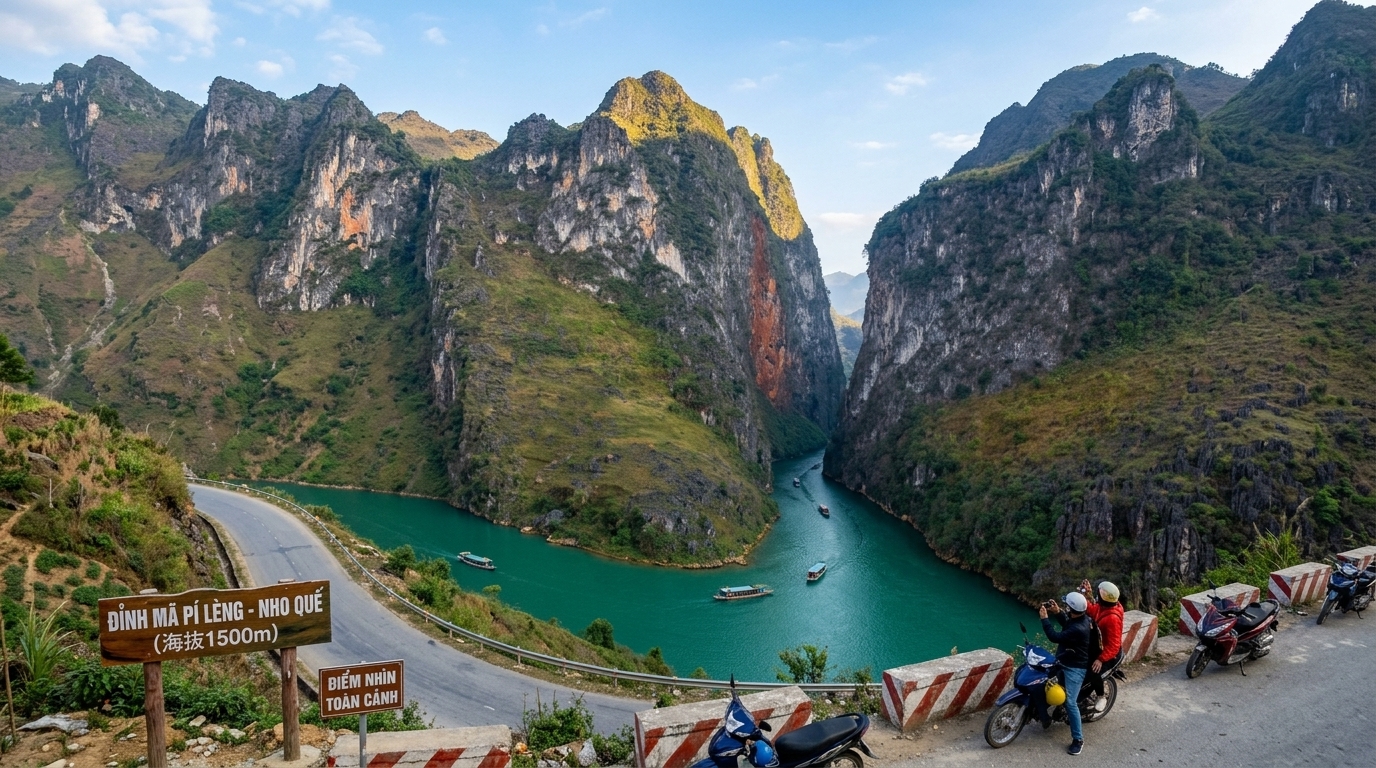
This is Ma Pi Leng — “sky-scraping horse’s nose” in Hmong — the pass that cuts along the edge of the Nho Que River canyon. The drop to the water is 700+ meters. The road was carved by hand between 1959 and 1965 by workers who suspended themselves from ropes on the clifface. You can feel that history in every meter of road.
At the bottom of the canyon, there’s a boat to the Nho Que River (say: n’hweh kweh). The water is a color of blue-green that makes you question your eyes — turquoise from the limestone geology, brightest in the dry season (October–April). The boat trip is 200,000 VND per person and worth it in good weather. In cloud, you won’t see the canyon walls anyway.
Meo Vac is 25km from Dong Van. The Meo Vac Sunday market is considered by many the most authentic ethnic minority market in northern Vietnam — less polished than Bac Ha (which feels partially staged), with real trading happening between H’mong, Dao, Giay, and Lo Lo groups. The smell is the honest indicator: thắng cố (say: thung koh) — a horse or pork stew simmered in a large cauldron — cooking alongside corn wine and roasted corn over charcoal. It’s confronting and unforgettable in equal measure. For the day-by-day logistics, our 3-day Ha Giang Loop itinerary maps out exactly which sections to tackle each day and where to sleep.
Nhà hàng Thanh Phương at 17 Đường Hạnh Phúc near the Meo Vac market serves thắng cố with corn wine. Order the corn wine small (50ml) first — it’s strong and gets stronger in the cold air.
★Jake’s Pick
O’Chau Meo Vac Homestay (400,000–600,000 VND/night) — the balcony view of the surrounding mountains at dawn is the best I’ve found on the entire loop. Book in advance for weekends in November.
Day 3 — Meo Vac to Yen Minh, or Back to Ha Giang
The return leg through Yen Minh. Some riders do Meo Vac → Yen Minh (60km) as a stopping night and then Ha Giang the next morning. Some push straight through in one day (115km).
If you have time: the village of Nam Dam near Yen Minh is a Dao community not yet saturated with tour groups. The path in is a short walk from the road. The bathing herb ceremony (ngâm thuốc) offered by local families is a genuine cultural practice — not a performance.
The side road to Lung Cu Flag Tower (Cột cờ Lũng Cú, 25,000 VND entry) is 24km off the main loop from Dong Van, not Yen Minh — worth noting for itinerary planning. The flag marks Vietnam’s northernmost point. The view from the hill is solid but the road up is now fully paved and busier than it used to be.
Day 4 — Back to Ha Giang City, Bus to Hanoi
An easy day. From Yen Minh to Ha Giang is about 100km on better roads. You’ll be back in Ha Giang City by early afternoon, enough time to shower, eat, and be on an evening bus back to Hanoi (departures 6pm–8pm, same operators as the way up).
Where to Stay on the Ha Giang Loop
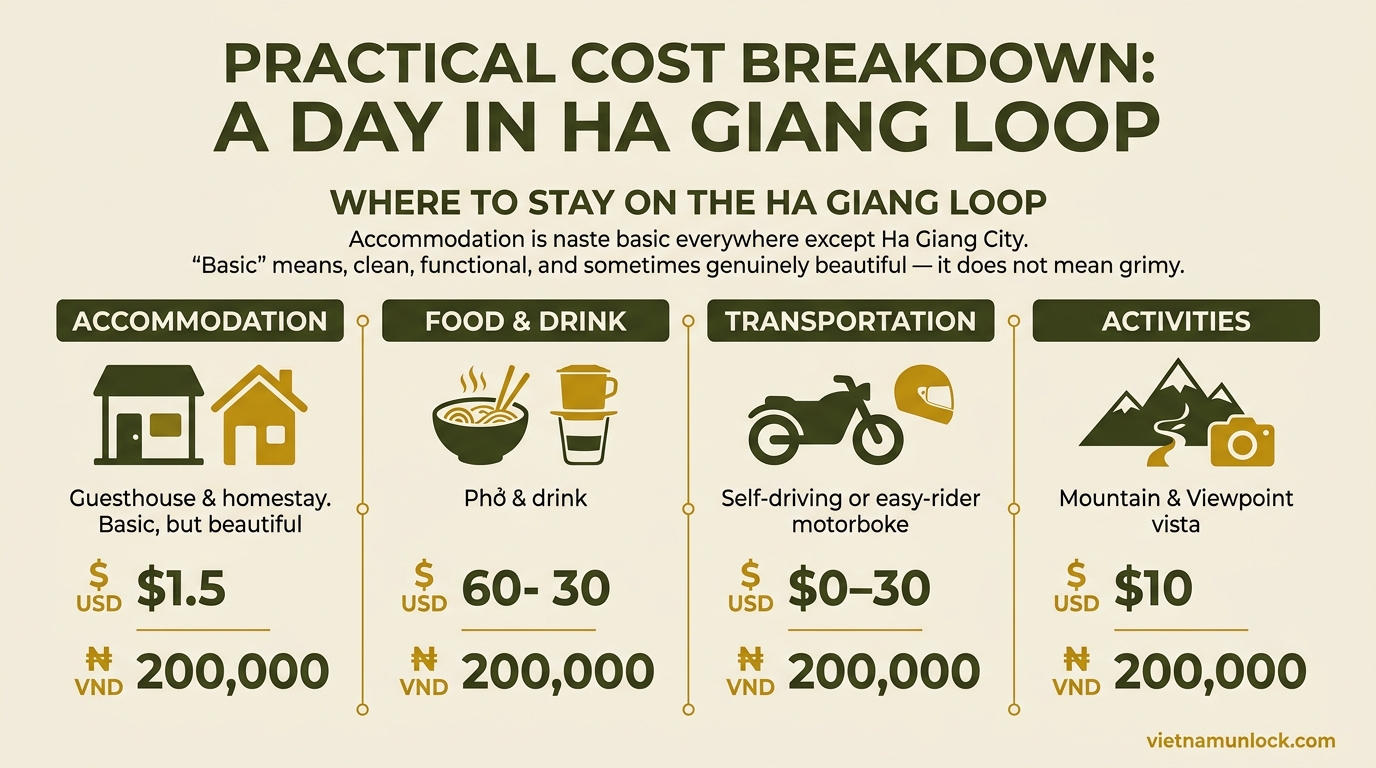
Accommodation is basic everywhere except Ha Giang City. “Basic” means clean, functional, and sometimes genuinely beautiful — it does not mean grimy.
Ha Giang City: Ha Giang Amazing Hostel (123A Lý Thường Kiệt, 150,000–500,000 VND) has a strong social atmosphere and organizes tours if you want company. Ha Giang Riverside Hostel (24 Nguyễn Trãi, 200,000–375,000 VND) has river views and motorbike rental on-site. Both are reliable starting points.
a-giang-best-time/”>Ha Giang best time guide breaks down what each season actually looks like on the road.
Meo Vac: Already mentioned O’Chau — the mountain views justify the price. Ma Pi Leng Panorama Hotel (500,000–800,000 VND) is another solid option with canyon views. Auberge de Meo Vac (600,000–900,000 VND) is the closest thing to boutique on this stretch.
Yen Minh: This is just a stopover town. Lũng Hồ Guesthouse (300,000 VND) is quiet and cheap. Hải Linh Guesthouse is clean and straightforward. Don’t overthink it.
What to Eat on the Ha Giang Loop
The food here is genuinely distinct from Vietnamese food elsewhere. This is H’mong, Tay, and Lo Lo territory — not a phở-and-bánh mì landscape.

Phở chua (say: fuh chua) is the Ha Giang breakfast essential — a sour rice noodle dish with cold broth, herbs, and sliced pork. Not hot-soup phở. Colder, sharper, stranger. Try it at Phở Chua Hà Giang Hiền Lương at 12 Bạch Đằng in Ha Giang City — 25,000–35,000 VND for a bowl.
Mèn mén (say: men men) is the H’mong staple: steamed corn mash with a dense, slightly sweet texture. It’s everywhere at roadside stalls and costs nothing. It fills you in a way that rice doesn’t.
Xôi ngũ sắc — five-color sticky rice dyed with natural plant extracts — appears at the Sunday markets in brilliant reds, purples, and yellows. Buy it for breakfast. Eat it with your hands.
Gà đen (black-feathered chicken, raised in the mountains) has the dense, gamey meat of an animal that actually lived. Available at most town restaurants for 200,000–350,000 VND per dish.
The corn wine (rượu ngô, say: z’oo ngo) is a different caliber from the rice wine you get elsewhere in Vietnam — sharper, smokier, made from local blue corn. The 50ml shot at a mountain market in freezing fog is an experience. The 200ml version that seemed like a good idea after sunset is not.
The Ha Giang Loop Scams — What Actually Happens
The motorbike damage scam is the most common and most expensive. The setup: a shop shows you a clean bike, you ride the loop, you return with normal wear. The shop owner walks around the bike with a new face and announces the rear fender has a crack “from the inside” that wasn’t there before. They want 500,000–2,000,000 VND. You have no video. You have no leverage.

The prevention: video every inch of the bike before you leave. In 2026, most reputable shops (QT Motorbikes, Loop Trails) have their own check-in procedures and you’re unlikely to have this problem with them specifically. But the video protects you everywhere.
The permit scam already covered above — worth repeating because it comes up every time. Anyone on the street offering to get your permit is running a scam.
The Police Checkpoint Problem — My Mistake
Let me be direct about the checkpoint issue because every blog I read before my second loop either glossed over it or buried it in a footnote.
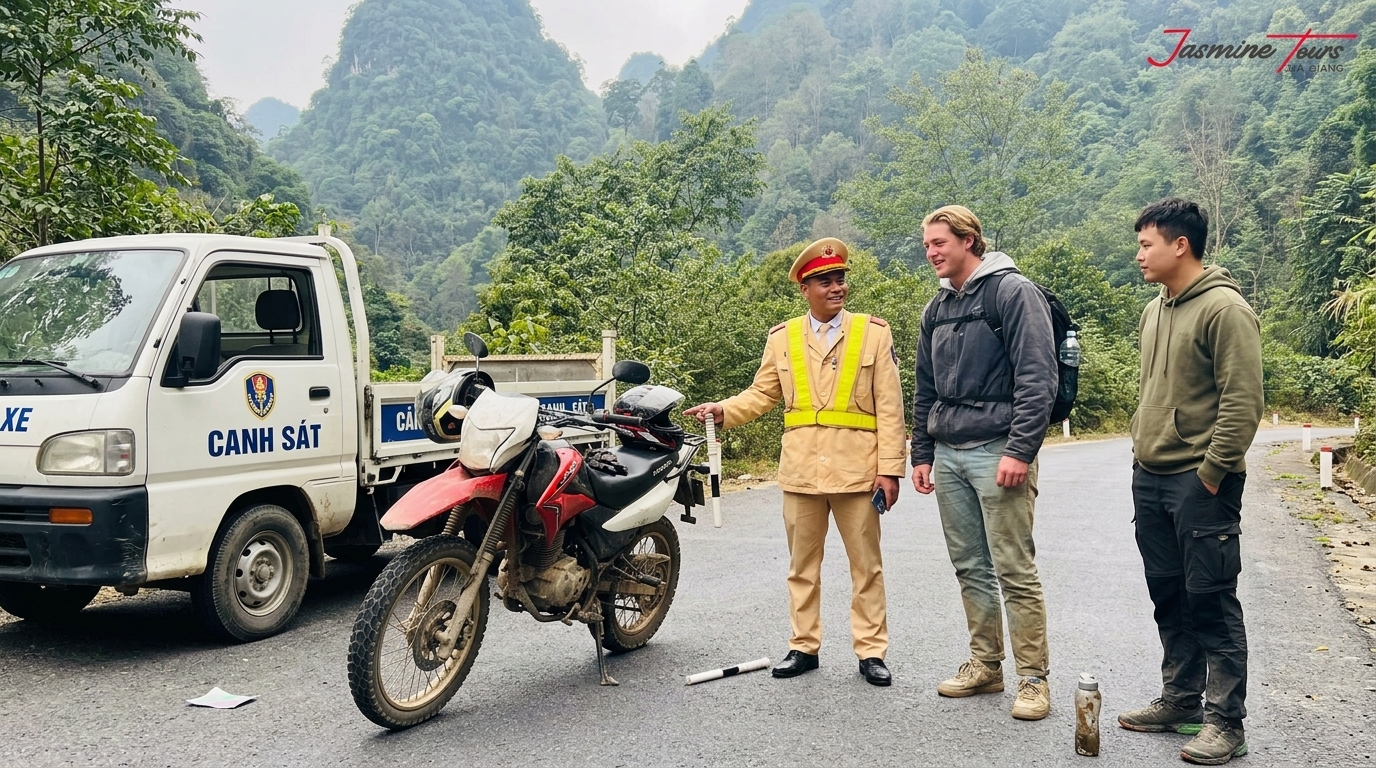
I was riding with a standard international driving permit — the type you get from AAA in the US or an automobile club elsewhere. My officer looked at it, handed it back, and told me it was not valid. Vietnam recognizes the Vienna Convention 1968 IDP specifically. Many commonly-issued IDPs are from a different convention and are not accepted.
The fine for riding without valid documentation is 1,500,000–3,000,000 VND ($60–120) — and as of 2026, police are no longer just collecting fines. They take the bike. Multiple riders reported on Reddit in early 2026 that their rental was confiscated on the spot, leaving them stranded on a mountain road. I paid a fine on my second loop and it ruined the day. The 2026 version of that situation is significantly worse. Get your IDP before you leave home — Vienna Convention 1968 specifically.
If you’re stopped and believe you’re being charged informally: stay calm, ask for an official receipt (biên lai). Unofficial “fines” without paperwork are not legally required.
⚠Real Talk
Since April 12, 2026, police have intensified patrols across the full loop — 40+ violations processed in a matter of weeks. The checkpoint experience is stricter than anything I saw on my previous loops. Go properly documented or take the easy rider option through a licensed operator. The anti-clockwise direction still has fewer checkpoints, but both directions are now genuinely policed.
Ha Giang Loop Budget — Real Numbers
Self-drive, 4 days, two people sharing accommodation:
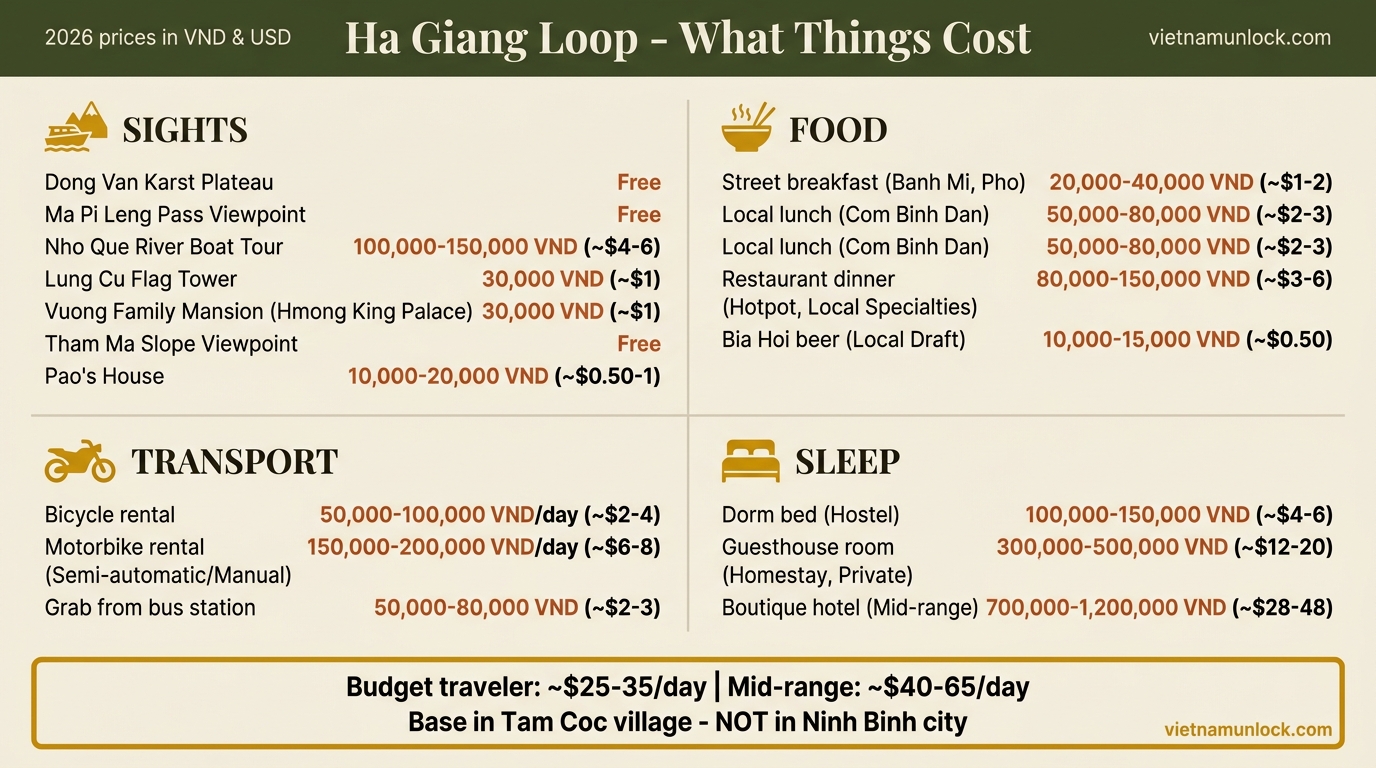
- Overnight bus Hanoi–Ha Giang (return): 700,000–1,100,000 VND
- Motorbike rental 4 days: 800,000–1,400,000 VND
- Fuel (~350–400km): 300,000–400,000 VND
- Accommodation 3 nights: 600,000–1,200,000 VND
- Food 4 days: 1,000,000–1,500,000 VND
- Permit + site entry fees: ~400,000 VND
- Total: ~3,800,000–6,000,000 VND ($152–240) per person
Easy rider tours start at 3,800,000 VND for 3 days/2 nights and go up to 6,300,000 VND for private guides. That’s inclusive of transport and guide — accommodation and food additional.
ATMs exist in Yen Minh and Quan Ba as of 2026, but bring enough cash for the full loop. Deep into the loop, you’re a long way from a working ATM and card readers don’t exist in village homestays.
When to Go — And the Buckwheat Flower Question
The Ha Giang Loop is rideable year-round, but the experiences are completely different by season.

March–May: Cool, relatively dry, terraces green from spring planting. Crowds are manageable. This is the best all-around window for first-timers.
June–August: Monsoon season. Rain makes the roads slippery and some passes legitimately dangerous. The landscape turns deep green and dramatic. Fewer tourists. If you’re an experienced rider, this can be spectacular — but one bad patch of mud on a switchback is enough to ruin a trip.
September–October: Rice harvest season. The terraces turn golden yellow in a way that photos consistently fail to capture. One of the most photogenic windows.
October–November: Buckwheat (tam giác mạch, say: tam jak mak) flower season. The fields around Dong Van turn pink-purple. This is the most visually striking time to come — and the most crowded. In 2026, the best flowers are forecast for the second week of November. Book accommodation at least 3–4 weeks in advance if you’re targeting this.
December–February: Cold. Genuinely cold — near 5°C at elevation, heavy fog that reduces visibility on the passes to 20–30 meters. Beautiful in a stripped, monochrome way. Pack properly or stay home.
What Travelers Actually Say: The Consensus
The Ha Giang Loop generates some of the most consistent superlatives in Vietnam travel feedback, with one significant caveat: it separates travelers who went prepared from those who didn’t. People who got the permit, brought an IDP, rented a reliable bike, and allowed four to five days describe it as the best experience of their Vietnam trip — sometimes their travel career. People who rushed it in three days, skipped the permit, or rented the cheapest available bike describe a stressful, sometimes costly experience. The loop punishes the underprepared specifically because the roads are genuinely remote and the consequences of a breakdown or police fine are significant.
The IDP requirement is real and enforcement varies — some riders report going the whole loop without being checked, others report multiple checkpoints per day. The fine for no IDP (2–8 million VND / ~$76–304) is not worth gambling. Get the permit and the IDP before you leave Ha Giang City.
⚠Real Talk
The “I’m a confident rider at home” logic doesn’t fully transfer to Ha Giang. The XR150 on a mountain pass in wet conditions is a different skill set from a scooter on flat urban roads. Multiple experienced riders note the loop humbled them — not dangerously, but in a “I was more cautious than I expected to be” way. If you’re not confident with manual bikes on steep, loose-gravel descents — rent a semi-automatic. That’s not a lesser choice.
Ha Giang Loop FAQ
Is the Ha Giang Loop safe?
The road itself is one of the more technically challenging in Southeast Asia — narrow switchbacks, blind corners, sheer drops. The greatest risk is overconfidence combined with inadequate riding experience. Locals drive carefully by necessity. Tourist crashes happen disproportionately in the first day when people are still adjusting. Ride at 30–50km/h on passes, don’t overtake on blind corners, stop before dark.
Do I need a motorbike license for the Ha Giang Loop?
Yes — and as of 2026, the enforcement is real. You need a valid IDP (Vienna Convention 1968 type) plus your home country license. Post-April 2026 crackdown, police at checkpoints are confiscating bikes from riders without valid documentation — not just issuing fines. Fines run 1,500,000–3,000,000 VND ($60–120) and losing the bike means losing your deposit (now up to 5,000,000 VND at some rental shops). The era of “most people get through fine without a license” is over for this stretch of Vietnam.
Can I do the Ha Giang Loop solo as a woman?
Yes — and many women do. The biggest safety concern on the loop is the road, not the people. H’mong communities are generally welcoming and incidents of harassment are rare compared to lowland tourist towns. Recommended: ride with at least one other person on the passes (not strictly necessary but reduces isolation if something goes wrong), stick to established hostels, communicate your itinerary to someone. Easy rider tours with established operators are a solid option for solo female travelers who want company and local knowledge.
What’s the Ha Giang Loop entry permit and where do I get it?
The restricted area permit costs approximately 230,000 VND ($9) and is purchased at the Ha Giang Public Security Department (Công an tỉnh Hà Giang) in Ha Giang City. Bring your passport. Process takes 30–60 minutes. Get it on the morning of your first riding day. The permit is required for all foreigners entering the Dong Van Karst Plateau area.
What should I pack for the Ha Giang Loop?
Helmet (your rental shop provides one — check the condition, replace if it’s cracked), full-fingered gloves, a warm layer even in summer (the passes can be 10–15°C cooler than Ha Giang City), rain jacket, cash for the full trip, a basic first aid kit, and a phone mount for maps. Google Maps works across the loop but download the Dong Van–Meo Vac section offline before you lose signal.