Every Da Nang itinerary has it. Every Instagram from Da Nang has it. And almost every traveler who visits spends about six minutes there before moving on — partly because they didn’t know what to actually do, and partly because they walked in during Mass and got a very pointed look from the priest.
Da Nang Cathedral — the Pink Church, the Rooster Church, the Chicken Cathedral — is worth a stop. But there’s a right way to visit an active parish that doubles as the city’s most-photographed building, and most travel guides skip the part where it’s, you know, a functioning church with services and rules.
Here’s everything you need to know before you go.
Da Nang Pink Cathedral — Quick Facts
| Official name | Church of the Sacred Heart of Jesus (Nhà thờ Chính tòa Đà Nẵng) |
| Address | 156 Trần Phú, Hải Châu, Đà Nẵng |
| Entry fee | Free — never pay anyone who says otherwise |
| Hours | 4:30am–8:00pm daily |
| Mass times (Mon–Sat) | 5:00am and 5:00pm |
| Mass times (Sunday) | 5:00am, 6:30am, and 4:30pm |
| English Mass | Sunday morning |
| Best time to visit | Before 8am or 3–4pm (light + fewer crowds) |
| Time needed | 30–45 minutes |
| Nearest landmark | Han Market (~500m), Dragon Bridge (~800m) |
What You’re Actually Looking At
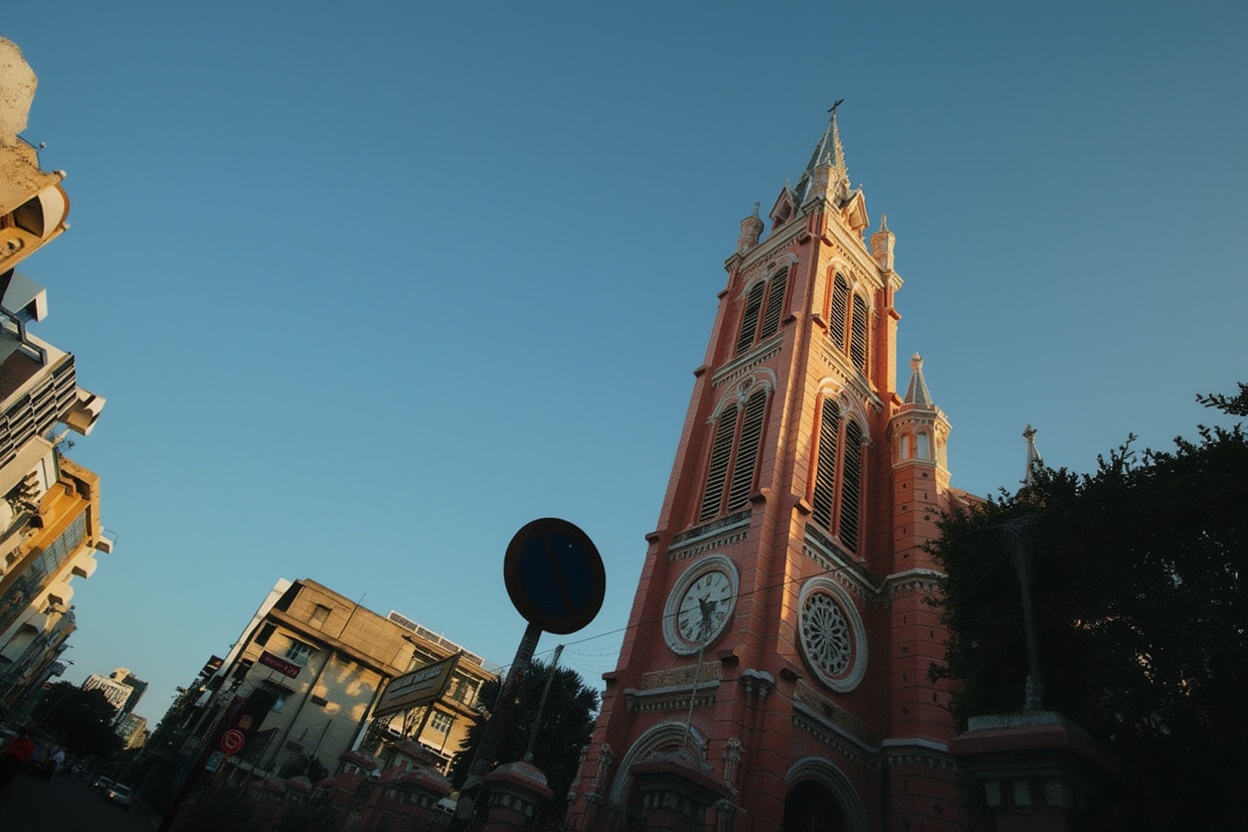
Da Nang Cathedral was built by the French in 1923 — pink stucco facade, Gothic-style spire, stained glass windows imported from Grenoble. The pink is original, not a renovation. The French liked pink.
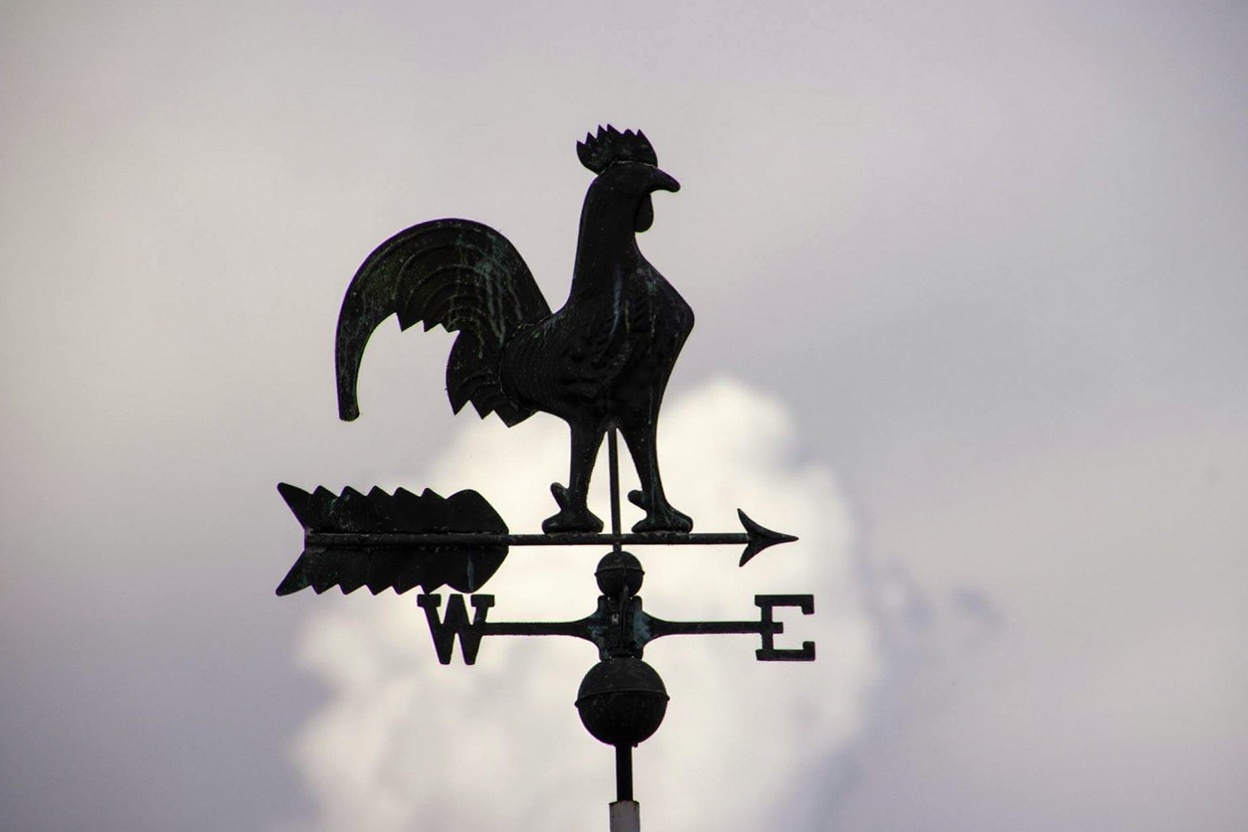
What makes this place actually interesting is the weathervane at the top of the spire: a rooster. That’s why locals don’t call it the Pink Church — they call it Nhà thờ Con Gà, which translates directly as “Chicken Church” or “Rooster Church.” Every guide will tell you it’s called the Pink Church. The people who actually live here call it the Rooster Church, and they will look at you with mild amusement if you correct them.
The rooster is a traditional Christian symbol — representing Peter’s denial of Christ, alertness before dawn, the call to prayer. The French architects knew what they were doing. But for a century of Da Nang locals, it’s just been the church with the chicken on top.
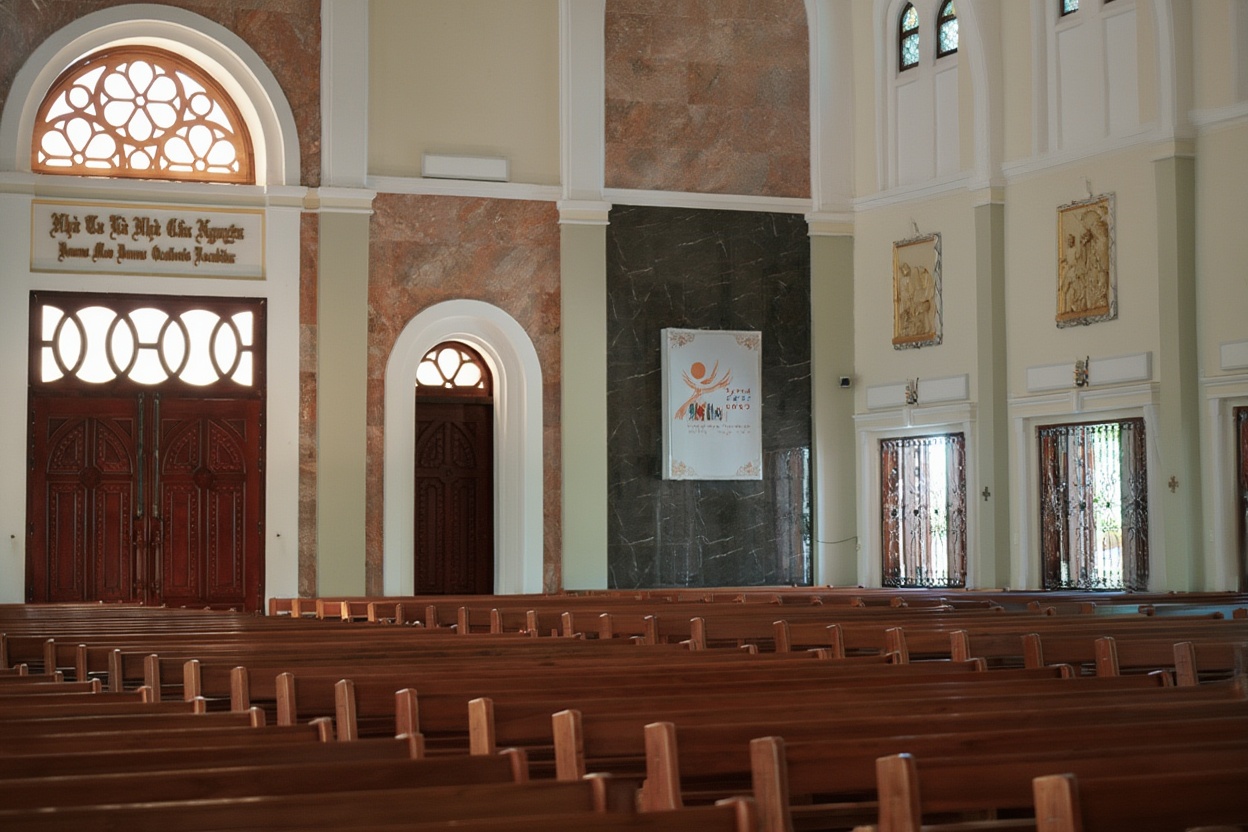
Inside: modest by cathedral standards, genuinely beautiful if you go in with the right expectations. No grand nave, no elaborate frescoes. Pale yellow walls, simple stained glass, wooden pews worn smooth by 100 years of worshippers. It’s not Saigon’s Notre-Dame or Hue’s Phuoc Kien Assembly Hall — but it has an intimacy those tourist-packed sites don’t.
A Short History Worth Knowing
The French colonial administration built Da Nang Cathedral in 1923, during a period when France was investing heavily in church construction across Indochina — Saigon’s Notre-Dame (1880), Hanoi’s St. Joseph’s Cathedral (1886), and dozens of provincial parishes throughout Vietnam. Da Nang’s cathedral was modest by comparison to those northern landmarks, but it was the first major Catholic church in the central coast region and became the seat of the Diocese of Da Nang when that diocese was established.
The architect chose French Gothic — elongated spire, pointed arches, rose window — but executed it in local materials and with local labor. The pink stucco is not a concession to Southeast Asian taste; it was common in French colonial construction throughout the region, where the color was thought to reflect heat and age more gracefully than white. Walk around the building and you’ll see it: the surface has a history written in it, repairs visible as slightly different shades of pink layered over a century.
Through the American War, Da Nang Cathedral remained open. The city was a major US military base — at its peak, Đà Nẵng airbase was one of the busiest airports in the world — and the cathedral served a community that included both Vietnamese parishioners and foreign workers. After reunification in 1975, Catholic churches across Vietnam faced restrictions, but by the late 1980s the parish community was functioning again. The 5pm mass on weekdays and the Sunday schedule have been continuous for decades.
Getting There
> **Quick Answer:** The cathedral is at 156 Trần Phú in Hải Châu district — central Da Nang, walking distance from Han Market and the Han River. Grab from Da Nang airport runs about 80,000–120,000 VND (~$3–5). From Hoi An, budget 250,000–350,000 VND (~$10–14) by Grab car.
The location is the cathedral’s best feature as a stop. It’s dead-center in downtown Da Nang, on Trần Phú street, which puts it about 500 meters from Han Market and less than a kilometer from Dragon Bridge. You’re not going out of your way for this — you’re connecting the dots between things you’d visit anyway.
12Go covers most Vietnam routes — sleeper buses, trains, and island ferries. Compare schedules and book in advance during peak season (Dec–Feb, Jun–Aug).
If you’re walking from Dragon Bridge heading toward Han Market, you’ll hit the cathedral naturally. From the Han River promenade, cut west two blocks on Bạch Đằng, then south on Trần Phú. You’ll see the pink tower before you see the sign.
The main gate faces Trần Phú Street. If it looks closed — and it sometimes does, depending on service schedule — there’s an open door on the right side of the building (not visible from the street). One Tripadvisor reviewer described finding it: “climb the left side ramp leading up, or the stairs to the right — you’ll find an open door on the church’s right-hand side.” The interior is rarely locked during daytime hours.
When to Visit (And When to Stay Away)
> **Quick Answer:** Early morning before 9am is best for photos and atmosphere. Avoid the 5pm mass slot if you just want to wander. Midday light is harsh and the sun hits the facade from the wrong angle.
Every source agrees on this, and I’ll add one layer: the quality of your visit depends almost entirely on timing.
Before 8am: The light hits the pink facade from the east and turns it almost coral. The grounds are quiet. The grotto — a collection of nativity scenes and religious statuary in the garden — is peaceful rather than crowded. This is when you get the photos that don’t have twelve other people in them.
8am–noon: Tourist traffic picks up. Still fine for a visit, but the midday sun creates harsh backlighting when shooting the facade from the street. The pink washes out.
3–4pm: Second-best window. The light softens, the heat eases slightly, and you’re ahead of the 5pm mass crowd. Late afternoon also works for photos — the facade catches warm western light.
5pm (weekdays) / 4:30pm (Sunday): Mass begins. If you’re there as a tourist, you can still attend from the alleyways outside — red plastic chairs appear, and locals sit alongside the church walls for overflow services. It’s actually a better window into Da Nang’s Catholic community than the interior. Roughly 8% of Vietnam is Catholic, concentrated in the central provinces; the crowds at the 5pm service are real and genuinely devout, not a show for tourists.
During any mass: Do not take photos inside. Do not walk in front of the altar. The signage is polite; the expectation is real. A Tripadvisor reviewer noted you can enter during mass “if you explain to the guard you are going in to attend the prayer” — but wander-and-shoot mode during an active service is the thing that gives travelers a bad reputation.
What the Experience Is Actually Like
Here’s the honest version: Da Nang Cathedral is a small building in the middle of a busy city street. The grounds are maybe the size of a large living room. The interior holds a few hundred people at capacity. You are not walking into a vast, echoing space with centuries of accumulated awe. You’re walking into a 100-year-old neighborhood church that happens to be very pink and very photogenic.
What makes it interesting is the juxtaposition. Step off Trần Phú — honking motorbikes, food vendors, the smell of coffee and exhaust — through the gate, and the noise drops. The garden, even the small one, creates a pocket of quiet. The incense smell from the grotto grottos is real, not decorative. The statuary weathered rather than restored. There’s a deliberate maintenance aesthetic here: functional, not pristine.
The parishioners are also real. This is not a heritage site or a state attraction — it’s where 10,000+ Catholic residents of Hải Châu district actually go to worship. The interaction between tourist traffic and parish life is managed with surprising grace: the guards are not rude, the signs are not aggressive. But the expectation is mutual respect, and most travelers figure it out quickly once they see that the people sitting in the pews are there for reasons that have nothing to do with Instagram.
One detail that stuck with me: at the weekday 5pm mass, the alleyways alongside the church fill with older Vietnamese women on plastic chairs, rosaries out, facing the open windows. They’ve been doing this for decades — possibly because the interior was full, possibly because it’s cooler outside, possibly because that’s just how this particular parish does things. It’s not staged. It’s just what happens at 5pm on Trần Phú Street.
What to Do When You’re There
Thirty to forty-five minutes is genuinely enough. Here’s how to use it:
The facade and spire: Cross to the opposite side of Trần Phú for the best straight-on shot. Include the palm trees if you can — they’re in the framing for a reason. The pink works best against blue sky; overcast days flatten it.
Klook has the widest selection for Vietnam and is usually the cheapest. KKday is strong on day trips and local experiences.
s a series of small grottos — nativity scenes, shrines, statuary. Less photographed than the facade, more interesting to walk through. The smell of incense is strongest here.
The interior: Worth five minutes. Go in quietly, stay near the back, don’t block the center aisle. The stained glass is simple but lets in colored light in the afternoon. The ceiling height is less dramatic than you’d expect — the spire is taller than the interior volume suggests. That’s the French colonial trick: invest in verticality outside, practicality inside.
English Mass (Sunday morning): If you’re in Da Nang on a Sunday and want an actual cultural experience rather than just photos, the English Mass is surprisingly moving — a small community of expats, English-speaking Vietnamese, and occasionally passing travelers, all in one of the oldest French-built churches in central Vietnam. Arrive 15 minutes early; it fills up.
Da Nang Cathedral vs Saigon’s Pink Church
Search “Vietnam pink church” and you’ll get two buildings: Da Nang Cathedral (Da Nang) and Tan Dinh Church (Saigon’s District 3). They’re not the same place, but travelers confuse them constantly — especially after seeing photos.
Tan Dinh Church in Saigon is actually pinker — a more saturated, bubblegum pink applied in a later renovation. It’s also larger, with a more dramatic interior, and it sits in a residential neighborhood rather than downtown. If you’re in Saigon, Tan Dinh is the one people mean when they say “the pink church in Saigon.” Da Nang Cathedral is a different building entirely, about 900km north.
The practical distinction: if you’re in Da Nang, you’re visiting Da Nang Cathedral. If you’re in Ho Chi Minh City, you’re visiting Tan Dinh. Both are free. Both are active parishes. Both have the same rules about photography during services. The Saigon one is more tourist-trafficked; the Da Nang one has a quieter neighborhood feel and is easier to visit without crowds if you go early.
The Scam You Should Know
It’s a simple one: someone asks you to buy a ticket. There are no tickets. There has never been a ticket. Entry is free. The cathedral has been free since it was built in 1923 and will presumably remain free for the foreseeable future.
VinWonders’ guide put it bluntly: “If you are asked to buy tickets online or at the church’s entrance, it is likely that they are scammers.” The targets are generally tourists who assume popular tourist sites have entry fees — a reasonable assumption in most of Southeast Asia. At Da Nang Cathedral, it’s wrong.
If someone approaches you near the gate with a lanyard and an envelope asking for payment: walk past them.
The Neighborhood: Trần Phú and Hải Châu District
Most visitors beeline for the cathedral and leave without noticing that Trần Phú Street itself is worth walking. It’s one of the old French-laid boulevards in central Da Nang, wide enough for tree cover, lined with a mix of colonial-era low buildings and newer shophouses. The blocks immediately around the cathedral have a density of coffee shops, bánh mì carts, and small pho restaurants that serve the morning mass crowd and the office workers from the administrative buildings nearby.
A few specifics: the coffee shop directly across Trần Phú from the cathedral gate serves cà phê trứng (egg coffee) that you’d expect to find only in Hanoi. The bánh mì cart at the corner of Trần Phú and Hoàng Diệu opens at 6am and is usually sold out by 8. These are not tourist operations — they’ve been there since before the cathedral became a photography destination.
The neighborhood also puts you within easy walking range of Con Market (Chợ Cồn), which is larger and less tourist-polished than Han Market — better for fabric, hardware, and the kind of stall food that costs 20,000 VND instead of 60,000. It’s about 700 meters southwest of the cathedral, on Ông Ích Khiêm Street.
Combining the Cathedral with a Half-Day in Downtown Da Nang
The cathedral makes most sense as one stop in a central Da Nang loop. Here’s how locals actually do it:
Morning route (3–4 hours):
- 7am: Cathedral — before the crowds, best light
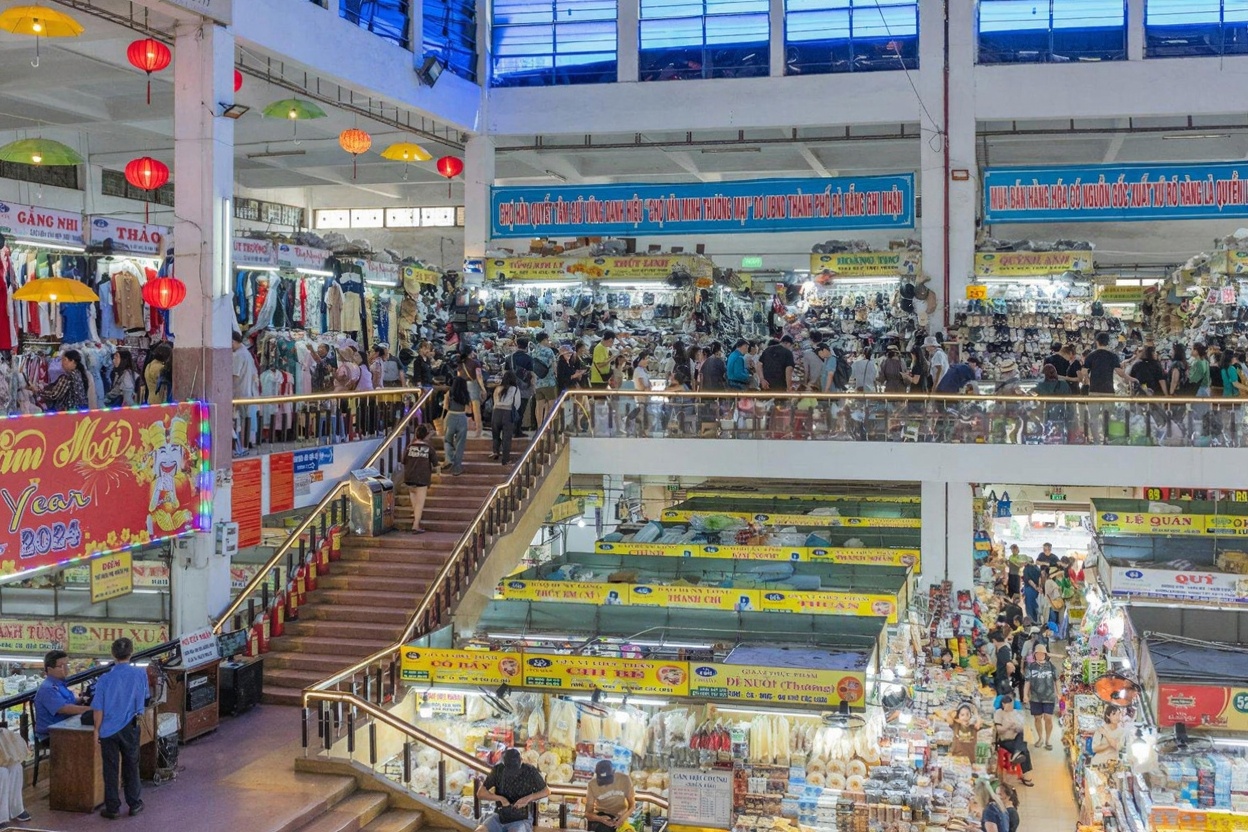
- 8:30am: Han Market — breakfast at the food stalls on the upper floor (bánh mì, bún bò, fresh juice), then wander the fabric and ceramic sections downstairs
- 10am: Han River promenade — walk north toward Dragon Bridge
- 10:30am: Dragon Bridge — less dramatic in daylight than at night, but the scale reads better without the light show distraction
If you’re doing the full Da Nang day — Marble Mountain in the morning, cathedral and Han Market at midday, then Son Tra Peninsula in the afternoon — the cathedral fits naturally as a lunch-break stop. Our Da Nang things to do guide has the full-day routing. The Marble Mountain guide covers the half-day combination that most travelers pair with a central Da Nang wander.
Is It Worth It?
> **Quick Answer:** Yes — with calibrated expectations. It’s a 30-minute stop, not a half-day attraction. Go early for photos, go at 5pm for atmosphere, skip it at midday if you’re short on time.
The Pink Church is not the main event in Da Nang. The main events are the beaches, the mountain, the Peninsula, and the food. But as a free, central, photogenic stop that also happens to be a genuine piece of French colonial history with a functioning parish community — it earns its place on the list.
What it isn’t: an immersive experience, a quiet sanctuary, or a place to linger. The grounds are small. The interior is modest. The crowds at peak hours are real.
What it is: one of the few buildings in Da Nang that looks exactly like it did in 1923, still being used for what it was built for, with a rooster on the roof.
That’s enough.
Practical Info
Da Nang Pink Cathedral — At a Glance
| Item | Details |
|---|---|
| Entry fee | Free (ignore anyone asking for payment) |
| Opening hours | 4:30am–8:00pm daily |
| Best photo time | Before 8am or 3–4pm |
| Dress code | Shoulders and knees covered inside |
| Photography inside | OK outside mass; prohibited during services |
| Mass (Mon–Sat) | 5:00am, 5:00pm |
| Mass (Sunday) | 5:00am, 6:30am, 4:30pm |
| English Mass | Sunday morning |
| Nearest market | Han Market — 500m walk |
| Grab from airport | 80,000–120,000 VND (~$3–5) |
| From Hoi An | 250,000–350,000 VND by Grab (~$10–14) |
Two things worth sorting before you land: a Vietnam eSIM so you have data the moment you clear customs, and travel insurance — medical costs for uninsured foreigners in Vietnam are significant.
Airalo eSIMs activate instantly. Buy before departure — airport SIM queues in Vietnam can take 30+ minutes.
FAQ
Is Da Nang Cathedral free to visit?
Yes, completely free. There are no tickets, no entry fees, no donations required. Anyone asking you to pay is running a scam.
Can I visit Da Nang Cathedral during Mass?
You can attend Mass as a visitor — just treat it as a service, not a photo stop. The guard at the gate will let you in if you explain you’re attending. During services, photography inside is not appropriate. Many tourists sit on the red plastic chairs outside in the alleyways alongside local parishioners — this is normal and welcome.
What’s the difference between the Pink Church and Da Nang Cathedral?
Same building. “Pink Church” is the tourist name. “Da Nang Cathedral” is the formal name. Locals call it Nhà thờ Con Gà — the Rooster Church — because of the weathervane on the spire.
What is the best time to photograph Da Nang Cathedral?
Before 8am for soft morning light, or 3–4pm for warm afternoon light. Midday is the worst — harsh sun creates backlighting that flattens the pink facade. Overcast days work reasonably well for even light.
Is the interior of Da Nang Cathedral open to tourists?
Yes, during non-service hours. The main gate is sometimes closed; the side entrance (right-hand side of the building, not visible from the street) is usually open. Interior is simple but worth a few minutes.
How far is Da Nang Cathedral from Hoi An?
About 30km — roughly 45 minutes by car or Grab. A Grab car from Hoi An to central Da Nang (including the cathedral area) runs 250,000–350,000 VND ($10–14) one way.
Da Nang Pink Cathedral — Cheat Sheet
| ✅ Go early (before 8am) for photos | ✅ Check mass times before you arrive |
| ✅ Free entry — never pay anyone | ✅ Side entrance open if main gate looks closed |
| ✅ Combine with Han Market + Dragon Bridge | ✅ Dress modestly — shoulders and knees |
| ❌ No photography during services | ❌ Don’t pay for tickets — there are none |
| ❌ Skip midday — worst light for photos | ❌ Don’t walk in front of altar during mass |