
Vietnam’s food is the reason some people come back. Not the beaches, not the temples — the food. It’s the country where you can spend $3 on a meal that’s more interesting than anything you’ve eaten in the past year, and where getting the same dish wrong can ruin an afternoon. The difference between a 35,000 VND bowl of bún bò Huế at 7am at a place with no English sign and a 95,000 VND bowl on the tourist strip is not about the price. It’s about understanding how Vietnamese food works.
Five years in Vietnam and 63 provinces covered means I’ve eaten in almost every configuration: five-star restaurants, rooftop bars, sidewalk plastic stools, market halls, floating restaurants on the Mekong, roadside stalls in the northern highlands at 1,500 meters altitude, and a woman’s kitchen in Hội An who fed me without a menu for 40,000 VND. The consistent finding: the best food is almost always the cheapest, and the cheapest is almost always not where the tourists are looking.
This guide covers the essential dishes, how to find them, how to order them, and the regional differences that matter.
The Essential Vietnamese Dishes
These are the dishes you need to understand before you land. Not because you need to study — but because knowing what’s in the bowl makes the experience better.
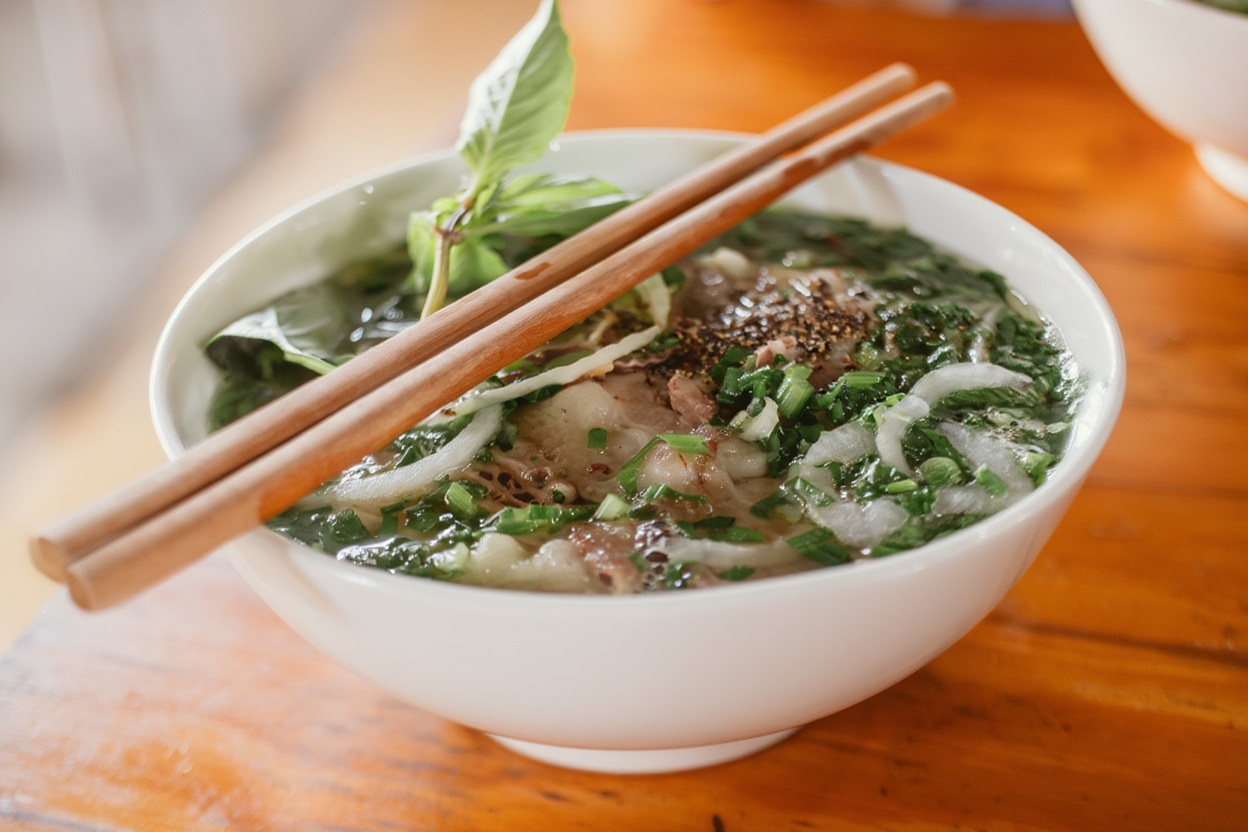
Phở — the national default. Rice noodle soup with beef (bò) or chicken (gà), in a clear broth built over 6–8 hours from bones. Served with a plate of fresh herbs, bean sprouts, lime, and chilies that you add yourself. Two regional versions: Hanoi pho is cleaner, less sweet, smaller portions, minimal garnish; Saigon pho has a slightly sweeter broth, more garnish, bigger bowls. The argument about which is better has been going on for 70 years with no resolution. A bowl: 45,000–80,000 VND at a proper local spot.
Bún bò Huế — Hue’s beef noodle soup with lemongrass and shrimp paste. Spicier and more complex than pho, with a broth that has real heat and funk. The noodles are rounder and thicker than pho noodles. Eat it before 9am. Non-negotiable.
Bánh mì — the Vietnamese baguette sandwich. French colonial legacy: the baguette shell, Vietnamese filling (pâté, cured pork, fresh cucumber, pickled daikon, cilantro, chilies). The best ones are 15,000–25,000 VND from a street cart and eaten standing up. Anything over 40,000 VND is tourist pricing for the same thing. The benchmark in Saigon is Bánh Mì Huỳnh Hoa at 26 Lê Thị Riêng Street — a queue out the door most of the day, worth it once.
Bún chả — Hanoi’s most Hanoi dish. Grilled pork (chả) in a vinegary-sweet dipping broth, with dry rice noodles (bún) on the side that you dip into the broth as you eat. Obama and Anthony Bourdain ate it together in Hanoi in 2016 at Bún Chả Hương Liên, 24 Lê Văn Hưu Street — the restaurant still calls itself “Obama Bun Cha” and still serves excellent bún chả. Tourists aside, it’s genuinely good. Cost: 45,000–65,000 VND.
Cơm tấm — broken rice, the South Vietnamese working-class staple. Jasmine rice with a cracked texture, served with grilled pork chop (sườn), egg omelette (trứng), shredded pork skin (bì), and fish sauce for dipping. A complete, balanced plate at 45,000–70,000 VND. The dish that Saigon eats for breakfast, lunch, and dinner simultaneously. Available all day, best quality midday.
Bánh xèo — sizzling rice flour crepe with shrimp, pork, bean sprouts, and turmeric in the batter. Eaten by wrapping pieces in lettuce and herbs and dipping in a peanut-fish sauce. Central Vietnam’s version (Hoi An, Da Nang) is larger. Saigon’s version is smaller, crunchier. The best ones arrive at the table still sizzling from the wok.
Gỏi cuốn (fresh spring rolls) — rice paper rolls with shrimp, pork, herbs, and rice noodles, served with peanut sauce. Not fried. The correct translation is “fresh spring rolls” or “summer rolls.” When menus say “spring rolls” in Vietnam they might mean either the fresh or fried version — check before ordering.
Chả giò / nem rán (fried spring rolls) — the crispy version, pork and vegetable filling in rice paper, deep fried. South Vietnam calls them chả giò; North Vietnam says nem rán. The same dish, different names, slightly different spicing.
| Dish | Where it’s from | Best time to eat | Street price |
|---|---|---|---|
| Phở bò | North Vietnam | Morning (6–10am) | 45,000–70,000 VND |
| Bún bò Huế | Hue (Central) | Morning (7–9am) | 35,000–55,000 VND |
| Bánh mì | South Vietnam | Anytime | 15,000–30,000 VND |
| Bún chả | Hanoi | Lunch (11am–2pm) | 45,000–65,000 VND |
| Cơm tấm | Ho Chi Minh City | All day | 45,000–70,000 VND |
| Bánh xèo | Central + South | Lunch to dinner | 60,000–100,000 VND |
How to Find the Right Place to Eat
The most reliable signal in Vietnam is foot traffic from locals. A place with a line of Vietnamese people at 7am is serving good food at honest prices. A place with photos of every dish in English near a tourist area is not. This sounds obvious; most travelers ignore it because the menus with photos are easier to navigate.
Google Maps in Vietnamese works better than in English for finding local spots. Search “bún bò Huế” rather than “Vietnamese restaurant” in Hue. Search “bún chả ngon” (bún chả delicious) rather than “best bún chả” in Hanoi. The Vietnamese-language reviews skew toward actual locals rather than tourists, which gives you a more accurate picture of food quality.
Ask the person at your guesthouse — but ask specifically. “Where do you eat breakfast?” is more useful than “what’s a good restaurant?” The guesthouse owner who’s lived in the neighborhood for 20 years knows exactly which pho cart opens at 5:30am and is worth the five-minute walk. That cart will not be on TripAdvisor.
Time of day matters enormously. Pho is a morning dish — the broth is freshest between 6–10am. After noon, the pho shops either close or are serving from broth that has been sitting all day. Bún chả is a lunch dish in Hanoi. Cơm binh dân (lunch rice) spots in HCMC close by 2pm. Eating the right dish at the right time is part of the experience.
Regional Differences That Actually Matter
Vietnam’s 1,650-kilometer length creates real food diversity. What you eat in Hanoi is genuinely different from what you eat in Hue or Saigon — not just variation on the same theme, but different flavor philosophies.
Hanoi and the North: Restrained. Subtler seasonings. Pho broth is clean and clear with star anise and ginger doing quiet work. Bún chả is the city’s contribution to Vietnam’s food canon. The traditional Hanoi palette is less sweet than the south. Cha ca La Vong — turmeric-marinated catfish cooked tableside with dill and spring onions — is the northern specialty most worth seeking out. Desserts lean toward chè (sweet soups) rather than the sugar-forward southern versions.
Hue and the Center: Complex and spicy. The imperial court’s obsession with intricate presentation created dozens of small dishes. Bún bò Huế is the flagship. The shrimp paste (mắm ruốc) base gives central Vietnamese food a depth that northern and southern food lacks. Hue’s bánh bèo, bánh lọc, bánh nậm — three rice flour steamed dishes from the royal kitchen — are unlike anything in the north or south.
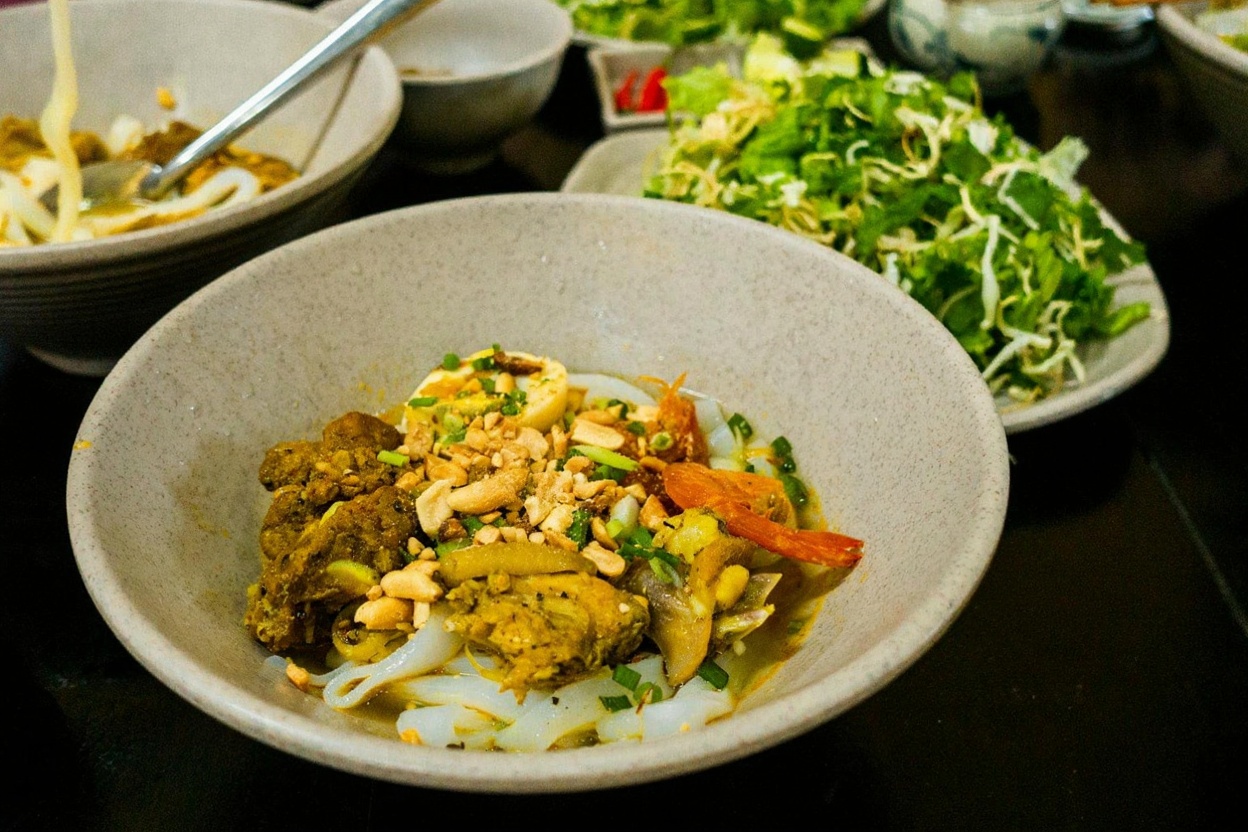
Da Nang and Hoi An: Central Vietnamese influence with some local variations. Mì Quảng — Quảng Nam province’s noodle soup with turmeric-tinted broth, served almost dry with only a small amount of broth at the bottom — is the regional specialty. Hoi An’s cao lầu (thick noodles made with water from a specific local well) is worth hunting down at Com Tam Bui, 10 Thoại Ngọc Hầu Street — a locals-only breakfast spot. Hoi An white rose dumplings (bánh bao vạc) are delicate, shrimp-filled, slightly gelatinous — only made by one family in the city who supplies all the restaurants.
Ho Chi Minh City and the South: Bold and sweet. The southern palate adds sugar to things the north would leave savory. Cơm tấm is the city’s soul food. The street food density in HCMC is higher than anywhere else in Vietnam — the city never stops eating. Saigon’s Southeast Asian proximity means you find Cambodian, Thai, and Chinese influences absorbed into the food in ways that don’t appear in the north. Hủ tiếu — a southern pork noodle soup with a clear, slightly sweet broth — is the dish you find on HCMC street corners at 6am that Hanoi doesn’t have an equivalent for. If you’re spending time in the south, our Saigon street food guide covers the city’s best stalls and dishes in detail. For a deeper dive into the city’s eating scene, our Saigon food guide covers the best stalls, markets, and dishes by neighborhood.
Vietnamese Food Vocabulary Worth Knowing
You don’t need to speak Vietnamese to eat well. But a dozen words make everything easier.
Ordering basics:
“Cho tôi…” = “Give me…” (use this to order)
“Một cái/bát/tô” = one piece / bowl (for soups)
“Ngon lắm” = very delicious (compliment after eating)
“Ít cay” = less spicy
“Không có thịt” = no meat (for vegetarian)
“Bao nhiêu tiền?” = how much?
“Tính tiền” = the bill, please
Menu keywords:
“Bò” = beef | “Gà” = chicken | “Heo/Lợn” = pork | “Tôm” = shrimp | “Cá” = fish
“Cơm” = rice | “Bún” = round rice noodles | “Phở” = flat rice noodles | “Mì” = wheat noodles
“Xào” = stir-fried | “Nướng” = grilled | “Hấp” = steamed | “Chiên” = fried
Drinks:
“Cà phê sữa đá” = iced coffee with condensed milk (the Vietnamese coffee default)
“Nước” = water
“Bia” = beer
“Sinh tố” = fruit smoothie
The Food Scam to Know About
The classic one: you sit down at a restaurant with no prices on the menu, you eat, and the bill is 10 times what you’d expect. The tell is any seafood or meat dish where the price is “per 100g” not listed on the menu — you order the dish, the serving is larger than expected, and you’re charged accordingly. Always ask “bao nhiêu tiền?” before ordering anything where the price isn’t listed. At proper street food stalls this never happens — the price is fixed. It mostly happens at tourist-facing seafood restaurants in coastal towns where menus are deliberately ambiguous.
The other common confusion: bottled water, wet wipes, and small peanut dishes placed on the table without being ordered, then charged. They’re technically optional. Decline if you don’t want them, or accept and pay the 5,000–15,000 VND for each item. The charge is legitimate, just not always communicated clearly upfront.
Vietnamese Coffee and Drinks
Vietnamese coffee is strong, dark, and served in three ways: cà phê đen (black, hot or iced), cà phê sữa (with condensed milk, hot or iced), and egg coffee (cà phê trứng) — a Hanoi specialty of strong espresso topped with a whipped egg yolk and sugar cream. The egg coffee at Đinh Café at 13 Đinh Tiên Hoàng in Hanoi is the original. Slightly sweet, slightly thick, genuinely delicious. Order it hot, sit near the window.
Vietnamese coffee uses Robusta beans grown in the central highlands around Đà Lạt and Buôn Ma Thuột — lower acidity, higher caffeine, bolder flavor than Ethiopian or Colombian Arabica. The slower drip (phin filter) means a single serving takes 5–10 minutes to drip through. This is not a design flaw; it’s the pace of a Vietnamese morning.
Nước mía (sugarcane juice) is pressed fresh to order from a cart — about 15,000–25,000 VND per glass. Best with ice on a hot afternoon. Sinh tố (fruit smoothies) at 20,000–40,000 VND are made from fresh local fruit — avocado smoothie (sinh tố bơ) is the sleeper best.
Bia hơi — draft beer served at roadside stalls for 7,000–15,000 VND per glass. Produced daily in small breweries (bia means beer, hơi means “steam” or “fresh”). Light, slightly bitter, not particularly strong. The experience of drinking it on a plastic stool on a Hanoi corner at 5pm is worth more than the cost of the beer.
How Much Should Food Cost?
Budget travelers who are eating at local spots should spend 100,000–200,000 VND per day on food ($4–$8). Three meals at local prices: 35,000–55,000 VND for breakfast (pho or bún bò), 50,000–70,000 VND for lunch (cơm binh dân), 60,000–100,000 VND for dinner. That’s roughly $6 for the day including coffee.
Mid-range restaurants with printed English menus: 100,000–250,000 VND per main ($4–$10). Quality varies widely — some are excellent, some are “international Vietnamese” simplified for nervous tourists. Check Google Maps reviews from the past three months, filtered for 3-star reviews (these tend to be more honest than 5-star enthusiast reviews or 1-star complaint reviews).
Fine dining Vietnamese food — places like Anan in HCMC (modern Vietnamese tasting menu) or Cục Gạch Quán in Saigon (colonial villa setting, traditional recipes) — runs 500,000–2,000,000 VND per person. Worth doing once if that’s your style. The food is genuinely good and the presentation is a different experience from street stalls.
Best Food Markets Worth Visiting
Vietnam’s wet markets are where actual food shopping happens — not the tourist night markets with the same fried banana stalls. Arriving at a good wet market between 5:30–7am and watching the first wave of business gives you more insight into Vietnamese daily life than most paid cultural experiences.
Đồng Xuân Market, Hanoi: The covered wholesale market in the Old Quarter, open from before sunrise. Ground floor is dry goods and clothing; the food section behind it has vegetables, meat, and dried goods from across northern Vietnam. Not a tourist experience — an operating market. Walk through, look around, don’t block traffic.
Chợ Bến Thành, Ho Chi Minh City: The tourist-facing facade (handicrafts, souvenirs) is not the point. Walk through to the back section where local vendors sell fresh produce, dried fish, and spices at honest prices. The food court on the interior perimeter is overpriced for tourists; the vendors around the back exit are not.
Hội An Central Market: Small, functional, atmospheric in the morning. The fresh pho and cao lầu vendors set up before 6am. The market is two minutes from the Ancient Town and visited by almost no tourists before 8am because everyone is sleeping off the night market. Show up at 6:30am and you’ll have it mostly to yourself.
Chợ Đông Ba, Hue: The largest market in central Vietnam, on the north bank of the Perfume River across from the citadel. Food section downstairs sells local produce, Hue shrimp paste (mắm ruốc), and dried specialties. The banh mi and cơm hến stalls on the perimeter in the morning are excellent and completely ignored by tourists.
Eating Solo in Vietnam
Solo dining in Vietnam is completely normal and easier than in most Asian countries. Many street food stalls are designed for single diners — you sit at a communal table or at the counter, and you’re served individually. Saying “một mình” (by myself/one person) when you sit down is enough context.
At local rice (cơm binh dân) restaurants, the system is straightforward: point at the dishes you want from the tray display, they plate them over rice, you pay at the end. No need to speak Vietnamese beyond thanking the person who serves you. The communal table dynamic means you’ll often end up sitting next to a group of Vietnamese construction workers or office staff eating the same lunch — which is the whole point.
Ordering half portions (“nửa phần”) is accepted at most street food stalls when dishes are large. This matters for solo travelers who want to try more than one thing without wasting food.
Two things worth sorting before you land: a Vietnam eSIM so you have data the moment you clear customs, and travel insurance — medical costs for uninsured foreigners in Vietnam are significant.
Airalo eSIMs activate instantly. Buy before departure — airport SIM queues in Vietnam can take 30+ minutes.
Frequently Asked Questions
What is the most popular food in Vietnam?
Pho is the most internationally recognized, but cơm (rice with various dishes) is what Vietnamese people actually eat most. The daily lunch at a cơm binh dân (workers’ rice) restaurant — where you point at dishes arranged behind a glass counter and they plate your selection over rice — is the actual staple of Vietnamese food culture. Pho is breakfast or a special occasion. Rice with various proteins and vegetables is the daily reality for most of the country.
Is Vietnamese food safe for sensitive stomachs?
Mostly yes, with caveats. The main risk factors: ice from unknown sources (street stalls often use block ice from questionable facilities — order drinks without ice if your stomach is sensitive), raw greens that haven’t been washed in clean water (the herb plates served with pho and spring rolls), and shellfish at low-quality seafood spots. At established pho shops and street stalls that have been open for years, the food safety is generally reliable. The worst food-related illness I’ve had in five years came from a mid-range “nice” restaurant, not a street stall.
Can you eat vegetarian in Vietnam?
Yes, better than you might expect. Vietnam has a strong Buddhist vegetarian tradition — “ăn chay” (eating vegetarian). On the 1st and 15th of each lunar month, many local restaurants offer vegetarian menus. In cities, dedicated chay restaurants are common. Hoi An, Hue, and Hanoi all have solid vegetarian options. The challenge is that many “vegetarian” dishes use shrimp paste or fish sauce as flavoring — say “không có nước mắm” (no fish sauce) and “không có tôm” (no shrimp) to be thorough. For a full breakdown of navigating plant-based eating across the country, see our Vietnam vegetarian guide.
What’s the difference between northern and southern Vietnamese food?
The northern palate is more restrained and less sweet. Southern food adds sugar in places the north leaves savory, has bolder garnish portions, and has absorbed more Chinese, Cambodian, and Thai influences from the Mekong region. The most concrete example: northern pho uses a cleaner broth with minimal garnish; southern pho adds sweetness, serves with a bigger herb plate and bean sprouts. Neither is wrong — they’re different food cultures that unified politically but kept their regional identities.
Is street food cheaper than restaurants?
Yes, always. A bowl of pho from a street cart: 45,000–60,000 VND. The same pho at a restaurant with AC and tablecloths: 80,000–130,000 VND. The same pho at a restaurant near a tourist site with English photos on the menu: 120,000–180,000 VND. The food quality doesn’t track with the price increase — if anything it inverts. The plastic stool places have usually been doing the same dish for 20–40 years and are very good at it.